



Build Your Custom Market Intelligence Report
Customize Your ReportU.S. Headwear Market Key Takeaways
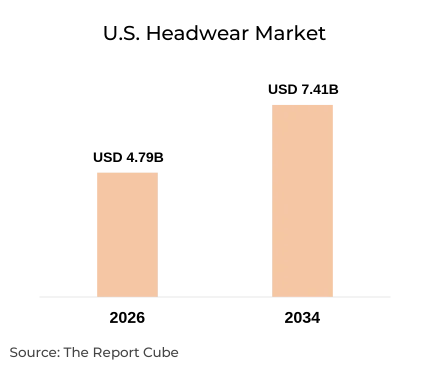
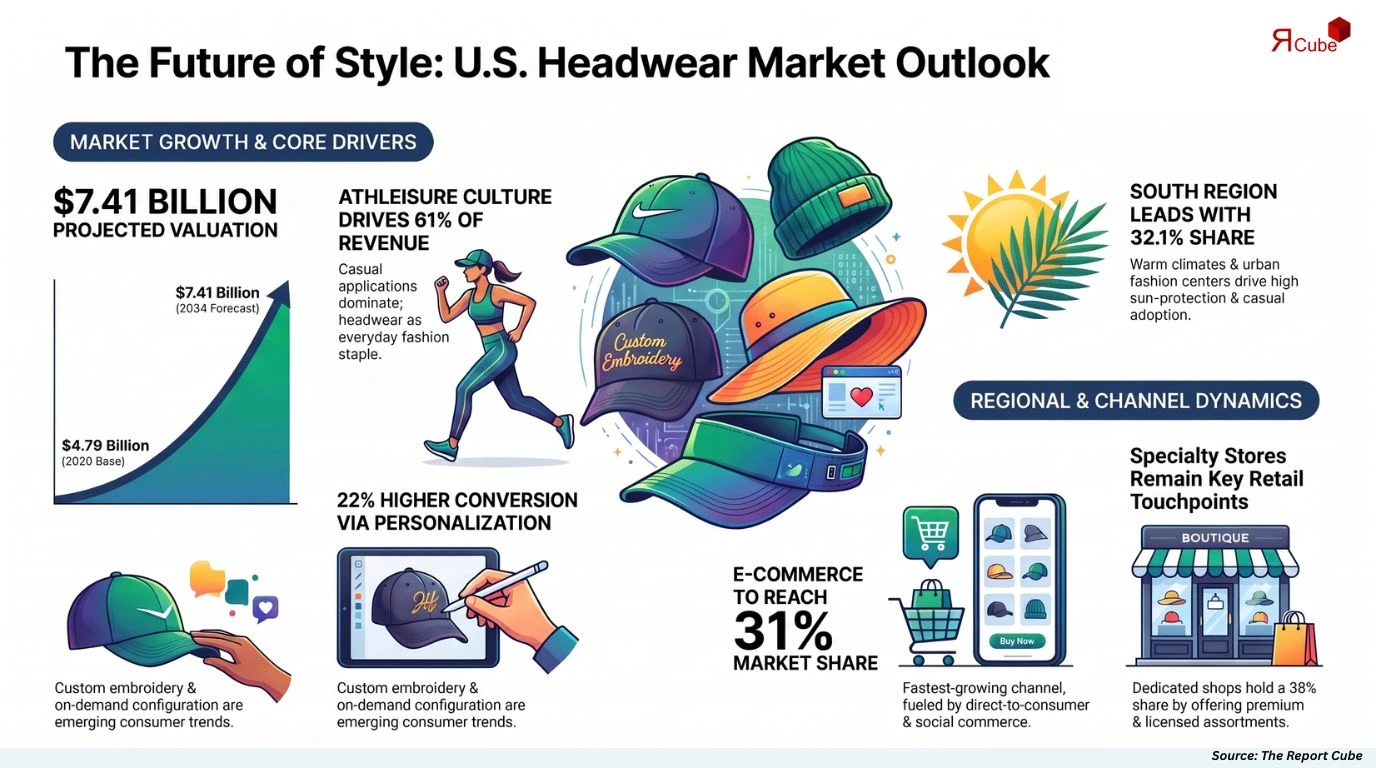
- Market valued at USD 4.79 billion in 2026, reflecting strong consumer lifestyle spending.
- Industry projected to reach USD 7.41 billion by 2034, growing at a 5.60% CAGR.
- Casual application dominates owing to widespread everyday fashion and athleisure adoption.
- Online distribution channels are gaining significant traction across all consumer age groups.
- Nike, Adidas, New Era Cap Company, and VF Corporation lead competitive market positioning.
- Specialty stores remain a key retail touchpoint for premium and performance headwear categories.
- Rising demand for medical and tactical headwear is broadening application segment diversity.
- Sustainable materials and personalized customization are emerging as major consumer preference trends.
U.S. Headwear Market Insights & Analysis
The U.S. Headwear Market is anticipated to register a 5.60% CAGR during 2026–2034. The market size was valued at USD 4.79 billion in 2026 and is projected to reach USD 7.41 billion by 2034. The market is benefiting from expanding athleisure culture, rising personalization trends, and increasing consumer investment in functional and fashion-forward head accessories. Government-backed textile industry modernization programs and growing e-commerce infrastructure are further supporting revenue expansion across casual, medical, and tactical application segments.
Brand investments in sustainable manufacturing, licensed sports merchandise, and direct-to-consumer platforms are reshaping competitive dynamics. New Era Cap Company's continued partnerships with major professional leagues, alongside Nike and Adidas's performance headwear innovations, reflect the market's dual emphasis on heritage and innovation. Columbia Sportswear and Under Armour are actively expanding outdoor and performance-oriented headwear in the outdoor performance apparel market, attracting outdoor recreation enthusiasts and fitness-focused consumers who prioritize both functionality and design.
U.S. Headwear Market Dynamics
The U.S. headwear industry continues to attract consistent demand across fashion, performance, and protection-focused consumer segments. Expanding e-commerce penetration, growing sports licensing revenues, rising athleisure adoption, and increased interest in tactical and outdoor accessories are reshaping product portfolios across leading brands and private-label manufacturers. Investments in sustainable sourcing and custom embroidery platforms further diversify growth pathways.
|
Factor |
Type |
Specific Impact on Market |
Magnitude |
|---|---|---|---|
|
Athleisure and lifestyle trend expansion |
Driver |
Boosts casual headwear volume and premiumization across brands |
Very High |
|
E-commerce channel acceleration |
Opportunity |
Expands direct-to-consumer revenue and brand discovery reach |
High |
|
Sports licensing and team merchandise |
Driver |
Sustains structured cap and fitted headwear category demand |
High |
|
Medical headwear adoption in clinical settings |
Opportunity |
Diversifies revenue across hospital and healthcare end-uses |
Moderate |
|
Sustainable materials adoption |
Trend |
Drives product innovation and eco-conscious consumer acquisition |
High |
Key Market Driver: Athleisure Culture Fueling Headwear Demand
The sustained mainstreaming of athleisure as an everyday dress culture across the U.S. continues to drive structured caps, performance beanies, and moisture-wicking headwear into regular consumer wardrobes. Brands such as Nike, Adidas, and Puma have invested heavily in performance-fabric headwear lines featuring UV protection, sweat management, and antimicrobial properties. Retail data indicates that performance-casual headwear units grew approximately 8% year-over-year in 2024, with millennials and Gen Z leading purchasing frequency across both physical and digital retail channels.
Major Industry Challenge: Counterfeit and Gray-Market Product Proliferation
The U.S. headwear market faces persistent pressure from counterfeit merchandise and unauthorized replica products, particularly within licensed sports headwear categories. The International AntiCounterfeiting Coalition estimated that counterfeit apparel and accessories cost U.S. brands over USD 200 billion annually, with headwear among the most replicated categories. This challenge compels brands including New Era Cap Company and Kering's portfolio labels to accelerate anti-counterfeiting authentication technologies such as QR-linked verification and serialized hang-tags, protecting brand equity and authorized retail revenue streams.
Emerging Trend Shaping Outlook: Customization and On-Demand Personalization
Consumer appetite for personalized headwear - including custom embroidery, patch-on-demand services, colorway configuration, and limited-edition licensed drops - is gaining measurable commercial traction across the U.S. Platforms offering made-to-order headwear have reported a 22% increase in conversion rates compared to standard catalog offerings. VF Corporation and specialty retailers are integrating digital customization tools into their e-commerce ecosystems, while companies participating in the licensed sports merchandise and team headwear market are leveraging limited-edition drops to sustain consumer engagement and command price premiums across both online and specialty store channels.
Need Specific Data, Let’s Customize the Report for You
Request CustomizationU.S. Headwear Market Segment-wise Analysis
The U.S. headwear market spans diverse application categories and distribution ecosystems, creating distinct revenue pools across casual fashion, medical utility, and tactical protection segments. Distribution evolution continues transforming how consumers discover, evaluate, and purchase headwear across traditional and digital retail environments.
By Application
- Casual
- Medical
- Tactical
- Others
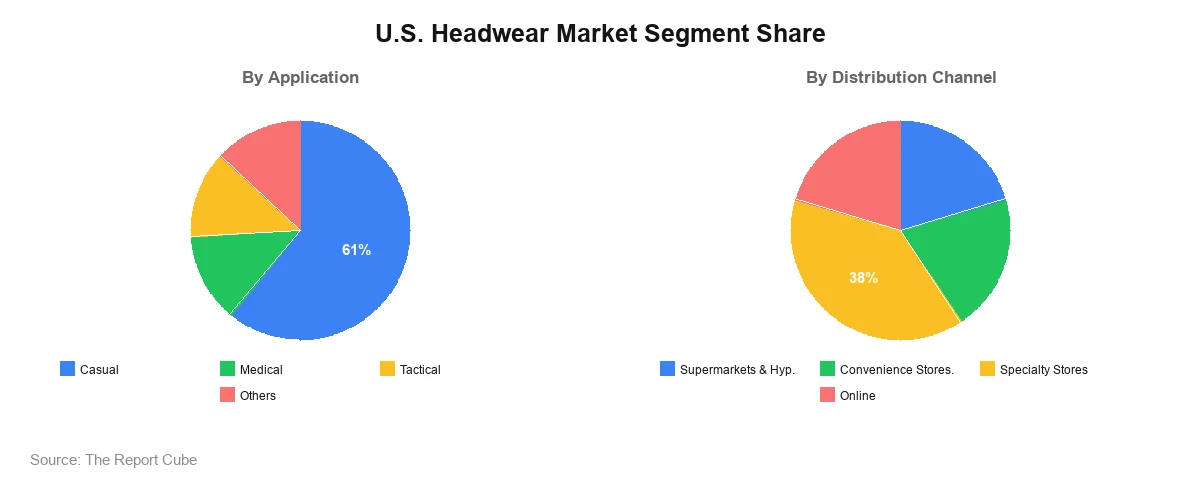
Casual headwear dominates the U.S. market with an estimated 61% revenue share, sustained by deep consumer affinity for caps, beanies, bucket hats, and visors as everyday fashion accessories. The segment benefits from pervasive athleisure adoption, rising brand collaborations with entertainment properties, and growing social-media-driven demand for trend-responsive headwear styles. Major brands including Adidas, H&M, and Puma consistently launch seasonal casual collections targeting younger demographics who treat headwear as expressive, low-barrier fashion investments.
The medical headwear segment is gaining meaningful momentum as healthcare institutions and individual consumers prioritize hygienic, chemotherapy-recovery, and post-surgical head protection solutions. The tactical segment, supported by law enforcement, military, and outdoor survival enthusiasts, commands a growing share driven by demand for ballistic-resistant, moisture-control, and camouflage headwear. The "Others" category captures sports-specific and occasion-driven products. Together, these segments demonstrate that demand for specialized protective and medical-grade headwear is broadening the market's revenue base well beyond its traditional fashion core.
By Distribution Channel
- Supermarkets & Hypermarkets
- Convenience Stores
- Specialty Stores
- Online
Specialty stores hold the dominant retail position with approximately 38% distribution channel share, driven by their ability to curate premium, licensed, and performance-oriented headwear assortments that mass-market retailers cannot replicate. Consumers visiting specialty channels - including dedicated cap shops, outdoor retailers, and sporting goods stores - demonstrate significantly higher average transaction values and stronger brand loyalty. New Era Cap Company, Columbia Sportswear, and Under Armour prioritize specialty channel partnerships to maintain product exclusivity and reinforce aspirational brand positioning within performance and lifestyle consumer segments.
Online distribution is the fastest-growing channel, with e-commerce headwear sales projected to account for over 31% of market revenue by 2034, up from approximately 22% in 2026. Platform-native brands and established players alike are investing in DTC websites, marketplace storefronts, and social commerce integrations. Supermarkets and hypermarkets serve value-seeking consumers with private-label and entry-level branded options, while convenience stores provide impulse-driven seasonal headwear access. The continued acceleration of direct-to-consumer fashion accessories retail online is fundamentally reshaping how U.S. consumers engage with headwear purchasing across price tiers.
Regional Projection of U.S. Headwear Market
The U.S. headwear market exhibits pronounced regional variation driven by climate conditions, demographic density, sports culture intensity, and retail infrastructure maturity. The South and West lead in volume, while the Northeast and Midwest sustain premium and licensed headwear demand through concentrated urban consumer markets and sports franchise influence.
|
Region |
Estimated Market Share |
Key Growth Factors |
Consumer Trends |
|---|---|---|---|
|
South |
32.1% |
Climate-driven demand, outdoor culture, urban fashion centers |
High casual and sun-protection headwear adoption |
|
West |
27.4% |
Outdoor recreation, surf and ski culture, tech-hub millennial base |
Premium performance and lifestyle brand preference |
|
Northeast |
22.3% |
Sports licensing stronghold, fashion-forward urban consumer density |
Licensed caps, luxury collaborations, and DTC brands |
|
Midwest |
18.2% |
Collegiate sports loyalty, agricultural and outdoor worker demand |
Team merchandise and functional headwear adoption |
- South: The South accounts for approximately 32.1% of U.S. headwear revenue, driven by year-round warm climate sustaining sun-protection caps, visors, and lightweight casual headwear demand. Urban fashion centers including Atlanta and Houston contribute significant branded headwear spending, while growing Latino consumer populations support demand for sports-licensed and team-branded caps across the region.
- West: The West sustains strong headwear demand through its outdoor recreation economy, surf and ski culture, and dense millennial consumer base in metropolitan tech hubs. California leads regional revenue with premium lifestyle brands, performance headwear, and limited-edition collaboration drops capturing high disposable income consumers, while Pacific Northwest outdoor culture supports weather-resistant functional headwear demand.
- Northeast: The Northeast represents the nation's strongest licensed sports headwear market, fueled by intense fan cultures surrounding professional baseball, basketball, and football franchises across New York, Boston, and Philadelphia. Fashion-forward urban consumers also drive demand for high-end headwear collaborations, designer caps, and premium streetwear styles with strong DTC brand penetration.
- Midwest: The Midwest sustains consistent headwear demand through deep collegiate sports merchandise loyalty, agricultural worker functional headwear needs, and growing urban fashion markets in Chicago and Minneapolis. Value-oriented purchasing behavior supports strong private-label sales, while rising e-commerce adoption supports branded headwear penetration in suburban and rural markets beyond traditional retail reach.
U.S. Headwear Market: Recent Development (2025)
- Nike launched its Dri-FIT ADV performance cap collection targeting premium athletic headwear consumers nationally.
- New Era Cap Company expanded its MLB licensed headwear portfolio with exclusive limited-edition team colorways.
- Adidas partnered with major collegiate athletic programs to supply custom performance headwear for student athletes.
- VF Corporation introduced a sustainable recycled-material headwear line across its Supreme and Dickies brand portfolios.
U.S. Headwear Market Future Outlook (2034)
The U.S. Headwear Market is projected to expand at a steady 5.60% CAGR, reaching USD 7.41 billion by 2034. Sustained growth will be underpinned by expanding athleisure adoption, evolving sports licensing ecosystems, rising demand for medical and protective headwear, and accelerating e-commerce penetration across all consumer demographics. Brands leveraging data-driven personalization, sustainable material sourcing, and omnichannel retail integration will be positioned to capture disproportionate share in an increasingly segmented and competitive marketplace.
Technology-driven transformation will further elevate the market, with AI-powered style recommendation engines, virtual try-on tools, and automated custom embroidery platforms reshaping the headwear purchasing experience. The growing intersection of smart wearable technology and functional headwear innovation - including UV-monitoring visors, temperature-regulating liners, and augmented-reality-integrated caps - will create premium product tiers with significantly enhanced margin potential. Long-term market expansion will also benefit from demographic tailwinds including Gen Alpha's emergence as a fashion-active consumer cohort and sustained immigration-driven population growth supporting diverse style preferences across U.S. markets.
U.S. Headwear Market Report Coverage
|
Report Attribute |
Details |
|---|---|
|
Market Name |
U.S. Headwear Market |
|
Market Size (2026) |
USD 4.79 Billion |
|
Market Size (2034) |
USD 7.41 Billion |
|
Forecast Period |
2026–2034 |
|
CAGR |
5.60% |
|
Base Year |
2026 |
|
Historical Years |
2021–2025 |
|
Forecast Years |
2026–2034 |
|
Segments Covered |
By Application, By Distribution Channel, By End User, By Type |
|
Regions Covered |
South, West, Northeast, Midwest |
|
Key Companies |
Nike, Adidas, Puma, Under Armour, New Era Cap Company, H&M, Kering, VF Corporation, Columbia Sportswear, Others |
|
Report Format |
PDF, Excel, PPT |
|
Customization |
Available as per client requirements |
Why Choose This Report?
- Comprehensive analysis covering all major U.S. headwear application and distribution segments.
- Accurate market sizing supported by a reliable 5.60% CAGR forecast through 2034.
- Detailed segmentation insights revealing dominant and fastest-growing revenue opportunities.
- Regional breakdowns covering South, West, Northeast, and Midwest consumer dynamics.
- Competitive profiling of Nike, Adidas, New Era Cap Company, and other key players.
- Analysis of e-commerce acceleration and direct-to-consumer channel transformation trends.
- Insights into sustainable materials, customization platforms, and smart headwear innovation.
- Strategic intelligence supporting investment, product development, and market entry decisions.
Table of Contents
- Introduction
- Objective of the Study
- Product Definition
- Market Segmentation
- Study Variables
- Research Methodology
- Secondary Data Points
- Companies Interviewed
- Primary Data Points
- Breakdown of Primary Interviews
- Secondary Data Points
- Executive Summary
- Market Dynamics
- Drivers
- Challenges
- Opportunity Assessment
- Recent Trends and Developments
- Policy and Regulatory Landscape
- U.S. Headwear Market Overview and Forecast Analysis (2021-2034)
- Market Size, By Value, By Growth Rate (CAGR/USD Billions)
- Demand – Supply Trends
- Market Share, By Type
- Beanies
- Headbands
- Caps and Hats
- Others
- Market Share, By End User
- Men
- Women
- Kids
- Market Share, By Application
- Casual
- Medical
- Tactical
- Others
- Market Share, By Distribution Channel
- Supermarkets & Hypermarkets
- Convenience Stores
- Specialty Stores
- Online
- Market Share, By Region
- West
- East
- South
- Midwest
- Others
- Market Share, By Competitors
- Competition Characteristics
- Revenue Shares
- Beanies U.S. Headwear Market Overview, 2021-2034F
- By Value (USD Million)
- By End User – Market Size & Forecast 2021-2034, USD Million
- Men
- Women
- Kids
- Headbands U.S. Headwear Market Overview, 2021-2034F
- By Value (USD Million)
- By End User – Market Size & Forecast 2021-2034, USD Million
- Men
- Women
- Kids
- Caps and Hats U.S. Headwear Market Overview, 2021-2034F
- By Value (USD Million)
- By End User – Market Size & Forecast 2021-2034, USD Million
- Men
- Women
- Kids
- Others U.S. Headwear Market Overview, 2021-2034F
- By Value (USD Million)
- By End User – Market Size & Forecast 2021-2034, USD Million
- Men
- Women
- Kids
- Competitive Outlook (Company Profile – Partial List)
- Nike
- Company Overview
- Business Segments
- Strategic Alliances/Partnerships
- Recent Developments
- Adidas
- Company Overview
- Business Segments
- Strategic Alliances/Partnerships
- Recent Developments
- Puma
- Company Overview
- Business Segments
- Strategic Alliances/Partnerships
- Recent Developments
- Under Armour
- Company Overview
- Business Segments
- Strategic Alliances/Partnerships
- Recent Developments
- New Era Cap Company
- Company Overview
- Business Segments
- Strategic Alliances/Partnerships
- Recent Developments
- H&M
- Company Overview
- Business Segments
- Strategic Alliances/Partnerships
- Recent Developments
- Kering
- Company Overview
- Business Segments
- Strategic Alliances/Partnerships
- Recent Developments
- VF Corporation
- Company Overview
- Business Segments
- Strategic Alliances/Partnerships
- Recent Developments
- Columbia Sportswear
- Company Overview
- Business Segments
- Strategic Alliances/Partnerships
- Recent Developments
- Others
- Nike
- Contact Us & Disclaimer
Top Key Players & Market Share Outlook
- Nike
- Adidas
- Puma
- Under Armour
- New Era Cap Company
- H&M
- Kering
- VF Corporation
- Columbia Sportswear
- Others
Frequently Asked Questions






