




Build Your Custom Market Intelligence Report
Customize Your ReportU.S. Healthcare Workforce Management System Market Insights & Analysis
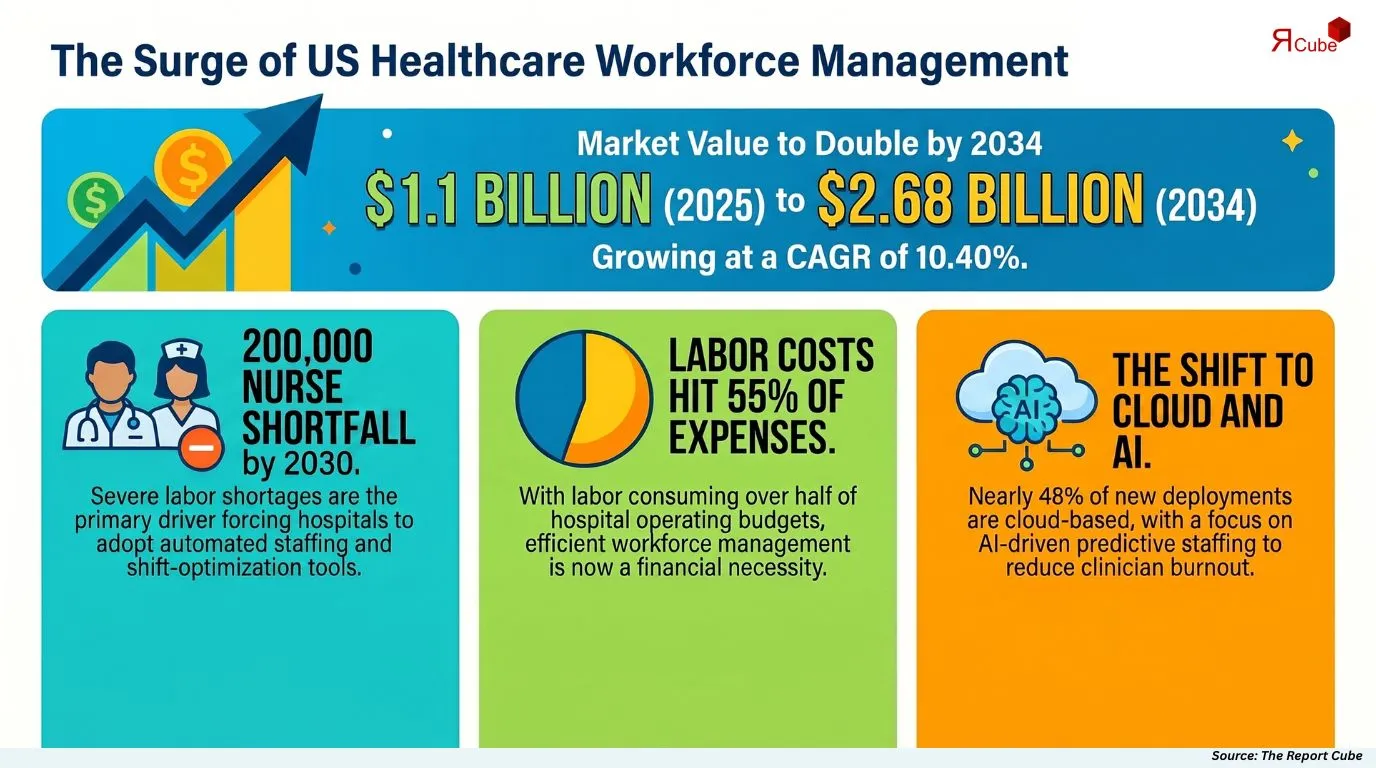
The U.S. Healthcare Workforce Management System Market is anticipated to register a CAGR of 10.40% during 2026–2034. The market size was valued at USD 1.1 billion in 2025 and is projected to reach USD 2.68 billion by 2034. The market is experiencing robust growth as healthcare providers increasingly adopt digital workforce solutions to address staff shortages, rising labor costs, and operational inefficiencies across hospitals and care facilities.
Healthcare organizations in the U.S. are under continuous pressure to optimize workforce utilization while maintaining quality patient care and regulatory compliance. Workforce management systems are playing a critical role in automating scheduling, payroll, time tracking, and compliance management. In 2024, over 62% of U.S. hospitals reported using advanced digital scheduling and staffing platforms, reflecting strong adoption momentum across the sector.
Additionally, the aging population, increasing prevalence of chronic diseases, and expansion of home healthcare services are intensifying workforce complexity. These factors are driving demand for scalable, cloud-based workforce management systems that offer real-time analytics, predictive staffing, and labor optimization. As healthcare providers focus on improving clinician satisfaction and reducing burnout, investment in workforce management technology is expected to remain strong through 2034.
U.S. Healthcare Workforce Management System Market Recent Developments
- 2025: UKG introduced AI-driven predictive staffing tools tailored for U.S. hospital systems.
- 2025: Workday expanded its healthcare workforce analytics suite to improve labor cost forecasting.
Government Initiatives & Policies
- HHS Digital Health Strategy: Federal initiative supporting healthcare IT modernization and workforce efficiency.
- CMS Workforce Optimization Programs: Programs encouraging operational efficiency and staffing optimization in healthcare facilities.
U.S. Healthcare Workforce Management System Market Dynamics
Key Driver: Increasing Workforce Shortages and Rising Labor Costs
Severe workforce shortages across the U.S. healthcare sector are a primary driver of workforce management system adoption. Hospitals and care facilities face persistent shortages of nurses, allied health professionals, and support staff. According to industry estimates, the U.S. healthcare system may face a shortfall of over 200,000 nurses by 2030. Workforce management systems enable organizations to optimize shift allocation, reduce overtime, and improve staff utilization. Rising labor costs, which account for nearly 55% of total hospital operating expenses, further underscore the need for efficient workforce planning tools, driving sustained market growth.
Industry Trends: Shift Toward Cloud-Based and Analytics-Driven Solutions
Cloud-based deployment is emerging as a dominant trend in the U.S. Healthcare Workforce Management System Market. Cloud platforms offer scalability, remote accessibility, and seamless integration with electronic health records and payroll systems. Nearly 48% of new workforce management deployments in 2024 were cloud-based. Advanced analytics and AI-powered forecasting tools are increasingly embedded within these systems, enabling predictive staffing, demand forecasting, and real-time decision-making. This trend supports improved operational efficiency and enhanced workforce satisfaction across healthcare organizations.
Book your FREE 30-minute expert consultation today
Contact UsMajor Challenge: Integration Complexity and Data Security Concerns
Integration with legacy healthcare IT systems remains a major challenge for workforce management system adoption. Many healthcare organizations operate fragmented systems, making seamless data exchange difficult. Additionally, workforce platforms manage sensitive employee and payroll data, raising concerns around cybersecurity and compliance with HIPAA regulations. Smaller healthcare providers often lack the technical resources to manage complex integrations, potentially slowing adoption. Addressing these challenges through interoperable platforms and robust security frameworks is essential for long-term market growth.
Opportunity: Expansion of Home Healthcare and Long-Term Care Services
The rapid expansion of home healthcare and long-term care services presents a significant growth opportunity for workforce management system providers. Home healthcare employment in the U.S. is projected to grow by over 20% by 2030, increasing the need for mobile workforce scheduling and remote time tracking solutions. Workforce management systems tailored for decentralized care models enable efficient staff coordination, compliance tracking, and productivity monitoring. Vendors offering flexible, mobile-first platforms are well-positioned to capitalize on this expanding segment.
U.S. Healthcare Workforce Management System Market Segment-wise Analysis
By Component:
- Software
- Services
Software dominates the market, accounting for approximately 68% of total revenue in 2025. Healthcare organizations increasingly prefer integrated software platforms offering scheduling, payroll, and analytics capabilities. Services, including implementation and support, play a critical role in system adoption but contribute a smaller revenue share.
By Software Type:
- Scheduling & Staffing
- Time & Attendance
- Payroll Management
- Talent Management
- Analytics & Reporting
Scheduling and staffing solutions lead this segment, holding nearly 34% market share. These tools directly address workforce shortages, reduce overtime costs, and improve shift coverage across hospitals and care facilities.
Need insights for a specific region within this market?
Request Regional DataRegional Projection of U.S. Healthcare Workforce Management System Industry
- Northeast
- Midwest
- South
- West
The Northeast region leads the U.S. Healthcare Workforce Management System Market, accounting for approximately 31% of total revenue. High healthcare expenditure, dense hospital networks, and early adoption of healthcare IT solutions support regional dominance. States such as New York and Massachusetts continue to invest heavily in workforce optimization technologies.
Why Choose This Report?
- Provides comprehensive insights into market size, trends, and growth drivers.
- Offers accurate segmentation and regional analysis.
- Delivers in-depth competitive benchmarking of leading vendors.
- Supports strategic planning with data-driven insights.
- Reduces research time with consolidated market intelligence.
- Highlights regulatory, operational, and technological risks.
- Identifies emerging opportunities across healthcare segments.
- Backed by real-world healthcare industry data and trends.
Table of Contents
- Introduction
- Objective of the Study
- Healthcare Workforce Management System Definition
- Market Segmentation
- Study Variables
- Research Methodology
- Secondary Data Points
- Breakdown of Secondary Sources
- Primary Data Points
- Breakdown of Primary Interviews
- Secondary Data Points
- Executive Summary
- Market Dynamics
- Drivers
- Challenges
- Opportunity Assessment
- Recent Trends and Developments
- Regulatory and Policy Landscape
- U.S. Healthcare Workforce Management System Market Overview (2020-2034)
- Market Size, By Value (USD Billion)
- Market Share, By Component
- Software
- Services
- Market Share, By Software Type
- Scheduling & Staffing
- Time & Attendance
- Payroll Management
- Talent Management
- Analytics & Reporting
- Market Share, By Deployment Model
- On-Premise
- Cloud-Based
- Market Share, By End User
- Hospitals
- Clinics & Ambulatory Care Centers
- Nursing Homes & Long-Term Care Facilities
- Home Healthcare Providers
- Market Share, By Workforce Type
- Clinical Staff
- Non-Clinical Staff
- Market Share, By Company
- Competition Characteristics
- Revenue Shares & Analysis
- Market Share, By Region
- Northeast U.S. Healthcare Workforce Management System Market
- Market Size, By Value
- Market Share, By Component
- Market Share, By End User
- Midwest U.S. Healthcare Workforce Management System Market
- Market Size, By Value
- Market Share, By Component
- Market Share, By End User
- South U.S. Healthcare Workforce Management System Market
- Market Size, By Value
- Market Share, By Component
- Market Share, By End User
- West U.S. Healthcare Workforce Management System Market
- Market Size, By Value
- Market Share, By Component
- Market Share, By End User
- Northeast U.S. Healthcare Workforce Management System Market
- Competitive Outlook and Company Profiles
- UKG (Ultimate Kronos Group)
- Company Overview
- Workforce Management Portfolio
- Strategic Alliances/Partnerships
- Recent Developments
- Oracle Cerner
- Company Overview
- Healthcare Workforce Solutions Portfolio
- Strategic Alliances/Partnerships
- Recent Developments
- Workday
- Company Overview
- Workforce Management Solutions Portfolio
- Strategic Alliances/Partnerships
- Recent Developments
- Infor
- Company Overview
- Healthcare Workforce Solutions Portfolio
- Strategic Alliances/Partnerships
- Recent Developments
- ADP
- Company Overview
- Healthcare Workforce Solutions Portfolio
- Strategic Alliances/Partnerships
- Recent Developments
- Others
- Company Overview
- Business Segments
- Strategic Alliances/Partnerships
- Recent Developments
- UKG (Ultimate Kronos Group)
- Contact Us / Disclaimer
Top Key Players & Market Share Outlook
- UKG (Ultimate Kronos Group)
- Oracle Cerner
- Workday
- Infor
- ADP
- Others
Frequently Asked Questions






