




Build Your Custom Market Intelligence Report
Customize Your ReportUS Heat Exchanger Market Key Takeaways
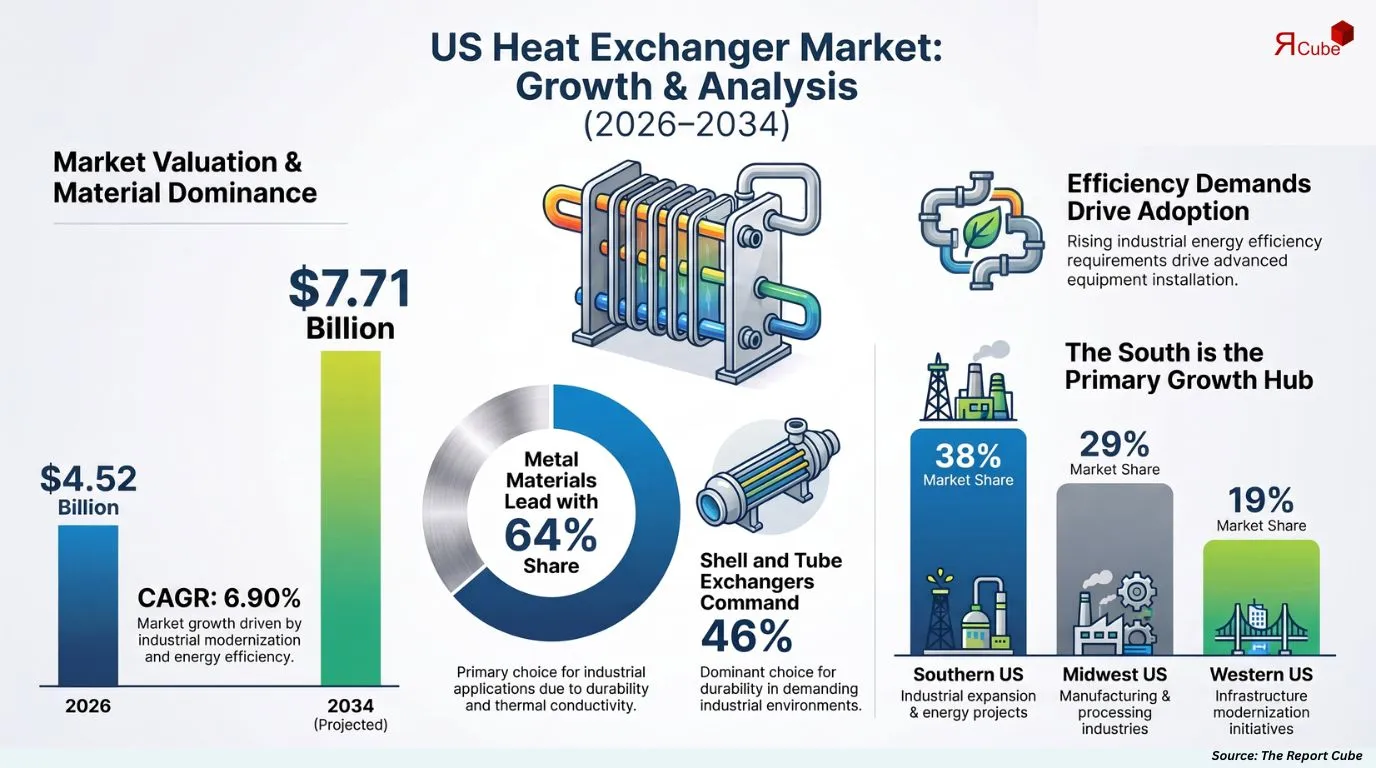
- Market size reached USD 4.52 billion during 2026 assessment year.
- Industry projected to attain USD 7.71 billion by 2034.
- Market forecast indicates a steady CAGR of 6.90% through 2034.
- Alfa Laval, GEA Group, SWEP, and Xylem remain leading participants.
- Metal materials dominate the material segment across the market.
- Shell and Tube Heat Exchangers generate the highest product revenues.
- Southern United States remains the leading regional demand hub.
- Industrial modernization continues accelerating heat exchanger adoption nationwide.
US Heat Exchanger Market Report Insights & Analysis
The US Heat Exchanger Market Report is anticipated to register a 6.90% CAGR during 2026-2034. The market size was valued at USD 4.52 billion in 2026 and is projected to reach USD 7.71 billion by 2034. The market is witnessing consistent growth due to rising industrial activity, increasing investments in energy-efficient systems, and expanding demand from power generation, chemical processing, and HVAC sectors. Heat exchangers play a critical role in thermal management, energy conservation, and process optimization across multiple industries. Growing emphasis on operational efficiency and sustainability is further contributing to market expansion.
Investments in advanced manufacturing technologies, industrial infrastructure modernization, and process efficiency improvements continue strengthening the market landscape. Companies are increasingly deploying high-performance heat exchanger solutions to improve energy utilization and reduce operational costs. Additionally, growing adoption across industrial and commercial applications is expected to support long-term market growth throughout the forecast period.
US Heat Exchanger Market Report Dynamics
The US heat exchanger industry is experiencing steady transformation driven by industrial modernization, energy efficiency requirements, and expanding infrastructure investments. Manufacturers and end users are increasingly adopting advanced thermal management technologies to improve process performance and reduce energy consumption. These evolving market dynamics are creating significant opportunities across industrial, commercial, and utility applications.
|
Factor |
Type |
Specific Impact on Market |
Magnitude |
|---|---|---|---|
|
Rising industrial energy efficiency demand |
Driver |
Increases adoption of advanced heat exchangers |
High |
|
Expansion of process industries |
Driver |
Boosts equipment installation requirements |
High |
|
Advanced thermal management technologies |
Trend |
Enhances system performance and reliability |
High |
|
Equipment maintenance complexity |
Challenge |
Requires specialized servicing and monitoring |
Medium |
|
Industrial infrastructure modernization |
Opportunity |
Supports replacement and upgrade demand |
High |
Key Market Driver: Growing Industrial Energy Efficiency Demand
The increasing emphasis on energy efficiency across industrial operations is a major factor driving the US heat exchanger market. Industries are actively investing in thermal management solutions that improve heat recovery, reduce energy losses, and optimize operational performance. Heat exchangers play an essential role in enhancing efficiency within chemical processing, food manufacturing, power generation, and HVAC systems. Regulatory focus on energy conservation and sustainability objectives is encouraging greater adoption of advanced equipment. Furthermore, rising operational efficiency requirements are strengthening demand for high-performance heat exchanger technologies across multiple industries.
Major Industry Challenge: Equipment Maintenance and Performance Optimization
Maintaining optimal heat exchanger performance remains an important challenge for industrial operators. Factors such as fouling, corrosion, scaling, and operational wear can reduce efficiency and impact system reliability over time. Effective maintenance strategies, regular inspections, and performance monitoring are necessary to ensure consistent operation. Additionally, complex industrial environments often require specialized servicing expertise and customized maintenance programs. Manufacturers continue developing advanced monitoring technologies and improved material solutions to address performance challenges and extend equipment lifecycle.
Emerging Trend Shaping Outlook: Advanced Thermal Technology Integration
The integration of advanced thermal management technologies is emerging as a significant trend influencing the future outlook of the market. Manufacturers are increasingly developing compact, high-efficiency heat exchanger systems capable of delivering superior thermal performance. Innovations in material science, digital monitoring, and process optimization technologies are enhancing operational capabilities. Industries are adopting intelligent thermal management solutions that support predictive maintenance and real-time performance monitoring. This trend is expected to improve efficiency, reduce downtime, and create new opportunities for market expansion.
The market continues benefiting from growing industrial investments, infrastructure development initiatives, and demand for sustainable process technologies. End users are focusing on solutions that improve operational efficiency while reducing energy consumption and environmental impact. These developments are strengthening market growth potential across diverse industrial sectors. Strategic collaborations among manufacturers, engineering firms, and industrial operators are accelerating technology adoption and product innovation. Organizations emphasizing advanced thermal solutions, energy efficiency, and process optimization are expected to maintain strong competitive positions throughout the forecast period.
Need Specific Data, Let’s Customize the Report for You
Request CustomizationUS Heat Exchanger Market Segment-wise Analysis
The US heat exchanger market demonstrates a diversified segmentation structure based on material types and product categories. Growing demand for efficient thermal management systems, industrial process optimization, and energy conservation continues influencing segment performance. Expanding industrial modernization projects and infrastructure investments are creating substantial opportunities across multiple market segments.
By Material
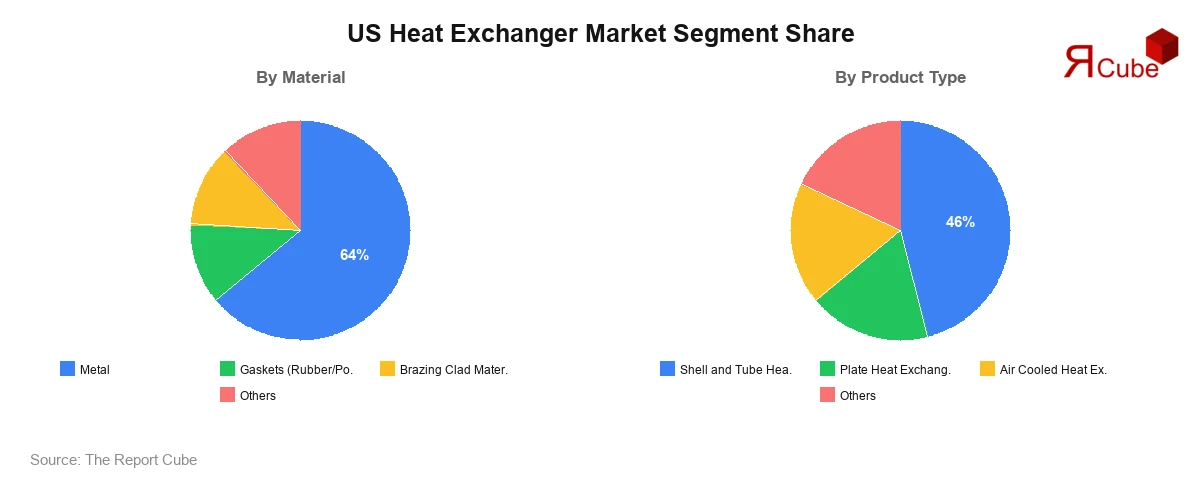
- Metal
- Gaskets (Rubber/Polymer)
- Brazing Clad Materials
- Others
Metal dominates the material segment with an estimated market share of approximately 64%. Growth is supported by excellent thermal conductivity, durability, corrosion resistance, and suitability for demanding industrial applications. Metal-based heat exchangers are widely utilized across power generation, chemical processing, manufacturing, and HVAC industries. Continuous advancements in metallurgy and fabrication technologies further strengthen segment leadership.
Brazing Clad Materials continue witnessing increasing demand due to their role in enhancing heat transfer performance and manufacturing efficiency. Gaskets (Rubber/Polymer) remain essential for sealing and operational reliability across plate heat exchanger systems. The Others segment includes specialized materials developed for niche industrial applications and extreme operating conditions.
By Product Type
- Shell and Tube Heat Exchangers
- Plate Heat Exchangers
- Air Cooled Heat Exchangers
- Others
Shell and Tube Heat Exchangers account for approximately 46% market share, making them the dominant product segment within the US heat exchanger market. Their widespread adoption across industrial processing, oil and gas operations, and power generation facilities supports strong market leadership. These systems offer durability, flexibility, and efficient heat transfer performance under demanding operating conditions.
Plate Heat Exchangers are gaining popularity due to their compact design, high efficiency, and ease of maintenance. Air Cooled Heat Exchangers continue experiencing demand growth within industries seeking water conservation and efficient cooling solutions. The Others segment includes specialized thermal management systems designed for unique industrial requirements.
Regional Projection of US Heat Exchanger Market
The regional landscape of the US heat exchanger market reflects differences in industrial concentration, manufacturing activity, and infrastructure development. Demand remains concentrated in regions with strong industrial bases, energy production facilities, and advanced manufacturing operations. Continued investment in industrial modernization and energy efficiency initiatives is expected to support market expansion across major regions.
|
Region |
Estimated Market Share |
Key Growth Factors |
Consumer Trends |
|---|---|---|---|
|
Southern United States |
38% |
Industrial expansion and energy projects |
Higher equipment replacement demand |
|
Midwest United States |
29% |
Manufacturing and processing industries |
Increased efficiency-focused investments |
|
Western United States |
19% |
Infrastructure modernization initiatives |
Growing sustainable technology adoption |
|
Northeastern United States |
14% |
Commercial and industrial upgrades |
Rising demand for advanced thermal systems |
- Southern United States
- Midwest United States
- Western United States
- Northeastern United States
Southern United States leads the market with an estimated 38% share due to its extensive industrial infrastructure, strong energy sector presence, and concentration of manufacturing facilities. The region hosts significant activity across chemical processing, oil and gas operations, food manufacturing, and power generation industries that require advanced heat exchanger systems.
The region also benefits from ongoing industrial expansion projects, infrastructure modernization initiatives, and increasing investments in energy-efficient technologies. Growing demand for process optimization and thermal management solutions is expected to reinforce the Southern United States' leadership position throughout the forecast period.
US Heat Exchanger Market: Recent Development (2025)
- Alfa Laval expanded advanced heat exchanger manufacturing capabilities supporting industrial efficiency improvement initiatives.
- GEA Group introduced innovative thermal management solutions enhancing process optimization across industries.
- SWEP International strengthened compact heat exchanger portfolio targeting sustainable energy applications nationwide.
- API Heat Transfer expanded production capacity supporting rising demand from industrial customers.
US Heat Exchanger Market Future Outlook (2034)
The US Heat Exchanger Market Report is expected to reach USD 7.71 billion by 2034 while expanding at a CAGR of 6.90% throughout the forecast period. Increasing industrial activity, growing demand for energy-efficient technologies, and expanding infrastructure modernization projects are expected to create substantial opportunities for manufacturers, engineering firms, and industrial operators.
Technological advancements in thermal management systems, AI-driven performance monitoring, predictive maintenance, and advanced material engineering are expected to improve operational efficiency and reliability. Expanding investments in industrial modernization, energy conservation initiatives, and sustainable manufacturing practices will support long-term market growth and innovation through 2034.
US Heat Exchanger Market Report Coverage
|
Report Attribute |
Details |
|---|---|
|
Market Name |
US Heat Exchanger Market Report |
|
Market Size (2026) |
USD 4.52 billion |
|
Market Size (2034) |
USD 7.71 billion |
|
Forecast Period |
2026-2034 |
|
CAGR |
6.90% |
|
Customization |
Available Upon Request |
|
Segments Covered |
By Material, By Product Type, By End Use |
|
Regions Covered |
Southern United States, Midwest United States, Western United States, Northeastern United States |
|
Key Companies |
Alfa Laval, GEA Group, SWEP International, Xylem, Tranter, Hisaka Works, API Heat Transfer, Thermal Transfer, HRS Heat Exchangers, Others |
|
Report Format |
PDF, Excel, PPT |
Why Choose This Report?
- Comprehensive assessment of market size, forecasts, and growth opportunities.
- Detailed evaluation of material and product segment performance trends.
- In-depth regional analysis highlighting industrial demand and adoption patterns.
- Competitive intelligence covering major companies and strategic developments.
- Insights into thermal management technologies and industrial efficiency solutions.
- Reliable forecasting framework supporting investment and business planning decisions.
Table of Contents
- Introduction
- Objective of the study
- Product Definition
- Market Segmentation
- Study Variables
- Research Methodology
- Secondary Data Points
- Companies Interviewed
- Primary Data Points
- Breakdown of Primary Interviews
- Secondary Data Points
- Executive Summary
- Market Dynamics
- Drivers
- Challenges
- Opportunity Assessment
- Recent Trends and Developments
- Policy and Regulatory Landscape
- US Heat Exchanger Market Overview and Forecast Analysis (2021-2034)
- Market Size, By Value, By growth rate (CAGR/USD Billions)
- Demand - Supply Trends
- Market Share, By End Use
- Automotive
- Energy & Power
- Food & Beverage
- Chemical
- HVAC
- Pulp & Paper
- Pharmaceuticals & Cosmetics
- Others
- Market Share, By Material
- Metal
- Gaskets (Rubber/Polymer)
- Brazing Clad Materials
- Others
- Market Share, By Product Type
- Shell and Tube Heat Exchangers
- Plate Heat Exchangers
- Air Cooled Heat Exchangers
- Others
- Market Share, By Region
- Southern United States
- Midwest United States
- Western United States
- Northeastern United States
- Market Share, By Competitors
- Competition Characteristics
- Revenue Shares
- US Automotive Heat Exchanger Market Overview, 2021-2034F
- By Value (USD Million)
- By Material - Market Size & Forecast 2021-2034, USD Million
- By Product Type- Market Size & Forecast 2021-2034, USD Million
- US Energy & Power Heat Exchanger Market Overview, 2021-2034F
- By Value (USD Million)
- By Material - Market Size & Forecast 2021-2034, USD Million
- By Product Type- Market Size & Forecast 2021-2034, USD Million
- US Food & Beverage Heat Exchanger Market Overview, 2021-2034F
- By Value (USD Million)
- By Material - Market Size & Forecast 2021-2034, USD Million
- By Product Type- Market Size & Forecast 2021-2034, USD Million
- US Chemical Heat Exchanger Market Overview, 2021-2034F
- By Value (USD Million)
- By Material - Market Size & Forecast 2021-2034, USD Million
- By Product Type- Market Size & Forecast 2021-2034, USD Million
- US HVAC Heat Exchanger Market Overview, 2021-2034F
- By Value (USD Million)
- By Material - Market Size & Forecast 2021-2034, USD Million
- By Product Type- Market Size & Forecast 2021-2034, USD Million
- US Pulp & Paper Heat Exchanger Market Overview, 2021-2034F
- By Value (USD Million)
- By Material - Market Size & Forecast 2021-2034, USD Million
- By Product Type- Market Size & Forecast 2021-2034, USD Million
- US Pharmaceuticals & Cosmetics Heat Exchanger Market Overview, 2021-2034F
- By Value (USD Million)
- By Material - Market Size & Forecast 2021-2034, USD Million
- By Product Type- Market Size & Forecast 2021-2034, USD Million
- US Others Heat Exchanger Market Overview, 2021-2034F
- By Value (USD Million)
- By Material - Market Size & Forecast 2021-2034, USD Million
- By Product Type- Market Size & Forecast 2021-2034, USD Million
- Competitive Outlook (Company Profile - Partial List)
- Alfa Laval
- Company Overview
- Business Segments
- Strategic Alliances/Partnerships
- Recent Developments
- GEA Group
- Company Overview
- Business Segments
- Strategic Alliances/Partnerships
- Recent Developments
- SWEP International
- Company Overview
- Business Segments
- Strategic Alliances/Partnerships
- Recent Developments
- Xylem
- Company Overview
- Business Segments
- Strategic Alliances/Partnerships
- Recent Developments
- Tranter
- Company Overview
- Business Segments
- Strategic Alliances/Partnerships
- Recent Developments
- Hisaka Works
- Company Overview
- Business Segments
- Strategic Alliances/Partnerships
- Recent Developments
- API Heat Transfer
- Company Overview
- Business Segments
- Strategic Alliances/Partnerships
- Recent Developments
- Thermal Transfer
- Company Overview
- Business Segments
- Strategic Alliances/Partnerships
- Recent Developments
- HRS Heat Exchangers
- Company Overview
- Business Segments
- Strategic Alliances/Partnerships
- Recent Developments
- Others
- Alfa Laval
- Contact Us & Disclaimer
Top Key Players & Market Share Outlook
- Alfa Laval
- GEA Group
- SWEP International
- Xylem
- Tranter
- Hisaka Works
- API Heat Transfer
- Thermal Transfer
- HRS Heat Exchangers
- Others
Frequently Asked Questions






