



Build Your Custom Market Intelligence Report
Customize Your ReportGlobal HVAC Systems Market Size, Share, Trends & Forecast 2026-2034
Key Takeaways
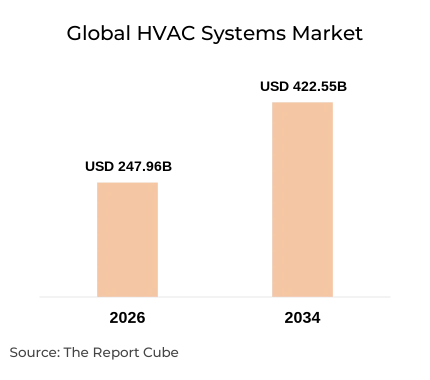
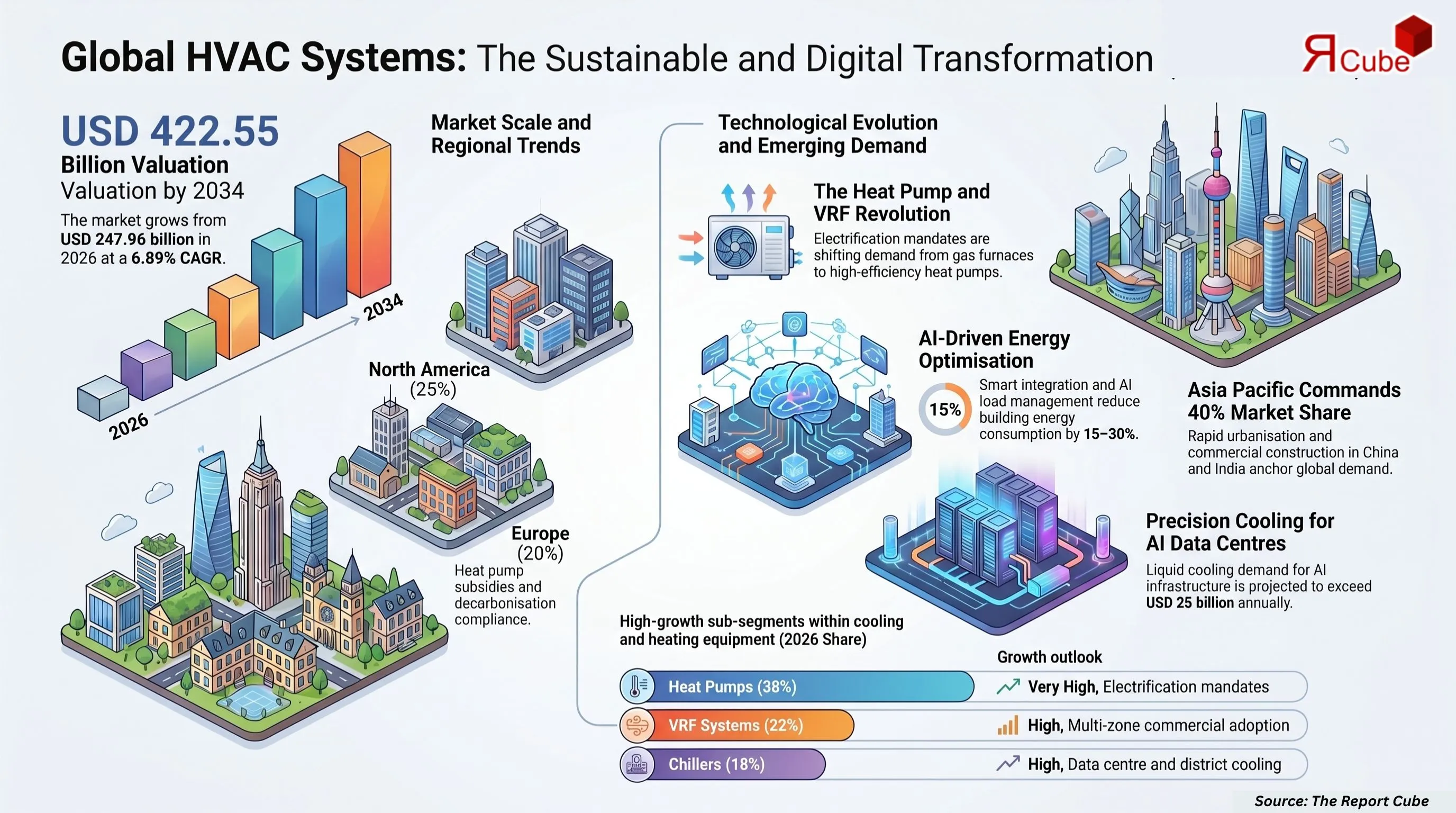
- The global HVAC systems market is projected to grow from USD 247.96 billion in 2026 to USD 422.55 billion by 2034, at a CAGR of 6.89%.
- Asia Pacific leads regional demand, driven by rapid urbanisation and rising commercial construction activity.
- Variable Refrigerant Flow (VRF) systems are gaining share over conventional unitary air conditioners in multi zone commercial installations.
- Regulatory pressure to phase out high GWP refrigerants under the Kigali Amendment is accelerating transition to next generation heat pump and chiller technologies.
- Smart HVAC integration - embedded sensors, IoT controls, and AI driven load optimisation—is moving from premium segment into mid-market product lines.
Global HVAC Systems Market Insights & Analysis
Heating, ventilation, and air conditioning accounts for 40–60% of total energy consumption in commercial buildings, yet most installed equipment globally is more than 15 years old and operates well below current efficiency benchmarks (International Energy Agency, 2024). That gap between performance expectation and installed reality is the central tension the HVAC market must resolve over the forecast period.
The global HVAC systems market is valued at USD 247.96 billion in 2026 and is projected to reach USD 422.55 billion by 2034, advancing at a CAGR of 6.89%. Three structural forces underpin this trajectory. First, accelerating urbanisation particularly across South and Southeast Asia is generating demand for new residential towers, data centres, and logistics facilities, all of which require climate control infrastructure from commissioning. Second, tightening energy codes in the European Union, the United States, and China are forcing equipment replacement cycles ahead of the traditional 15–20-year schedule. Third, the post pandemic emphasis on indoor air quality has elevated ventilation from a background specification item to a procurement priority for hospitals, schools, and office operators.
The competitive landscape is consolidating. Carrier, Daikin, and Trane Technologies collectively hold an estimated 35–40% of the global installed unit market, while regional players across China and India Midea, Gree, Voltas are scaling into export markets. The intersection of electrification mandates and refrigerant transition is creating a product development race: manufacturers that certify A2L and A3 class refrigerant compatibility before 2027 regulatory deadlines will hold a measurable pricing advantage in the EU and North American replacement markets.
Global HVAC Systems Market Dynamics
Key Market Driver: Energy Efficiency Mandates and Building Decarbonisation Policy
Building sectors in the EU, US, and China face legally binding carbon reduction targets that have direct procurement consequences for HVAC equipment. The EU's revised Energy Performance of Buildings Directive (EPBD, 2024) requires all new buildings to be zero emission by 2028 and mandates that the worst performing existing stock undergo energy renovation by 2033 (European Commission, 2024). Each renovation cycle triggers an HVAC replacement event.
Equipment manufacturers are responding with high efficiency heat pumps rated at Coefficient of Performance (COP) values of 4.0–5.5 delivering four to five units of heating for every unit of electricity consumed compared to a COP of 0.85–0.95 for conventional gas furnaces. The US Department of Energy's appliance efficiency standards, updated in 2023, require residential central air conditioners to achieve a minimum SEER2 rating of 14.3 in the northern region and 15.2 in the south, eliminating roughly 30% of the previously compliant product catalogue and accelerating replacement demand (US DOE, 2023).
Major Industry Challenge: Refrigerant Transition Costs and Supply Chain Disruption
The phase down of high global warming potential (GWP) refrigerants specifically R 410A under the American Innovation and Manufacturing (AIM) Act and the EU F Gas Regulation creates a dual cost burden. Equipment redesigned for lower GWP alternatives such as R 32, R 454B, or natural refrigerants (propane R 290, CO₂ R 744) requires new compressor architecture, modified heat exchangers, and A2L rated safety controls raising per unit manufacturing costs by an estimated 8–15% before economies of scale take effect (ASHRAE, 2023).
Contractors and distributors face parallel inventory risk. Pre transition R 410A stock may depreciate rapidly once regulatory deadlines pass, while A2L certified technician capacity is constrained: fewer than 20% of HVAC service technicians in North America held A2L refrigerant handling certification as of 2024 (Air Conditioning, Heating & Refrigeration Institute, 2024). This skills gap lengthens installation timelines and may suppress replacement cycle velocity in the short term.
Emerging Trend: Integration of AI Driven Building Management and Predictive Maintenance
HVAC systems are shifting from stand alone mechanical equipment to data generating nodes within building intelligence platforms. AI enabled building management systems (BMS) continuously analyse occupancy patterns, external weather data, and equipment performance telemetry to adjust set points in real time, reducing HVAC energy consumption by 15–30% in trials across commercial office portfolios (Lawrence Berkeley National Laboratory, 2023).
Predictive maintenance is accelerating this transition. Embedded vibration sensors, refrigerant pressure monitors, and compressor current signatures feed machine learning models that identify impending failures 48–72 hours in advance, cutting unplanned downtime costs by an estimated 25–40% per service event. Johnson Controls' OpenBlue platform and Carrier's Abound suite exemplify the manufacturer push to monetise connected equipment through software as a service subscription models layered on top of hardware sales.
Emerging Opportunity: Data Centre Cooling Demand from AI Infrastructure Expansion
AI model training and inference workloads are driving data centre power density to 30–100 kW per rack well beyond the capacity of conventional raised floor air cooling. This creates a structurally distinct procurement segment for precision cooling: in row liquid cooling units, rear door heat exchangers, and direct liquid cooling (DLC) systems. Global data centre cooling capital expenditure is projected to exceed USD 25 billion annually by 2027 (International Data Corporation, 2024), with HVAC vendors that hold liquid cooling product lines positioned to capture incremental revenue outside the traditional building comfort segment.
Hyperscaler operators Microsoft, Google, Amazon Web Services—have each published cooling roadmaps mandating zero water or water minimised designs for new builds, creating demand for free cooling economiser configurations and closed loop liquid systems rather than evaporative cooling towers.
Need Specific Data, Let’s Customize the Report for You
Request CustomizationGlobal HVAC Systems Market Segment wise Analysis
By Cooling Equipment
Unitary air conditioners represent the highest installed volume segment, but Variable Refrigerant Flow systems are capturing disproportionate share of new commercial project specifications.
|
Sub Segment |
Estimated Share (2026) |
Growth Outlook |
|---|---|---|
|
Unitary Air Conditioners |
34% |
Moderate - replacement driven demand |
|
Variable Refrigerant Flow (VRF) Systems |
22% |
High - multi zone commercial adoption |
|
Chillers |
18% |
High - data centre and district cooling demand |
|
Room Air Conditioners |
14% |
Moderate - residential replacement cycles |
|
Coolers |
7% |
Low moderate - niche industrial use |
|
Cooling Towers |
5% |
Low - mature, industrial and HVAC plant |
VRF systems are gaining ground in commercial fit outs because a single outdoor condensing unit can serve up to 64 indoor fan coil units simultaneously, eliminating the duct infrastructure that accounts for 15–20% of HVAC project cost in mid rise office buildings. Daikin and Mitsubishi Electric together control an estimated 50%+ of the global VRF market by revenue (Japan Refrigeration and Air Conditioning Industry Association, 2023). Chillers are seeing above average growth driven by hyper scale data centre demand and district energy systems in Middle Eastern urban developments.
By Heating Equipment
Heat pumps are the fastest growing sub segment within the heating equipment category, driven by electrification policy and gas ban regulations in multiple jurisdictions.
|
Sub Segment |
Estimated Share (2026) |
Growth Outlook |
|---|---|---|
|
Heat Pumps |
38% |
Very High - electrification mandates |
|
Furnaces |
28% |
Low - declining in regulated markets |
|
Unitary Heaters |
18% |
Moderate - commercial and industrial |
|
Boilers |
16% |
Low moderate - industrial process retention |
Heat pump shipments in Europe grew 40% year over year in 2022 before cooling in 2023 due to installation bottlenecks and subsidy programme gaps (European Heat Pump Association, 2024). The underlying demand signal remains intact: the UK's Future Homes Standard, Germany's Building Energy Act amendment (GEG 2024), and France's MaPrimeRénov scheme each create financial incentives that shift new build and retrofit specifications from gas boilers to air source heat pumps. Bosch Thermotechnology and Rheem Manufacturing are investing in ground source heat pump product lines to address demand in suburban US and European retrofit markets where air source units underperform in sub zero temperatures.
Regional Projection of Global HVAC Systems Market
|
Region |
Estimated Share (2026) |
Key Growth Driver |
Notable Gap |
|---|---|---|---|
|
Asia Pacific |
40% |
Urbanisation, rising cooling degree days |
Grid reliability limits VRF adoption in Tier 3 cities |
|
North America |
25% |
Regulatory replacement demand, data centre build out |
Technician shortage slows installation velocity |
|
Europe |
20% |
Heat pump subsidy programmes, EPBD compliance |
Supply chain bottlenecks for A2L compatible components |
|
Middle East & Africa |
9% |
District cooling expansion, hospitality construction |
Financing access constrains SME adoption |
|
Latin America |
6% |
Residential AC penetration, informal construction sector |
Fragmented distribution channels |
- Asia Pacific accounts for the largest regional share at approximately 40% of global HVAC revenue in 2026, anchored by China's construction pipeline and India's accelerating commercial real estate market. India's Bureau of Energy Efficiency (BEE) mandates a minimum 5 star energy rating for new commercial HVAC installations in major cities, pulling procurement toward premium, higher margin equipment.
- North America is the second largest market, with replacement demand concentrated in the US Sun Belt states where ageing equipment installed during the mid 2000s construction boom is reaching end of life.
- Europe leads the world in heat pump penetration rate as a share of new heating installations, with Norway (80%+), Finland, and Sweden setting benchmarks that are reshaping manufacturer R&D investment priorities globally.
- Middle East & Africa is growing fastest in absolute CAGR terms within its regional base, driven by district cooling networks in Saudi Arabia's NEOM project and UAE urban expansion.
- Latin America remains under penetrated relative to cooling degree day exposure, with residential AC penetration in Brazil and Mexico at 20–30% versus 90%+ in the US pointing to a long term structural demand runway.
Global HVAC Systems Market: Recent Developments (2025)
- January 2025: Carrier Global announced EPA pre approval for its Puron Advance (R 454B) residential heat pump line, targeting US market availability ahead of the 2025 SEER2 regulatory transition.
- March 2025: Daikin Industries confirmed a EUR 300 million capacity expansion at its Czech Republic manufacturing facility to meet European heat pump demand, adding 500,000 units annually by 2027.
Global HVAC Systems Market Future Outlook (2034)
By 2034, the global HVAC systems market is forecast to reach USD 422.55 billion but the composition of that revenue will differ materially from today's installed base. Equipment sold before 2030 will be defined by refrigerant transition: A2L and A3 rated products will constitute the majority of new shipments in regulated markets, while high GWP legacy equipment will be confined to unregulated geographies or aftermarket servicing.
Electrification is the defining macro structural shift. The International Energy Agency forecasts that heat pumps must supply 20% of global heating by 2030 to stay on a net zero pathway (IEA, 2023). Meeting that target requires tripling the annual installation rate from its current global baseline an execution challenge that will stress installer capacity, grid infrastructure, and component supply chains simultaneously. Governments that resolve the installer shortage bottleneck through accelerated training programmes and subsidy linked certification requirements will see faster adoption curves.
AI driven building management will transition from a feature premium to a baseline specification. By 2030, building codes in leading markets are expected to require demand response compatibility in new commercial HVAC installations, enabling grid operators to modulate building loads in real time to balance renewable intermittency. Manufacturers that control the full stack hardware, firmware, building OS, and data monetisation layer will extract structurally higher margins than those competing purely on equipment specification. Carrier, Johnson Controls, and Daikin have each signalled software revenue ambitions exceeding 20% of total revenue by 2030, a target that will reshape their investment allocation and acquisition strategies through the forecast period.
Global HVAC Systems Market Report Coverage
|
Report Features |
Details |
|---|---|
|
Market Size (Value) |
USD 247.96 Billion (2026) |
|
Forecast Period |
2026 2034 |
|
CAGR |
6.89% |
|
Base Year |
2026 |
|
Historical Data |
2021 2025 |
|
Customization |
Available |
|
Segments Covered |
By Cooling Equipment; By Heating Equipment, By Ventilation Type, By Implementation Type, By Application |
|
Regions Covered |
North America, Europe, Asia Pacific, Latin America, Middle East & Africa |
|
Key Companies |
Carrier, Trane Technologies, Daikin, Johnson Controls, Lennox International, Mitsubishi Electric, Rheem Manufacturing, York International, Bosch Thermotechnology |
|
Report Format |
PPT, PDF & Excel |
Why Choose This Report?
- Covers the full refrigerant transition impact R 410A phase down, A2L adoption timelines, and cost modelling as a dedicated analytical layer rather than a footnote.
- Provides granular sub segment data for both cooling and heating equipment with share estimates and growth outlook per sub segment.
- Benchmarks energy efficiency regulations by jurisdiction EU EPBD, US DOE SEER2, BEE India and maps their direct procurement consequences for equipment manufacturers and buyers.
- Includes a dedicated data centre cooling demand analysis, quantifying the AI infrastructure driven opportunity as a structurally distinct HVAC sub market.
- Tracks six recent corporate developments (2024–2025) with acquisition, product launch, and partnership detail updated through Q1 2025.
- Delivers verified competitive positioning for nine named players, including post divestiture Bosch/York structure and Carrier's refrigerant product roadmap.
- Addresses the installer capacity bottleneck as a demand constraint a factor absent from most published HVAC market reports with regional skills gap data from AHRI and EHPA.
Table of Contents
- Introduction
- Objective of the study
- Product Definition
- Market Segmentation
- Study Variables
- Research Methodology
- Secondary Data Points
- Companies Interviewed
- Primary Data Points
- Breakdown of Primary Interviews
- Secondary Data Points
- Executive Summary
- Market Dynamics
- Drivers
- Challenges
- Opportunity Assessment
- Recent Trends and Developments
- Policy and Regulatory Landscape
- Global HVAC Systems Market Overview and Forecast Analysis (2021-2034)
- Market Size, By Value, By growth rate (CAGR/USD Billions)
- Demand - Supply Trends
- Market Share, By Cooling Equipment
- Unitary Air Conditioners
- Variable Refrigerant Flow Systems (VRF)
- Chillers
- Room Air Conditioners
- Coolers
- Cooling Towers
- Market Share, By Heating Equipment
- Heat Pumps
- Furnaces
- Unitary Heaters
- Boilers
- Market Share, By Ventilation Type
- Air-handling Units (AHUs)
- Air Filters
- Dehumidifiers
- Ventilation Fans
- Humidifiers
- Air Purifiers
- Market Share, By Implementation Type
- New Construction
- Retrofit
- Market Share, By Application
- Residential
- Commercial
- Industrial
- Market Share, By Region
- Asia Pacific
- North America
- Europe
- Middle East & Africa
- Latin America
- Market Share, By Company
- Revenue Shares
- Competition Characteristics
- North America HVAC Systems Market Overview (2021-2034)
- Market Size, By Value (in USD Billions)
- Market Share, By Cooling Equipment
- Market Share, By Heating Equipment
- Market Share, By Ventilation Type
- Market Share, By Implementation Type
- Market Share, By Application
- By Country
- The US
- Canada
- Mexico
- The US HVAC Systems Market Overview (2021-2034)
- Market Share, By Cooling Equipment
- Market Share, By Heating Equipment
- Market Share, By Ventilation Type
- Market Share, By Implementation Type
- Market Share, By Application
- Canada HVAC Systems Market Overview (2021-2034)
- Market Share, By Cooling Equipment
- Market Share, By Heating Equipment
- Market Share, By Ventilation Type
- Market Share, By Implementation Type
- Market Share, By Application
- Mexico HVAC Systems Market Overview (2021-2034)
- Market Share, By Cooling Equipment
- Market Share, By Heating Equipment
- Market Share, By Ventilation Type
- Market Share, By Implementation Type
- Market Share, By Application
- South America HVAC Systems Market Overview (2021-2034)
- Market Size, By Value (in USD Billions)
- Market Share, By Cooling Equipment
- Market Share, By Heating Equipment
- Market Share, By Ventilation Type
- Market Share, By Implementation Type
- Market Share, By Application
- By Country
- Brazil
- Argentina
- Rest of South America
- Brazil HVAC Systems Market Overview (2021-2034)
- Market Share, By Cooling Equipment
- Market Share, By Heating Equipment
- Market Share, By Ventilation Type
- Market Share, By Implementation Type
- Market Share, By Application
- Argentina HVAC Systems Market Overview (2021-2034)
- Market Share, By Cooling Equipment
- Market Share, By Heating Equipment
- Market Share, By Ventilation Type
- Market Share, By Implementation Type
- Market Share, By Application
- Europe HVAC Systems Market Overview (2021-2034)
- Market Size, By Value (in USD Billions)
- By Cooling Equipment
- By Heating Equipment
- By Ventilation Type
- By Implementation Type
- By Application
- By Country
- Germany
- The UK
- France
- Spain
- Italy
- Rest of Europe
- Germany HVAC Systems Market Overview (2021-2034)
- Market Share, By Cooling Equipment
- Market Share, By Heating Equipment
- Market Share, By Ventilation Type
- Market Share, By Implementation Type
- Market Share, By Application
- France HVAC Systems Market Overview (2021-2034)
- Market Share, By Cooling Equipment
- Market Share, By Heating Equipment
- Market Share, By Ventilation Type
- Market Share, By Implementation Type
- Market Share, By Application
- The UK HVAC Systems Market Overview (2021-2034)
- Market Share, By Cooling Equipment
- Market Share, By Heating Equipment
- Market Share, By Ventilation Type
- Market Share, By Implementation Type
- Market Share, By Application
- Spain HVAC Systems Market Overview (2021-2034)
- Market Share, By Cooling Equipment
- Market Share, By Heating Equipment
- Market Share, By Ventilation Type
- Market Share, By Implementation Type
- Market Share, By Application
- Italy HVAC Systems Market Overview (2021-2034)
- Market Share, By Cooling Equipment
- Market Share, By Heating Equipment
- Market Share, By Ventilation Type
- Market Share, By Implementation Type
- Market Share, By Application
- The Middle East & Africa HVAC Systems Market Overview (2021-2034)
- Market Size, By Value (in USD Billions)
- By Cooling Equipment
- By Heating Equipment
- By Ventilation Type
- By Implementation Type
- By Application
- By Country
- The UAE
- Saudi Arabia
- South Africa
- Rest of the Middle East & Africa
- The UAE HVAC Systems Market Overview (2021-2034)
- Market Share, By Cooling Equipment
- Market Share, By Heating Equipment
- Market Share, By Ventilation Type
- Market Share, By Implementation Type
- Market Share, By Application
- Saudi Arabia HVAC Systems Market Overview (2021-2034)
- Market Share, By Cooling Equipment
- Market Share, By Heating Equipment
- Market Share, By Ventilation Type
- Market Share, By Implementation Type
- Market Share, By Application
- South Africa HVAC Systems Market Overview (2021-2034)
- Market Share, By Cooling Equipment
- Market Share, By Heating Equipment
- Market Share, By Ventilation Type
- Market Share, By Implementation Type
- Market Share, By Application
- Asia-Pacific HVAC Systems Market Overview (2021-2034)
- Market Size, By Value (in USD Billions)
- By Cooling Equipment
- By Heating Equipment
- By Ventilation Type
- By Implementation Type
- By Application
- By Country
- China
- India
- Japan
- South Korea
- Australia
- Rest of Asia-Pacific
- China HVAC Systems Market Overview (2021-2034)
- Market Share, By Cooling Equipment
- Market Share, By Heating Equipment
- Market Share, By Ventilation Type
- Market Share, By Implementation Type
- Market Share, By Application
- India HVAC Systems Market Overview (2021-2034)
- Market Share, By Cooling Equipment
- Market Share, By Heating Equipment
- Market Share, By Ventilation Type
- Market Share, By Implementation Type
- Market Share, By Application
- Japan HVAC Systems Market Overview (2021-2034)
- Market Share, By Cooling Equipment
- Market Share, By Heating Equipment
- Market Share, By Ventilation Type
- Market Share, By Implementation Type
- Market Share, By Application
- South Korea HVAC Systems Market Overview (2021-2034)
- Market Share, By Cooling Equipment
- Market Share, By Heating Equipment
- Market Share, By Ventilation Type
- Market Share, By Implementation Type
- Market Share, By Application
- Austraila HVAC Systems Market Overview (2021-2034)
- Market Share, By Cooling Equipment
- Market Share, By Heating Equipment
- Market Share, By Ventilation Type
- Market Share, By Implementation Type
- Market Share, By Application
- Competitive Outlook (Company Profile - Partial List)
- Carrier
- Company Overview
- Business Segments
- Strategic Alliances/Partnerships
- Recent Developments
- Trane Technologies
- Company Overview
- Business Segments
- Strategic Alliances/Partnerships
- Recent Developments
- Daikin
- Company Overview
- Business Segments
- Strategic Alliances/Partnerships
- Recent Developments
- Johnson Controls
- Company Overview
- Business Segments
- Strategic Alliances/Partnerships
- Recent Developments
- LennoxInternational
- Company Overview
- Business Segments
- Strategic Alliances/Partnerships
- Recent Developments
- Mitsubishi Electric
- Company Overview
- Business Segments
- Strategic Alliances/Partnerships
- Recent Developments
- Rheem Manufacturing
- Company Overview
- Business Segments
- Strategic Alliances/Partnerships
- Recent Developments
- York International
- Company Overview
- Business Segments
- Strategic Alliances/Partnerships
- Recent Developments
- Bosch Thermotechnology
- Company Overview
- Business Segments
- Strategic Alliances/Partnerships
- Recent Developments
- Others
- Carrier
- Disclaimer
Top Key Players & Market Share Outlook
- Carrier
- Trane Technologies
- Daikin
- Johnson Controls
- LennoxInternational
- Mitsubishi Electric
- Rheem Manufacturing
- York International
- Bosch Thermotechnology
- Others
Frequently Asked Questions






