


Build Your Custom Market Intelligence Report
Customize Your ReportKey Highlights
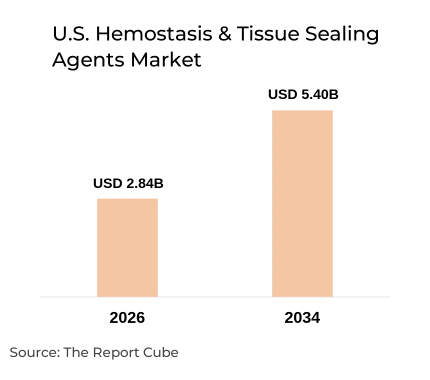
- The U.S. Hemostasis & Tissue Sealing Agents Market is estimated at USD 2.84 billion in 2026.
- Market size is projected to reach USD 5.40 billion by 2034.
- The market is forecast to grow at a CAGR of 8.37% during 2026–2034.
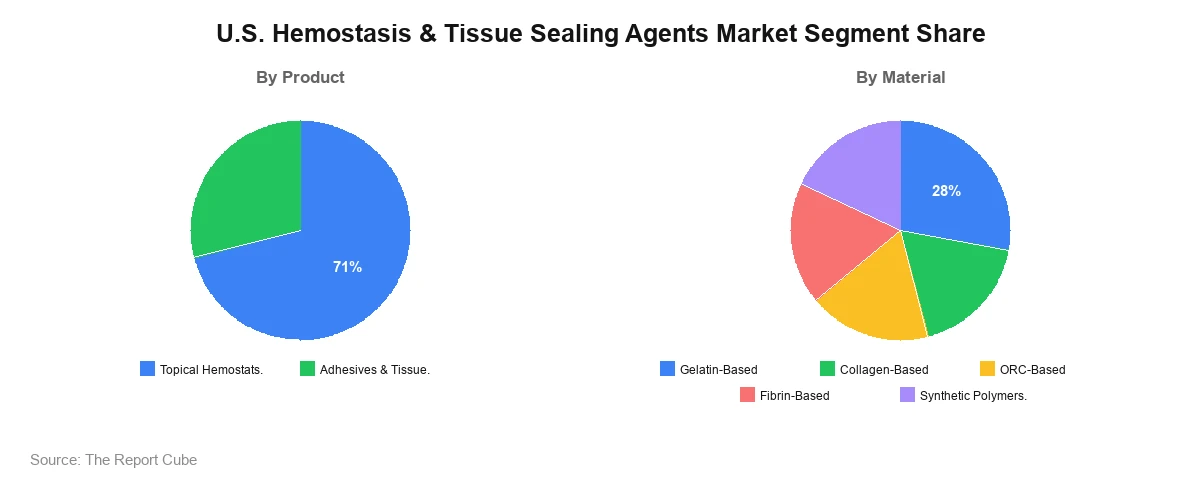
- Topical hemostats lead the product segment with an estimated 71% share in 2026.
- The South is the leading region, with an estimated 34% share in 2026, pending validation.
- Rising demand for effective intraoperative bleeding control is the major growth driver.
- Johnson & Johnson (Ethicon), Baxter and Integra LifeSciences are among the established participants.
Market Outlook
The U.S. Hemostasis & Tissue Sealing Agents Market covers medical products that control surgical bleeding, support tissue adhesion and seal tissues. Hospitals use them when sutures, ligatures or cautery are insufficient or impractical. The category includes topical hemostats, tissue adhesives, fibrin sealants and related surgical products.
Demand follows surgical procedure volumes, procedural complexity and hospital purchasing decisions. Product choice depends on bleeding characteristics, application method, clinical evidence, cost and regulatory approval. Topical hemostats come in mechanical, active and flowable formats, while sealants are available in natural and synthetic formulations used across general, cardiovascular, orthopaedic and neurological surgery.
The market is estimated at USD 2.84 billion in 2026 and projected to reach USD 5.40 billion by 2034, a CAGR of 8.37%. Growth is supported by sustained surgical activity, specialised sealants and advancing surgical technology. Competition centres on clinical performance, approved indications and procurement relationships, and manufacturers with indication-specific portfolios are positioned to gain.
Government Regulations
The U.S. Food and Drug Administration (FDA) regulates hemostasis and tissue sealing products. Biologic products such as fibrin sealants are generally reviewed by the Center for Biologics Evaluation and Research, while many device-based hemostats fall under the Center for Devices and Radiological Health. Manufacturers must establish safety and effectiveness for each intended indication, comply with manufacturing quality requirements and meet post-market obligations. FDA product listings define approved uses; for example, VISTASEAL and TISSEEL are listed as adjuncts to haemostasis when conventional techniques are ineffective or impractical, and ARTISS is indicated for adhering autologous skin grafts and tissue flaps. These requirements lengthen development timelines and raise evidence-generation costs, favouring established manufacturers with regulatory expertise, while label-specific indications shape how companies position products and how hospitals select them.
U.S. Hemostasis & Tissue Sealing Agents Market Dynamics
Market dynamics reflect surgical demand, clinical need for reliable bleeding control, product innovation and hospital procurement practices. Advanced haemostatic products offer options where conventional techniques fall short, while regulatory requirements, evidence expectations and cost pressure influence adoption and commercial expansion across U.S. healthcare providers.
|
Factor |
Type |
Specific Impact on Market |
Magnitude |
|---|---|---|---|
|
Demand for effective intraoperative bleeding control |
Driver |
Supports use of topical hemostats and sealants where conventional methods are insufficient |
High |
|
Healthcare utilisation and hospital activity |
Driver |
Sustains demand for surgical consumables and specialised products |
Medium |
|
Regulatory and clinical evidence requirements |
Challenge |
Raises development cost and time to commercialisation |
Medium–High |
|
Hospital budget pressure |
Challenge |
Premium products must demonstrate clinical or operational value |
Medium |
|
Multifunctional haemostatic and sealing products |
Opportunity |
Combined bleeding control and tissue sealing in complex procedures |
Medium |
|
Indication-specific product portfolios |
Trend |
Differentiation through defined surgical applications |
Medium |
Growth Drivers: Demand for Effective Intraoperative Bleeding Control
Surgical bleeding can be difficult to manage with conventional techniques alone. Topical hemostats and fibrin sealants give surgeons additional options when sutures, ligatures or cautery are ineffective or impractical. FDA listings for VISTASEAL and TISSEEL describe use as adjuncts to haemostasis in specified surgical settings. Broad relevance across general, cardiovascular and orthopaedic procedures keeps demand steady, and hospital expenditure, which CMS reports rose 8.9% to about USD 1,634.7 billion in 2024, indicates a supportive healthcare environment, though not a direct measure of this market.
Market Opportunities: Multifunctional Haemostatic and Sealing Products
Products that combine bleeding control with tissue adhesion or sealing may add value in procedures requiring several clinical functions. Manufacturers that improve application control, ease of handling and demonstrated clinical benefit can find openings in specialised and complex surgeries. Clear evidence of clinical or operational advantage also helps justify premium pricing to hospital buyers, and companies able to generate indication-specific data are better placed to strengthen their positioning in defined surgical applications.
Industry Challenges: Regulatory Requirements and Hospital Cost Pressure
Manufacturers must satisfy FDA requirements and demonstrate safety and effectiveness for each intended indication, which adds development cost and delays commercialisation. Hospitals also balance clinical performance against acquisition cost, inventory needs and procurement priorities, so premium products must show meaningful benefit. Differences in product format, application method and approved indications further complicate selection, and these combined pressures can slow adoption of newer products even where clinical need is established.
Need Specific Data, Let’s Customize the Report for You
Request CustomizationMarket Trends: Indication-Specific Product Portfolios
Manufacturers increasingly differentiate products by surgical application and clinical indication. ARTISS illustrates how a specialised tissue-adherence indication supports distinct positioning, while topical hemostats remain the leading category with mechanical, active and flowable formats serving different mechanisms and delivery needs. Portfolio breadth across surgical specialties is becoming a competitive factor, and companies are aligning product development with defined clinical settings rather than relying on general-purpose bleeding-control claims.
U.S. Hemostasis & Tissue Sealing Agents Market Segment Analysis
The market is segmented by product, material, application and end user. Leading-segment shares below are the supplied 2026 estimates; they are analyst allocations rather than officially published statistics.
By Product
- Topical Hemostats
- Adhesives & Tissue Sealants
Topical hemostats lead the product segment with an estimated 71% share in 2026. They are used across a wide range of surgeries to control bleeding at the surgical site, and their mechanical, active and flowable formats serve different procedural needs, supporting broad hospital adoption. Adhesives and tissue sealants rank second, supporting tissue adhesion, sealing and closure where conventional techniques are insufficient. Natural and synthetic formulations expand their use in specialised procedures, and this segment is positioned to gain relative importance as indication-specific products develop.
By Material
- Gelatin-Based
- Collagen-Based
- ORC-Based
- Fibrin-Based
- Synthetic Polymers and Other Materials
Gelatin-based materials lead the material segment with an estimated 28% share in 2026. They are used in absorbable haemostatic matrices and other topical formats, and their established role in surgical bleeding management supports their position. Collagen-based materials rank second, promoting clot formation through their material properties and serving selected surgical applications requiring local bleeding control. ORC-based, fibrin-based and synthetic polymer materials make up the remaining segments, offering absorbable haemostasis, biological sealing and specialised formulations respectively, with selection depending on handling, absorption and procedure requirements.
U.S. Hemostasis & Tissue Sealing Agents Market Regional Analysis
The market is analysed across the Northeast, Midwest, South and West. Regional demand reflects healthcare infrastructure, hospital concentration, surgical activity, specialist availability and distribution networks. Only the leading regional share was supplied, and it is an analyst allocation that requires validation against state-level sales or procurement data.
|
Region |
Estimated Market Share |
Key Growth Factors |
Industry Trends |
|---|---|---|---|
|
Northeast |
- |
Established hospital networks and academic medical centres |
Demand for advanced surgical products |
|
Midwest |
- |
Broad hospital and provider base |
Demand linked to general and specialised surgery |
|
South |
34% |
Large provider network and substantial surgical-care demand |
Leading regional demand in the working model |
|
West |
- |
Major metropolitan markets and specialist medical centres |
Established surgical infrastructure |
The South leads with an estimated 34% share in 2026, reflecting its large healthcare-provider network and substantial surgical-care demand. Its leadership remains an assumption until verified with state-level sales and hospital procurement data. Shares for the Northeast, Midwest and West are not displayed in this report.
Competitive Landscape
The U.S. market includes established medical technology and healthcare companies offering topical hemostats, fibrin sealants, tissue adhesives and related surgical products. Competition is shaped by clinical performance, FDA-approved indications, handling characteristics, pricing, supply reliability, surgeon familiarity and hospital procurement relationships. The table reflects product portfolios and does not represent a market-share ranking.
|
Company |
Competitive Strength |
Primary Segment Served |
|---|---|---|
|
Johnson & Johnson / Ethicon |
Surgical and haemostatic solutions, including EVARREST |
Topical hemostats and fibrin sealant patches |
|
Fibrin sealants and tissue-adhesion products, including TISSEEL and ARTISS |
Adhesives and tissue sealants |
|
|
Integra LifeSciences |
Surgical technologies and specialised medical products |
Specialised surgical applications |
|
Becton, Dickinson and Company (BD) |
Medical technology and surgical product portfolio |
Hospital surgical products |
|
B. Braun |
Surgical and medical technologies relevant to haemostasis |
General surgery |
|
Smith+Nephew |
Advanced wound management and surgical technologies |
Surgical and wound care |
|
Advanced Medical Solutions Group |
Tissue adhesives and sealants, wound-closure technologies |
Adhesives and tissue sealants |
|
CryoLife / Artivion |
Surgical products for cardiovascular and tissue applications |
Cardiovascular surgery |
Baxter International: Baxter is a global healthcare company whose surgical portfolio includes the fibrin sealants TISSEEL and ARTISS. FDA listings describe TISSEEL as an adjunct to haemostasis in specified adult and paediatric surgical settings and ARTISS as indicated for adherence of autologous skin grafts and tissue flaps. Its strength lies in indication-specific fibrin sealant products serving hospital surgical programmes.
Johnson & Johnson / Ethicon: Ethicon is the surgical business of Johnson & Johnson and offers surgical and haemostatic products, including EVARREST, a fibrin sealant patch. The FDA lists EVARREST as an adjunct to haemostasis in specified surgical settings. Its competitive position rests on a broad surgical portfolio and established relationships with hospitals and surgeons.
Recent Developments and Updates
- Grifols (VISTASEAL): The FDA lists VISTASEAL as a human fibrin sealant used as an adjunct to haemostasis when conventional techniques are ineffective or impractical, reflecting continued regulatory activity in fibrin sealants.
- Baxter and Ethicon: TISSEEL, ARTISS and EVARREST remain listed with defined indications. These records show approved clinical applications and should not be read as evidence of market-share gains.
U.S. Hemostasis & Tissue Sealing Agents Market Future Outlook
The market is expected to benefit from continued surgical activity, demand for effective bleeding control and specialised haemostatic technologies. Under the working forecast, it rises from USD 2.84 billion in 2026 to USD 5.40 billion in 2034, a CAGR of 8.37%. Topical hemostats are expected to remain the major product category, while tissue sealants may increase their relative contribution as specialised applications develop.
Competition is likely to centre on clinical evidence, FDA-approved indications, portfolio breadth and hospital procurement relationships. Growth in outpatient and specialised surgical settings may widen purchasing channels, while regulatory requirements and hospital cost pressure will continue to influence adoption. Outcomes depend on procedure volumes, clinical adoption, product innovation and manufacturers’ ability to show clinical and economic value.
U.S. Hemostasis & Tissue Sealing Agents Market Report Coverage
This report summarises the supplied valuation, forecast, segmentation, regional framework and competitive landscape for the U.S. Hemostasis & Tissue Sealing Agents Market.
|
Parameter |
Details |
|---|---|
|
Market Name |
U.S. Hemostasis & Tissue Sealing Agents Market |
|
Market Size (Base Year) |
USD 2.84 billion (2026) |
|
Market Size (Forecast Year) |
USD 5.40 billion (2034) |
|
CAGR |
8.37% |
|
Base Year |
2026 |
|
Historical Period |
2021–2025 |
|
Forecast Period |
2026–2034 |
|
Geographic Scope |
United States |
|
Segmentation |
By Product; By Material; By Application; By End User |
|
Regions Covered |
Northeast, Midwest, South, West |
|
Key Companies |
Johnson & Johnson / Ethicon; Baxter International; Integra LifeSciences; BD; B. Braun; Smith+Nephew; Advanced Medical Solutions Group; CryoLife / Artivion |
|
Customization |
Available as per requirement |
Why Choose This U.S. Hemostasis & Tissue Sealing Agents Market Report?
- Presents the 2026 valuation, 2034 forecast and 8.37% CAGR with stated assumptions.
- Segments the market by product, material, application and end user.
- Reviews drivers, opportunities, challenges and trends affecting surgical haemostasis demand.
- Provides regional context across the Northeast, Midwest, South and West, with unsupplied shares identified.
- Profiles eight participants by capability and primary segment served.
- Highlights opportunities in multifunctional and indication-specific products.
- Summarises FDA regulatory context to support strategic and procurement decisions.
Table of Contents
- Introduction
- Objective of the Study
- Product Definition
- Market Segmentation
- Study Variables
- Research Methodology
- Secondary Data Points
- Companies Interviewed
- Primary Data Points
- Breakdown of Primary Interviews
- Secondary Data Points
- Executive Summary
- Market Dynamics
- Drivers
- Challenges
- Opportunity Assessment
- Recent Trends and Developments
- Policy and Regulatory Landscape
- U.S. Hemostasis & Tissue Sealing Agents Market Overview and Forecast Analysis (2021-2034)
- Market Size, By Value, By Growth Rate (CAGR/USD Billions)
- Demand – Supply Trends
- Market Share, By Product
- Topical Hemostats
- Adhesives & Tissue Sealants
- Market Share, By Material
- Gelatin-Based
- Collagen-Based
- ORC-Based
- Fibrin-Based
- Synthetic Polymers
- Other Materials
- Market Share, By Application
- General Surgery
- Cardiovascular Surgery
- Orthopaedic Surgery
- Neurological Surgery
- Plastic and Reconstructive Surgery
- Other Surgical Applications
- Market Share, By End User
- Hospitals
- Ambulatory Surgical Centres (ASCs)
- Specialty Clinics and Surgical Centres
- Market Share, By Region
- Northeast
- Midwest
- South
- West
- Market Share, By Competitors
- Competition Characteristics
- Revenue Shares
- Topical Hemostats U.S. Hemostasis & Tissue Sealing Agents Market Overview, 2021-2034F
- By Value (USD Million)
- By Material – Market Size & Forecast 2021-2034, USD Million
- Gelatin-Based
- Collagen-Based
- ORC-Based
- Fibrin-Based
- Synthetic Polymers
- Other Materials
- Adhesives & Tissue Sealants U.S. Hemostasis & Tissue Sealing Agents Market Overview, 2021-2034F
- By Value (USD Million)
- By Material – Market Size & Forecast 2021-2034, USD Million
- Gelatin-Based
- Collagen-Based
- ORC-Based
- Fibrin-Based
- Synthetic Polymers
- Other Materials
- Competitive Outlook (Company Profile – Partial List)
- Johnson & Johnson
- Company Overview
- Business Segments
- Strategic Alliances/Partnerships
- Recent Developments
- Baxter International
- Company Overview
- Business Segments
- Strategic Alliances/Partnerships
- Recent Developments
- Integra LifeSciences
- Company Overview
- Business Segments
- Strategic Alliances/Partnerships
- Recent Developments
- Becton Dickinson and Company (BD)
- Company Overview
- Business Segments
- Strategic Alliances/Partnerships
- Recent Developments
- B. Braun
- Company Overview
- Business Segments
- Strategic Alliances/Partnerships
- Recent Developments
- Smith+Nephew
- Company Overview
- Business Segments
- Strategic Alliances/Partnerships
- Recent Developments
- Advanced Medical Solutions Group
- Company Overview
- Business Segments
- Strategic Alliances/Partnerships
- Recent Developments
- CryoLife / Artivion
- Company Overview
- Business Segments
- Strategic Alliances/Partnerships
- Recent Developments
- Johnson & Johnson
- Contact Us & Disclaimer
Top Key Players & Market Share Outlook
- Johnson & Johnson
- Baxter International
- Integra LifeSciences
- Becton, Dickinson and Company (BD)
- B. Braun
- Smith+Nephew
- Advanced Medical Solutions Group
- CryoLife / Artivion
Frequently Asked Questions