



Build Your Custom Market Intelligence Report
Customize Your ReportIndia Herbal Laxative Market Key Highlights
By Product Type:
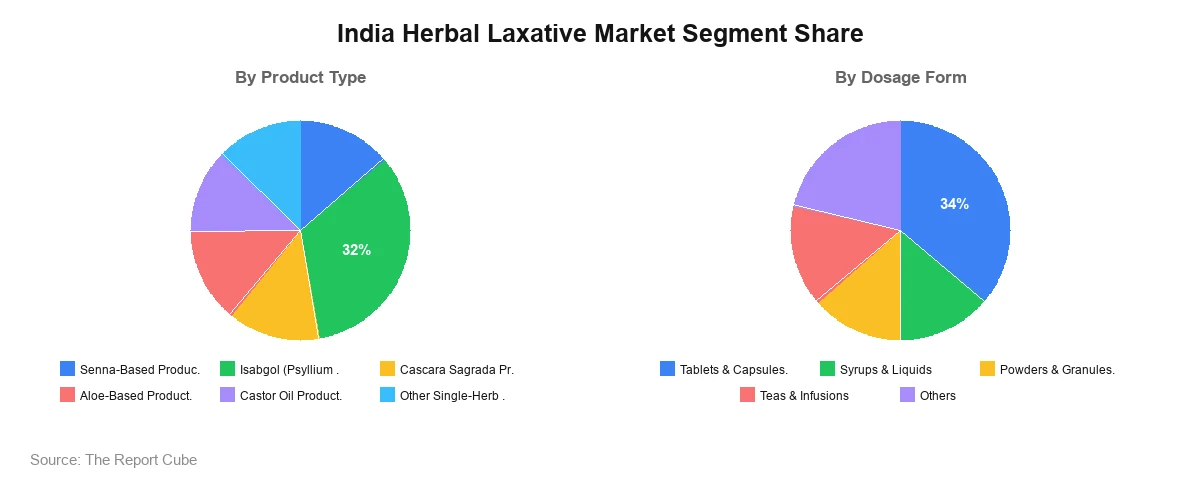
Isabgol (Psyllium Husk) Products segment leads the market with nearly 32% share.
By Dosage Form:
Tablets & Capsules segment dominates the market with around 34% of revenue.
Regional Outlook:
North region dominates the India Herbal Laxative market with approximately 36% share.
India Herbal Laxative Market Insights & Analysis
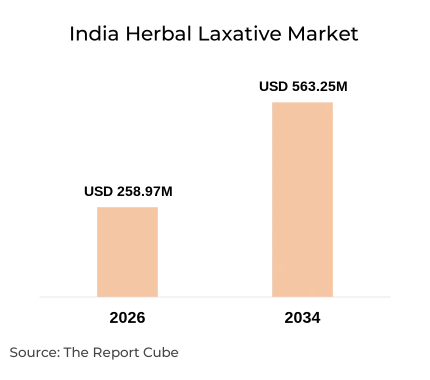
The India Herbal Laxative Market is anticipated to register a CAGR of around 10.2% during the forecast period 2026-2034. The market size is valued at USD 258.97 million in 2026 and is projected to reach USD 563.25 million by 2034. The market is witnessing steady growth supported by rising digestive health awareness and increasing preference for plant-based healthcare solutions. Herbal laxatives such as psyllium husk and senna are gaining strong consumer trust due to their natural composition and fewer side effects compared to synthetic alternatives.
Growing urbanization and sedentary lifestyles have increased constipation-related disorders across India, with over 22% of adults experiencing digestive irregularities in 2025. This has encouraged higher adoption of Ayurvedic formulations and herbal digestive solutions. In addition, companies are investing in D2C platforms, digital consultations, and product innovation, improving accessibility and consumer engagement. The integration of traditional knowledge with modern packaging and branding has further strengthened the market presence of herbal laxative products in both urban and semi-urban regions.
India Herbal Laxative Market Dynamics
Key Driver: Rising Digestive Disorders and Preference for Natural Remedies
The increasing prevalence of digestive issues such as constipation and bloating is a primary growth driver for the India herbal laxative market. Studies indicate that nearly 1 in 5 Indians face occasional constipation, especially among urban populations. This trend is strongly linked to changing dietary habits, reduced fiber intake, and sedentary lifestyles. As a result, consumers are actively seeking safer and long-term solutions.
Herbal laxatives are widely preferred as they offer gentle relief without causing dependency. Products based on isabgol and senna have become household staples. Additionally, rising health awareness and the shift toward preventive healthcare are encouraging consumers to adopt herbal digestive wellness products regularly, boosting market demand.
Book your FREE 30-minute expert consultation today
Contact UsIndustry Trends: Expansion of Ayurvedic Branded Products and Online Sales Channels
The herbal laxative market in India is experiencing a strong shift toward branded Ayurvedic products. Consumers are increasingly choosing trusted brands offering standardized formulations, quality assurance, and scientific backing. This shift has encouraged major companies to expand their product portfolios and invest in research-driven herbal solutions.
Online pharmacies and e-commerce platforms are playing a critical role in market expansion. In 2025, nearly 28% of herbal healthcare product sales were generated through digital channels. Subscription-based models and personalized wellness recommendations are further enhancing customer retention and driving repeat purchases.
Major Challenge: Quality Standardization and Raw Material Variability
One of the key challenges in the India herbal laxative market is maintaining consistent product quality due to variability in raw herbal ingredients. Factors such as climate conditions, harvesting techniques, and storage practices can affect the potency and efficacy of herbs like senna and psyllium.
In addition, regulatory compliance and quality certification requirements can increase production complexity. Smaller manufacturers often face challenges in meeting standardized guidelines, which can impact consumer trust. Ensuring uniformity in formulation and maintaining supply chain consistency remain critical hurdles for market players.
Opportunity: Growing Demand for Preventive Healthcare and Wellness Products
The increasing focus on preventive healthcare presents a strong opportunity for the herbal laxative market in India. Consumers are now incorporating digestive wellness products into their daily routines rather than using them only for treatment. This trend is particularly visible among younger demographics and working professionals.
There is also growing demand for multifunctional products that combine laxative benefits with detoxification and gut health improvement. Companies are launching herbal blends, digestive teas, and fiber supplements to meet this demand. Expansion into international markets and rising exports of Ayurvedic products further strengthen growth opportunities.
India Herbal Laxative Market Segment-wise Analysis
By Product Type:
- Single-Herb Laxatives
- Herbal Combination Laxatives
- Herbal Laxative Teas
- Herbal Laxative Syrups
- Herbal Laxative Tablets & Capsules
- Other Herbal Laxative Forms
The isabgol (psyllium husk) products segment holds a leading share of around 32% in 2025, driven by its widespread use as a natural fiber supplement for digestive regulation. Its effectiveness in treating both occasional and chronic constipation has made it a preferred choice among consumers. The segment benefits from strong brand recognition and extensive distribution across pharmacies and retail stores.
Furthermore, psyllium-based products are increasingly marketed as daily wellness supplements rather than just medicinal solutions. Their role in cholesterol management and gut health has expanded their consumer base. Companies are also introducing flavored and easy-to-consume variants, enhancing product appeal and supporting segment growth.
By Dosage Form:
- Tablets & Capsules
- Syrups & Liquids
- Powders & Granules
- Teas & Infusions
- Others
Tablets and capsules dominate the dosage form segment with approximately 34% market share due to convenience, precise dosage, and longer shelf life. These forms are particularly popular among working professionals and younger consumers seeking easy-to-use solutions.
Manufacturers are focusing on encapsulation technologies to improve product stability and effectiveness. The growing preference for portable and discreet consumption options is further boosting demand for tablets and capsules. This trend is expected to continue as consumers prioritize convenience alongside efficacy.
Regional Projection of India Herbal Laxative Industry
- North
- South
- East
- West
- Central
The North region leads the India herbal laxative market with an estimated 36% share, driven by strong consumer awareness and high adoption of Ayurvedic products. States such as Delhi, Uttar Pradesh, and Punjab have a well-established market for herbal healthcare products, supported by extensive retail networks and availability of traditional medicine practitioners.
Additionally, higher disposable income levels and increasing health consciousness in urban centers contribute to market growth. The region also benefits from strong distribution channels, including pharmacies, Ayurvedic stores, and e-commerce platforms. Continuous promotional activities by leading brands further strengthen market penetration in the North region.
Government Initiatives & Policies
- Ministry of AYUSH National Ayush Mission (2025 Update): Focuses on promoting herbal medicine manufacturing, strengthening supply chains, and improving quality standards for Ayurvedic products across India.
- PLI Scheme for Pharmaceuticals Expansion 2025: Government supports herbal and traditional medicine production under pharma incentives, encouraging domestic manufacturing and global export competitiveness.
India Herbal Laxative Industry Recent Developments
- 2025: Dabur India Ltd launched ‘Dabur Ventures’, a INR 500 crore investment arm to support digital-first D2C wellness and Ayurveda brands, strengthening innovation and expanding market reach.
Need insights for a specific region within this market?
Request Regional DataWhy Choose This Report?
- Provides a comprehensive overview of the overall market analysis, encompassing key trends, consumer behavior analysis, and risk assessment to support strategic decision-making.
- Provides accurate, up-to-date insights into market size, segmentation, and emerging opportunities, helping to minimize risk & capitalizing on growth.
- Gives deep understanding of target audience preferences, investment habits, and communication channels for enhanced product development & marketing effectiveness.
- Delivers competitive analysis & benchmarking, uncovering the strengths & weaknesses of market competitors to guide strategies.
- Consolidate comprehensive market intelligence, reducing reasoning & streamlining research efforts.
- Facilitates customized market segmentation & risk mitigation strategies, fine-tuned to the business objectives.
- Aids in identifying both market challenges & untapped opportunities within the industry to drive long-term business growth.
- Provides valuable information based on actual customer data & search trends.
Table of Contents
- Introduction
- Objective of the Study
- Product and Category Definition
- Market Segmentation
- Study Variables
- Research Methodology
- Secondary Data Points
- Breakdown of Secondary Sources
- Primary Data Points
- Breakdown of Primary Interviews
- Secondary Data Points
- Executive Summary
- Market Dynamics
- Drivers
- Challenges
- Opportunity Assessment
- Recent Trends and Developments
- Regulatory and Policy Landscape
- India Herbal Laxative Market Overview (2021-2034)
- Market Size, By Value (INR Crore)
- Market Share, By Product Type
- Single-Herb Laxatives
- Senna-Based Products
- Isabgol (Psyllium Husk) Products
- Cascara Sagrada Products
- Aloe-Based Products
- Castor Oil Products
- Other Single-Herb Products
- Herbal Combination Laxatives
- Ayurvedic Proprietary Formulations
- Classical Ayurvedic Formulations
- Herbal Digestive Tonic Laxatives
- Herbal Fiber Blends
- Other Combination Products
- Herbal Laxative Teas
- Herbal Laxative Syrups
- Herbal Laxative Tablets & Capsules
- Other Herbal Laxative Forms
- Single-Herb Laxatives
- Market Share, By Dosage Form
- Tablets & Capsules
- Syrups & Liquids
- Powders & Granules
- Teas & Infusions
- Others
- Market Share, By Indication
- Occasional Constipation
- Chronic Constipation
- Digestive Wellness & Detox
- Others
- Market Share, By End User
- Adult Patients
- Geriatric Patients
- Pediatric Patients
- General Wellness Consumers
- Market Share, By Distribution Channel
- Retail Pharmacies
- Ayurvedic & Herbal Stores
- Supermarkets & Hypermarkets
- Online Pharmacies & E-commerce
- Others
- Market Share, By Region
- North
- South
- East
- West
- Central
- Market Share, By Company
- Revenue Shares & Analysis
- Competitive Landscape
- North India Herbal Laxative Market
- Market Size, By Value (INR Crore)
- Market Share, By Product Type
- Market Share, By Dosage Form
- Market Share, By Indication
- Market Share, By End User
- Market Share, By Distribution Channel
- South India Herbal Laxative Market
- Market Size, By Value (INR Crore)
- Market Share, By Product Type
- Market Share, By Dosage Form
- Market Share, By Indication
- Market Share, By End User
- Market Share, By Distribution Channel
- East India Herbal Laxative Market
- Market Size, By Value (INR Crore)
- Market Share, By Product Type
- Market Share, By Dosage Form
- Market Share, By Indication
- Market Share, By End User
- Market Share, By Distribution Channel
- West India Herbal Laxative Market
- Market Size, By Value (INR Crore)
- Market Share, By Product Type
- Market Share, By Dosage Form
- Market Share, By Indication
- Market Share, By End User
- Market Share, By Distribution Channel
- Central India Herbal Laxative Market
- Market Size, By Value (INR Crore)
- Market Share, By Product Type
- Market Share, By Dosage Form
- Market Share, By Indication
- Market Share, By End User
- Market Share, By Distribution Channel
- Competitive Outlook and Company Profiles
- Dabur India Ltd
- Company Overview
- Product Portfolio
- Strategic Alliances/Partnerships
- Recent Developments
- The Himalaya Wellness Co.
- Company Overview
- Product Portfolio
- Strategic Alliances/Partnerships
- Recent Developments
- Baidyanath (Shree Baidyanath)
- Company Overview
- Product Portfolio
- Strategic Alliances/Partnerships
- Recent Developments
- Patanjali Ayurved Ltd
- Company Overview
- Product Portfolio
- Strategic Alliances/Partnerships
- Recent Developments
- Zandu (Emami Ltd)
- Company Overview
- Product Portfolio
- Strategic Alliances/Partnerships
- Recent Developments
- Hamdard Laboratories
- Company Overview
- Product Portfolio
- Strategic Alliances/Partnerships
- Recent Developments
- Charak Pharma Pvt Ltd
- Company Overview
- Product Portfolio
- Strategic Alliances/Partnerships
- Recent Developments
- Vicco Laboratories
- Company Overview
- Product Portfolio
- Strategic Alliances/Partnerships
- Recent Developments
- Albert David Limited
- Company Overview
- Product Portfolio
- Strategic Alliances/Partnerships
- Recent Developments
- Shelter Pharma Ltd
- Company Overview
- Product Portfolio
- Strategic Alliances/Partnerships
- Recent Developments
- Isha Agro Developers
- Company Overview
- Product Portfolio
- Strategic Alliances/Partnerships
- Recent Developments
- Tansukh Herbals
- Company Overview
- Product Portfolio
- Strategic Alliances/Partnerships
- Recent Developments
- Zoic Pharmaceuticals
- Company Overview
- Product Portfolio
- Strategic Alliances/Partnerships
- Recent Developments
- Human Pharmacia Inc.
- Company Overview
- Product Portfolio
- Strategic Alliances/Partnerships
- Recent Developments
- Uniray Lifesciences
- Company Overview
- Product Portfolio
- Strategic Alliances/Partnerships
- Recent Developments
- Ruhani Herbals
- Company Overview
- Product Portfolio
- Strategic Alliances/Partnerships
- Recent Developments
- Velnex Medicare
- Company Overview
- Product Portfolio
- Strategic Alliances/Partnerships
- Recent Developments
- Others
- Dabur India Ltd
- Contact Us and Disclaimer
List of Figure
List of Table
Top Key Players & Market Share Outlook
- Dabur India Ltd
- The Himalaya Wellness Co.
- Baidyanath (Shree Baidyanath)
- Patanjali Ayurved Ltd
- Zandu (Emami Ltd)
- Hamdard Laboratories
- Charak Pharma Pvt Ltd
- Vicco Laboratories
- Albert David Limited
- Shelter Pharma Ltd
- Isha Agro Developers
- Tansukh Herbals
- Zoic Pharmaceuticals
- Human Pharmacia Inc.
- Uniray Lifesciences
- Ruhani Herbals
- Velnex Medicare
- Others
Frequently Asked Questions






