



Build Your Custom Market Intelligence Report
Customize Your ReportEurope Home Fitness Equipment Market Key Highlights
By Product Type:
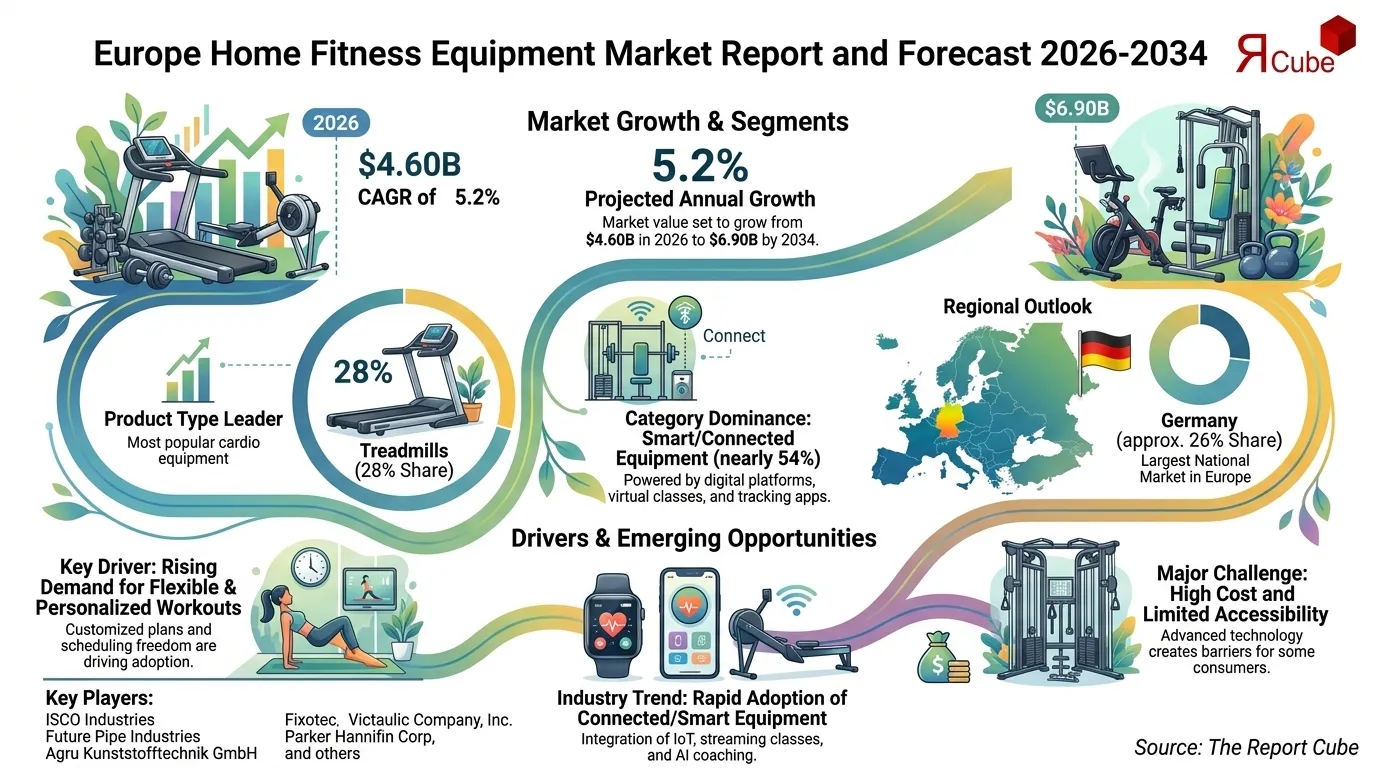
Treadmills segment leads the market with around 28% share.
By Category:
Smart/Connected Equipment segment dominates the market with nearly 54% of revenue.
Regional Outlook:
Germany region dominates the Europe Home Fitness Equipment market with approximately 26% share.
Europe Home Fitness Equipment Market Insights & Analysis
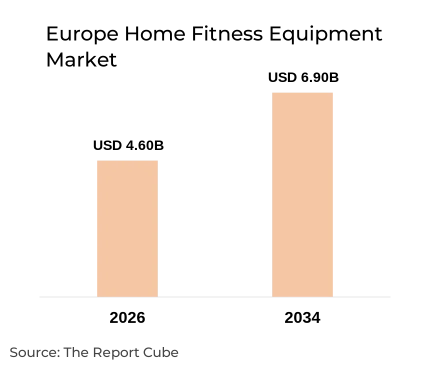
The Europe Home Fitness Equipment Market is anticipated to register a CAGR of around 5.2% during the forecast period 2026-2034. The market size is valued at USD 4.60 billion in 2026 and is projected to reach USD 6.90 billion by 2034. The market is evolving with strong consumer inclination toward flexible fitness routines, especially in urban households where gym accessibility and time constraints influence purchasing decisions. Rising health awareness across Europe has contributed to a steady increase in home-based workout adoption, supported by digital fitness ecosystems and wearable integrations.
Investment activity across Europe reflects increasing confidence in connected fitness infrastructure. In 2025, more than 35% of new product launches included app integration and performance tracking features, highlighting a shift toward personalized fitness experiences. Companies are actively collaborating with digital fitness platforms to bundle subscription-based services with equipment sales, improving customer retention rates. Additionally, government-backed health awareness campaigns across countries like Germany and the UK are encouraging physical activity at home, indirectly boosting demand. The expansion of e-commerce fitness platforms and same-day delivery services has also accelerated market penetration across both urban and semi-urban areas.
Europe Home Fitness Equipment Market Dynamics
Key Driver: Rising Demand for Flexible and Personalized Home Workouts
The increasing preference for flexible workout routines is a major factor driving the Europe Home Fitness Equipment Market. Consumers are prioritizing convenience, with over 48% of European fitness users in 2025 preferring home workouts at least three times per week. This shift is supported by changing lifestyles, remote working patterns, and limited time availability for gym visits. Home fitness equipment offers users the ability to customize workout schedules, making it a practical solution for modern consumers.
Additionally, the growing influence of digital fitness platforms has enhanced user engagement. Connected equipment allows users to access live classes, performance analytics, and personalized coaching. This integration has improved workout consistency and satisfaction levels. As a result, demand for smart treadmills, bikes, and strength systems continues to rise, contributing significantly to market growth.
Book your FREE 30-minute expert consultation today
Contact UsIndustry Trends: Rapid Adoption of Connected and Smart Fitness Equipment
The Europe Home Fitness Equipment Market is witnessing a strong trend toward connected fitness solutions. Smart equipment accounted for more than 50% of total revenue share in 2025, driven by increasing consumer interest in data-driven fitness tracking. Devices integrated with mobile applications and cloud-based platforms provide real-time feedback, improving workout effectiveness.
Another notable trend is the rise of compact and space-saving equipment designed for urban living. Manufacturers are focusing on foldable treadmills, modular strength systems, and multi-functional machines to cater to small apartments. Subscription-based fitness ecosystems are also gaining traction, where users receive continuous content updates, enhancing long-term engagement and recurring revenue streams for companies.
Major Challenge: High Cost and Limited Accessibility of Advanced Equipment
The high cost associated with advanced home fitness equipment remains a key challenge for market expansion. Smart and connected machines often require significant upfront investment, with premium products priced 30% to 50% higher than conventional alternatives. This pricing gap limits adoption among price-sensitive consumers, particularly in emerging European markets.
In addition, maintenance costs and subscription fees for digital content can increase the total cost of ownership. Consumers may hesitate to invest in high-end equipment without guaranteed long-term usage. Limited awareness in certain regions also restricts market penetration, as traditional fitness habits still dominate in some demographics.
Opportunity: Integration of Digital Fitness Ecosystems and Corporate Wellness Programs
The growing adoption of corporate wellness programs presents a significant opportunity for the Europe Home Fitness Equipment Market. Companies are increasingly offering fitness benefits to employees, including subsidized home fitness equipment and digital subscriptions. This trend is expected to expand the customer base beyond individual consumers.
Moreover, partnerships between equipment manufacturers and fitness app providers are creating new revenue streams. Bundled offerings that combine hardware with guided workouts enhance user experience and retention. The increasing focus on preventive healthcare across Europe also supports long-term demand, as individuals invest in fitness equipment to maintain overall well-being.
Europe Home Fitness Equipment Market Segment-wise Analysis
By Product Type:
- Elliptical Machines
- Rowing Machines
- Strength Training Equipment
- Stationary Cycles
- Treadmills
- Others
Treadmills lead the Europe Home Fitness Equipment Market, accounting for nearly 28% of total market share in 2025. Their dominance is driven by their versatility and suitability for all fitness levels. Consumers prefer treadmills for cardiovascular workouts due to their ease of use and effectiveness in calorie burning. The segment has also benefited from technological advancements, including smart displays, virtual running environments, and heart rate monitoring features.
Additionally, treadmill manufacturers are introducing compact and foldable designs to cater to space constraints in urban homes. Entry-level models have become more affordable, attracting first-time buyers, while premium models offer advanced features such as AI-based coaching. This balance of affordability and innovation continues to support segment growth across Europe.

By Category:
- Smart/Connected Equipment
- Conventional Equipment
Smart/Connected Equipment dominates the market with approximately 54% revenue share. The segment’s growth is fueled by increasing demand for interactive fitness experiences. Consumers are shifting toward equipment that offers real-time tracking, virtual coaching, and personalized workout plans.
Furthermore, subscription-based models have strengthened customer engagement, allowing users to access a wide range of training programs. The integration of wearable devices and mobile applications enhances performance monitoring, making connected equipment a preferred choice among tech-savvy users. This trend is expected to continue as digital fitness ecosystems expand across Europe.
Regional Projection of Europe Home Fitness Equipment Industry
- The UK
- Germany
- The Netherlands
- France
- Spain
- Italy
- Rest of Europe
Germany leads the Europe Home Fitness Equipment Market, holding around 26% market share. The country’s strong fitness culture and high disposable income levels contribute to increased spending on home fitness solutions. In 2025, over 42% of German households reported owning at least one piece of fitness equipment, reflecting widespread adoption.
The presence of leading manufacturers and well-established distribution networks further strengthens the market in Germany. Online retail channels have gained significant traction, with nearly 60% of equipment purchases made through e-commerce platforms. Additionally, government initiatives promoting active lifestyles and preventive healthcare continue to support market growth across the region.
Government Initiatives & Policies
- EU4Health Programme 2025: Supports preventive healthcare and physical activity initiatives across Europe.
- Germany National Health Promotion Strategy 2026: Encourages active lifestyles and home fitness adoption through awareness campaigns.
Europe Home Fitness Equipment Industry Recent Developments
- 2025: Decathlon SA partnered with Freeletics to co-develop over 100 fitness products by 2026, integrating digital subscriptions with equipment purchases and targeting corporate wellness programs to expand its connected fitness ecosystem.
- 2025: Life Fitness expanded its market presence following LifeFit Group’s acquisition of FIT/One, adding 210 fitness clubs and strengthening hybrid fitness models combining gym memberships with home equipment usage.
- 2025: Decathlon SA launched a new range of compact home fitness equipment, including treadmills and rowing machines, focusing on space efficiency and affordability to attract first-time buyers in urban markets.
Need insights for a specific region within this market?
Request Regional DataWhy Choose This Report?
- Provides a comprehensive overview of the overall market analysis, encompassing key trends, consumer behavior analysis, and risk assessment to support strategic decision-making.
- Provides accurate, up-to-date insights into market size, segmentation, and emerging opportunities, helping to minimize risk & capitalizing on growth.
- Gives deep understanding of target audience preferences, investment habits, and communication channels for enhanced product development & marketing effectiveness.
- Delivers competitive analysis & benchmarking, uncovering the strengths & weaknesses of market competitors to guide strategies.
- Consolidate comprehensive market intelligence, reducing reasoning & streamlining research efforts.
- Facilitates customized market segmentation & risk mitigation strategies, fine-tuned to the business objectives.
- Aids in identifying both market challenges & untapped opportunities within the industry to drive long-term business growth.
- Provides valuable information based on actual customer data & search trends.
Table of Contents
- Introduction
- Objective of the Study
- Product and Category Definition
- Market Segmentation
- Study Variables
- Research Methodology
- Secondary Data Points
- Breakdown of Secondary Sources
- Primary Data Points
- Breakdown of Primary Interviews
- Secondary Data Points
- Executive Summary
- Market Dynamics
- Drivers
- Challenges
- Opportunity Assessment
- Recent Trends and Developments
- Regulatory and Policy Landscape
- Europe Home Fitness Equipment Market Overview (2021-2034)
- Market Size, By Value (USD Billion)
- Market Share, By Product Type
- Elliptical Machines
- Rowing Machines
- Strength Training Equipment
- Free Weights
- Multi-Gyms
- Cable Machines
- Resistance Bands
- Suspension Trainers
- Stationary Cycles
- Upright Bikes
- Recumbent Bikes
- Indoor Cycling Bikes
- Treadmills
- Others
- Market Share, By Category
- Smart/Connected Equipment
- App-Integrated Cardio Equipment
- Connected Strength Systems
- Interactive Rowers and Bikes
- Subscription-Based Digital Content
- Conventional
- Non-Connected Cardio Equipment
- Traditional Strength Equipment
- Entry-Level Home Fitness Products
- Smart/Connected Equipment
- Market Share, By End User
- Female
- Male
- Market Share, By Distribution Channel
- Online Retail Stores
- Company-Owned E-Commerce
- Third-Party Marketplaces
- Specialty Fitness Platforms
- Offline Retail Stores
- Sports and Fitness Specialty Stores
- Multi-Brand Retail Chains
- Brand Showrooms
- Hypermarkets and Department Stores
- Online Retail Stores
- Market Share, By Region
- The UK
- Germany
- The Netherlands
- France
- Spain
- Italy
- Rest of Europe
- Market Share, By Company
- Revenue Shares and Analysis
- Competitive Landscape
- The UK Home Fitness Equipment Market
- Market Size, By Value (USD Billion/Million)
- Market Share, By Product Type
- Market Share, By Category
- Market Share, By End User
- Market Share, By Distribution Channel
- Germany Home Fitness Equipment Market
- Market Size, By Value (USD Billion/Million)
- Market Share, By Product Type
- Market Share, By Category
- Market Share, By End User
- Market Share, By Distribution Channel
- The Netherlands Home Fitness Equipment Market
- Market Size, By Value (USD Billion/Million)
- Market Share, By Product Type
- Market Share, By Category
- Market Share, By End User
- Market Share, By Distribution Channel
- France Home Fitness Equipment Market
- Market Size, By Value (USD Billion/Million)
- Market Share, By Product Type
- Market Share, By Category
- Market Share, By End User
- Market Share, By Distribution Channel
- Spain Home Fitness Equipment Market
- Market Size, By Value (USD Billion/Million)
- Market Share, By Product Type
- Market Share, By Category
- Market Share, By End User
- Market Share, By Distribution Channel
- Italy Home Fitness Equipment Market
- Market Size, By Value (USD Billion/Million)
- Market Share, By Product Type
- Market Share, By Category
- Market Share, By End User
- Market Share, By Distribution Channel
- Rest of Europe Home Fitness Equipment Market
- Market Size, By Value (USD Billion/Million)
- Market Share, By Product Type
- Market Share, By Category
- Market Share, By End User
- Market Share, By Distribution Channel
- Competitive Outlook and Company Profiles
- Hydrow
- Company Overview
- Product Portfolio
- Strategic Alliances/Partnerships
- Recent Developments
- Precor
- Company Overview
- Product Portfolio
- Strategic Alliances/Partnerships
- Recent Developments
- Technogym
- Company Overview
- Product Portfolio
- Strategic Alliances/Partnerships
- Recent Developments
- Volava
- Company Overview
- Product Portfolio
- Strategic Alliances/Partnerships
- Recent Developments
- Peloton Interactive, Inc.
- Company Overview
- Product Portfolio
- Strategic Alliances/Partnerships
- Recent Developments
- BH Fitness
- Company Overview
- Product Portfolio
- Strategic Alliances/Partnerships
- Recent Developments
- Hammer Sport AG
- Company Overview
- Product Portfolio
- Strategic Alliances/Partnerships
- Recent Developments
- Life Fitness
- Company Overview
- Product Portfolio
- Strategic Alliances/Partnerships
- Recent Developments
- Star Trac/Core Health & Fitness
- Company Overview
- Product Portfolio
- Strategic Alliances/Partnerships
- Recent Developments
- NOHrD/WaterRower
- Company Overview
- Product Portfolio
- Strategic Alliances/Partnerships
- Recent Developments
- Echelon Fitness
- Company Overview
- Product Portfolio
- Strategic Alliances/Partnerships
- Recent Developments
- Decathlon SA
- Company Overview
- Product Portfolio
- Strategic Alliances/Partnerships
- Recent Developments
- Sport-Tiedje GmbH
- Company Overview
- Product Portfolio
- Strategic Alliances/Partnerships
- Recent Developments
- JTX Fitness
- Company Overview
- Product Portfolio
- Strategic Alliances/Partnerships
- Recent Developments
- ICON Health & Fitness
- Company Overview
- Product Portfolio
- Strategic Alliances/Partnerships
- Recent Developments
- Tonal Systems
- Company Overview
- Product Portfolio
- Strategic Alliances/Partnerships
- Recent Developments
- True Fitness
- Company Overview
- Product Portfolio
- Strategic Alliances/Partnerships
- Recent Developments
- Nautilus Inc.
- Company Overview
- Product Portfolio
- Strategic Alliances/Partnerships
- Recent Developments
- Johnson Health Tech
- Company Overview
- Product Portfolio
- Strategic Alliances/Partnerships
- Recent Developments
- Sport-Thieme GmbH
- Company Overview
- Product Portfolio
- Strategic Alliances/Partnerships
- Recent Developments
- Others
- Hydrow
- Contact Us and Disclaimer
Top Key Players & Market Share Outlook
- ISCO Industries
- Future Pipe Industries
- Watts EMEA Holding B.V.
- Agru Kunststofftechnik GmbH
- Hayward Industries, Inc.
- Fixotec
- Victaulic Company
- Collins Companies, Inc.
- Parker Hannifin Corp
- Aquatherm
- Valex
- GF Piping Systems
- Harrington Industrial Plastics LLC
- IPEX USA LLC
- BRUGG Pipes
- Others
Frequently Asked Questions






