



Build Your Custom Market Intelligence Report
Customize Your ReportU.S. Honey Market Insights & Analysis
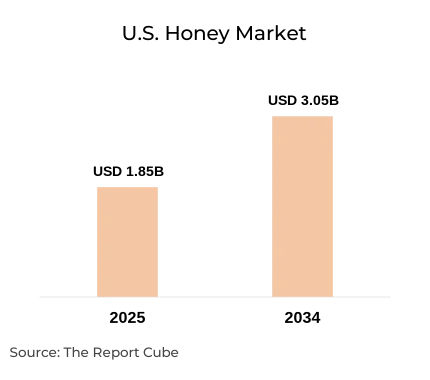
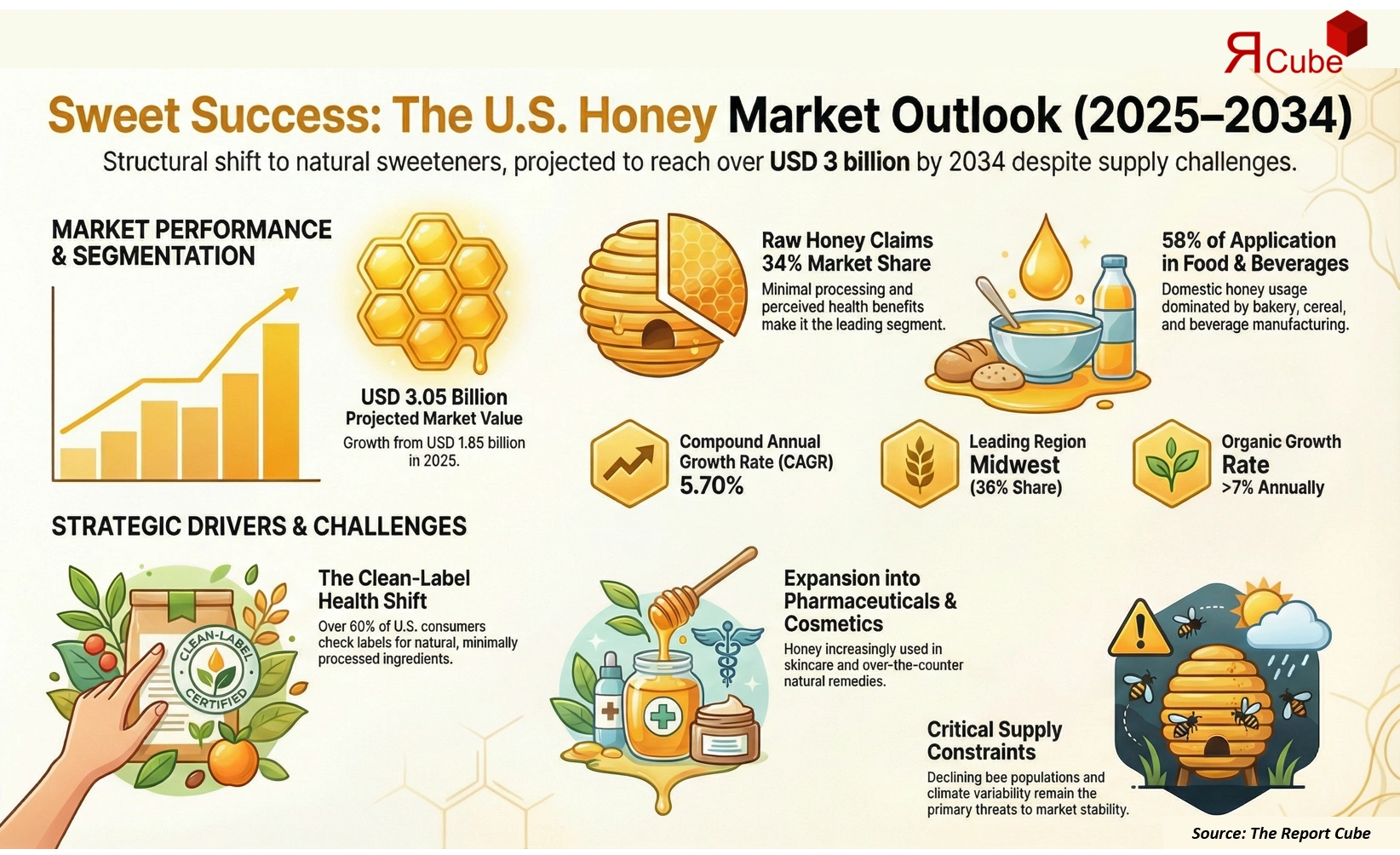
The U.S. Honey Market is anticipated to register a CAGR of 5.70% during the forecast year 2026-2034. The market size was valued at USD 1.85 billion in 2025 and is projected to reach USD 3.05 billion by 2034. This steady expansion is primarily supported by rising consumer preference for natural sweeteners, increasing awareness of honey’s functional health benefits, and growing demand across food, pharmaceutical, and personal care industries.
Honey consumption in the United States has witnessed a structural shift, moving beyond table sweeteners toward value-added and specialty varieties. Consumers are increasingly opting for raw, organic, and monofloral honey products due to their perceived immunity-boosting, antioxidant, and antimicrobial properties. This trend aligns with broader clean-label and wellness-focused consumption patterns, particularly among health-conscious millennials and aging populations managing lifestyle-related conditions.
Moreover, domestic production limitations and rising imports are reshaping supply dynamics, prompting manufacturers to focus on quality assurance, traceability, and branding. Food and beverage manufacturers are incorporating honey into bakery, beverages, cereals, and functional foods, while pharmaceutical and cosmetic companies are leveraging its therapeutic properties. These interconnected demand drivers continue to strengthen the U.S. Honey Market outlook through 2034.
U.S. Honey Market Recent Developments
- 2025: GloryBee Inc. expanded its organic honey portfolio to meet rising demand from natural food manufacturers.
- 2025: Barkman Honey LLC invested in advanced filtration and traceability systems to enhance product authenticity.
Government Initiatives & Policies
- USDA Pollinator Health Initiative: Supports beekeeping sustainability and honey production across the U.S.
- National Organic Program (NOP): Regulates organic honey certification and labeling standards.
U.S. Honey Market Dynamics
Key Driver: Rising Demand for Natural and Functional Sweeteners
The primary driver of the U.S. Honey Market is the growing consumer shift toward natural and functional sweeteners as alternatives to refined sugar and artificial additives. Increasing incidences of obesity, diabetes, and cardiovascular diseases have encouraged consumers to adopt healthier dietary choices. Honey, perceived as a natural source of energy with antioxidant and anti-inflammatory properties, fits well into this trend. In the U.S., over 60% of consumers actively check ingredient labels, favoring products with recognizable and minimally processed components. This behavior directly boosts honey usage in households and packaged foods. Additionally, the expanding popularity of functional foods and beverages fortified with natural ingredients continues to reinforce honey’s role as a preferred sweetener, driving sustained market growth.
Book your FREE 30-minute expert consultation today
Contact UsIndustry Trends: Growth of Organic and Specialty Honey Varieties
A notable trend shaping the U.S. Honey Market is the increasing demand for organic and specialty honey varieties such as clover, manuka-style blends, and infused honey. Consumers are willing to pay premium prices for traceable, ethically sourced, and organic honey products. Organic honey sales in the U.S. have grown at an estimated rate of over 7% annually since 2021, outpacing conventional honey. This trend is further supported by e-commerce platforms and specialty retail stores that provide wider access to niche honey products. Manufacturers are responding by investing in certification, transparent sourcing, and differentiated branding strategies, making specialty honey a high-growth segment within the market.
Major Challenge: Supply Constraints and Price Volatility
Despite strong demand, the U.S. Honey Market faces challenges related to supply constraints and price volatility. Declining bee populations, climate variability, and rising operational costs for beekeepers have impacted domestic honey production. These factors increase reliance on imports, exposing the market to fluctuations in global honey prices and quality concerns. Additionally, adulteration issues and regulatory scrutiny can affect consumer trust and increase compliance costs for manufacturers. Smaller producers often struggle to absorb these costs, which may limit market participation and scalability. Addressing supply sustainability remains critical to maintaining long-term market stability.
Opportunity: Expanding Applications in Pharmaceuticals and Cosmetics
The expanding use of honey in pharmaceutical and cosmetic applications presents a significant opportunity for market growth. Honey is widely recognized for its antibacterial, wound-healing, and moisturizing properties, making it a valuable ingredient in cough syrups, lozenges, skincare products, and hair care formulations. The U.S. natural cosmetics segment has grown steadily, creating demand for honey-based formulations. Pharmaceutical applications, particularly in over-the-counter remedies, further diversify revenue streams for honey producers. This cross-industry adoption enhances value addition and positions honey as a multifunctional ingredient beyond food consumption.
U.S. Honey Market Segment-wise Analysis
By Product Segment:
- Raw Honey
- Organic Honey
- Processed Honey
- Clover Honey
- Specialty Honey
Raw Honey leads the product segment, accounting for approximately 34% of the U.S. Honey Market share in 2025. Consumers prefer raw honey for its minimal processing and perceived health benefits. Organic Honey follows closely, supported by clean-label trends and premium positioning. Clover Honey remains widely consumed due to its mild flavor and versatility, while Specialty Honey is emerging rapidly as consumers explore differentiated taste profiles and functional benefits. Processed Honey continues to serve mass-market applications, particularly in food manufacturing, maintaining stable demand.
By Application:
- Food & Beverages
- Pharmaceuticals
- Cosmetics
- Others
The Food & Beverages segment dominates the market with nearly 58% share, driven by widespread use of honey in bakery, beverages, and breakfast foods. Pharmaceuticals account for around 18% share, supported by rising demand for natural remedies and immune-support products. Cosmetics represent a fast-growing segment as brands incorporate honey into natural skincare lines. Other applications, including nutraceuticals and animal feed, contribute incremental growth, enhancing overall market diversification.
Regional Projection of U.S. Honey Industry
- Midwest
- West
- South
- Northeast
The Midwest leads the U.S. Honey Market, holding approximately 36% market share due to its strong beekeeping base and large-scale honey production. States such as North Dakota and South Dakota are major contributors, benefiting from favorable forage conditions. The West follows, supported by demand from organic and specialty food manufacturers. The South shows steady growth driven by food processing industries, while the Northeast benefits from high per-capita consumption and premium product demand. The Midwest is expected to maintain its leadership through 2034, supported by production capacity and supply chain infrastructure.
Need insights for a specific region within this market?
Request Regional DataWhy Choose This Report?
- Provides a comprehensive overview of the overall market analysis, encompassing key trends, consumer behavior analysis, and risk assessment to support strategic decision-making.
- Provides accurate, up-to-date insights into market size, segmentation, and emerging opportunities, helping to minimize risk & capitalizing on growth.
- Gives deep understanding of target audience preferences, investment habits, and communication channels for enhanced product development & marketing effectiveness.
- Delivers competitive analysis & benchmarking, uncovering the strengths & weaknesses of market competitors to guide strategies.
- Consolidate comprehensive market intelligence, reducing reasoning & streamlining research efforts.
- Facilitates customized market segmentation & risk mitigation strategies, fine-tuned to the business objectives.
- Aids in identifying both market challenges & untapped opportunities within the industry to drive long-term business growth.
- Provides valuable information based on actual customer data & search trends.
Table of Contents
- Introduction
- Objective of the Study
- Product and Category Definition
- Market Segmentation
- Study Variables
- Research Methodology
- Secondary Data Points
- Breakdown of Secondary Sources
- Primary Data Points
- Breakdown of Primary Interviews
- Secondary Data Points
- Executive Summary
- Market Dynamics
- Drivers
- Challenges
- Opportunity Assessment
- Recent Trends and Developments
- Regulatory and Policy Landscape
- United States Honey Market Overview (2021-2034)
- Market Size, By Value (USD Billion)
- Market Share, By Product Segment
- Raw Honey
- Organic Honey
- Processed Honey
- Clover Honey
- Specialty Honey
- Market Share, By Application
- Food & Beverages
- Pharmaceuticals
- Cosmetics
- Others
- Market Share, By Channel Type
- Supermarkets
- Hypermarkets
- Specialty Stores
- Online Retail
- Market Share, By Pack Size
- 200-250 Gram
- 500 Gram
- Above 1 Kg
- Market Share, By Region
- Midwest
- West
- South
- Northeast
- Market Share, By Company
- Market Share, By Company
- Competition Characteristics
- Revenue Shares & Analysis
- Midwest Honey Market
- Market Size, By Value (USD Billion)
- Market Share, By Product Segment
- Market Share, By Application
- Market Share, By Channel Type
- Market Share, By Pack Size
- Market Share, By State Group
- Market Share, By Key States
- North Dakota
- South Dakota
- Minnesota
- Rest of Midwest
- West Honey Market
- Market Size, By Value (USD Billion)
- Market Share, By Product Segment
- Market Share, By Application
- Market Share, By Channel Type
- Market Share, By Pack Size
- Market Share, By State Group
- Market Share, By Key States
- California
- Washington
- Oregon
- Rest of West
- South Honey Market
- Market Size, By Value (USD Billion)
- Market Share, By Product Segment
- Market Share, By Application
- Market Share, By Channel Type
- Market Share, By Pack Size
- Market Share, By State Group
- Market Share, By Key States
- Texas
- Florida
- Georgia
- Rest of South
- Northeast Honey Market
- Market Size, By Value (USD Billion)
- Market Share, By Product Segment
- Market Share, By Application
- Market Share, By Channel Type
- Market Share, By Pack Size
- Market Share, By State Group
- Market Share, By Key States
- New York
- Pennsylvania
- Massachusetts
- Rest of Northeast
- Competitive Outlook and Company Profiles
- Comvita Limited
- Company Overview
- Product Portfolio
- Strategic Alliances/Partnerships
- Recent Developments
- Barkman Honey LLC
- Company Overview
- Product Portfolio
- Strategic Alliances/Partnerships
- Recent Developments
- Dutch Gold Honey Inc.
- Company Overview
- Product Portfolio
- Strategic Alliances/Partnerships
- Recent Developments
- Adee Honey Farms
- Company Overview
- Product Portfolio
- Strategic Alliances/Partnerships
- Recent Developments
- Sioux Honey Association
- Company Overview
- Product Portfolio
- Strategic Alliances/Partnerships
- Recent Developments
- Bee Maid Honey Ltd.
- Company Overview
- Product Portfolio
- Strategic Alliances/Partnerships
- Recent Developments
- GloryBee Inc.
- Company Overview
- Product Portfolio
- Strategic Alliances/Partnerships
- Recent Developments
- Capilano Honey Ltd.
- Company Overview
- Product Portfolio
- Strategic Alliances/Partnerships
- Recent Developments
- Rowse Honey Ltd.
- Company Overview
- Product Portfolio
- Strategic Alliances/Partnerships
- Recent Developments
- Billy Bee Honey Products
- Company Overview
- Product Portfolio
- Strategic Alliances/Partnerships
- Recent Developments
- Others
- Comvita Limited
- Contact Us and Disclaimer
Top Key Players & Market Share Outlook
- Comvita Limited
- Barkman Honey LLC
- Dutch Gold Honey Inc.
- Adee Honey Farms
- Sioux Honey Association
- Bee Maid Honey Ltd.
- GloryBee Inc.
- Capilano Honey Ltd.
- Rowse Honey Ltd.
- Billy Bee Honey Products
- Others
Frequently Asked Questions






