




Build Your Custom Market Intelligence Report
Customize Your ReportKey Takeaways
- United States Hospital at Home Programs Market valued at USD 2.51 billion in 2026, reflecting accelerating care delivery transformation.
- Market projected to reach USD 10.37 billion by 2034, expanding at a robust 19.40% CAGR.
- Market advancing at 19.40% CAGR through 2034, driven by payer adoption and federal waivers.
- Cardiovascular conditions lead the disease indication segment as the highest-volume acute care category.
- Hospitals & health systems dominate end-user procurement across the United States hospital at home landscape.
- Home health agencies & joint ventures are the fastest-growing end-user category driven by partnership models.
- DispatchHealth, Biofourmis, Amedisys (Contessa Health), and Optum are leading program operators nationally.
- Remote patient monitoring integration and value-based care incentives are fundamentally reshaping acute care delivery.
Market Overview
The United States Hospital at Home Programs Market is anticipated to register a 19.40% CAGR during 2026–2034, expanding from USD 2.51 billion in 2026 to USD 10.37 billion by 2034. A rigorous United States Hospital at Home Programs Market analysis reveals that this growth is sustained by federal policy support, chronic disease burden, rising hospital capacity constraints, and demonstrated clinical outcomes parity for acute-level home-based care delivery. CMS waivers under the Acute Hospital Care at Home initiative and bipartisan legislative efforts to extend these programs beyond their pandemic-era origins are providing the regulatory confidence needed for health systems to scale investments in technology platforms, clinical staffing, and patient logistics infrastructure.
Integrated health systems including those partnering with DispatchHealth, Biofourmis, and Amedisys (Contessa Health) are embedding hospital-at-home capabilities within broader care continuum strategies to reduce avoidable readmissions and total cost of care. The South and West regions lead adoption as high-population states pursue cost-containment strategies within their Medicaid and commercial managed care contracts. Optum and LHC Group are reinforcing market positioning through expanded service footprints, data-driven patient selection algorithms, and payer contracting that aligns reimbursement with outcomes-based performance benchmarks across acute and post-acute care pathways.
Market Size & Forecast
|
Metric |
Details |
|---|---|
|
Market Size (2026) |
USD 2.51 Billion |
|
Market Size (2034) |
USD 10.37 Billion |
|
CAGR (2026–2034) |
19.40% |
|
Base Year |
2026 |
|
Historical Years |
2021–2025 |
|
Forecast Years |
2026–2034 |
The United States Hospital at Home Programs Market size was valued at USD 2.51 billion in 2026 and is projected to reach USD 10.37 billion by 2034, growing at a 19.40% CAGR. This trajectory significantly outpaces the broader U.S. home health services sector average, driven by accelerating payer adoption of value-based acute care models, expanding CMS waiver participation among hospital networks, and rising patient preference for hospital-equivalent care delivered in home settings.
Market Dynamics
The United States Hospital at Home Programs Market is experiencing transformative expansion as health systems seek to decompress inpatient capacity, reduce per-episode costs, and align care delivery with patient-centered outcomes. Converging forces including federal reimbursement support, advanced remote monitoring technology, and insurer interest in reducing total medical expenditure are sustaining United States Hospital at Home Programs Market growth across all major U.S. regions and care indication categories.
|
Factor |
Type |
Specific Impact on Market |
Magnitude |
|---|---|---|---|
|
CMS Acute Hospital Care at Home waiver extension |
Driver |
Enables reimbursement parity for acute-level home-based care delivery |
High |
|
Hospital bed capacity constraints |
Driver |
Accelerates health system adoption of home-based acute care diversion programs |
High |
|
Reimbursement uncertainty beyond waiver periods |
Challenge |
Creates financial planning hesitancy among hospital system program operators |
Medium |
|
Remote patient monitoring technology advancement |
Opportunity |
Expands eligible patient populations and improves clinical safety monitoring |
High |
|
Payer value-based contract integration |
Trend |
Aligns financial incentives between hospitals, home health agencies, and insurers |
Medium |
- Growth Drivers - Federal Waiver Support and Capacity Pressure: The CMS Acute Hospital Care at Home initiative, extended through federal legislation, has enabled over 300 hospital systems to receive Medicare reimbursement for acute-level care delivered in patient homes. Escalating inpatient capacity constraints, particularly across high-growth Sun Belt states, are accelerating institutional investment in hospital-at-home program infrastructure and technology platforms.
- Market Restraints - Reimbursement Continuity Risk: Dependence on waiver-based reimbursement structures introduces planning uncertainty for health systems committing capital to program development. Permanent Medicare coverage pathways for hospital-at-home services remain under legislative discussion, creating financial exposure for program operators should waiver authority lapse without a durable legislative replacement or permanent CMS rulemaking.
- Market Opportunities - Remote Monitoring and Payer Partnerships: Expanding capabilities in wearable sensor technology, AI-driven vital sign monitoring, and telehealth platforms are enabling hospital-at-home programs to manage increasingly complex patient acuity profiles at home. Commercial payer interest in bundling hospital-at-home within value-based contracts creates scalable revenue diversification pathways for health systems and joint venture partners.
- Industry Challenges - Workforce and Logistics Complexity: Deploying clinical-grade acute care outside hospital walls requires specialized mobile nursing teams, rapid dispatch logistics, and 24/7 remote monitoring infrastructure. Workforce shortages in home health nursing, variable state licensure requirements, and patient home environment suitability assessments collectively constrain the speed at which health systems can scale hospital-at-home program capacity.
Need Specific Data, Let’s Customize the Report for You
Request CustomizationMarket Trends
- Emerging Trends: United States Hospital at Home Programs Market trends reflect accelerating convergence between inpatient care models and advanced home health delivery. Health systems are expanding eligible diagnosis lists beyond initial cardiovascular and respiratory conditions to include oncology infusion, post-surgical recovery, and complex infectious disease management protocols.
- Technology Trends: AI-powered predictive deterioration algorithms, continuous biometric monitoring wearables, and integrated nurse call platforms are enabling hospital-at-home programs to manage higher-acuity patients safely at home. Biofourmis and similar digital health companies are embedding machine learning models within remote monitoring platforms to generate real-time clinical alerts and automated escalation pathways for enrolled patients.
- Consumer / Buyer Trends: Patient preference for home-based acute care is strengthening as awareness of hospital-at-home programs expands. Elderly patients and caregivers increasingly prioritize recovery comfort, reduced infection exposure risk, and preserved daily routine continuity when selecting acute care settings. Health systems report measurably higher patient satisfaction scores for hospital-at-home episodes compared with equivalent traditional inpatient admissions.
- Regulatory Trends: Congressional efforts to establish permanent Medicare reimbursement for hospital-at-home services are advancing, with bipartisan support reflecting demonstrated cost savings and quality outcomes data from CMS waiver program participants. State Medicaid agencies across the South and Midwest are developing hospital-at-home coverage frameworks, while Joint Commission accreditation standards for home-based acute care programs are being formalized to support institutional compliance requirements.
United States Hospital at Home Programs Market Segment Analysis
The United States Hospital at Home Programs Market serves distinct clinical indication categories and institutional end-user types, each characterized by unique acuity requirements, reimbursement structures, technology dependencies, and program scale considerations across the national care delivery landscape.
By Disease Indication
- Cardiovascular Conditions
- Respiratory Diseases
- Infectious Diseases
- Oncology & Specialized Care
- Post-Surgical Recovery
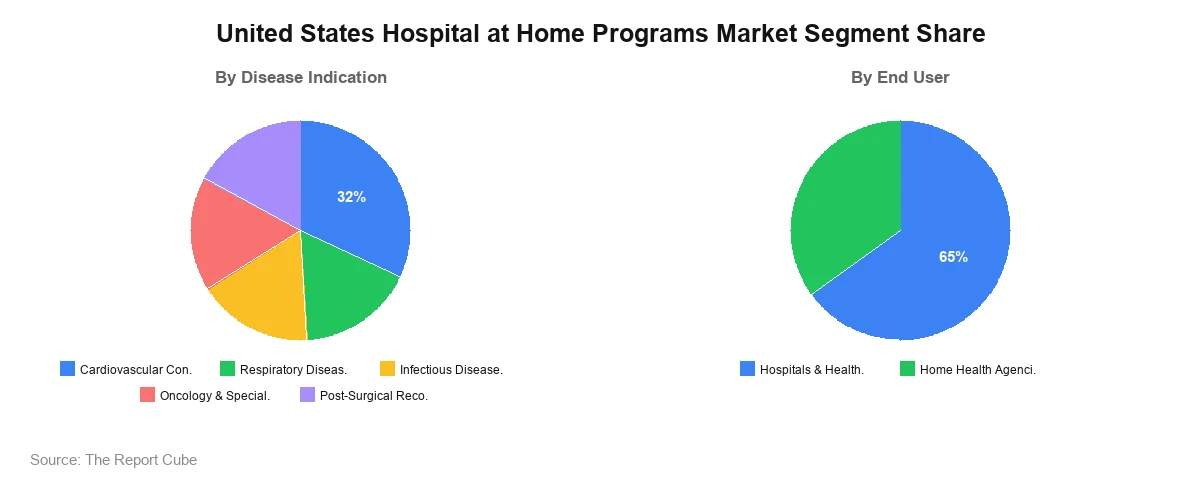
Cardiovascular conditions command the leading United States Hospital at Home Programs Market share by disease indication, accounting for an estimated 32% of total program enrollment in 2026. DispatchHealth and Amedisys (Contessa Health) operate structured hospital-at-home pathways for heart failure exacerbations, hypertensive urgency management, and post-cardiac procedure monitoring. Respiratory diseases represent approximately 25% of indication volume, with COPD exacerbation and pneumonia management programs deployed by Optum and LHC Group. Infectious diseases account for an estimated 18%, oncology and specialized care for 14%, and post-surgical recovery for the remaining 11%, with WellSky supporting care coordination technology across multiple indication pathways.
By End User
- Hospitals & Health Systems
- Home Health Agencies & Joint Ventures
Hospitals and health systems represent the dominant end-user category at an estimated 65% share of the United States Hospital at Home Programs Market in 2026. Major academic medical centers and regional health systems deploy programs in partnership with technology providers including Biofourmis and WellSky, leveraging existing clinical infrastructure and payer relationships. Home health agencies and joint ventures account for the remaining 35% and are the fastest-growing end-user category, as Amedisys (Contessa Health) and LHC Group establish joint venture structures with health systems to co-develop scalable hospital-at-home operating models and shared risk contracts with commercial and government payers.
Regional Analysis
|
Region |
Estimated Market Share |
Key Growth Factors |
Consumer Trends |
|---|---|---|---|
|
South |
34% |
Large Medicare population, rapid health system expansion, Sun Belt capacity pressures |
High chronic disease burden drives cardiovascular and respiratory program adoption |
|
West |
28% |
Technology infrastructure maturity, integrated payer-provider models, large managed care enrollment |
Strong patient preference for home-based care and digital health engagement |
|
Northeast |
22% |
Academic medical center program leadership, dense urban health system networks |
Early adopter demand for cancer and complex condition home-based management |
|
Midwest |
16% |
Rural access gap solutions, integrated delivery network investment, state Medicaid waiver activity |
Post-surgical and infectious disease home care demand in underserved geographies |
- South: Accounting for approximately 34% of national program volume, the South benefits from a large Medicare-eligible population base, significant chronic cardiovascular and respiratory disease burden, and aggressive health system investment in hospital-at-home as an inpatient diversion strategy. DispatchHealth and Optum have established strong operational footprints across Texas, Florida, and Georgia markets.
- West: The West region commands an estimated 28% share, driven by technology-forward integrated delivery networks and robust managed care infrastructure in California, Washington, and Colorado. Biofourmis and WellSky have deepened partnerships with West Coast health systems, providing advanced remote monitoring and care coordination platforms that support high-acuity patient management at home.
- Northeast: Contributing approximately 22% of market volume, the Northeast is distinguished by academic medical center program leadership, with institutions in Massachusetts, New York, and Pennsylvania pioneering hospital-at-home protocols for oncology, complex infectious disease, and post-surgical recovery indications. Regulatory engagement with state Medicaid agencies is advancing faster in this region than any other.
- Midwest: Representing an estimated 16% of the market, the Midwest's hospital-at-home adoption is driven by rural access considerations, where home-based acute care reduces the geographic burden on patients requiring hospitalization. LHC Group and Amedisys (Contessa Health) are active in developing rural-focused joint venture models with Midwest integrated delivery networks and federally qualified health center partnerships.
Market Share & Competitive Landscape
The United States Hospital at Home Programs Market competitive environment features a mix of digital health technology companies, national home health operators, and integrated payer-provider organizations competing across technology platforms, clinical program infrastructure, and payer contracting capabilities.
|
Company |
Competitive Strength |
Primary Segment Served |
|---|---|---|
|
DispatchHealth |
Nationwide mobile acute care dispatch, broad payer contracts |
Hospitals & health systems, cardiovascular and infectious disease |
|
Biofourmis |
AI-powered remote monitoring platform, predictive analytics |
Hospitals & health systems, technology infrastructure |
|
WellSky |
Care coordination software, post-acute interoperability |
Hospitals & health systems, post-surgical and oncology |
|
Amedisys (Contessa Health) |
Joint venture model expertise, value-based care contracts |
Home health agencies & joint ventures |
|
Optum (UnitedHealth Group) |
Integrated payer-provider scale, data analytics infrastructure |
Hospitals & health systems, all indication categories |
|
LHC Group |
Rural market reach, post-acute care network depth |
Home health agencies & joint ventures |
|
Others |
Regional operators, specialty program developers |
Variable by geography and clinical indication |
Key Companies in the United States Hospital at Home Programs Market
DispatchHealth
DispatchHealth, headquartered in Denver, Colorado, is a leading provider of advanced in-home medical care operating across more than 50 U.S. markets. In 2024, the company expanded its acute care capabilities by broadening payer contracts and extending its geographic reach into additional South and Midwest markets. Its 24/7 mobile clinical team model and strong multi-payer contracting position it as a structurally important operator in the United States Hospital at Home Programs Market.
Amedisys (Contessa Health)
Amedisys, headquartered in Baton Rouge, Louisiana, operates the Contessa Health hospital-at-home platform through a joint venture model that partners with health systems to co-develop and co-manage acute care programs. In 2025, Amedisys continued scaling its hospital-at-home joint venture network following UnitedHealth Group's acquisition interest, strengthening its competitive position as one of the most clinically validated and financially structured hospital-at-home operators in the United States.
Recent Developments
|
Year |
Company |
Development |
|---|---|---|
|
Jan 2025 |
DispatchHealth |
Announced expansion of hospital-at-home services into additional Midwest and South markets, broadening payer network coverage |
|
2025 |
Biofourmis |
Launched next-generation AI deterioration prediction platform for hospital-at-home programs across partner health systems |
|
2025 |
Optum (UnitedHealth Group) |
Advanced integration of hospital-at-home capabilities within value-based care contracts across multiple U.S. regions |
Future Outlook
The United States Hospital at Home Programs Market is projected to reach USD 10.37 billion by 2034, advancing at a 19.40% CAGR across the forecast period. This United States Hospital at Home Programs Market forecast reflects sustained momentum from permanent Medicare reimbursement legislation, expanding health system program adoption, and broadening clinical indication eligibility. DispatchHealth, Optum, and Biofourmis are expected to deepen market penetration through technology-led care model differentiation, national payer partnership expansion, and development of advanced patient selection algorithms that extend program eligibility to higher-acuity populations.
Technological maturation across wearable biosensor platforms, AI-assisted clinical monitoring, and integrated care coordination software will progressively lower the operational barriers to hospital-at-home program scalability. Value-based reimbursement structures will become the standard contracting mechanism as payers quantify episode-level cost savings achieved through home-based acute care substitution. Regulatory formalization of Joint Commission accreditation standards and CMS quality reporting frameworks will institutionalize hospital-at-home programs as a permanent, measurable component of the U.S. acute care delivery system through 2034.
United States Hospital at Home Programs Market Report Coverage
This United States Hospital at Home Programs Market report provides comprehensive analysis of program growth, clinical segmentation, regional adoption dynamics, competitive positioning, and regulatory evolution across the 2026–2034 forecast period.
|
Report Attribute |
Details |
|---|---|
|
Market Name |
United States Hospital at Home Programs Market |
|
Market Size (2026) |
USD 2.51 Billion |
|
Market Size (2034) |
USD 10.37 Billion |
|
Forecast Period |
2026–2034 |
|
CAGR |
19.40% |
|
Base Year |
2026 |
|
Historical Years |
2021–2025 |
|
Forecast Years |
2026–2034 |
|
Segments Covered |
By Component Type, By Service Delivery Type, By Disease Indication, By End User |
|
Regions Covered |
South, West, Northeast, Midwest |
|
Key Companies |
DispatchHealth, Biofourmis, WellSky, Amedisys (Contessa Health), Optum (UnitedHealth Group), LHC Group, Others |
|
Report Format |
PDF, Excel, PPT |
|
Customization |
Available as per client requirements |
Why Choose This United States Hospital at Home Programs Market Report?
- Comprehensive coverage of the U.S. hospital-at-home landscape across all major clinical indication categories and end-user types.
- Accurate market sizing from USD 2.51 billion in 2026 through the 2034 forecast with validated CAGR analysis.
- Detailed segmentation by disease indication and institutional end-user category with estimated share percentages.
- Regional insights across all four U.S. census regions with share estimates and key growth driver analysis.
- Competitive profiling of leading program operators including DispatchHealth, Biofourmis, Optum, and Amedisys.
- Analysis of remote monitoring technology trends and payer contracting shifts reshaping acute care delivery models.
- Forecast data supporting strategic investment, partnership planning, and payer contracting decision-making.
- Research aligned with CMS Acute Hospital Care at Home waiver program developments and emerging federal legislation.
Table of Contents
- Introduction
- Objective of the Study
- Product Definition
- Market Segmentation
- Study Variables
- Research Methodology
- Secondary Data Points
- Companies Interviewed
- Primary Data Points
- Breakdown of Primary Interviews
- Secondary Data Points
- Executive Summary
- Market Dynamics
- Drivers
- Challenges
- Opportunity Assessment
- Recent Trends and Developments
- Policy and Regulatory Landscape
- United States Hospital at Home Programs Market Overview and Forecast Analysis (2021-2034)
- Market Size, By Value, By Growth Rate (CAGR/USD Billions)
- Demand – Supply Trends
- Market Share, By Component Type
- Equipment & Devices
- Software & Services
- Market Share, By Service Delivery Type
- Skilled Nursing Services
- Physician Care Services
- Diagnostic & Monitoring Services
- Therapy Services
- Market Share, By Disease Indication
- Cardiovascular Conditions
- Respiratory Diseases
- Infectious Diseases
- Oncology & Specialized Care
- Post-Surgical Recovery
- Market Share, By End User
- Hospitals & Health Systems
- Home Health Agencies & Joint Ventures
- Market Share, By Region
- Midwest
- West
- South
- Northeast
- Market Share, By Competitors
- Competition Characteristics
- Revenue Shares
- Equipment & Devices United States Hospital at Home Programs Market Overview, 2021-2034F
- By Value (USD Million)
- By Service Delivery Type – Market Size & Forecast 2021-2034, USD Million
- Skilled Nursing Services
- Physician Care Services
- Diagnostic & Monitoring Services
- Therapy Services
- Software & Services United States Hospital at Home Programs Market Overview, 2021-2034F
- By Value (USD Million)
- By Service Delivery Type – Market Size & Forecast 2021-2034, USD Million
- Skilled Nursing Services
- Physician Care Services
- Diagnostic & Monitoring Services
- Therapy Services
- Competitive Outlook (Company Profile - Partial List)
- DispatchHealth
- Company Overview
- Business Segments
- Strategic Alliances/Partnerships
- Recent Developments
- Biofourmis
- Company Overview
- Business Segments
- Strategic Alliances/Partnerships
- Recent Developments
- WellSky
- Company Overview
- Business Segments
- Strategic Alliances/Partnerships
- Recent Developments
- Amedisys (Contessa Health)
- Company Overview
- Business Segments
- Strategic Alliances/Partnerships
- Recent Developments
- Optum (UnitedHealth Group)
- Company Overview
- Business Segments
- Strategic Alliances/Partnerships
- Recent Developments
- LHC Group
- Company Overview
- Business Segments
- Strategic Alliances/Partnerships
- Recent Developments
- Others
- DispatchHealth
- Contact Us & Disclaimer
Top Key Players & Market Share Outlook
- DispatchHealth
- Biofourmis
- WellSky
- Amedisys (Contessa Health)
- Optum (UnitedHealth Group)
- LHC Group
- Others
Frequently Asked Questions






