



Build Your Custom Market Intelligence Report
Customize Your ReportSingapore Hospital Revenue Cycle Management Market Key Highlights
By Product Type:
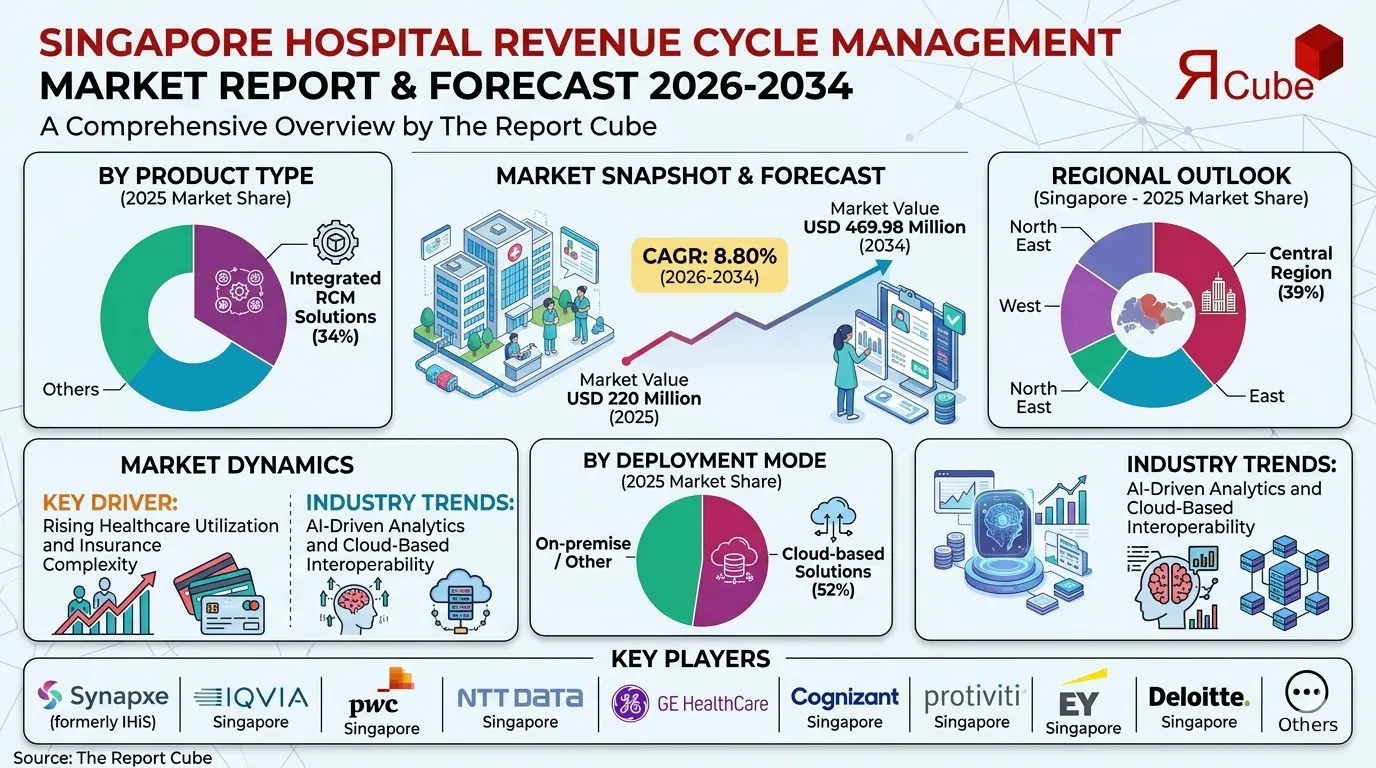
Integrated Revenue Cycle Management Solutions segment leads the market, with around 34% share.
By Deployment Mode:
Cloud-based Solutions segment dominates the market, accounting for nearly 52% of total revenue.
Regional Outlook:
Central region dominates the singapore hospital revenue cycle management market, with around 39% share.
Government Initiatives & Policies
- Singapore Health Digital Strategy 2025 (MOH & Synapxe): Expands interoperable electronic medical records, national billing data integration, and AI-enabled hospital financing frameworks to strengthen operational efficiency and revenue transparency.
- Healthcare Services (Amendment) Regulations 2025: Enhances compliance, audit traceability, and financial governance standards for public and private hospitals under MOH oversight.
Singapore Hospital Revenue Cycle Management Market Insights & Analysis
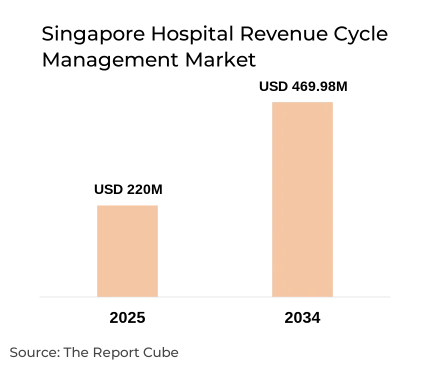
The Singapore Hospital Revenue Cycle Management Market is anticipated to register a CAGR: 8.80% during 2026-34. The market size was valued at USD 220 million in 2025 and is projected to reach USD 469.98 million by 2034. Rapid digitization of healthcare services, expanding private hospital networks, and stronger compliance frameworks are accelerating the modernization of billing, coding, and financial workflows across Singapore’s healthcare ecosystem.
Singapore’s healthcare system, anchored by a mix of public clusters and premium private hospitals, is witnessing growing patient volumes driven by aging demographics and medical tourism. Citizens aged 65 and above account for nearly 20% of the total population in 2025, increasing demand for chronic disease management and complex procedures. This surge directly affects billing complexity, insurance coordination, and claims processing volumes. Hospitals are shifting from manual coding and fragmented billing systems toward fully integrated revenue cycle platforms that connect patient registration, clinical documentation, coding, claims, and reconciliation in real time.
Additionally, national digital health transformation initiatives led by Synapxe are standardizing data exchange across institutions. Unified health data standards enhance charge capture accuracy and reduce claim denials linked to incomplete documentation. Private providers such as IHH Healthcare and Fullerton Health are investing in AI-powered diagnostics and digital front-door platforms, enabling better cost transparency and faster billing cycles. As insurers tighten reimbursement scrutiny and patients demand upfront cost estimates, hospitals are prioritizing predictive analytics and denial management tools to maintain financial sustainability. These dynamics are shaping a robust double-digit growth trajectory for revenue cycle modernization across Singapore’s hospital landscape.
Singapore Hospital Revenue Cycle Management Market Dynamics
Key Driver: Rising Healthcare Utilization and Insurance Complexity
Singapore records over 1.5 million inpatient admissions and millions of outpatient visits annually, creating significant billing transaction volumes. As integrated shield plans and corporate insurance schemes expand, hospitals must navigate multi-layer reimbursement models involving co-payments, deductibles, and government subsidies. This complexity increases the need for automated eligibility verification, pre-authorization systems, and real-time claims adjudication. Claim denial rates in manual systems can reach 8-10%, while integrated RCM platforms reduce this to below 4% through automated coding validation and documentation checks. Growing case mix complexity, especially in oncology, cardiology, and surgical specialties, further necessitates advanced analytics to ensure accurate revenue capture and compliance alignment.
Book your FREE 30-minute expert consultation today
Contact UsIndustry Trends: AI-Driven Analytics and Cloud-Based Interoperability
Cloud adoption is accelerating as hospitals seek scalable, secure, and interoperable platforms. Over 50% of new RCM deployments in 2025 are cloud-based, reflecting the need for centralized data visibility across hospital groups. AI-enabled coding tools are improving diagnostic-related group (DRG) accuracy and shortening claims submission cycles by up to 30%. Predictive denial management systems identify high-risk claims before submission, minimizing revenue leakage. Interoperable data standards such as SS719:2025 strengthen semantic alignment across EMR, billing, and insurer systems. Additionally, patient portals integrated with billing modules allow upfront cost estimates and digital payments, enhancing financial transparency and patient satisfaction.
Major Challenge: Regulatory Compliance and Data Security Pressures
Singapore’s healthcare environment operates under strict Personal Data Protection Act (PDPA) standards and Healthcare Services Act requirements. Revenue cycle systems must ensure secure data storage, encryption, and audit trails. Implementation costs for advanced compliance modules and cybersecurity safeguards can be significant, particularly for mid-sized specialty centers. Furthermore, frequent updates in reimbursement coding standards require continuous system upgrades and staff training. Workforce shortages in certified medical coders and financial analysts add operational strain. Maintaining interoperability across legacy hospital information systems also presents integration challenges, slowing transition timelines for some institutions.
Opportunity: Integrated Health Systems and Regional Medical Tourism Growth
Singapore remains a regional healthcare hub, attracting patients from Southeast Asia for complex treatments. Medical tourism contributes substantially to private hospital revenues, with international patient inflows rebounding post-2023. Integrated RCM platforms enable hospitals to manage multi-currency billing, international insurance claims, and bundled payment models efficiently. Expansion of integrated health systems combining primary care, specialty centers, and hospitals further supports unified revenue cycle ecosystems. Analytics-driven performance benchmarking tools allow hospital groups to optimize payer contracts and reduce accounts receivable days, strengthening long-term financial resilience.
Singapore Hospital Revenue Cycle Management Market Segment-wise Analysis
By Product Type:
- Integrated Revenue Cycle Management Solutions
- Standalone Billing and Claims Management
- Practice Management and Scheduling
- Patient Access and Eligibility Verification
- Accounts Receivable and Denial Management
- Analytics and Reporting Tools
- Consulting and Advisory Services
- Outsourced Revenue Cycle Management Services
Integrated Revenue Cycle Management Solutions account for approximately 34% of the market share in 2025. Hospitals increasingly prefer unified platforms that combine patient registration, charge capture, coding, claims submission, and analytics into a single architecture. These systems reduce administrative duplication and improve clean-claim rates above 96%. Public hospitals adopting integrated RCM frameworks report reductions in accounts receivable days from an average of 48 days to nearly 34 days. The scalability of integrated solutions is particularly attractive to large hospital groups operating multiple facilities across Singapore’s Central and West regions.
By Deployment Mode:
- On-premise Solutions
- Cloud-based Solutions
- Hybrid Deployment
Cloud-based solutions dominate with nearly 52% share due to flexibility, lower upfront infrastructure investment, and seamless interoperability. Hospitals transitioning to hybrid cloud architectures report up to 25% faster claims processing cycles. Cloud platforms also support AI-based analytics and real-time dashboards accessible across departments. With national interoperability standards expanding, cloud deployments provide faster integration with insurer networks and government reimbursement systems. Hybrid models remain relevant for institutions requiring localized data control while leveraging cloud-based analytics modules.
Regional Projection of Singapore Hospital Revenue Cycle Management Industry
- Central
- East
- North
- West
- Northeast
The Central region leads with approximately 39% share, driven by concentration of major tertiary hospitals, private healthcare institutions, and medical tourism facilities. High patient turnover and complex specialty services necessitate advanced revenue cycle systems. The West region follows, supported by growing residential developments and expanding integrated health campuses. Northern and Northeast regions are witnessing steady adoption due to polyclinic expansions and digital transformation initiatives. Regional infrastructure distribution directly influences transaction volumes and RCM technology investment intensity.
Singapore Hospital Revenue Cycle Management Market Recent Developments
- 2025: Synapxe introduced SS719:2025 and SS720:2025 national standards integrated into HealthX Innovation Sandbox 2.0, enhancing healthcare data interoperability and remote monitoring capabilities that strengthen billing accuracy and data-driven revenue management.
- 2025: Fullerton Health secured a 25% strategic investment from Mitsubishi Corporation to expand telemedicine and AI diagnostics, increasing digital patient touchpoints and strengthening outpatient revenue cycle scalability across Asia.
- 2025: InterSystems partnered with MyCLNQ Health to integrate InterSystems IRIS for Health platform into mobile health applications, enabling real-time billing data exchange and improved service capture for hospitals.
- 2025: IHH Healthcare completed the rollout of its Cerebral Plus (C+) EMR system across four Singapore hospitals, embedding AI-powered diagnostics to support operational excellence and financially resilient hospital operations.
Need insights for a specific region within this market?
Request Regional DataWhy Choose This Report?
- Provides a comprehensive overview of the overall market analysis, encompassing key trends, consumer behavior analysis, and risk assessment to support strategic decision-making.
- Provides accurate, up-to-date insights into market size, segmentation, and emerging opportunities, helping to minimize risk & capitalizing on growth.
- Gives deep understanding of target audience preferences, investment habits, and communication channels for enhanced product development & marketing effectiveness.
- Delivers competitive analysis & benchmarking, uncovering the strengths & weaknesses of market competitors to guide strategies.
- Consolidate comprehensive market intelligence, reducing reasoning & streamlining research efforts.
- Facilitates customized market segmentation & risk mitigation strategies, fine-tuned to the business objectives.
- Aids in identifying both market challenges & untapped opportunities within the industry to drive long-term business growth.
- Provides valuable information based on actual customer data & search trends.
Table of Contents
- Introduction
- Objective of the Study
- Product and Category Definition
- Market Segmentation
- Study Variables
- Research Methodology
- Secondary Data Points
- Breakdown of Secondary Sources
- Primary Data Points
- Breakdown of Primary Interviews
- Secondary Data Points
- Executive Summary
- Market Dynamics
- Drivers
- Challenges
- Opportunity Assessment
- Recent Trends and Developments
- Regulatory and Policy Landscape
- Singapore Hospital Revenue Cycle Management Market Overview (2021-2034)
- Market Size, By Value (USD Million)
- Market Share, By Product Type
- Integrated Revenue Cycle Management Solutions
- Standalone Billing and Claims Management
- Practice Management and Scheduling
- Patient Access and Eligibility Verification
- Accounts Receivable and Denial Management
- Analytics and Reporting Tools
- Consulting and Advisory Services
- Outsourced Revenue Cycle Management Services
- Market Share, By Deployment Mode
- On-premise Solutions
- Cloud-based Solutions
- Hybrid Deployment
- Market Share, By End User
- Public Hospitals
- Private Hospitals
- Specialty and Day Surgery Centers
- Primary Care and Polyclinics
- Integrated Health Systems and Hospital Groups
- Market Share, By Function
- Patient Registration and Pre-authorization
- Charge Capture and Coding
- Claims Submission and Processing
- Payment Posting and Reconciliation
- Denial Management and Appeals
- Audit and Compliance Management
- Performance Analytics and Benchmarking
- Market Share, By Region
- East
- North
- Northeast
- West
- Central
- Market Share, By Company
- Revenue Shares & Analysis
- Competitive Landscape
- East Singapore Hospital Revenue Cycle Management Market
- Market Size, By Value (USD Million)
- Market Share, By Product Type
- Market Share, By Deployment Mode
- Market Share, By End User
- Market Share, By Function
- North Singapore Hospital Revenue Cycle Management Market
- Market Size, By Value (USD Million)
- Market Share, By Product Type
- Market Share, By Deployment Mode
- Market Share, By End User
- Market Share, By Function
- Northeast Singapore Hospital Revenue Cycle Management Market
- Market Size, By Value (USD Million)
- Market Share, By Product Type
- Market Share, By Deployment Mode
- Market Share, By End User
- Market Share, By Function
- West Singapore Hospital Revenue Cycle Management Market
- Market Size, By Value (USD Million)
- Market Share, By Product Type
- Market Share, By Deployment Mode
- Market Share, By End User
- Market Share, By Function
- Central Singapore Hospital Revenue Cycle Management Market
- Market Size, By Value (USD Million)
- Market Share, By Product Type
- Market Share, By Deployment Mode
- Market Share, By End User
- Market Share, By Function
- Competitive Outlook and Company Profiles
- Synapxe (formerly IHiS)
- Company Overview
- Product Portfolio
- Strategic Alliances/Partnerships
- Recent Developments
- IQVIA Singapore
- Company Overview
- Product Portfolio
- Strategic Alliances/Partnerships
- Recent Developments
- PwC Singapore
- Company Overview
- Product Portfolio
- Strategic Alliances/Partnerships
- Recent Developments
- NTT DATA Singapore
- Company Overview
- Product Portfolio
- Strategic Alliances/Partnerships
- Recent Developments
- GE HealthCare
- Company Overview
- Product Portfolio
- Strategic Alliances/Partnerships
- Recent Developments
- Cognizant Singapore
- Company Overview
- Product Portfolio
- Strategic Alliances/Partnerships
- Recent Developments
- Protiviti Singapore
- Company Overview
- Product Portfolio
- Strategic Alliances/Partnerships
- Recent Developments
- EY Singapore
- Company Overview
- Product Portfolio
- Strategic Alliances/Partnerships
- Recent Developments
- Deloitte Singapore
- Company Overview
- Product Portfolio
- Strategic Alliances/Partnerships
- Recent Developments
- KPMG Singapore
- Company Overview
- Product Portfolio
- Strategic Alliances/Partnerships
- Recent Developments
- Fullerton Health
- Company Overview
- Product Portfolio
- Strategic Alliances/Partnerships
- Recent Developments
- IHH Healthcare
- Company Overview
- Product Portfolio
- Strategic Alliances/Partnerships
- Recent Developments
- Accenture Singapore
- Company Overview
- Product Portfolio
- Strategic Alliances/Partnerships
- Recent Developments
- MHC Asia Group
- Company Overview
- Product Portfolio
- Strategic Alliances/Partnerships
- Recent Developments
- Zuellig Pharma
- Company Overview
- Product Portfolio
- Strategic Alliances/Partnerships
- Recent Developments
- InterSystems
- Company Overview
- Product Portfolio
- Strategic Alliances/Partnerships
- Recent Developments
- Others
- Synapxe (formerly IHiS)
- Contact Us and Disclaimer
Top Key Players & Market Share Outlook
- Synapxe (formerly IHiS)
- IQVIA Singapore
- PwC Singapore
- NTT DATA Singapore
- GE HealthCare
- Cognizant Singapore
- Protiviti Singapore
- EY Singapore
- Deloitte Singapore
- KPMG Singapore
- Fullerton Health
- IHH Healthcare
- Accenture Singapore
- MHC Asia Group
- Zuellig Pharma
- InterSystems
Frequently Asked Questions






