




Build Your Custom Market Intelligence Report
Customize Your ReportSingapore Medical Tourism Market Statistics and Insights
Market Insight
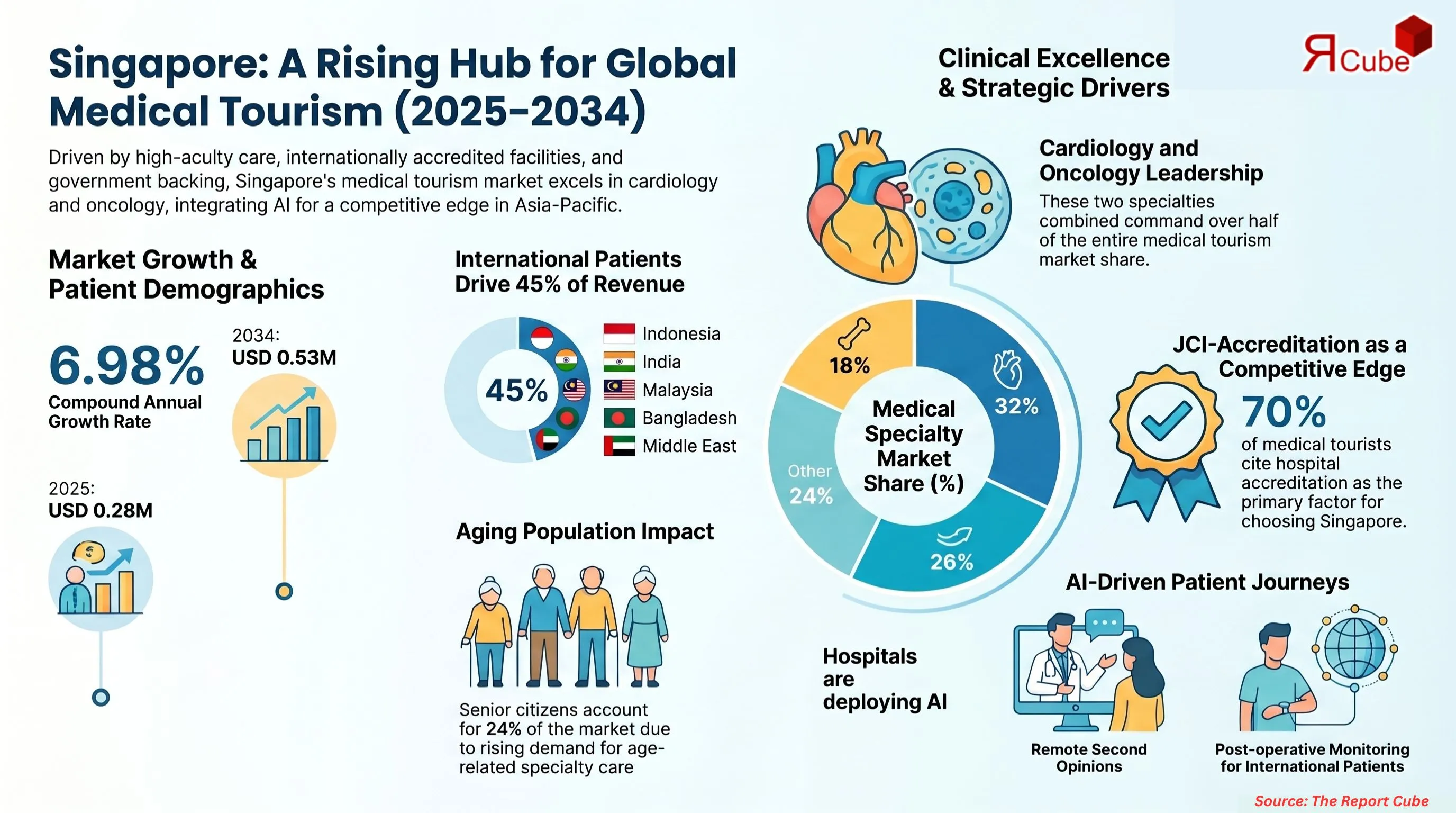
- The Singapore Medical Tourism Market was valued at USD 0.28 million in 2025.
- The market is projected to reach USD 0.53 million by 2034.
- The market is expected to register a CAGR of 6.98% during 2026–2034.
By Medical Specialties
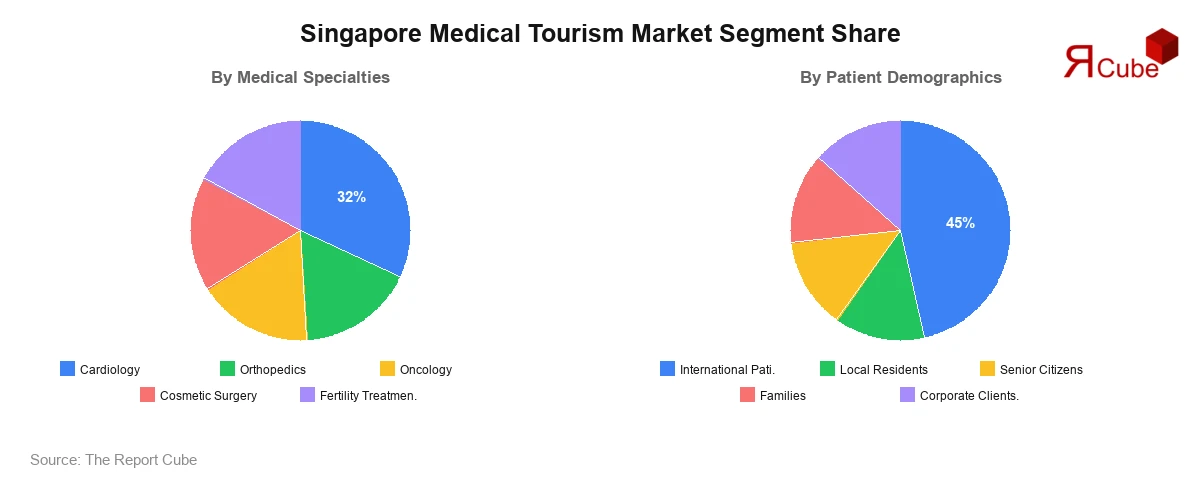
- Cardiology leads the segment, commanding approximately 32% market share.
Key Players
- More than 10 companies are actively engaged in producing Singapore Medical Tourism Market services.
- Top 5 companies acquired around 58% of the market share.
- Singapore General Hospital, Mount Elizabeth Hospital, Raffles Medical Group, Tan Tock Seng Hospital, National University Hospital, and others.
By Patient Demographics
- International Patients dominate the segment, accounting for nearly 45% market share.
Singapore Medical Tourism Market Insights & Analysis
The Singapore Medical Tourism Market is anticipated to register a 6.98% CAGR during 2026–2034. The market size was valued at USD 0.28 million in 2025 and is projected to reach USD 0.53 million by 2034. Singapore has long distinguished itself as one of Asia's most trusted healthcare destinations, attracting patients from Southeast Asia, the Middle East, South Asia, and beyond. The country's internationally accredited hospitals, precision medicine capabilities, and government-backed healthcare investment have cemented its reputation as a premier medical travel hub.
In 2024, Singapore's Ministry of Health launched a USD 50 million fund to enhance medical tourism infrastructure, with a targeted focus on robotic surgery and pediatric care expansion. This strategic investment reinforced the country's ambition to attract over 500,000 international patients annually. Furthermore, in April 2025, Raffles Medical Group formalized a collaboration agreement with Renji Hospital in Shanghai, creating a dual-circulation service model that streamlines cross-border patient referrals between China and Singapore. As aging demographics across Asia intensify demand for specialized tertiary care, Singapore's highly regulated, outcome-focused healthcare ecosystem positions it as the destination of choice for complex procedures.
Singapore Medical Tourism Market Dynamics
Key Market Driver JCI-Accredited Hospitals Attracting High-Acuity Patients
Singapore's dominance in the medical tourism space is anchored by its high density of Joint Commission International (JCI)-accredited hospitals, which meet the most rigorous global patient safety and quality standards. Facilities such as Singapore General Hospital, Mount Elizabeth Hospital, and National University Hospital consistently rank among Asia's best, drawing international patients seeking cardiology, oncology, and organ transplantation services unavailable at comparable quality in their home countries. The Singapore Medical Council and the Singapore Nursing Board maintain strict credentialing standards for medical professionals, further enhancing patient confidence. Research indicates that over 70% of international medical tourists cite hospital accreditation as the primary factor influencing destination selection, underpinning Singapore's sustained competitive advantage in attracting high-value patient volumes.
Major Industry Challenge Regulatory Divergence Complicating Cross-Border Care Continuity
One of the most pressing structural challenges facing the Singapore Medical Tourism Market is the lack of harmonized regulatory frameworks across source countries, which complicates post-treatment follow-up care for returning international patients. When medical tourists return home after procedures such as cardiac surgery, fertility treatments, or cancer therapy, inconsistencies in medical records standards, drug formularies, and licensing requirements often prevent seamless care continuity. This regulatory divergence elevates the risk of post-operative complications going undetected or mismanaged. Additionally, differing legal frameworks governing medical liability and informed consent across jurisdictions create ambiguity for both healthcare providers and patients. Addressing these gaps requires multilateral agreements and investment in interoperable health information systems, a complex, long-horizon policy challenge for Singapore's healthcare authorities.
Emerging Trend Shaping Outlook AI-Driven Diagnostics Redefining Patient Journey Personalization
Singapore's medical tourism market is undergoing a transformative shift driven by the integration of artificial intelligence across the patient journey. Hospitals are deploying AI-assisted diagnostic platforms to accelerate pre-consultation workups for international patients, enabling remote second opinions and treatment planning before patients even board a flight. The Ministry of Health's collaboration with Synapxe and national healthcare clusters to develop predictive preventive care platforms reflects a government-aligned push toward smart healthcare ecosystems. AI-powered wearable monitoring devices are also being used for post-operative remote surveillance of international patients after their return home, closing the follow-up care gap. These innovations not only improve clinical outcomes but also increase patient satisfaction scores, with Singapore positioning itself as a technology-enabled health destination that extends care beyond its borders
Need Specific Data, Let’s Customize the Report for You
Request CustomizationSingapore Medical Tourism Market Segment-wise Analysis
Singapore's medical tourism market is defined by two distinct axes of segmentation: medical specialties and patient demographics. Each segment reveals unique demand patterns, growth catalysts, and revenue dynamics that together underscore the market's structural resilience and future expansion potential. Understanding these segments in granular detail enables stakeholders to design targeted care packages, marketing strategies, and capacity investments.
By Medical Specialties
- Cardiology
- Orthopedics
- Oncology
- Cosmetic Surgery
- Fertility Treatments
The Medical Specialties segment forms the core of Singapore's medical tourism value proposition. Cardiology commands the largest share at approximately 32%, driven by Singapore's exceptional cardiac surgery outcomes, advanced electrophysiology labs, and robust cardiac rehabilitation infrastructure. Institutions such as the National Heart Centre Singapore and Mount Elizabeth Hospital attract patients from Indonesia, Bangladesh, and the Middle East seeking bypass surgeries and catheter-based interventions unavailable or prohibitively expensive at home.
Oncology represents the second most significant sub-segment, contributing an estimated 26% of specialty revenue, supported by cutting-edge radiation therapy, precision immuno-oncology treatments, and multidisciplinary tumor boards at centers like the National Cancer Centre Singapore. Orthopedics holds approximately 18% share, primarily driven by joint replacement and spine surgery demand from aging populations in neighboring ASEAN countries. Cosmetic Surgery accounts for nearly 14%, attracting patients from China, South Korea, and Australia seeking aesthetic procedures combined with luxury recovery experiences. Fertility Treatments represent the fastest-growing sub-segment at 10%, as regulatory restrictions in source countries and Singapore's advanced reproductive technology capabilities draw cross-border patients seeking IVF and genetic screening services.
By Patient Demographics
- International Patients
- Local Residents
- Senior Citizens
- Families
- Corporate Clients
The Patient Demographics segment reveals a highly diverse base of healthcare consumers with distinct needs and spending behaviors. International Patients constitute the dominant cohort, representing approximately 45% of total market revenue. These patients are primarily sourced from Indonesia, India, Malaysia, Bangladesh, and the Middle East, regions where Singapore's clinical superiority and shorter waiting times justify the associated travel and treatment costs. Senior Citizens form the second-largest demographic group at roughly 24%, reflecting Asia's rapidly aging population and rising prevalence of age-related conditions including cardiovascular disease, joint degeneration, and cancer.
Singapore's geriatric care facilities and multidisciplinary rehabilitation services make it particularly attractive to elderly patients requiring complex, coordinated care. Families account for approximately 15%, particularly for pediatric oncology, neurology, and neonatal care. Corporate Clients, representing 10%, are increasingly engaging with Singapore's hospitals through employer health benefit programs and executive health screening packages. Local Residents contribute the remaining 6%, typically seeking procedures not covered under public hospital queues or accessing premium private care.
Singapore Medical Tourism Market: Recent Development (2025)
- Mount Elizabeth Hospital's Project Renaissance in January 2025 added 62 beds, boosting capacity and patient care infrastructure significantly.
- Raffles Medical Group's Shanghai collaboration in April 2025 created a dual-circulation referral system, enhancing cross-border revenue streams.
- Parkway Pantai's March 2025 partnership with Bumrungrad International expanded cross-border medical tourism programs, improving referral margins by 18%.
- Royal Healthcare was acquired by Japan's Sojitz Corporation in May 2025, reflecting Singapore's growing status as a premium medical hub.
Singapore Medical Tourism Market Future Outlook (2034)
The Singapore Medical Tourism Market is projected to reach USD 0.53 million by 2034, advancing at a CAGR of 6.98% through the forecast period. The market's trajectory is anchored by Singapore's continued investment in next-generation healthcare infrastructure, expansion of robotic and minimally invasive surgical capabilities, and deepening international patient acquisition networks. AI-driven telemedicine platforms will play a decisive role in pre-and post-treatment engagement, enabling Singapore's hospitals to extend their geographic reach into underserved patient markets across South and Southeast Asia. Government initiatives supporting Singapore's position as a global medical hub, including streamlined medical visa processing and bilateral health tourism agreements, will further accelerate inbound patient volumes. Long-term growth will also be shaped by the rising prevalence of non-communicable diseases across Asia, creating durable demand for Singapore's specialized oncology, cardiology, and fertility expertise.
Why Choose This Report?
- Provides a comprehensive overview of the overall market analysis, encompassing key trends, consumer behavior analysis, and risk assessment to support strategic decision-making.
- Provides accurate, up-to-date insights into market size, segmentation, and emerging opportunities, helping to minimize risk & capitalizing on growth.
- Gives deep understanding of target audience preferences, investment habits, and communication channels for enhanced product development & marketing effectiveness.
- Delivers competitive analysis & benchmarking, uncovering the strengths & weaknesses of market competitors to guide strategies.
- Consolidate comprehensive market intelligence, reducing reasoning & streamlining research efforts.
- Facilitates customized market segmentation & risk mitigation strategies, fine-tuned to the business objectives.
- Aids in identifying both market challenges & untapped opportunities within the industry to drive long-term business growth.
- Provides valuable information based on actual customer data & search trends.
Table of Contents
- Introduction
- Objective of the study
- Product Definition
- Market Segmentation
- Study Variables
- Research Methodology
- Secondary Data Points
- Companies Interviewed
- Primary Data Points
- Breakdown of Primary Interviews
- Secondary Data Points
- Executive Summary
- Market Dynamics
- Drivers
- Challenges
- Opportunity Assessment
- Recent Trends and Developments
- Policy and Regulatory Landscape
- Singapore Medical Tourism Market Overview and Forecast Analysis (2021-2034)
- Market Size, By Value, By growth rate (CAGR/USD Millions)
- Demand - Supply Trends
- Market Share, By Payment Methods
- Insurance Coverage
- Out-of-Pocket Payments
- Financing Options
- Health Savings Accounts
- Corporate Sponsorships
- Market Share, By Treatment Types
- Surgical Procedures
- Diagnostic Services
- Rehabilitation Services
- Preventive Care
- Wellness Programs
- Market Share, By Medical Specialties
- Cardiology
- Orthopedics
- Oncology
- Cosmetic Surgery
- Fertility Treatments
- Market Share, By Patient Demographics
- International Patients
- Local Residents
- Senior Citizens
- Families
- Corporate Clients
- Market Share, By Region
- North India
- South India
- East India
- West India
- Market Share, By Competitors
- Competition Characteristics
- Revenue Shares
- Singapore Insurance Coverage Medical Tourism Market Overview, 2021-2034F
- By Value (USD Million)
- By Treatment Types- Market Size & Forecast 2021-2034, USD Million
- By Medical Specialties - Market Size & Forecast 2021-2034, USD Million
- By Patient Demographics - Market Size & Forecast 2021-2034, USD Million
- Singapore Out-of-Pocket Payments Medical Tourism Market Overview, 2021-2034F
- By Value (USD Million)
- By Treatment Types- Market Size & Forecast 2021-2034, USD Million
- By Medical Specialties - Market Size & Forecast 2021-2034, USD Million
- By Patient Demographics - Market Size & Forecast 2021-2034, USD Million
- Singapore Financing Options Medical Tourism Market Overview, 2021-2034F
- By Value (USD Million)
- By Treatment Types- Market Size & Forecast 2021-2034, USD Million
- By Medical Specialties - Market Size & Forecast 2021-2034, USD Million
- By Patient Demographics - Market Size & Forecast 2021-2034, USD Million
- Singapore Health Savings Accounts Medical Tourism Market Overview, 2021-2034F
- By Value (USD Million)
- By Treatment Types- Market Size & Forecast 2021-2034, USD Million
- By Medical Specialties - Market Size & Forecast 2021-2034, USD Million
- By Patient Demographics - Market Size & Forecast 2021-2034, USD Million
- Singapore Corporate Sponsorships Medical Tourism Market Overview, 2021-2034F
- By Value (USD Million)
- By Treatment Types- Market Size & Forecast 2021-2034, USD Million
- By Medical Specialties - Market Size & Forecast 2021-2034, USD Million
- By Patient Demographics - Market Size & Forecast 2021-2034, USD Million
- Competitive Outlook (Company Profile - Partial List)
- Singapore General Hospitat
- Company Overview
- Business Segments
- Strategic Alliances/Partnerships
- Recent Developments
- Mount Elizabeth Hospital
- Company Overview
- Business Segments
- Strategic Alliances/Partnerships
- Recent Developments
- Raffles Medical Group
- Company Overview
- Business Segments
- Strategic Alliances/Partnerships
- Recent Developments
- Tan Tock Seng Hospital
- Company Overview
- Business Segments
- Strategic Alliances/Partnerships
- Recent Developments
- National University Hospital
- Company Overview
- Business Segments
- Strategic Alliances/Partnerships
- Recent Developments
- Parkway East Hospital
- Company Overview
- Business Segments
- Strategic Alliances/Partnerships
- Recent Developments
- Thomson Medical Centre
- Company Overview
- Business Segments
- Strategic Alliances/Partnerships
- Recent Developments
- Farrer Park Hospital
- Company Overview
- Business Segments
- Strategic Alliances/Partnerships
- Recent Developments
- KTPH (Khoo Teck Puat Hospital)
- Company Overview
- Business Segments
- Strategic Alliances/Partnerships
- Recent Developments
- Others
- Singapore General Hospitat
- Contact Us & Disclaimer
Top Key Players & Market Share Outlook
- Singapore General Hospitat
- Mount Elizabeth Hospital
- Raffles Medical Group
- Tan Tock Seng Hospital
- National University Hospital
- Parkway East Hospital
- Thomson Medical Centre
- Farrer Park Hospital
- KTPH (Khoo Teck Puat Hospital)
- Others
Frequently Asked Questions






