


Build Your Custom Market Intelligence Report
Customize Your ReportIndia Anisole Market Overview
The India Anisole Market is shaped by demand for specialty aromatic chemicals used in fragrance formulations, pharmaceutical intermediates, agrochemicals, dyes, and other chemical synthesis applications. Anisole, also known as methoxybenzene or methyl phenyl ether, is an important chemical intermediate used in the production of perfumes, synthetic anethole, insect pheromones, and pharmaceutical compounds. India's domestic manufacturing capabilities, established specialty chemical companies, and demand from downstream formulation industries support the development of the market.
The fragrance and flavour industry represents an important demand centre because anisole is used as a starting material for fragrance-related compounds. Pharmaceutical manufacturers also use anisole as a solvent and chemical intermediate, while agrochemical and dye manufacturers use it in selected synthesis processes. The market's development is influenced by the availability and cost of phenol and other chemical inputs, production efficiency, product purity, and the ability of domestic manufacturers to meet technical specifications.
India Anisole Market Key Highlights
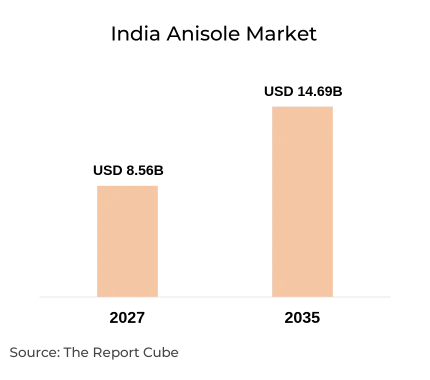
- The India Anisole Market is estimated at USD 8.56 million in 2027 and is projected to reach USD 14.69 million by 2035, based on the supplied market estimates.
- The market is projected to expand at a CAGR of approximately 6.98% during 2027–2035.
- Above 99.5% grade is estimated to account for approximately 78% of the market in 2026, reflecting the assumed importance of higher-purity anisole in specialty chemical applications.
- Perfumes and fragrances are estimated to represent approximately 43% of the market in 2026, supported by anisole's role as a precursor for fragrance-related compounds.
- Pharmaceuticals, agrochemicals, perfumes and fragrances, and dyes represent important downstream application areas for anisole.
- Clean Science and Technology Limited and Atul Limited are among the established Indian companies with publicly documented anisole manufacturing or product portfolios.
- Production efficiency, high-purity grades, raw material availability, and environmental management are important competitive factors in the Indian anisole industry.
- Regional demand is supported by India's chemical manufacturing, pharmaceutical, and fragrance-related industrial clusters, although comparable regional revenue shares are not publicly established.
India Anisole Market Outlook
The India Anisole Market is expected to experience steady growth during the forecast period, supported by demand from fragrance, pharmaceutical, agrochemical, and specialty chemical manufacturers. Anisole's role as a chemical intermediate used in the synthesis of perfumes, synthetic anethole, insect pheromones, and pharmaceutical compounds provides a diversified downstream demand base. The expansion of specialty chemical manufacturing and the increasing requirement for application-specific chemical intermediates are expected to support market development.
Higher-purity anisole is expected to remain an important product category because downstream manufacturers require consistent chemical specifications and controlled impurity levels for selected synthesis and formulation processes. Manufacturers with established production capabilities, quality assurance systems, and reliable supply relationships may benefit from demand for higher-grade products. However, the actual grade-wise revenue distribution remains dependent on end-user specifications and procurement requirements.
Government Regulations
Anisole manufacturing and handling in India operate within the country's broader chemical, environmental, workplace safety, and hazardous substance regulatory framework. Relevant legislation includes the Environment (Protection) Act, 1986, the Water (Prevention and Control of Pollution) Act, 1974, and the Air (Prevention and Control of Pollution) Act, 1981. Depending on the manufacturing process, facility characteristics, and waste streams, producers may also be subject to the Manufacture, Storage and Import of Hazardous Chemical Rules, 1989, and the Hazardous and Other Wastes (Management and Transboundary Movement) Rules, 2016. Environmental permissions, pollution-control consents, safe storage, chemical handling, and waste treatment requirements can influence plant operations and compliance expenditure. The Ministry of Environment, Forest and Climate Change identifies the principal environmental laws and the role of the Central and State Pollution Control Boards in their implementation. Manufacturers must assess the applicability of individual requirements to their facilities and processes.
India Anisole Market Dynamics
The India Anisole Market is influenced by downstream demand for fragrance ingredients, pharmaceutical intermediates, agrochemical compounds, and specialty chemicals. Manufacturing capabilities, product purity, raw material availability, and process efficiency determine the ability of suppliers to serve different end-use industries. At the same time, environmental compliance, hazardous effluent management, and competition from domestic and international producers affect manufacturing costs and market expansion. The following factors summarize the key forces influencing the industry.
| Factor | Type | Specific Impact on Market | Magnitude |
|---|---|---|---|
| Growing demand for fragrance ingredients | Growth Driver | Anisole is used as a starting material for perfumes, fragrance-related compounds, synthetic anethole, and other aroma chemicals. Demand from fragrance and personal care manufacturers supports consumption of anisole and related intermediates. | High |
| Expanding pharmaceutical and agrochemical applications | Growth Driver | Anisole serves as a chemical intermediate and solvent in selected pharmaceutical processes and is also used in agrochemical synthesis. Demand from these downstream industries provides additional consumption opportunities. | Medium to High |
| Demand for higher-purity anisole | Market Opportunity | Specialty chemical and formulation manufacturers require consistent product specifications. Suppliers capable of producing and documenting higher-purity grades may strengthen their position in specification-sensitive applications. | Medium to High |
| Efficient and cleaner manufacturing processes | Market Opportunity | Production technologies that improve material efficiency and reduce hazardous effluent generation can support operational competitiveness and help manufacturers address environmental requirements. | High |
| Raw material price volatility | Industry Challenge | Changes in phenol and other input costs can affect production economics and supplier margins. Manufacturers may face difficulties passing cost increases to customers under fixed-price or competitive procurement arrangements. | Medium to High |
| Environmental compliance and effluent management | Industry Challenge | Conventional anisole production routes can generate process-related effluents requiring appropriate treatment and disposal. Environmental permissions, pollution control infrastructure, and waste management can increase operating complexity and expenditure. | High |
Growth Drivers: Increasing Demand from Fragrance and Specialty Chemical Manufacturers
The fragrance and specialty chemical industries represent important demand sources for anisole in India. Anisole is used as a raw material in the synthesis of perfumes, fragrance compounds, synthetic anethole, and other aromatic chemicals. The Gem Aromatics prospectus identifies fragrance as the primary application area for anisole and describes its use in manufacturing fragrances, perfumes, and flavours. As manufacturers develop new fragrance formulations and expand specialty chemical production, the requirement for suitable aromatic intermediates can support anisole consumption. Domestic producers with reliable quality, consistent supply, and established customer relationships are positioned to serve this demand.
Need Specific Data, Let’s Customize the Report for You
Request CustomizationMarket Opportunities: Expansion of High-Purity Anisole Supply
Higher-purity anisole presents an opportunity for manufacturers serving specialty chemical, fragrance, and pharmaceutical customers with demanding technical specifications. Product purity, impurity control, batch consistency, and documentation can influence supplier selection in specification-sensitive applications. Manufacturers that strengthen quality control, testing capabilities, and customer-specific product development may improve their competitiveness. The supplied segmentation estimates that above 99.5% grade accounts for approximately 78% of the Indian market in 2026; however, this figure is an analyst estimate and is not supported by a publicly identified India-specific grade revenue breakdown.
Industry Challenges: Raw Material Cost Volatility and Competitive Pricing
Anisole manufacturers are exposed to fluctuations in raw material costs, particularly inputs associated with aromatic chemical production. Changes in input prices, energy costs, transportation expenses, and procurement conditions can affect production margins. Suppliers may find it difficult to transfer sudden cost increases to customers when competing against domestic manufacturers and international suppliers. Maintaining cost-efficient production, optimizing procurement, and developing long-term customer relationships are therefore important for protecting margins and maintaining market position.
Market Trends: Growing Focus on Fragrance and Aroma Chemical Intermediates
Anisole's importance as a precursor for fragrance-related compounds is influencing its position in the Indian specialty chemical value chain. The chemical is used in the production of perfumes, synthetic anethole, and other aromatic compounds. Manufacturers serving fragrance and flavour customers increasingly need dependable raw material supply and consistent product specifications. This supports opportunities for producers that can meet application requirements and maintain reliable relationships with downstream formulation companies.
India Anisole Market Segment Analysis
The India Anisole Market is segmented by grade type, application, and region. Grade type reflects the purity specifications required by downstream users, while application segmentation captures demand from pharmaceutical, agrochemical, fragrance, dye, and other chemical industries. Regional segmentation reflects the geographic distribution of chemical manufacturing and downstream industrial demand across India. The following analysis retains the supplied segmentation and identifies the leading categories using the provided 2026 analyst estimates.
By Grade Type
- Up To 99.5%
- Above 99.5%
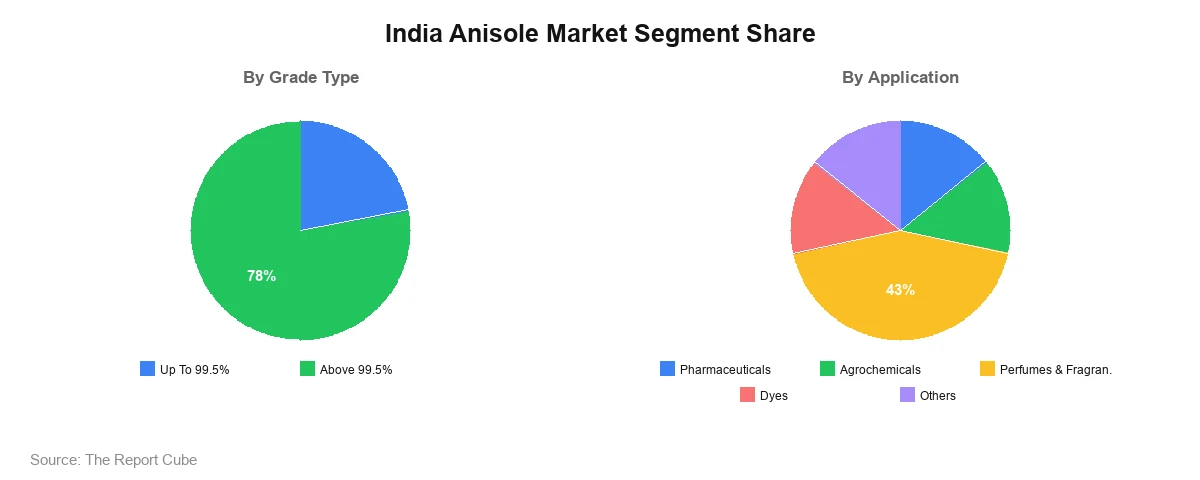
Above 99.5% grade is estimated to lead the India Anisole Market with an approximate 78% share in 2026. Higher-purity anisole is relevant for downstream manufacturers requiring controlled specifications and consistent chemical quality. Its use in selected specialty chemical, fragrance, and pharmaceutical synthesis applications can support demand for higher-purity material. The 78% share is an analyst estimate; no India-specific published grade revenue split was identified during the research.
By Application
- Pharmaceuticals
- Agrochemicals
- Perfumes & Fragrances
- Dyes
- Others
Perfumes & Fragrances are estimated to lead the India Anisole Market with an approximate 43% share in 2026. Anisole is used as a starting material for fragrance-related compounds, perfumes, and synthetic anethole. The Gem Aromatics prospectus identifies fragrance as the primary application of anisole and also describes its use in manufacturing fragrances, perfumes, flavours, pharmaceuticals, and insect pheromones. The 43% share is an analyst estimate; the prospectus's published global application categories do not directly match this India-specific application segmentation.
India Anisole Market Regional Analysis
Regional demand for anisole is influenced by the location of specialty chemical manufacturers, pharmaceutical companies, fragrance and formulation businesses, and chemical distribution networks. West India has an established chemical manufacturing base, particularly across Gujarat and Maharashtra. North and South India provide important downstream demand centres through pharmaceutical, industrial, and laboratory chemical users. East India contributes through its broader industrial and chemical consumption base. The regional analysis below is qualitative because a reliable, comparable regional anisole revenue breakdown was not identified.
| Region | Key Growth Factors | Industry Trends |
|---|---|---|
| North India | Pharmaceutical manufacturing, laboratory chemical demand, industrial users, and chemical distribution networks. | Demand for chemical intermediates and laboratory-grade materials, supported by pharmaceutical and industrial procurement. |
| South India | Pharmaceutical production, specialty chemical consumption, research facilities, and industrial formulation activities. | Greater emphasis on consistent chemical specifications, quality documentation, and dependable sourcing for downstream manufacturing. |
| East India | Industrial chemical consumption, manufacturing activity, and regional distribution networks. | Demand development through industrial users and chemical distributors, with regional consumption dependent on downstream application requirements. |
| West India | Established chemical manufacturing clusters, specialty chemical producers, industrial infrastructure, and proximity to key manufacturing and port networks. | Strong manufacturing and supply-chain presence, with opportunities in production capacity, process efficiency, and specialty chemical exports. |
India Anisole Market Competitive Landscape
The competitive landscape of the India Anisole Market includes chemical manufacturers, specialty chemical suppliers, and laboratory chemical distributors. Clean Science and Technology Limited and Atul Limited have publicly documented anisole manufacturing or product portfolios. Other companies listed in the supplied competitive set include chemical suppliers and distributors; their direct participation in commercial-scale anisole manufacturing could not be independently confirmed from the reviewed public information. Competitive positioning is influenced by production capacity, product purity, manufacturing technology, pricing, customer relationships, and supply reliability.
| Company | Competitive Strength | Primary Segment Served |
|---|---|---|
| Atul Ltd | Publicly lists anisole in its bulk chemicals portfolio and identifies its use in perfumery chemicals and as a solvent in the pharmaceutical industry. | Pharmaceutical, perfumery, and dyestuff-related chemical intermediates. |
| Clean Science and Technology Limited | Publicly identifies anisole as a product and describes its use in agrochemicals, fragrances, pharmaceuticals, and insect pheromones. The company identifies itself as a leading anisole manufacturer with two production lines. | Agrochemical, pharmaceutical, fragrance, and specialty chemical intermediates. |
| Gunjal Industries | Included in the supplied competitive set; independent public evidence confirming commercial-scale anisole manufacturing or a dedicated anisole portfolio was not established during this research. | Company-specific anisole segment participation requires verification. |
| Manas Petro Chem | Included in the supplied competitive set; direct anisole manufacturing capacity and product specifications require further verification. | Company-specific anisole segment participation requires verification. |
| Modi Chemical | Included in the supplied competitive set; publicly verifiable evidence of dedicated anisole manufacturing was not established during this research. | Company-specific anisole segment participation requires verification. |
| Stratechem (I) Pvt. Ltd. | Included in the supplied competitive set; direct anisole production and commercial supply capabilities require independent verification. | Company-specific anisole segment participation requires verification. |
| Central Drug House | Provides laboratory chemical products and has an anisole safety data sheet identifying the chemical as a laboratory and professional-use product. | Laboratory chemicals and research-use supply. |
| Otto Chemie Pvt. Ltd. | Lists anisole for synthesis with product specifications, purity information, CAS number, and multiple packaging options. | Laboratory, synthesis, and semi-bulk chemical supply. |
| Others | Other domestic and international chemical manufacturers, importers, and distributors may participate in the supply chain. Their market participation requires company- and product-level verification. | Industrial chemical supply, specialty intermediates, and distribution. |
- Clean Science and Technology Limited: Clean Science and Technology Limited is an Indian specialty chemical manufacturer with a publicly documented anisole product portfolio. The company's product information identifies anisole as a starting material for agrochemicals, flavours, and fragrance products, as well as a precursor for synthetic anethole, insect pheromones, and pharmaceuticals. The company states that it manufactures anisole through two production lines. Its portfolio across pharmaceutical, agrochemical, and specialty chemical intermediates supports its position in the domestic anisole supply chain. The Gem Aromatics prospectus also identifies Clean Science as a leading anisole manufacturer in India and globally by manufacturing capacity.
- Atul Limited: Atul Limited is an established Indian chemical manufacturer with a diversified portfolio of bulk chemicals and intermediates. Its official product information lists anisole as an ingredient used in the manufacture of perfumery chemicals and as a solvent in the pharmaceutical industry. The company also identifies anisole under its dyestuff and pharmaceutical industry applications. Its established chemical manufacturing operations and presence across multiple downstream industries support its relevance to the Indian anisole competitive landscape.
Recent Developments and Updates
- August 2025 – Gem Aromatics' public offer documentation: The company's SEBI-filed offer document provides information on the Indian anisole industry, including market estimates, manufacturing capacity, competitive positioning, and production technology. It identifies Clean Science and Technology Limited as a major Indian anisole manufacturer and describes Gem Aromatics' planned 7,000 MT anisole capacity using vapor-phase technology. The capacity disclosure should be interpreted in the context of the document's stated plans and not automatically treated as evidence that the capacity was fully commissioned.
- May 2026 – Clean Science and Technology investor discussion: During its May 14, 2026 earnings call, Clean Science and Technology discussed competition and the demand-supply environment in the anisole market. The discussion also addressed manufacturing technology, including vapor-phase production. This indicates that production efficiency, competitive capacity, and supply conditions remain relevant industry considerations.
India Anisole Market Future Outlook
The India Anisole Market is expected to maintain a positive growth trajectory through 2035, supported by demand from fragrance, pharmaceutical, agrochemical, and specialty chemical industries. The importance of anisole as a chemical intermediate for perfumes, fragrance compounds, synthetic anethole, and selected pharmaceutical and agrochemical applications provides a diversified demand base. Domestic manufacturers with established production capabilities, consistent product quality, and reliable customer relationships are expected to remain important participants in the market.
Future competitive development will depend on the ability of manufacturers to improve production efficiency, supply higher-purity grades, manage raw material costs, and comply with environmental requirements. Investments in cleaner production processes and effective effluent management may become increasingly important for maintaining operational competitiveness. Based on the supplied market estimates, the Indian anisole market is projected to increase from USD 8.56 million in 2027 to USD 14.69 million by 2035, registering a CAGR of 6.98%. These figures represent the working forecast supplied for this report and should be reconciled against the differing published market estimates before being used as independently verified industry statistics.
India Anisole Market Report Coverage
The India Anisole Market Report provides an assessment of market size, growth outlook, industry dynamics, application areas, grade categories, regional trends, and competitive positioning. The report evaluates the key factors influencing anisole demand across fragrance, pharmaceutical, agrochemical, dye, and other chemical applications. It also examines manufacturing capabilities, product quality requirements, production technology, regulatory considerations, and the competitive presence of domestic manufacturers and chemical suppliers. Market size figures and segment shares identified as analyst estimates should be interpreted separately from published company and industry disclosures.
| Parameter | Details |
|---|---|
| Market Name | India Anisole Market |
| Market Size (Base Year) | USD 8.56 million |
| Market Size (Forecast Year) | USD 14.69 million |
| CAGR | 6.98% |
| Base Year | 2026 |
| Historical Period | 2022–2026 |
| Forecast Period | 2027–2035 |
| Geographic Scope | India |
| Segmentation | By Grade Type, By Application, and By Region |
| Regions Covered | North India, South India, East India, and West India |
| Key Companies | Atul Ltd, Clean Science and Technology Limited, Gunjal Industries, Manas Petro Chem, Modi Chemical, Stratechem (I) Pvt. Ltd., Central Drug House, Otto Chemie Pvt. Ltd., and Others |
| Customization | Market sizing, grade-wise analysis, application-level demand assessment, regional analysis, competitive benchmarking, and customized research support |
Why Choose This India Anisole Market Report?
- Provides an overview of the Indian anisole industry, including market size estimates, growth outlook, and key demand factors.
- Examines grade-wise market segmentation, including up to 99.5% and above 99.5% purity categories.
- Evaluates key application areas, including pharmaceuticals, agrochemicals, perfumes and fragrances, dyes, and other uses.
- Assesses regional market conditions across North India, South India, East India, and West India.
- Identifies key growth drivers, market opportunities, industry challenges, and manufacturing trends influencing the market.
- Reviews the competitive landscape and distinguishes publicly documented anisole manufacturers from laboratory chemical suppliers and companies requiring further verification.
- Includes information on production technology, product quality, environmental compliance, and raw material considerations.
- Supports strategic planning through market segmentation, competitive assessment, and customized research opportunities.
Table of Contents
- Introduction
- Objective of the Study
- Product Definition
- Market Segmentation
- Study Variables
- Research Methodology
- Secondary Data Points
- Companies Interviewed
- Primary Data Points
- Breakdown of Primary Interviews
- Secondary Data Points
- Executive Summary
- Market Dynamics
- Drivers
- Challenges
- Opportunity Assessment
- Recent Trends and Developments
- Policy and Regulatory Landscape
- India Anisole Market Overview and Forecast Analysis (2022-2035)
- Market Size, By Value, By Growth Rate (CAGR/USD Millions)
- Demand – Supply Trends
- Market Share, By Grade Type
- Up To 99.5%
- Above 99.5%
- Market Share, By Application
- Pharmaceuticals
- Agrochemicals
- Perfumes & Fragrances
- Dyes
- Others
- Market Share, By Region
- North India
- South India
- East India
- West India
- Market Share, By Competitors
- Competition Characteristics
- Revenue Shares
- Up To 99.5% India Anisole Market Overview, 2022-2035F
- By Value (USD Million)
- By Application – Market Size & Forecast 2022-2035, USD Million
- Pharmaceuticals
- Agrochemicals
- Perfumes & Fragrances
- Dyes
- Others
- Above 99.5% India Anisole Market Overview, 2022-2035F
- By Value (USD Million)
- By Application – Market Size & Forecast 2022-2035, USD Million
- Pharmaceuticals
- Agrochemicals
- Perfumes & Fragrances
- Dyes
- Others
- Competitive Outlook (Company Profile – Partial List)
- Atul Ltd
- Company Overview
- Business Segments
- Strategic Alliances/Partnerships
- Recent Developments
- Clean Science and Technology Limited
- Company Overview
- Business Segments
- Strategic Alliances/Partnerships
- Recent Developments
- Gunjal Industries
- Company Overview
- Business Segments
- Strategic Alliances/Partnerships
- Recent Developments
- Manas Petro Chem
- Company Overview
- Business Segments
- Strategic Alliances/Partnerships
- Recent Developments
- Modi Chemical
- Company Overview
- Business Segments
- Strategic Alliances/Partnerships
- Recent Developments
- Stratechem (I) Pvt. Ltd.
- Company Overview
- Business Segments
- Strategic Alliances/Partnerships
- Recent Developments
- Central Drug House
- Company Overview
- Business Segments
- Strategic Alliances/Partnerships
- Recent Developments
- Otto Chemie Pvt. Ltd.
- Company Overview
- Business Segments
- Strategic Alliances/Partnerships
- Recent Developments
- Others
- Atul Ltd
- Contact Us & Disclaimer
Top Key Players & Market Share Outlook
- Atul Ltd
- Clean Science and Technology Limited
- Gunjal Industries
- Manas Petro Chem
- Modi Chemical
- Stratechem (I) Pvt. Ltd
- Central Drug House
- Otto Chemie Pvt. Ltd
- and others
Frequently Asked Questions