




Build Your Custom Market Intelligence Report
Customize Your ReportIndia Basmati Rice Market Insights & Analysis
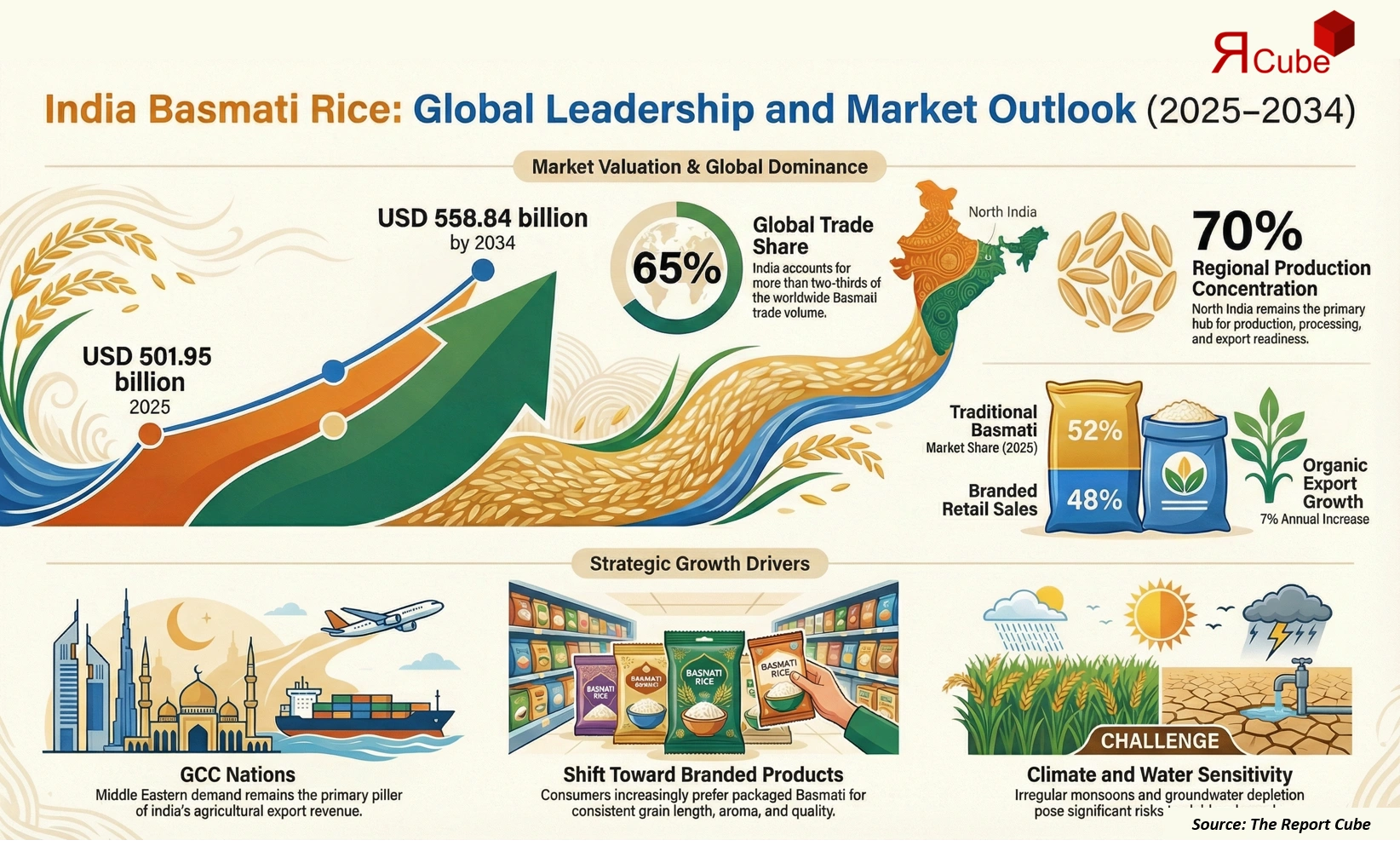
The India Basmati Rice Market is anticipated to register a CAGR of 1.20% during 2026-2034. The market size was valued at USD 501.95 billion in 2025 and is projected to reach USD 558.84 billion by 2034. India remains the global epicenter of basmati rice production and exports, accounting for more than 65% of worldwide basmati trade volume. The market’s steady growth reflects its mature nature, supported by strong international demand, especially from the Middle East, Europe, and North America, where basmati rice is positioned as a premium staple.
Domestically, rising urbanization, growing preference for aromatic long-grain rice, and increasing disposable income continue to support consistent consumption. Export performance remains a key pillar, with basmati rice contributing significantly to India’s agricultural export revenues. Government support through minimum support prices, export facilitation, and quality certification has further strengthened farmer confidence and supply stability.
Additionally, the market is witnessing gradual diversification with the introduction of improved seed varieties, organic basmati cultivation, and value-added packaging. While volume growth remains moderate, pricing stability and premium positioning ensure sustained revenue generation. Collectively, these factors underpin the India Basmati Rice Market’s resilience and long-term relevance through 2034.
India Basmati Rice Market Recent Developments
- 2025: KRBL Limited expanded its organic basmati sourcing program across Punjab and Haryana to meet export demand.
- 2025: LT Foods introduced traceability-enabled packaging for flagship basmati brands targeting European markets.
Government Initiatives & Policies
- Agricultural Export Policy: Supports basmati rice exports through infrastructure and market access initiatives.
- National Food Security Mission: Promotes productivity improvement and quality enhancement in rice cultivation.
India Basmati Rice Market Dynamics
Key Driver: Strong Export Demand for Premium Aromatic Rice
Export demand remains the primary growth driver for the India Basmati Rice Market. Indian basmati rice enjoys geographical indication protection, ensuring authenticity and premium pricing in global markets. Countries across the Gulf Cooperation Council account for nearly 55% of total basmati exports, driven by dietary preferences and large expatriate populations. Additionally, rising awareness of basmati’s nutritional benefits, including lower glycemic index and superior aroma, supports demand in developed markets. Export-oriented pricing stability also cushions farmers against domestic market fluctuations, reinforcing sustained production and supply continuity.
Book your FREE 30-minute expert consultation today
Contact UsIndustry Trends: Shift Toward Branded and Value-Added Basmati
The market is increasingly shifting from loose, unbranded rice to branded and packaged basmati products. Consumers now associate brands with consistent grain length, aroma, and cooking quality, encouraging premium purchases. Value-added trends such as aged basmati, vacuum packaging, and organic certification are gaining traction. In 2025, branded basmati accounted for nearly 48% of organized retail sales, reflecting evolving consumer trust in established players. This trend is also improving margins for manufacturers while enhancing global brand recognition for Indian exporters.
Major Challenge: Climate Variability and Water Dependency
Basmati rice cultivation is highly sensitive to climatic conditions and water availability, posing a significant challenge to market stability. Irregular monsoons, groundwater depletion in northern India, and rising input costs directly impact yield and quality. Moreover, environmental regulations restricting water-intensive crops in certain states may limit acreage expansion. These factors introduce supply-side uncertainties, potentially affecting export commitments and price stability, particularly during adverse agricultural seasons.
Opportunity: Growing Global Demand for Organic and Sustainable Rice
Organic and sustainably produced basmati rice presents a notable growth opportunity. Health-conscious consumers in Europe and North America increasingly prefer chemical-free, ethically sourced food products. Although organic basmati currently represents less than 6% of total exports, demand is rising at over 7% annually. Indian producers investing in certification, farmer training, and traceability systems can capture higher margins and long-term buyer contracts. This transition aligns well with global sustainability goals and enhances India’s competitive positioning.
India Basmati Rice Market Segment-wise Analysis
By Product:
- Traditional Basmati
- PUSA Varieties
- Parboiled Basmati
- Raw Basmati
- Organic Basmati
Traditional Basmati dominates the product segment, accounting for approximately 52% of total market share in 2025. Its superior aroma, long grain elongation, and strong acceptance in export markets sustain its leadership. PUSA varieties follow due to higher yields and adaptability, supporting supply consistency. Organic basmati, while smaller in volume, is the fastest-growing sub-segment, benefiting from premium pricing and expanding health-conscious consumer bases.
By Pack Size:
- Small Packs
- Family Packs
- Bulk Packs
Bulk packs lead the pack size segment, holding nearly 46% market share, driven primarily by export shipments and institutional buyers. Family packs are gaining popularity in urban households due to convenience and value pricing. Small packs cater to trial purchases and premium gifting, particularly in international retail. The diversification of pack sizes enables manufacturers to address varied consumption patterns across domestic and global markets.
Regional Projection of India Basmati Rice Industry
- North India
- West
- South
- East
- Central
North India dominates the India Basmati Rice Market, contributing nearly 70% of total production and revenue. States such as Punjab, Haryana, and western Uttar Pradesh benefit from suitable agro-climatic conditions, established irrigation infrastructure, and farmer expertise. The region also hosts major milling and processing facilities, ensuring quality consistency and export readiness. While North India leads, western and southern regions are gradually adopting basmati cultivation on a limited scale, supporting incremental supply diversification.
Need insights for a specific region within this market?
Request Regional DataWhy Choose This Report?
- Provides a comprehensive overview of the overall market analysis, encompassing key trends, consumer behavior analysis, and risk assessment to support strategic decision-making.
- Provides accurate, up-to-date insights into market size, segmentation, and emerging opportunities, helping to minimize risk & capitalizing on growth.
- Gives deep understanding of target audience preferences, investment habits, and communication channels for enhanced product development & marketing effectiveness.
- Delivers competitive analysis & benchmarking, uncovering the strengths & weaknesses of market competitors to guide strategies.
- Consolidate comprehensive market intelligence, reducing reasoning & streamlining research efforts.
- Facilitates customized market segmentation & risk mitigation strategies, fine-tuned to the business objectives.
- Aids in identifying both market challenges & untapped opportunities within the industry to drive long-term business growth.
- Provides valuable information based on actual customer data & search trends.
Table of Contents
- Introduction
- Objective of the Study
- Product and Category Definition
- Market Segmentation
- Study Variables
- Research Methodology
- Secondary Data Points
- Breakdown of Secondary Sources
- Primary Data Points
- Breakdown of Primary Interviews
- Secondary Data Points
- Executive Summary
- Market Dynamics
- Drivers
- Challenges
- Opportunity Assessment
- Recent Trends and Developments
- Regulatory and Policy Landscape
- India Basmati Rice Market Overview (2020-2034)
- Market Size, By Value (INR Billion)
- Market Share, By Product
- Traditional Basmati
- PUSA Varieties
- Parboiled Basmati
- Raw Basmati
- Organic Basmati
- Market Share, By Pack Size
- Small Packs
- Family Packs
- Bulk Packs
- Market Share, By End Use
- Household Use
- HoReCa Sector
- Industrial Use
- Market Share, By Distribution
- Traditional Retail
- Modern Trade
- Online Channels
- Market Share, By Region
- North India
- West
- South
- East
- Central
- Market Share, By Company
- Revenue Shares
- Competitive Landscape
- North India Basmati Rice Market
- Market Size, By Value (INR Billion)
- Market Share, By Product
- Market Share, By Pack Size
- Market Share, By End Use
- Market Share, By Distribution
- West India Basmati Rice Market
- Market Size, By Value (INR Billion)
- Market Share, By Product
- Market Share, By Pack Size
- Market Share, By End Use
- Market Share, By Distribution
- South India Basmati Rice Market
- Market Size, By Value (INR Billion)
- Market Share, By Product
- Market Share, By Pack Size
- Market Share, By End Use
- Market Share, By Distribution
- East India Basmati Rice Market
- Market Size, By Value (INR Billion)
- Market Share, By Product
- Market Share, By Pack Size
- Market Share, By End Use
- Market Share, By Distribution
- Central India Basmati Rice Market
- Market Size, By Value (INR Billion)
- Market Share, By Product
- Market Share, By Pack Size
- Market Share, By End Use
- Market Share, By Distribution
- Competitive Outlook and Company Profiles
- KRBL Limited
- Company Overview
- Product Portfolio
- Strategic Alliances/Partnerships
- Recent Developments
- LT Foods
- Company Overview
- Product Portfolio
- Strategic Alliances/Partnerships
- Recent Developments
- Chaman Lal Setia
- Company Overview
- Product Portfolio
- Strategic Alliances/Partnerships
- Recent Developments
- Kohinoor Foods
- Company Overview
- Product Portfolio
- Strategic Alliances/Partnerships
- Recent Developments
- India Gate Foods
- Company Overview
- Product Portfolio
- Strategic Alliances/Partnerships
- Recent Developments
- Amira Nature Foods
- Company Overview
- Product Portfolio
- Strategic Alliances/Partnerships
- Recent Developments
- Supple Tek
- Company Overview
- Product Portfolio
- Strategic Alliances/Partnerships
- Recent Developments
- Shri Lal Mahal
- Company Overview
- Product Portfolio
- Strategic Alliances/Partnerships
- Recent Developments
- Olam Agri India
- Company Overview
- Product Portfolio
- Strategic Alliances/Partnerships
- Recent Developments
- Patanjali Foods
- Company Overview
- Product Portfolio
- Strategic Alliances/Partnerships
- Recent Developments
- Others
- KRBL Limited
- Contact Us and Disclaimer
Top Key Players & Market Share Outlook
- KRBL Limited
- LT Foods
- Chaman Lal Setia
- Kohinoor Foods
- India Gate Foods
- Amira Nature Foods
- Supple Tek
- Shri Lal Mahal
- Olam Agri India
- Patanjali Foods
- Others
Frequently Asked Questions






