




Build Your Custom Market Intelligence Report
Customize Your ReportWhat Is the Indonesia Ice Cream Market Size & Value?
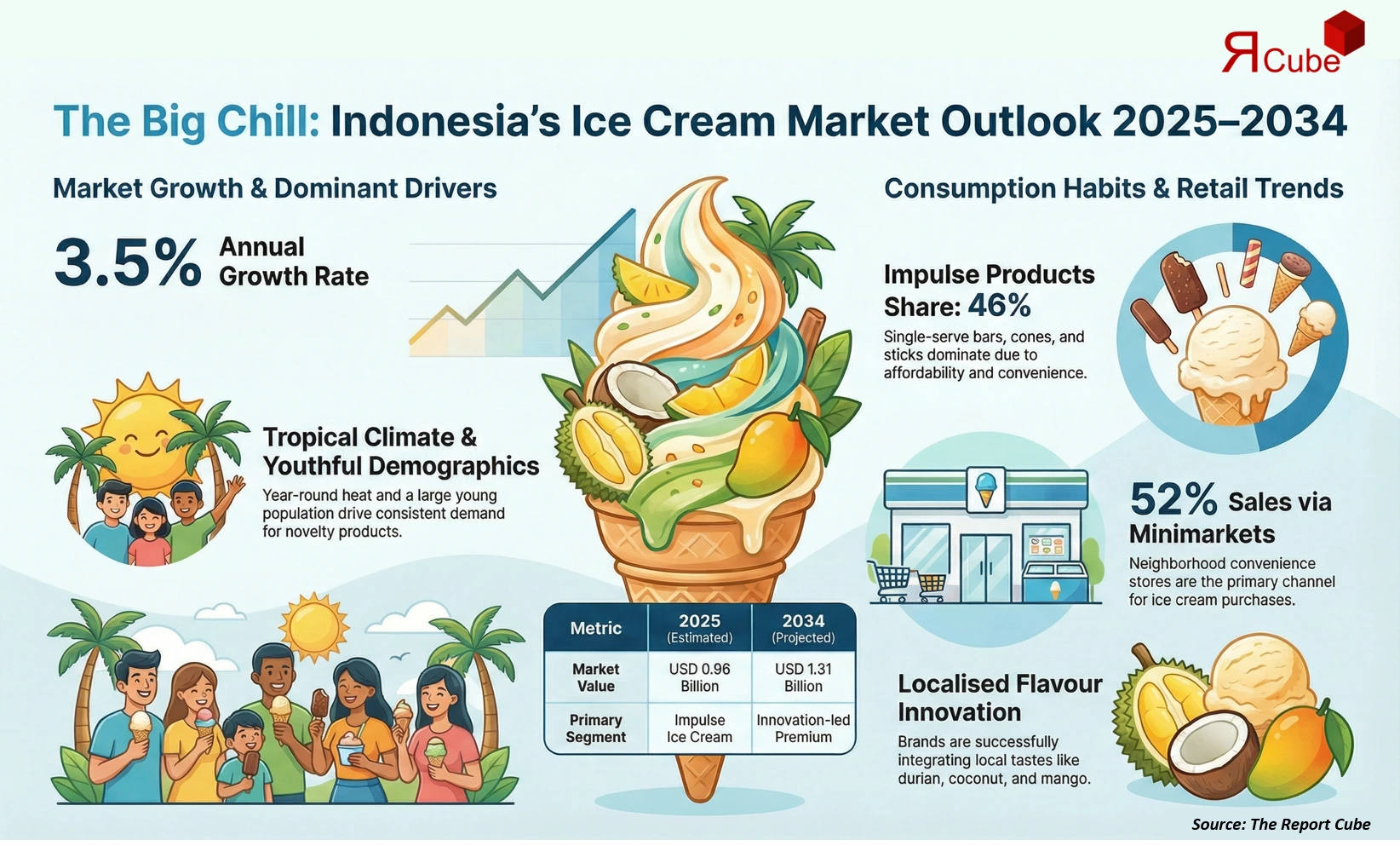
The Indonesia Ice Cream Market is anticipated to register a 3.5% CAGR during 2026–2034. The market size was valued at USD 0.96 Billion in 2025 and is projected to reach USD 1.31 Billion by 2034. Rising urbanization, a large young population, and increasing disposable income are supporting steady growth in ice cream consumption. Tropical climate conditions enable year-round demand, while expanding modern retail, convenience stores, and on-the-go consumption formats continue to improve product accessibility across urban and semi-urban regions.
Indonesia Ice Cream Market Key Highlights
- Tropical climate supports consistent year-round ice cream consumption across regions
- Youthful population drives strong demand for impulse and novelty ice cream products
- Opportunity emerges from premium, health-oriented, and locally inspired flavor innovation
- Leading segments include impulse ice cream, take-home packs, and frozen novelties
- Java dominates consumption due to population density and retail penetration
- Government of Indonesia supports food manufacturing, cold-chain, and retail expansion
Indonesia Ice Cream Market Dynamics
Key Market Driver: Hot Climate and Expanding Middle-Class Consumption
Indonesia’s warm climate is a fundamental driver of ice cream demand, making frozen desserts a regular indulgence rather than a seasonal product. Rising middle-class income levels and urban lifestyles are encouraging higher spending on branded food products, including ice cream. Increased availability through minimarkets, supermarkets, and street-level retail outlets is further strengthening impulse purchases, particularly among children and young adults.
Major Industry Challenge: Cold-Chain Infrastructure and Price Sensitivity
Maintaining cold-chain integrity across Indonesia’s vast archipelago presents logistical and cost challenges. Energy costs, transportation complexity, and storage limitations can affect product quality and distribution reach, especially in remote regions. Additionally, price sensitivity among lower-income consumers limits rapid premium product adoption, requiring manufacturers to balance affordability with innovation.
Emerging Trend Shaping Outlook: Premiumization and Local Flavor Innovation
The market is witnessing gradual premiumization, with consumers showing interest in higher-quality ingredients, unique textures, and indulgent formats. At the same time, manufacturers are innovating with local flavors such as coconut, durian, mango, and traditional desserts to appeal to regional tastes. Smaller pack sizes and affordable price points are helping brands expand penetration while testing premium concepts.
Book your FREE 30-minute expert consultation today
Contact UsIndonesia Ice Cream Industry Analysis 2026–2034
The Indonesia ice cream industry includes impulse products, take-home tubs, frozen novelties, and family packs sold through retail and foodservice channels. Growth is driven by population expansion, retail modernization, and strong brand recognition among leading players. Profitability is highest in impulse and novelty segments due to high turnover and frequent purchases. The industry is closely linked to dairy processing, food manufacturing, cold-chain logistics, and retail distribution. Sales channels include minimarkets, supermarkets, convenience stores, traditional kiosks, and online grocery platforms. During 2024–2025, manufacturers focused on expanding distribution coverage, introducing new flavors, and improving packaging efficiency to support mass-market growth.
How Are the Indonesia Ice Cream Market Segments Defined?
Market segmentation highlights product formats and distribution reach, enabling stakeholders to assess consumption behavior and growth opportunities.
By Product Type
- Impulse Ice Cream
- Take-Home Ice Cream
- Frozen Novelties
- Premium and Artisanal Ice Cream
Impulse ice cream leads the market with approximately 46 percent share due to affordability and wide retail availability. Take-home ice cream accounts for nearly 29 percent, supported by household consumption and family-oriented purchasing patterns.
By Distribution Channel
- Minimarkets and Convenience Stores
- Supermarkets and Hypermarkets
- Traditional Retail and Kiosks
- Online Grocery Platforms
Minimarkets and convenience stores dominate with around 52 percent share, reflecting Indonesia’s dense neighborhood retail network and impulse-driven purchasing behavior.
Indonesia Ice Cream Industry: Country Insights
Indonesia is one of Southeast Asia’s fastest-growing ice cream markets, with Java accounting for nearly 65 percent of total consumption due to high population density, urbanization, and retail infrastructure. Greater Jakarta, West Java, and East Java lead demand, while other islands are gradually expanding through improved cold-chain and retail investments.
Indonesia Ice Cream Market: Recent Innovations (2025)
- Unilever Indonesia expanded Wall’s impulse and family-pack portfolios with locally inspired flavors
- Aice Group Holdings introduced affordable novelty ice cream products targeting mass-market consumers
Government Initiatives and Programs (2025)
- Government of Indonesia supported cold-chain logistics development for food and beverage distribution
- Authorities strengthened food safety, labeling, and quality compliance standards for frozen products
Indonesia Ice Cream Market Future Outlook (2034)
By 2034, the Indonesia Ice Cream Market is expected to reach USD 1.31 Billion, growing at a 3.5% CAGR. Market expansion will be driven by population growth, urban retail penetration, and product innovation. Technology advancement in cold-chain management, packaging efficiency, and flavor development will enhance distribution reach and product quality. Future growth will favor brands offering affordable, innovative, and locally relevant Indonesia ice cream products aligned with evolving consumer preferences.
Top Companies in Indonesia Ice Cream Market
Ask Our Lead Analyst a Question About This Report
Contact UsWhy Choose This Report?
- Provides a comprehensive overview of the overall market analysis, encompassing key trends, consumer behavior analysis, and risk assessment
- Provides accurate, up-to-date insights into market size, segmentation, and emerging opportunities
- Gives deep understanding of target audience preferences and communication channels
- Delivers competitive analysis and benchmarking to guide strategy development
- Consolidates comprehensive market intelligence, reducing research effort
- Facilitates customized market segmentation and risk mitigation strategies
- Identifies market challenges and untapped opportunities
- Provides insights based on actual customer data and search trends
Table of Contents
- Introduction
- Objective of the Study
- Product Definition
- Market Segmentation
- Study Variables
- Research Methodology
- Secondary Data Points
- Companies Interviewed
- Primary Data Points
- Break Down of Primary Interviews
- Secondary Data Points
- Executive Summary
- Market Dynamics
- Drivers
- Challenges
- Opportunity Assessment
- Recent Trends and Developments
- Policy and Regulatory Landscape
- Indonesia Ice Cream Market Overview
- Market Size, By Value (USD Million)
- Market Share, By Product Type
- Impulse ice cream (single-serve: bars, cones, cups, sticks)
- Take-home/bulk ice cream (tubs, pints, multi-packs)
- Artisanal ice cream (premium, small-batch)
- Market Share, By Category
- Dairy
- Non-dairy (including plant-based)
- Market Share, By Flavor
- Vanilla
- Chocolate
- Fruit
- Local/Exotic Flavors
- Others
- Market Share, By Distribution Channel
- Supermarkets and hypermarkets
- Convenience stores
- Ice cream parlors
- Online stores
- Specialist stores
- Market Share, By Region
- Java
- Sumatra
- Kalimantan
- Sulawesi
- Others (Papua and other islands)
- Market Share, By Company
- Revenue Shares
- Competition Characteristics
- Competitive Outlook (Company Profiles)
- Unilever Indonesia (Wall's)
- Company Overview
- Business Segments
- Strategic Alliances/Partnerships
- Recent Developments
- PT Campina Ice Cream Industry Tbk
- Company Overview
- Business Segments
- Strategic Alliances/Partnerships
- Recent Developments
- Aice Group Holdings
- Company Overview
- Business Segments
- Strategic Alliances/Partnerships
- Recent Developments
- Nestlé Indonesia
- Company Overview
- Business Segments
- Strategic Alliances/Partnerships
- Recent Developments
- Indoeskrim
- Company Overview
- Business Segments
- Strategic Alliances/Partnerships
- Recent Developments
- PT Diamond Cold Storage
- Company Overview
- Business Segments
- Strategic Alliances/Partnerships
- Recent Developments
- PT United Family Food
- Company Overview
- Business Segments
- Strategic Alliances/Partnerships
- Recent Developments
- PT Glico Wings (part of Ezaki Glico, Japan)
- Company Overview
- Business Segments
- Strategic Alliances/Partnerships
- Recent Developments
- PT Green Asia Food Indonesia (Joyday brand)
- Company Overview
- Business Segments
- Strategic Alliances/Partnerships
- Recent Developments
- Others
- Unilever Indonesia (Wall's)
- Contact Us & Disclaimer
Top Key Players & Market Share Outlook
- Unilever Indonesia (Wall's)
- PT Campina Ice Cream Industry Tbk
- Aice Group Holdings
- Nestlé Indonesia
- Indoeskrim
- PT Diamond Cold Storage
- PT United Family Food
- PT Glico Wings (part of Ezaki Glico, Japan)
- PT Green Asia Food Indonesia (Joyday brand)
- Others
Frequently Asked Questions






