



Build Your Custom Market Intelligence Report
Customize Your ReportSouth Korea Inertial Navigation Systems Market Key Highlights
By Application:
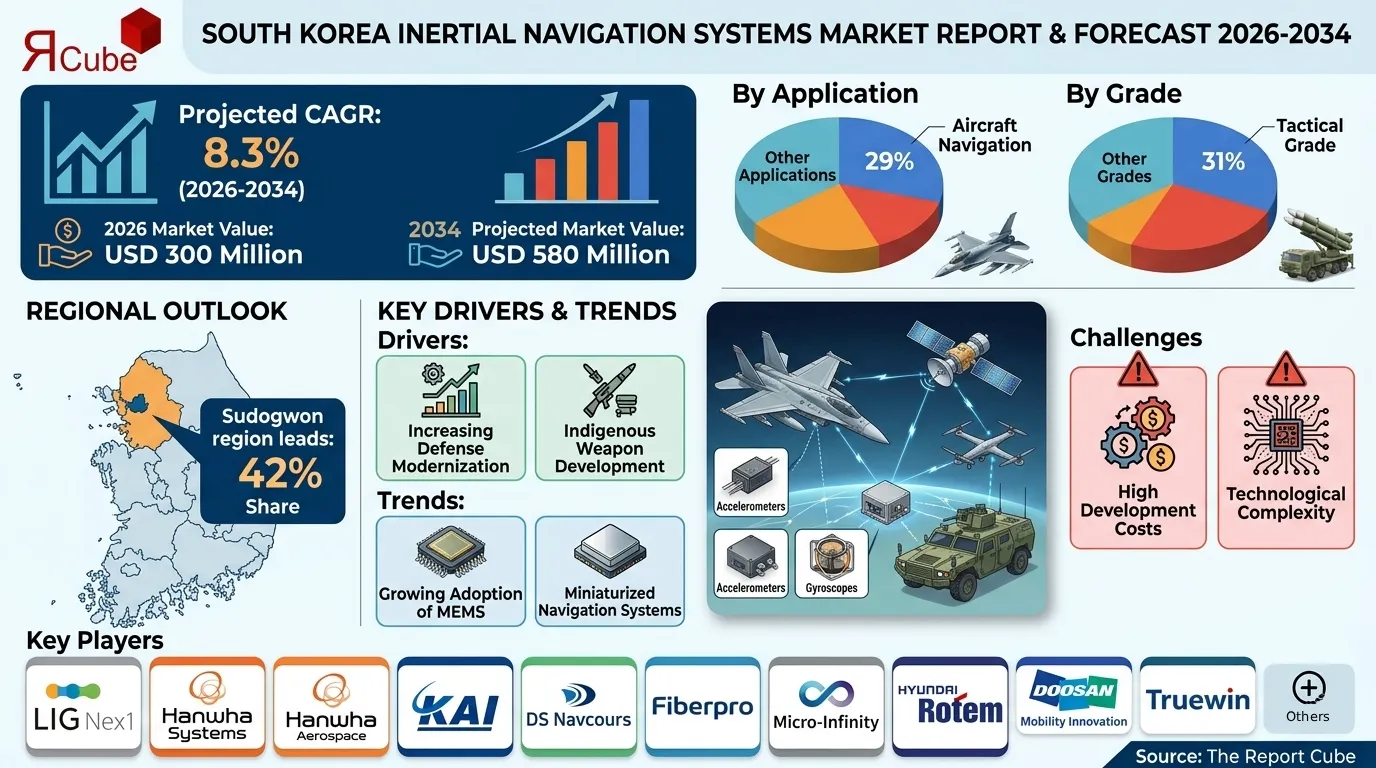
Aircraft Navigation segment leads the market with around 29% share.
By Grade:
Tactical Grade segment dominates the market with nearly 31% of revenue.
Regional Outlook:
Sudogwon region dominates the South Korea Inertial Navigation Systems market with approximately 42% share.
South Korea Inertial Navigation Systems Market Insights & Analysis
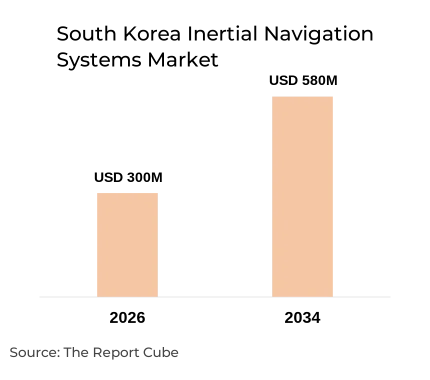
The South Korea Inertial Navigation Systems Market is anticipated to register a CAGR of around 8.3% during the forecast period 2026-2034. The market size is valued at USD 300 million in 2026 and is projected to reach USD 580 million by 2034. The South Korea inertial navigation systems market size is expanding steadily as the country strengthens its defense capabilities and aerospace manufacturing ecosystem. Increased investments in indigenous missile systems, unmanned aerial platforms, and next-generation fighter aircraft are directly boosting demand for precision navigation technologies. The growing adoption of INS in robotics and industrial automation also contributes to broader commercial adoption.
Government-backed defense programs and private sector innovation continue to shape the South Korea inertial navigation systems market growth. Major companies are focusing on MEMS-based solutions to reduce size, weight, and power consumption, which is essential for UAV and portable defense applications. Additionally, advancements in fiber optic gyro technology and integration with GPS-denied navigation systems are enhancing operational reliability. Rising export potential of Korean defense platforms, including armored vehicles and aircraft, further supports market revenue expansion and strengthens the country’s position in global navigation technology markets.
South Korea Inertial Navigation Systems Market Dynamics
Key Driver: Increasing Defense Modernization and Indigenous Weapon Development
South Korea’s growing focus on defense modernization is a primary driver of the inertial navigation systems market. The country continues to invest heavily in advanced weapon systems, including guided missiles, submarines, and fighter jets, all of which require high-precision navigation solutions. Defense spending in South Korea has increased consistently, with a significant share allocated to next-generation technologies such as INS and integrated navigation systems.
Moreover, the push toward indigenous production reduces reliance on foreign suppliers and strengthens domestic capabilities. Programs such as the KF-21 fighter jet and advanced missile systems are creating long-term demand for locally developed inertial navigation solutions. This strategic shift is expected to significantly enhance the South Korea inertial navigation systems market share over the coming years.
Book your FREE 30-minute expert consultation today
Contact UsIndustry Trends: Growing Adoption of MEMS and Miniaturized Navigation Systems
The market is witnessing a clear shift toward micro-electro-mechanical systems (MEMS)-based navigation technologies. These systems offer compact size, lower cost, and improved durability, making them ideal for UAVs, autonomous vehicles, and portable defense equipment. MEMS-based INS solutions are becoming a preferred choice in both military and commercial applications.
Another notable trend is the integration of INS with artificial intelligence and sensor fusion technologies. Combining INS with GNSS, LiDAR, and radar improves navigation accuracy, especially in challenging environments. This trend is contributing to increased South Korea inertial navigation systems market value, as industries seek reliable and cost-efficient navigation solutions.
Major Challenge: High Development Costs and Technological Complexity
The development of advanced inertial navigation systems requires substantial investment in research, testing, and precision manufacturing. High-performance systems such as fiber optic gyros and ring laser gyros involve complex engineering processes, which increase production costs. This creates barriers for smaller companies entering the market.
Additionally, maintaining accuracy over long durations without external references remains a technical challenge. Errors accumulate over time, requiring advanced correction algorithms and integration with other navigation systems. These complexities can limit adoption in cost-sensitive applications and slow overall market growth.
Opportunity: Expansion in Autonomous Systems and Commercial Applications
The rapid growth of autonomous systems presents a strong opportunity for the inertial navigation systems market in South Korea. Self-driving vehicles, drones, and robotic systems require reliable navigation in environments where GPS signals are weak or unavailable. INS technology plays a crucial role in enabling these capabilities.
Furthermore, industrial automation and smart manufacturing are creating new demand for precise motion tracking and positioning systems. As South Korea continues to invest in Industry 4.0 initiatives, the adoption of INS across commercial sectors is expected to rise, supporting long-term market growth and diversification.
South Korea Inertial Navigation Systems Market Segment-wise Analysis
By Application:
- Aircraft Navigation
- Unmanned Aerial Vehicle Navigation
- Land Vehicle Navigation
- Marine and Submarine Navigation
- Missile and Guided Munition Navigation
- Space Launch Vehicle Navigation
- Industrial and Robotics Navigation
- Others
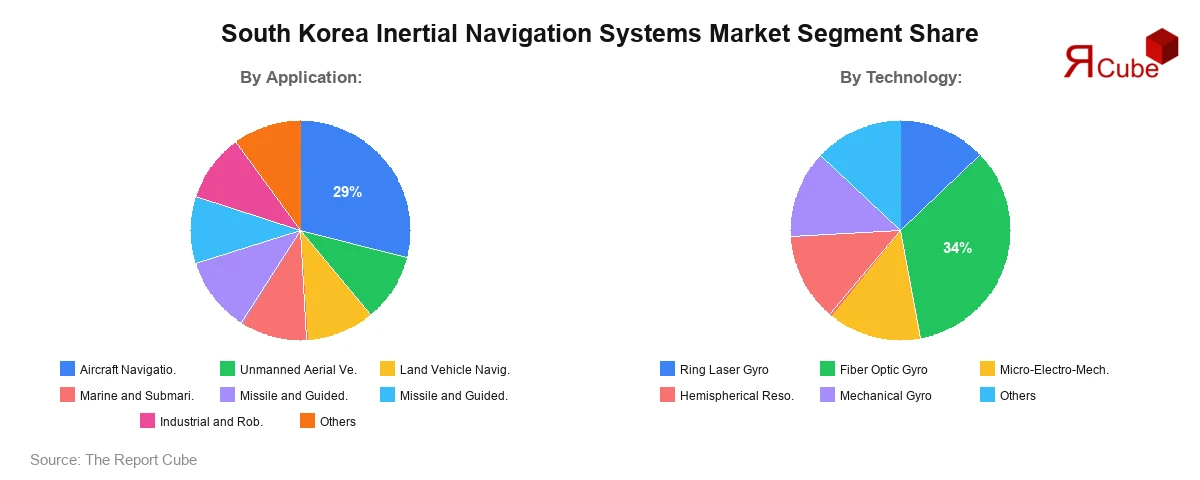
The aircraft navigation segment dominates the South Korea inertial navigation systems market, accounting for approximately 29% of total revenue. This leadership is driven by ongoing aerospace developments, including fighter jets, military aircraft, and commercial aviation systems.
Aircraft require highly reliable and accurate navigation systems to operate in GPS-denied environments, making INS a critical component. The growing production and deployment of advanced aircraft platforms in South Korea further strengthen this segment’s dominance. Additionally, increasing demand for unmanned aerial systems is supporting growth in related applications, contributing to the overall market expansion.
By Technology:
- Ring Laser Gyro
- Fiber Optic Gyro
- Micro-Electro-Mechanical Systems
- Hemispherical Resonator Gyro
- Mechanical Gyro
- Others
The fiber optic gyro segment holds a leading share of around 34% in the South Korea inertial navigation systems market. This technology is widely preferred due to its high accuracy, reliability, and resistance to external disturbances. Fiber optic gyros are extensively used in defense applications, including missile guidance and naval navigation systems.
Their ability to operate effectively in harsh conditions makes them ideal for military platforms. Continuous advancements in optical technologies and increasing demand for precision navigation are further boosting the adoption of this segment across multiple industries.
Regional Projection of South Korea Inertial Navigation Systems Industry
- Sudogwon
- Yeongnam
- Honam
- Hoseo
- Gwandong
The Sudogwon region dominates the South Korea inertial navigation systems market with a share of approximately 42%. This dominance is attributed to the concentration of major defense contractors, research institutions, and technology companies in the region.
Seoul and surrounding areas serve as key hubs for aerospace and defense innovation, attracting significant investments and government funding. The presence of leading companies and advanced manufacturing facilities further strengthens the region’s position. Additionally, strong infrastructure and access to skilled workforce contribute to sustained growth in this region, making it a central driver of market expansion.
Government Initiatives & Policies
- Defense Reform 4.0 Program: South Korea’s initiative to modernize military technologies, focusing on autonomous systems, AI integration, and advanced navigation systems.
- Korean New Deal - Digital Transformation Strategy: Supports robotics, smart manufacturing, and autonomous technologies, indirectly boosting INS adoption.
South Korea Inertial Navigation Systems Industry Recent Developments
- 2025: LIG Nex1 secured a major contract exceeding 120 billion KRW to develop inertial navigation units for KF-21 missile systems, strengthening domestic defense navigation capabilities.
- 2026: Korea Aerospace Industries (KAI) rolled out the first KF-21 Boramae fighter jet, increasing demand for advanced avionics and inertial navigation subsystems.
Need insights for a specific region within this market?
Request Regional DataWhy Choose This Report?
- Provides a comprehensive overview of the overall market analysis, encompassing key trends, consumer behavior analysis, and risk assessment to support strategic decision-making.
- Provides accurate, up-to-date insights into market size, segmentation, and emerging opportunities, helping to minimize risk & capitalizing on growth.
- Gives deep understanding of target audience preferences, investment habits, and communication channels for enhanced product development & marketing effectiveness.
- Delivers competitive analysis & benchmarking, uncovering the strengths & weaknesses of market competitors to guide strategies.
- Consolidate comprehensive market intelligence, reducing reasoning & streamlining research efforts.
- Facilitates customized market segmentation & risk mitigation strategies, fine-tuned to the business objectives.
- Aids in identifying both market challenges & untapped opportunities within the industry to drive long-term business growth.
- Provides valuable information based on actual customer data & search trends.
Table of Contents
- Introduction
- Objective of the Study
- Product and Category Definition
- Market Segmentation
- Study Variables
- Research Methodology
- Secondary Data Points
- Breakdown of Secondary Sources
- Primary Data Points
- Breakdown of Primary Interviews
- Secondary Data Points
- Executive Summary
- Market Dynamics
- Drivers
- Challenges
- Opportunity Assessment
- Recent Trends and Developments
- Regulatory and Policy Landscape
- South Korea Inertial Navigation Systems Market Overview (2021-2034)
- Market Size, By Value (USD Million)
- Market Share, By Application
- Aircraft Navigation
- Unmanned Aerial Vehicle Navigation
- Land Vehicle Navigation
- Marine and Submarine Navigation
- Missile and Guided Munition Navigation
- Space Launch Vehicle Navigation
- Industrial and Robotics Navigation
- Others
- Market Share, By Grade
- Strategic Grade
- Tactical Grade
- Navigation Grade
- Industrial Grade
- Commercial Grade
- Marine Grade
- Market Share, By Technology
- Ring Laser Gyro
- Fiber Optic Gyro
- Micro‑Electro‑Mechanical Systems
- Hemispherical Resonator Gyro
- Mechanical Gyro
- Others
- Market Share, By Solution
- Inertial Navigation Systems
- Inertial Measurement Units
- Attitude and Heading Reference Systems
- Gyrocompasses
- Integrated Navigation Systems
- Others
- Market Share, By Region
- Sudogwon
- Yeongnam
- Honam
- Hoseo
- Gwandong
- Market Share, By Company
- Revenue Shares and Analysis
- Competitive Landscape
- Sudogwon Inertial Navigation Systems Market
- Market Size, By Value (USD Million)
- Market Share, By Application
- Market Share, By Grade
- Market Share, By Technology
- Market Share, By Solution
- Yeongnam Inertial Navigation Systems Market
- Market Size, By Value (USD Million)
- Market Share, By Application
- Market Share, By Grade
- Market Share, By Technology
- Market Share, By Solution
- Honam Inertial Navigation Systems Market
- Market Size, By Value (USD Million)
- Market Share, By Application
- Market Share, By Grade
- Market Share, By Technology
- Market Share, By Solution
- Hoseo Inertial Navigation Systems Market
- Market Size, By Value (USD Million)
- Market Share, By Application
- Market Share, By Grade
- Market Share, By Technology
- Market Share, By Solution
- Gwandong Inertial Navigation Systems Market
- Market Size, By Value (USD Million)
- Market Share, By Application
- Market Share, By Grade
- Market Share, By Technology
- Market Share, By Solution
- Competitive Outlook and Company Profiles
- LIG Nex1
- Company Overview
- Product Portfolio
- Strategic Alliances/Partnerships
- Recent Developments
- Hanwha Systems
- Company Overview
- Product Portfolio
- Strategic Alliances/Partnerships
- Recent Developments
- Hanwha Aerospace
- Company Overview
- Product Portfolio
- Strategic Alliances/Partnerships
- Recent Developments
- Korea Aerospace Industries (KAI)
- Company Overview
- Product Portfolio
- Strategic Alliances/Partnerships
- Recent Developments
- DS Navcours
- Company Overview
- Product Portfolio
- Strategic Alliances/Partnerships
- Recent Developments
- Fiberpro
- Company Overview
- Product Portfolio
- Strategic Alliances/Partnerships
- Recent Developments
- Micro-Infinity
- Company Overview
- Product Portfolio
- Strategic Alliances/Partnerships
- Recent Developments
- Hyundai Rotem
- Company Overview
- Product Portfolio
- Strategic Alliances/Partnerships
- Recent Developments
- Doosan Mobility Innovation
- Company Overview
- Product Portfolio
- Strategic Alliances/Partnerships
- Recent Developments
- Truewin
- Company Overview
- Product Portfolio
- Strategic Alliances/Partnerships
- Recent Developments
- Safran Electronics & Defense Korea
- Company Overview
- Product Portfolio
- Strategic Alliances/Partnerships
- Recent Developments
- KAI (Korea Avionics)
- Company Overview
- Product Portfolio
- Strategic Alliances/Partnerships
- Recent Developments
- Sensonic
- Company Overview
- Product Portfolio
- Strategic Alliances/Partnerships
- Recent Developments
- Innospace
- Company Overview
- Product Portfolio
- Strategic Alliances/Partnerships
- Recent Developments
- Sensonics Korea
- Company Overview
- Product Portfolio
- Strategic Alliances/Partnerships
- Recent Developments
- Tamagawa Seiki Korea
- Company Overview
- Product Portfolio
- Strategic Alliances/Partnerships
- Recent Developments
- Huvitz (Network/Nav Div)
- Company Overview
- Product Portfolio
- Strategic Alliances/Partnerships
- Recent Developments
- Others
- LIG Nex1
- Contact Us and Disclaimer
Top Key Players & Market Share Outlook
- LIG Nex1
- Hanwha Systems
- Hanwha Aerospace
- Korea Aerospace Industries (KAI)
- DS Navcours
- Fiberpro
- Micro-Infinity
- Hyundai Rotem
- Doosan Mobility Innovation
- Truewin
- Safran Electronics & Defense Korea
- KAI (Korea Avionics)
- Sensonic
- Innospace
- Sensonics Korea
- Tamagawa Seiki Korea
- Huvitz (Network/Nav Div)
- Others
Frequently Asked Questions






