



Build Your Custom Market Intelligence Report
Customize Your ReportGlobal Insurance Analytics Market Key Highlights
By Component:
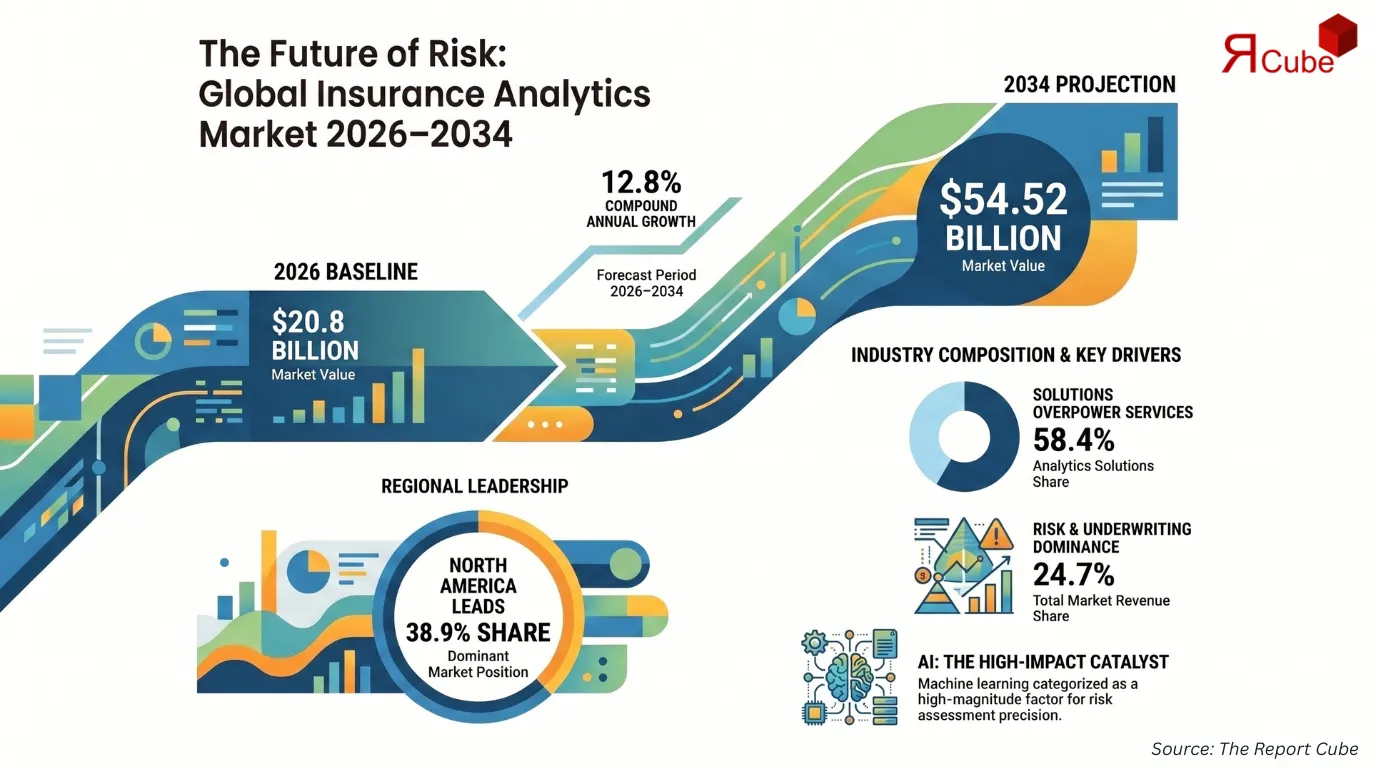
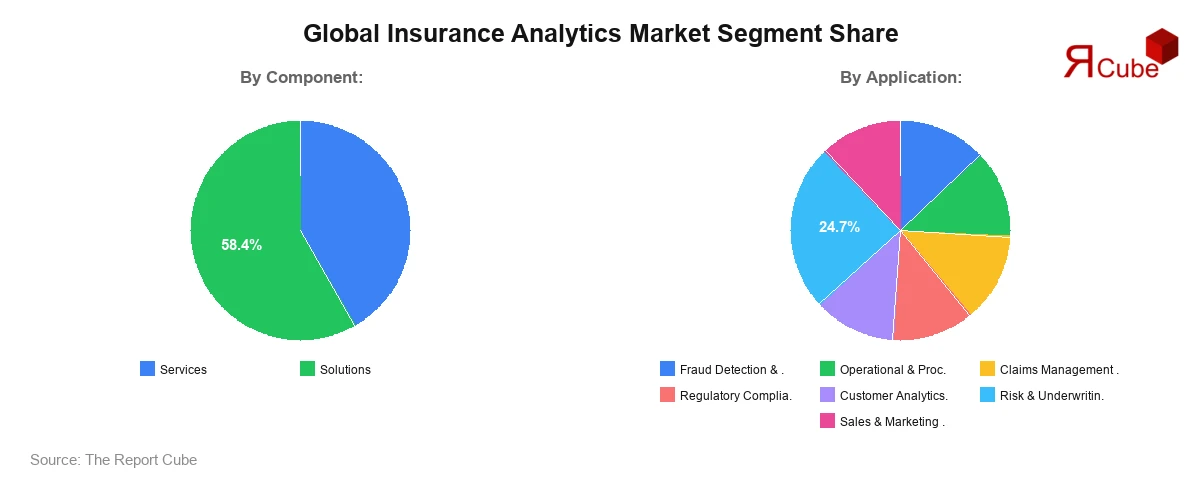
Solutions segment leads the market with nearly 58.4% share.
By Application:
Risk & Underwriting Analytics segment dominates the market with around 24.7% of total revenue.
Regional Outlook:
North America dominates the Global Insurance Analytics Market with approximately 38.9% share.
Global Insurance Analytics Market Insights & Analysis
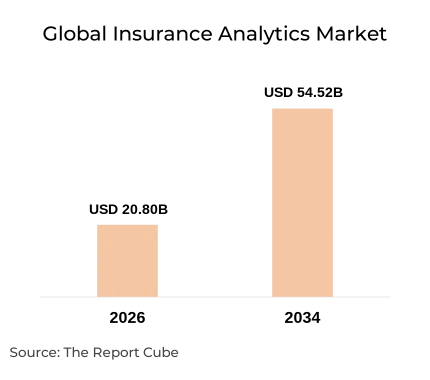
The Global Insurance Analytics Market is projected to expand steadily at a CAGR of 12.8% between 2026 and 2034, rising from USD 20.8 billion in 2026 to nearly USD 54.52 billion by 2034. Insurance providers across developed and emerging economies are strengthening investments in advanced analytics infrastructure to improve underwriting precision, claims transparency, customer retention, and fraud mitigation. As insurers continue modernizing legacy operational frameworks, analytics platforms are becoming essential for real-time decision support and risk forecasting. Large insurance carriers are increasingly integrating predictive modeling, cloud-native data environments, and automation tools into policy administration systems to improve operational scalability and cost efficiency.
Industry expansion is also supported by rising adoption of AI-enabled analytics solutions capable of processing large insurance datasets across health, life, property, and specialty insurance lines. Market participants are prioritizing embedded analytics and intelligent workflow automation to accelerate claims settlements and improve policyholder engagement. Growing regulatory oversight surrounding financial transparency and risk governance is encouraging insurers to deploy compliance-focused analytics systems with advanced reporting capabilities. At the same time, enterprise insurers are collaborating with technology providers to build centralized data ecosystems that support faster pricing adjustments, portfolio optimization, and more accurate customer risk assessment across multi-channel insurance operations.
Global Insurance Analytics Market Impact Analysis
| Factor | Type | Specific Impact on Market | Magnitude | Business Implication |
|---|---|---|---|---|
| AI & Machine Learning Integration | Technological | Enhances risk assessment precision and claim automation | High | Invest in AI-driven tools for personalized pricing models |
| Regulatory Compliance Mandates | Regulatory | Stricter rules require robust data tracking and reporting | High | Deploy analytics platforms ensuring audit-ready compliance |
| Cloud Adoption Acceleration | Technological | Cloud platforms enable scalable, cost-efficient analytics | High | Migrate legacy systems to hybrid cloud for agile deployment |
| Fraud Detection Demand | Market | Rising claim fraud drives need for real-time detection tools | High | Implement predictive fraud analytics and IoT data integration |
| Digital Transformation Push | Market | Insurers modernize operations via analytics-led digital shift | High | Align analytics roadmap with end-to-end digital strategies |
| Customer Experience Personalization | Consumer | Data insights enable tailored products and dynamic pricing | Medium | Build customer segmentation models and behavior analytics |
| APAC Market Expansion | Market | Fast-growing economies in Asia-Pacific boost analytics uptake | Medium | Target China, India, Japan with localized analytics solutions |
| Process Optimization Emphasis | Market | Streamlined underwriting and claims cut operational costs | Medium | Automate workflows using predictive and prescriptive analytics |
| Data Volume Explosion | Technological | IoT, social media, satellite data increase analytics complexity | Medium | Adopt big data platforms and advanced data integration tools |
| Competitive Pricing Pressure | Competitive | Insurers use analytics to optimize pricing and reduce losses | Low | Leverage real-time market data for dynamic rate adjustments |
Global Insurance Analytics Market Dynamics
Key Driver: Accelerating digital transformation across underwriting and claims operations
Insurance companies are rapidly shifting toward data-driven operating models to improve underwriting consistency, reduce claim processing delays, and strengthen customer lifecycle management. Advanced analytics solutions are helping insurers process structured and unstructured policyholder data more efficiently while improving risk evaluation accuracy. Predictive analytics and machine learning technologies are increasingly used to support premium pricing strategies, policy recommendations, and automated underwriting decisions. Growing pressure to reduce operational costs while improving service quality is encouraging insurers to modernize traditional workflows with scalable analytics ecosystems.
Another major growth catalyst is the increasing financial impact of fraudulent claims and cyber-related insurance risks. Insurers are deploying real-time fraud analytics systems capable of identifying suspicious transaction patterns and abnormal behavioral activity across digital insurance channels. These platforms support faster investigation cycles and improve fraud detection efficiency across property, casualty, health, and life insurance segments. As insurance providers continue expanding digital engagement models, demand for intelligent analytics tools capable of delivering operational visibility and risk transparency is expected to rise consistently throughout the forecast period.
Industry Trends: Growing integration of generative AI and cloud-based analytics platforms
Cloud-native insurance analytics platforms are becoming a core component of enterprise modernization strategies due to their scalability, lower infrastructure costs, and faster deployment capabilities. Insurers are increasingly replacing fragmented legacy systems with centralized analytics environments that support unified data management across underwriting, customer engagement, compliance, and claims functions. Cloud deployment models are also improving collaboration between insurers, brokers, and third-party service providers while enabling secure access to real-time operational insights.
Generative AI integration is reshaping insurance analytics capabilities by enabling automated document analysis, intelligent claims summarization, and dynamic pricing recommendations. Technology vendors are introducing AI-powered analytics platforms designed to improve underwriting accuracy and accelerate decision workflows across large insurance enterprises. Embedded analytics capabilities within policy administration systems are also gaining momentum as insurers seek faster access to actionable insights without disrupting existing operations. These advancements are strengthening the role of predictive and cognitive analytics across modern insurance ecosystems.
Major Challenge: Complex integration requirements and evolving regulatory obligations
One of the primary challenges limiting insurance analytics adoption is the complexity involved in integrating advanced analytics platforms with outdated insurance infrastructure. Many insurers continue operating on legacy systems containing disconnected policy, claims, and customer databases that restrict seamless data flow and real-time analytics processing. Migrating toward modern analytics architectures often requires extensive system upgrades, workforce training, and significant capital expenditure, particularly for mid-sized insurance providers with limited digital transformation budgets.
Data governance requirements are also becoming more stringent across global insurance markets, increasing operational complexity for insurers deploying AI-driven analytics systems. Regulatory authorities are emphasizing transparency in automated decision-making, customer data protection, and algorithm accountability across underwriting and claims operations. Insurers must ensure compliance with evolving cybersecurity standards and regional privacy regulations while maintaining operational efficiency. Concerns surrounding biased predictive models and inaccurate risk classifications further highlight the importance of responsible analytics governance within the insurance industry.
Opportunity: Expansion of personalized insurance models and embedded insurance ecosystems
Rising demand for personalized insurance offerings is creating strong growth opportunities for analytics providers across the global insurance sector. Insurers are increasingly leveraging behavioral analytics, telematics, wearable technologies, and transaction-based datasets to develop customized policies and usage-based pricing models. Real-time analytics platforms allow insurers to evaluate customer risk profiles more accurately while improving engagement through tailored product recommendations and proactive policy management services.
Embedded insurance ecosystems are also opening new revenue streams for analytics vendors and insurance providers. Financial institutions, automotive manufacturers, healthcare companies, and e-commerce platforms are integrating insurance products directly into digital customer journeys, increasing demand for API-enabled analytics infrastructure. Rapid expansion of digital insurance distribution channels across Asia Pacific and Latin America is further strengthening adoption of cloud-based analytics solutions capable of supporting high-volume customer interactions and automated underwriting workflows. These developments are expected to enhance long-term market growth across both developed and emerging insurance economies.
Global Insurance Analytics Market Segment-wise Analysis
By Component:
- Services
- Managed Services
- Professional Services
- Support & Maintenance
- Consulting
- Integration & Deployment
- Solutions
The solutions segment continues to account for the largest share of the Global Insurance Analytics Market, holding nearly 58.4% in 2026 due to the rising deployment of AI-enabled underwriting platforms, fraud management systems, and predictive claims analytics solutions. Insurance enterprises are prioritizing integrated analytics software capable of supporting multiple operational functions within a centralized digital environment. Growing reliance on data-driven decision-making has accelerated demand for scalable analytics platforms equipped with machine learning, automation, and intelligent reporting capabilities. Large insurers are particularly investing in cloud-based analytics ecosystems that improve operational visibility across policy administration, compliance management, and customer relationship functions.
Demand for analytics solutions is also increasing as insurers seek faster access to actionable insights and improved operational agility. Advanced analytics software enables insurers to process high-volume policyholder data in real time while reducing manual intervention across underwriting and claims workflows. Vendors are continuously enhancing platform interoperability and embedded analytics functionality to support integration with existing insurance infrastructure. This transition toward automated and connected insurance operations continues to strengthen the long-term position of the solutions segment within the global insurance analytics industry.
By Application:
- Fraud Detection & Prevention
- Operational & Process Optimization
- Claims Management Analytics
- Regulatory Compliance Analytics
- Customer Analytics
- Risk & Underwriting Analytics
- Sales & Marketing Analytics
Risk & Underwriting Analytics remains the leading application segment within the Global Insurance Analytics Market with approximately 24.7% revenue share as insurers continue focusing on pricing precision and portfolio risk optimization. Advanced analytics technologies allow insurance providers to evaluate historical claims patterns, demographic information, behavioral indicators, and third-party datasets to strengthen underwriting accuracy. Automated underwriting systems are helping insurers accelerate policy approvals while improving consistency across complex risk assessment processes. Strong adoption is visible across property & casualty, health, life, and specialty insurance segments, where accurate pricing directly influences profitability.
Insurance companies are also integrating external datasets such as telematics, IoT-enabled monitoring systems, and healthcare analytics into underwriting workflows to improve predictive capabilities. Real-time analytics engines help insurers identify emerging risk patterns and optimize premium calculations based on changing market conditions. Increasing pressure to minimize underwriting losses and maintain competitive pricing strategies is driving continuous investment in predictive and cognitive analytics technologies across the global insurance industry.
Regional Projection of Global Insurance Analytics Industry
- North America
- Europe
- Asia Pacific
- Middle East & Africa
- South America
North America continues to dominate the Global Insurance Analytics Market with nearly 38.9% share due to strong digital insurance penetration, advanced enterprise analytics adoption, and significant investment in AI-driven insurance technologies. The United States represents the largest regional market supported by widespread deployment of predictive analytics, cloud-based underwriting platforms, and automated fraud detection systems among leading insurers. Insurance providers across the region are modernizing legacy infrastructure through strategic partnerships with cloud service providers and analytics software companies to improve operational efficiency and customer engagement capabilities.
Regulatory emphasis on financial transparency, cybersecurity, and data governance is also contributing to the adoption of compliance-focused analytics solutions across North America. Canadian insurers are increasingly investing in intelligent claims analytics and customer retention platforms to improve service quality and reduce processing costs. The region’s mature cloud infrastructure, strong presence of analytics technology vendors, and continuous investment in enterprise AI innovation are expected to sustain North America’s leadership position throughout the forecast period.
Need insights for a specific region within this market?
Request Regional DataGlobal Insurance Analytics Industry Regional Analysis
The global insurance analytics industry varies significantly across regions due to technology adoption, regulatory frameworks, and digital transformation initiatives.
| Region | Demand Level | Key Markets | System Dominance | Core Demand Logic | Growth Nature |
|---|---|---|---|---|---|
| North America | Very High | USA, Canada | AI/ML fraud detection & cloud tools | Advanced analytics for risk & compliance | Mature market leadership |
| Europe | High | UK, Germany, France | Regulatory compliance analytics | GDPR compliance & cost optimization | Steady regulatory-driven |
| Asia Pacific | Extremely High | China, India, Japan | Cloud-based & mobile analytics | Digital transformation & insurtech boom | Fastest-growing segment |
| Middle East & Africa | Medium | UAE, Saudi Arabia, South Africa | Emerging digital platforms | Government-backed digital initiatives | Developing market growth |
| South America | Medium | Brazil, Mexico | Data-driven tools & services | Rising insurance penetration & fintech | Emerging growth market |
Government Initiatives & Policies
- U.S. National AI Governance Framework 2025: The U.S. government expanded AI governance guidelines supporting responsible enterprise AI adoption across financial and insurance sectors, encouraging transparent analytics deployment and algorithmic accountability in underwriting and risk assessment operations.
- European Union AI Act Implementation 2026: The European Union advanced regulatory frameworks governing AI-based insurance analytics systems to improve data transparency, consumer protection, and responsible usage of predictive decision-making technologies across insurance operations.
Global Insurance Analytics Industry Recent Developments
- 2025: WTW introduced Radar 5, an upgraded insurance pricing and analytics platform integrating generative AI capabilities for underwriting, claims analytics, and portfolio optimization. The platform enhances SaaS-based analytics functionality while improving pricing agility, automated risk assessment, and insurer decision-making efficiency.
- 2025: Microsoft Corporation enhanced Microsoft Fabric with Azure AI integrations and AI-enabled lakehouse architecture to support real-time insurance analytics, intelligent automation, customer churn modeling, and dynamic pricing strategies across enterprise insurance environments.
- 2025: IBM expanded its watsonx platform with advanced AI-driven insurance analytics capabilities supporting underwriting automation, fraud detection, and claims processing optimization. The update strengthens hybrid cloud scalability and improves enterprise decision workflows across policy lifecycle management.
Why Choose This Report?
- Provides a comprehensive overview of the overall market analysis, encompassing key trends, consumer behavior analysis, and risk assessment to support strategic decision-making.
- Provides accurate, up-to-date insights into market size, segmentation, and emerging opportunities, helping to minimize risk & capitalizing on growth.
- Gives deep understanding of target audience preferences, investment habits, and communication channels for enhanced product development & marketing effectiveness.
- Delivers competitive analysis & benchmarking, uncovering the strengths & weaknesses of market competitors to guide strategies.
- Consolidate comprehensive market intelligence, reducing reasoning & streamlining research efforts.
- Facilitates customized market segmentation & risk mitigation strategies, fine-tuned to the business objectives.
- Aids in identifying both market challenges & untapped opportunities within the industry to drive long-term business growth.
- Provides valuable information based on actual customer data & search trends.
Table of Contents
- Introduction
- Objective of the Study
- Product and Category Definition
- Market Segmentation
- Study Variables
- Research Methodology
- Secondary Data Points
- Breakdown of Secondary Sources
- Primary Data Points
- Breakdown of Primary Interviews
- Secondary Data Points
- Executive Summary
- Market Dynamics
- Emerging Opportunities
- Adoption Trends
- Demand Drivers
- Disruption Analysis (Challenges)
- Industry Analysis & Strategic Insights
- Supply/Value Chain Analysis
- Pricing Analysis
- Go-To-Market (GTM) Strategy
- BCG Matrix
- Recent Trends and Developments
- Regulatory and Policy Landscape
- Region-wise Policies
- Government Initiatives
- Global Insurance Analytics Market Overview and Forecast Analysis (2021-2034)
- Market Size, By Value, By Growth Rate (CAGR/USD Billion)
- Market Share, By Component
- Services
- Managed Services
- Professional Services
- Support & Maintenance
- Consulting
- Integration & Deployment
- Solutions
- Services
- Market Share, By Analytics Type
- Predictive Analytics
- Cognitive / AI-Driven Analytics
- Diagnostic Analytics
- Prescriptive Analytics
- Descriptive Analytics
- Market Share, By Deployment Mode
- On-Premises
- Cloud-Based
- Market Share, By Organization Size
- Small & Medium Enterprises (SMEs)
- Large Enterprises
- Market Share, By Delivery Model
- API / Embedded Analytics
- Core-System Embedded Analytics
- Stand-Alone Analytics Platforms
- Market Share, By Application
- Fraud Detection & Prevention
- Operational & Process Optimization
- Claims Management Analytics
- Regulatory Compliance Analytics
- Customer Analytics
- Risk & Underwriting Analytics
- Sales & Marketing Analytics
- Market Share, By Insurance Type
- Reinsurance
- Property & Casualty (P&C) Insurance
- Specialty Insurance
- Life Insurance
- Health Insurance
- Market Share, By End User
- Insurance Brokers & Agencies
- Government & Regulatory Bodies
- Third-Party Administrators (TPAs)
- Primary Insurers
- Reinsurers
- Market Share, By Region
- North America
- Europe
- Asia Pacific
- Middle East & Africa
- South America
- Market Share, By Company
- Revenue Shares & Analysis
- Competitive Landscape
- North America Insurance Analytics Market Overview and Forecast Analysis (2021-2034)
- Market Size, By Value, By Growth Rate (CAGR/USD Billion/Million)
- Market Share, By Component
- Market Share, By Analytics Type
- Market Share, By Deployment Mode
- Market Share, By Organization Size
- Market Share, By Delivery Model
- Market Share, By Application
- Market Share, By Insurance Type
- Market Share, By End User
- Market Share, By Country
- United States
- Canada
- Mexico
- Rest of North America
- Europe Insurance Analytics Market Overview and Forecast Analysis (2021-2034)
- Market Size, By Value, By Growth Rate (CAGR/USD Billion/Million)
- Market Share, By Component
- Market Share, By Analytics Type
- Market Share, By Deployment Mode
- Market Share, By Organization Size
- Market Share, By Delivery Model
- Market Share, By Application
- Market Share, By Insurance Type
- Market Share, By End User
- Market Share, By Country
- Germany
- United Kingdom
- France
- Italy
- Spain
- Netherlands
- Russia
- Poland
- Belgium
- Sweden
- Rest of Europe
- Asia Pacific Insurance Analytics Market Overview and Forecast Analysis (2021-2034)
- Market Size, By Value, By Growth Rate (CAGR/USD Billion/Million)
- Market Share, By Component
- Market Share, By Analytics Type
- Market Share, By Deployment Mode
- Market Share, By Organization Size
- Market Share, By Delivery Model
- Market Share, By Application
- Market Share, By Insurance Type
- Market Share, By End User
- Market Share, By Country
- China
- India
- Japan
- South Korea
- Australia
- Indonesia
- Thailand
- Malaysia
- Vietnam
- Philippines
- Singapore
- New Zealand
- Rest of Asia Pacific
- Middle East & Africa Insurance Analytics Market Overview and Forecast Analysis (2021-2034)
- Market Size, By Value, By Growth Rate (CAGR/USD Billion/Million)
- Market Share, By Component
- Market Share, By Analytics Type
- Market Share, By Deployment Mode
- Market Share, By Organization Size
- Market Share, By Delivery Model
- Market Share, By Application
- Market Share, By Insurance Type
- Market Share, By End User
- Market Share, By Country
- Saudi Arabia
- United Arab Emirates
- South Africa
- Egypt
- Nigeria
- Morocco
- Turkey
- Rest of Middle East & Africa
- South America Insurance Analytics Market Overview and Forecast Analysis (2021-2034)
- Market Size, By Value, By Growth Rate (CAGR/USD Billion/Million)
- Market Share, By Component
- Market Share, By Analytics Type
- Market Share, By Deployment Mode
- Market Share, By Organization Size
- Market Share, By Delivery Model
- Market Share, By Application
- Market Share, By Insurance Type
- Market Share, By End User
- Market Share, By Country
- Brazil
- Argentina
- Chile
- Colombia
- Peru
- Rest of South America
- Competitive Analysis, 2026
- Market Share of Key Players
- Competitive Mapping for Each Segment and Companies/Provider Operating Regionally
- North America Insurance Analytics Companies/Provider Share & Competitive Analysis, 2026
- Europe Insurance Analytics Companies/Provider Share & Competitive Analysis, 2026
- Asia Pacific Insurance Analytics Companies/Provider Share & Competitive Analysis, 2026
- Middle East & Africa Insurance Analytics Companies/Provider Share & Competitive Analysis, 2026
- South America Insurance Analytics Companies/Provider Share & Competitive Analysis, 2026
- Company Profile (Partial List)
- Guidewire Software, Inc.
- Company Overview
- Product Portfolio
- Strategic Alliances/Partnerships
- Recent Developments
- Fair Isaac Corporation
- Company Overview
- Product Portfolio
- Strategic Alliances/Partnerships
- Recent Developments
- Oracle Corporation
- Company Overview
- Product Portfolio
- Strategic Alliances/Partnerships
- Recent Developments
- IBM
- Company Overview
- Product Portfolio
- Strategic Alliances/Partnerships
- Recent Developments
- Salesforce, Inc.
- Company Overview
- Product Portfolio
- Strategic Alliances/Partnerships
- Recent Developments
- Verisk Analytics, Inc.
- Company Overview
- Product Portfolio
- Strategic Alliances/Partnerships
- Recent Developments
- SAS Institute Inc.
- Company Overview
- Product Portfolio
- Strategic Alliances/Partnerships
- Recent Developments
- Pegasystems Inc.
- Company Overview
- Product Portfolio
- Strategic Alliances/Partnerships
- Recent Developments
- LexisNexis Risk Solutions
- Company Overview
- Product Portfolio
- Strategic Alliances/Partnerships
- Recent Developments
- Open Text Corporation
- Company Overview
- Product Portfolio
- Strategic Alliances/Partnerships
- Recent Developments
- Sapiens International Corporation N.V.
- Company Overview
- Product Portfolio
- Strategic Alliances/Partnerships
- Recent Developments
- Duck Creek Technologies LLC
- Company Overview
- Product Portfolio
- Strategic Alliances/Partnerships
- Recent Developments
- Microsoft Corporation
- Company Overview
- Product Portfolio
- Strategic Alliances/Partnerships
- Recent Developments
- SAP SE
- Company Overview
- Product Portfolio
- Strategic Alliances/Partnerships
- Recent Developments
- Cognizant Technology Solutions Corporation
- Company Overview
- Product Portfolio
- Strategic Alliances/Partnerships
- Recent Developments
- Others (Partial List)
- Guidewire Software, Inc.
- Contact Us and Disclaimer
Top Key Players & Market Share Outlook
- Guidewire Software, Inc.
- Fair Isaac Corporation
- Oracle Corporation
- IBM
- Salesforce, Inc.
- Verisk Analytics, Inc.
- SAS Institute Inc.
- Pegasystems Inc.
- LexisNexis Risk Solutions
- Open Text Corporation
- Sapiens International Corporation N.V.
- Duck Creek Technologies LLC
- Microsoft Corporation
- SAP SE
- Cognizant Technology Solutions Corporation
Frequently Asked Questions






