



Build Your Custom Market Intelligence Report
Customize Your ReportGlobal Jet Fuel Market Key Highlights
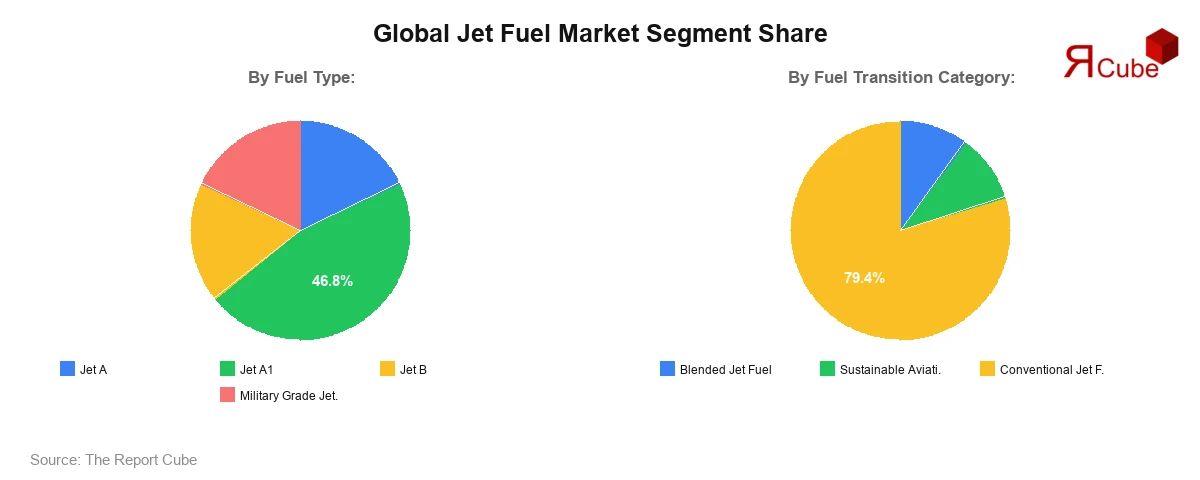
By Fuel Type:
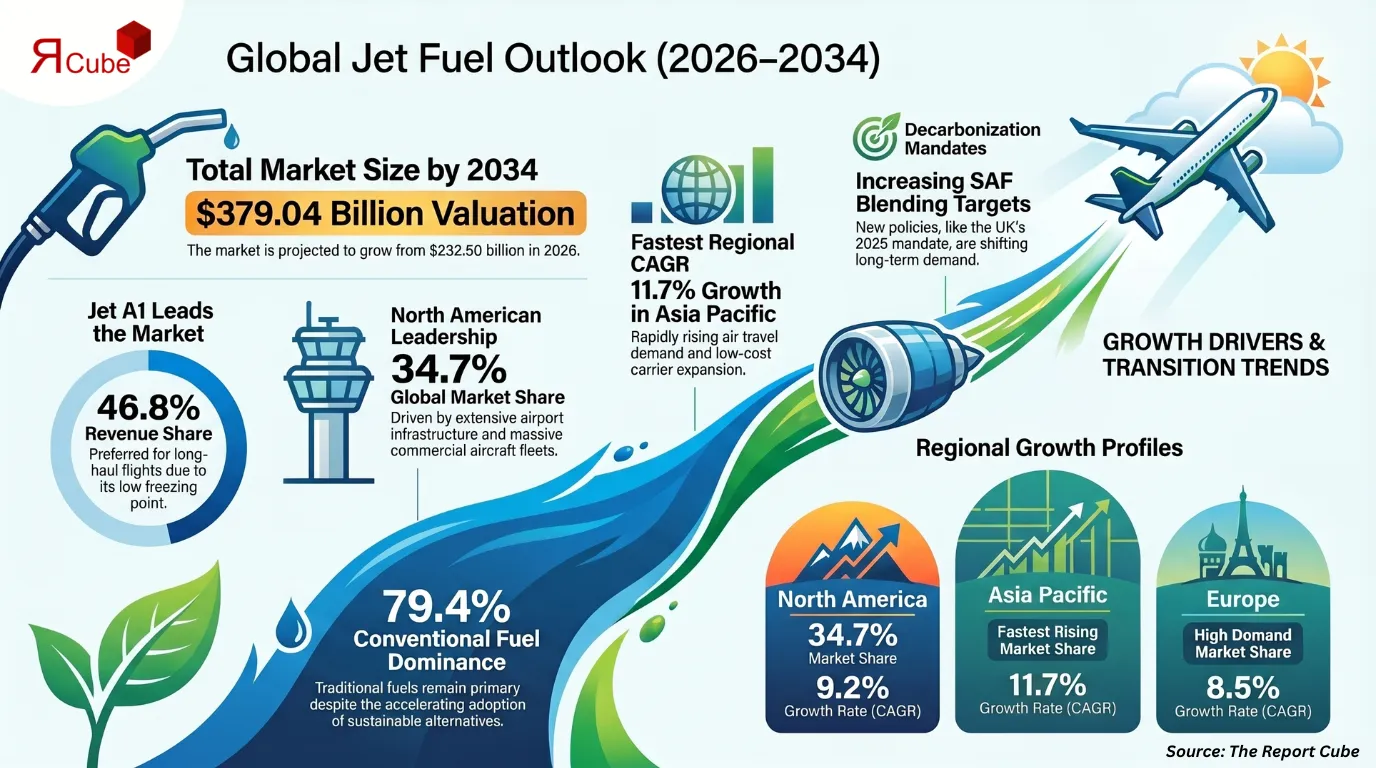
Jet A1 segment leads the market with nearly 46.8% share.
By Fuel Transition Category:
Conventional Jet Fuel segment dominates the market with approximately 79.4% of revenue.
Regional Outlook:
North America region dominates the Global Jet Fuel Market with around 34.7% share.
Global Jet Fuel Market Insights & Analysis
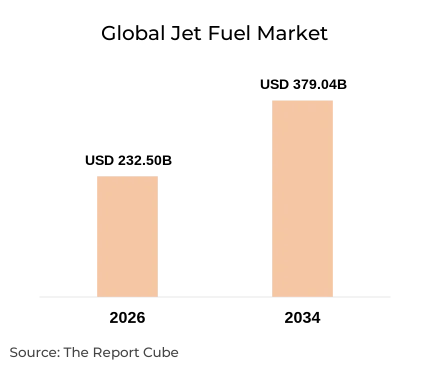
The Global Jet Fuel Market is anticipated to register a CAGR of around 6.3% during the forecast period 2026-2034. The market size is valued at USD 232.50 billion in 2026 and is projected to reach USD 379.04 billion by 2034. Market expansion is being supported by sustained growth in commercial aviation, increasing international connectivity, and rising aircraft utilization rates across passenger and cargo operations. Major airlines continue to restore and expand route networks while aircraft manufacturers maintain strong order backlogs, reflecting long-term confidence in global air travel demand. Industry participants are also investing in refinery upgrades to increase jet fuel production yields as aviation activity grows faster than several other transportation fuel segments.
The industry is undergoing a structural transition as governments, airlines, and fuel suppliers work toward aviation decarbonization goals. Several large-scale sustainable aviation fuel projects have entered commercial development stages, supported by public funding mechanisms and long-term procurement agreements. At the same time, strategic investments in airport fueling infrastructure, storage facilities, and supply chain modernization are strengthening fuel availability across major aviation hubs. Growing defense aviation requirements, expanding cargo fleets, and increased long-haul flight operations continue to create stable demand fundamentals, reinforcing positive growth prospects for the global jet fuel market throughout the forecast period.
Global Jet Fuel Market Impact Analysis
| Factor | Type | Specific Impact on Market | Magnitude | Business Implication |
|---|---|---|---|---|
| Global Air Passenger Recovery | Market | Rebound in international and domestic flights lifts fuel uplift volumes worldwide | High | Supports higher jet fuel offtake contracts and throughput at major hubs |
| Crude Oil Price Volatility | Environmental | Fluctuations in crude benchmarks directly swing refinery jet fuel prices | High | Requires dynamic hedging, pricing clauses, and margin risk management tools |
| Stringent Carbon Emission Policies | Regulatory | Climate regulations increase pressure to cut lifecycle emissions from aviation fuels | High | Drives investment in low carbon fuels, offsets, and compliance cost pass through |
| Adoption of Sustainable Aviation Fuel | Technological | Growing SAF blending mandates gradually shift part of demand from conventional kerosene | Medium | Creates new premium product streams and long term supply partnerships with airlines |
| Fleet Modernization and Efficiency | Competitive | Newer aircraft burn less fuel per seat, moderating unit consumption growth | Medium | Refiners must plan for slower intensity growth but higher quality and specification needs |
| Regional Traffic Shifts to Asia Pacific | Market | Fast rising air travel in Asia Pacific raises regional jet fuel demand share | High | Encourages infrastructure expansion at Asian hubs and rebalancing of global supply flows |
| Geopolitical and Supply Chain Disruptions | Environmental | Conflicts and logistics issues can tighten supply and widen regional price spreads | Medium | Needs diversified sourcing, flexible routing, and index linked pricing for buyers |
Global Jet Fuel Market Dynamics
Key Driver: Rising Global Air Passenger Traffic and Airline Fleet Expansion
The most significant growth driver for the Global Jet Fuel Market is the steady expansion of global air transportation. International travel volumes have surpassed pre-pandemic levels across several major aviation corridors, supported by economic growth, rising tourism expenditure, and increasing business mobility. Airlines are introducing new routes, increasing flight frequencies, and expanding fleet capacity to accommodate growing passenger volumes. This trend is particularly visible in Asia Pacific, the Middle East, and North America, where airport infrastructure investments are supporting higher aircraft movements.
In parallel, the rapid growth of air freight services has strengthened aviation fuel consumption. E-commerce expansion, time-sensitive logistics requirements, and increasing global trade activity have encouraged cargo carriers to increase flight operations. Commercial aviation, cargo transport, and military aviation collectively contribute to rising fuel demand, creating a strong foundation for sustained market growth. As airline profitability improves and fleet utilization rates increase, jet fuel consumption is expected to remain on a long-term market expansion.
Industry Trends: Accelerating Adoption of Sustainable Aviation Fuel
A notable trend shaping the Global Jet Fuel Market is the accelerating integration of sustainable aviation fuel into commercial aviation supply chains. Governments and regulatory bodies are introducing blending mandates, carbon reduction targets, and financial incentives to encourage the adoption of lower-emission fuel alternatives. Airlines are increasingly entering multi-year supply agreements with fuel producers to secure future SAF volumes and support corporate sustainability commitments.
Another emerging trend is the diversification of feedstocks used in sustainable fuel production. Producers are investing in technologies capable of converting waste oils, agricultural residues, municipal waste, and synthetic feedstocks into aviation-grade fuel. These developments are helping expand production capacity while improving supply security. As commercial-scale facilities become operational and production costs gradually improve, blended fuel solutions are expected to play a larger role within the broader aviation fuel ecosystem.
Book your FREE 30-minute expert consultation today
Contact UsMajor Challenge: Volatility in Crude Oil Prices and Supply Chain Risks
Crude oil market volatility remains one of the most persistent challenges facing the Global Jet Fuel Market. Jet fuel prices are closely linked to fluctuations in global crude benchmarks, making airlines and fuel suppliers vulnerable to geopolitical events, supply disruptions, and shifts in energy market dynamics. Sudden increases in fuel costs can significantly affect airline operating margins, particularly for carriers operating large international networks.
The industry also faces challenges related to sustainable aviation fuel scalability. While demand for lower-carbon alternatives continues to increase, current production capacity remains limited compared with total global aviation fuel requirements. Supply chain constraints, feedstock availability concerns, and higher production costs continue to influence commercialization efforts. Addressing these challenges will require coordinated investment from governments, refiners, airlines, and technology developers to ensure reliable and economically viable fuel supplies.
Opportunity: Government Support for Low-Carbon Aviation Fuel Development
The growing policy focus on reducing aviation emissions presents substantial opportunities across the jet fuel value chain. Governments in North America, Europe, and Asia are implementing programs designed to stimulate investment in sustainable aviation fuel production and supporting infrastructure. Financial incentives, blending mandates, and research funding initiatives are encouraging both established energy companies and emerging fuel producers to expand capacity.
Additional opportunities are emerging through partnerships between airlines, airports, fuel suppliers, and technology providers. These collaborations are facilitating long-term supply agreements and accelerating the deployment of advanced fuel production technologies. As global aviation works toward net-zero emission objectives, companies capable of delivering scalable and cost-effective sustainable fuel solutions are expected to gain competitive advantages. This evolving market environment is likely to unlock new investment avenues while supporting long-term jet fuel industry growth.
Global Jet Fuel Market Segment-wise Analysis
By Fuel Type:
- Jet A
- Jet A1
- Jet B
- Military Grade Jet Fuel
- JP5
- JP8
- JP54
Jet A1 remains the dominant fuel type in the Global Jet Fuel Market, accounting for approximately 46.8% of total revenue. Its leadership position is largely attributed to widespread adoption across international commercial aviation operations. The fuel's lower freezing point compared with Jet A makes it particularly suitable for long-distance flights operating across diverse climatic regions, including high-altitude and cold-weather environments. As a result, Jet A1 has become the preferred aviation fuel standard at many international airports worldwide.
The segment also benefits from well-established global distribution networks and strong compatibility with modern commercial aircraft fleets. Rising international passenger traffic and increasing long-haul flight activity continue to strengthen consumption levels. In addition, fleet expansion programs undertaken by major airlines are supporting sustained demand. Given its operational reliability and extensive acceptance across global aviation markets, Jet A1 is expected to maintain its leading position throughout the forecast period.
By Fuel Transition Category:
- Blended Jet Fuel
- Sustainable Aviation Fuel
- Conventional Jet Fuel
Conventional Jet Fuel continues to account for the largest share of market revenue, representing nearly 79.4% of the Global Jet Fuel Market. The segment's dominance is supported by decades of established refining infrastructure, global supply availability, and compatibility with existing aviation fueling systems. Commercial airlines, cargo operators, and defense organizations continue to rely heavily on conventional jet fuel due to its proven performance characteristics and widespread accessibility.
Although sustainable aviation fuel adoption is expanding, conventional products remain critical to meeting current aviation energy requirements. The global aircraft fleet is primarily configured to operate using conventional or blended fuel systems, supporting continued demand across both developed and emerging markets. Strong growth in passenger traffic, increasing cargo transportation volumes, and expanding airline operations are expected to sustain consumption levels while the industry gradually transitions toward lower-carbon alternatives.
Regional Projection of Global Jet Fuel Industry
- North America
- Europe
- Asia Pacific
- Middle East and Africa
- South America
North America represents the largest regional market, accounting for approximately 34.7% of global revenue. The region benefits from one of the world's most developed aviation ecosystems, supported by extensive airport infrastructure, large commercial airline fleets, and substantial military aviation activity. The United States remains the primary contributor due to its high volume of domestic and international flights, strong refining capacity, and extensive aviation fuel distribution network.
The region is also at the forefront of sustainable aviation fuel development, supported by favorable policy frameworks and increasing investment from both public and private sectors. Several large-scale SAF production facilities are currently under development or expansion across the United States and Canada. Combined with strong passenger demand, growing cargo aviation activity, and continued airport modernization efforts, these factors are expected to reinforce North America's leadership position in the global jet fuel market over the coming years.
Need insights for a specific region within this market?
Request Regional DataGlobal Jet Fuel Market Regional Analysis
The global jet fuel market varies significantly across regions due to refining capacity, aviation traffic recovery, geopolitical supply disruptions, and sustainable aviation fuel adoption.
| Region | Demand Level | Key Markets | System Dominance | Core Demand Logic | Growth Nature |
|---|---|---|---|---|---|
| North America | Very High | USA, Canada, Mexico | Jet-A conventional fuel | Domestic production & net export capacity | Steady 9.2% CAGR growth |
| Europe | High (Constrained) | UK, France, Spain, Germany | Conventional & SAF blends | Middle East supply disruption & imports | Slower 8.5% CAGR growth |
| Asia Pacific | Extremely High | China, India, Southeast Asia | Jet-A1 & emerging SAF | Fastest passenger traffic & LCC expansion | Leading 11.7% CAGR growth |
| Middle East and Africa | High (Volatile) | UAE, Saudi Arabia, Qatar | Regional refining hubs | Export-driven supply & geopolitical risks | Moderate 5.2% CAGR growth |
| South America | Medium | Brazil, Chile, Colombia | ATF & biofuel blends | Tourism boom & domestic connectivity rise | Strong 12.17% CAGR growth |
Government Initiatives & Policies
- United Kingdom Sustainable Aviation Fuel Mandate (2026): The UK Department for Transport reinforced its SAF mandate pathway targeting 2% of jet fuel demand in 2025, increasing to 10% by 2030 and 22% by 2040, supporting long-term sustainable aviation fuel adoption and investment.
- United States SAF Incentive Programs (2025-2026): Federal clean fuel incentive programs and aviation decarbonization initiatives continue supporting SAF production expansion, encouraging refinery investments and accelerating commercialization of low-carbon aviation fuel technologies through financial incentives and research funding.
Global Jet Fuel Industry Recent Developments
- 2025: U.S. Energy Information Administration (EIA) reported that U.S. refineries produced a record-high share of jet fuel during 2024, reflecting stronger aviation fuel demand compared with gasoline and other transportation fuels, highlighting the continued recovery and expansion of global air travel activity.
- 2025: Shell PLC expanded its Avelia platform through the addition of Moeve as the first external sustainable aviation fuel supplier. By June 2025, the platform had facilitated more than 41 million gallons of SAF injection across 17 airport locations globally.
- 2026: UK Department for Transport published the SAF Task and Finish Group report, reaffirming progressive SAF blending targets through 2040. The policy framework is expected to strengthen investment confidence and accelerate demand for low-carbon aviation fuel solutions.
Why Choose This Report?
- Provides a comprehensive overview of the overall market analysis, encompassing key trends, consumer behavior analysis, and risk assessment to support strategic decision-making.
- Provides accurate, up-to-date insights into market size, segmentation, and emerging opportunities, helping to minimize risk & capitalizing on growth.
- Gives deep understanding of target audience preferences, investment habits, and communication channels for enhanced product development & marketing effectiveness.
- Delivers competitive analysis & benchmarking, uncovering the strengths & weaknesses of market competitors to guide strategies.
- Consolidate comprehensive market intelligence, reducing reasoning & streamlining research efforts.
- Facilitates customized market segmentation & risk mitigation strategies, fine-tuned to the business objectives.
- Aids in identifying both market challenges & untapped opportunities within the industry to drive long-term business growth.
- Provides valuable information based on actual customer data & search trends.
Table of Contents
- Introduction
- Objective of the Study
- Product and Category Definition
- Market Segmentation
- Study Variables
- Research Methodology
- Secondary Data Points
- Breakdown of Secondary Sources
- Primary Data Points
- Breakdown of Primary Interviews
- Secondary Data Points
- Executive Summary
- Market Dynamics
- Emerging Opportunities
- Adoption Trends
- Demand Drivers
- Disruption Analysis (Challenges)
- Industry Analysis & Strategic Insights
- Supply/Value Chain Analysis
- Pricing Analysis
- Go-To-Market (GTM) Strategy
- BCG Matrix
- Recent Trends and Developments
- Import and Export Analysis
- Regulatory and Policy Landscape
- Region-wise policies
- Government Initiatives
- Global Jet Fuel Market Overview and Forecast Analysis (2021-2034)
- Market Size, By Value, By Growth Rate (CAGR/USD Billion)
- Market Share, By Fuel Type
- Jet A
- Jet A1
- Jet B
- Military Grade Jet Fuel
- JP5
- JP8
- JP54
- Market Share, By Fuel Transition Category
- Blended Jet Fuel
- Sustainable Aviation Fuel
- Conventional Jet Fuel
- Market Share, By Production Source
- Synthetic Jet Fuel
- Bio Based Jet Fuel
- Co Processed Jet Fuel
- Petroleum Refined Jet Fuel
- Waste Derived Jet Fuel
- Market Share, By End User
- Defense and Military Agencies
- Business and Private Aviation Operators
- General Aviation Operators
- Commercial Passenger Airlines
- Cargo and Logistics Operators
- Emergency and Medical Aviation Operators
- Others
- Market Share, By Aircraft Type
- Cargo Aircraft
- Military Aircraft
- Business Jets
- Wide Body Aircraft
- Regional Aircraft
- Narrow Body Aircraft
- Helicopters
- Others
- Market Share, By Pricing Model
- Long Term Fixed Contracts
- Spot Pricing
- Market Share, By Procurement Model
- Fuel Hedging Based Procurement
- Government Tender Based Procurement
- Spot Market Procurement
- SAF Offtake Agreements
- Index Linked Procurement
- Long Term Supply Contracts
- Market Share, By Supply Channel
- Fuel Traders and Resellers
- Airport Fuel Service Providers
- Integrated Oil Company Supply
- Independent Aviation Fuel Supplier
- Direct Refinery Supply
- Market Share, By Region
- North America
- Europe
- Asia Pacific
- Middle East and Africa
- South America
- Market Share, By Company
- Revenue Shares & Analysis
- Competitive Landscape
- North America Jet Fuel Market Overview and Forecast Analysis (2021-2034)
- Market Size, By Value, By Growth Rate (CAGR/USD Billion/Million)
- Market Share, By Fuel Type
- Market Share, By Fuel Transition Category
- Market Share, By Production Source
- Market Share, By End User
- Market Share, By Aircraft Type
- Market Share, By Pricing Model
- Market Share, By Procurement Model
- Market Share, By Supply Channel
- Market Share, By Country
- The US
- Canada
- Mexico
- Rest of North America
- Europe Jet Fuel Market Overview and Forecast Analysis (2021-2034)
- Market Size, By Value, By Growth Rate (CAGR/USD Billion/Million)
- Market Share, By Fuel Type
- Market Share, By Fuel Transition Category
- Market Share, By Production Source
- Market Share, By End User
- Market Share, By Aircraft Type
- Market Share, By Pricing Model
- Market Share, By Procurement Model
- Market Share, By Supply Channel
- Market Share, By Country
- Germany
- The UK
- France
- Italy
- Spain
- Netherlands
- Russia
- Poland
- Belgium
- Sweden
- Rest of Europe
- Asia Pacific Jet Fuel Market Overview and Forecast Analysis (2021-2034)
- Market Size, By Value, By Growth Rate (CAGR/USD Billion/Million)
- Market Share, By Fuel Type
- Market Share, By Fuel Transition Category
- Market Share, By Production Source
- Market Share, By End User
- Market Share, By Aircraft Type
- Market Share, By Pricing Model
- Market Share, By Procurement Model
- Market Share, By Supply Channel
- Market Share, By Country
- China
- India
- Japan
- South Korea
- Australia
- Indonesia
- Thailand
- Malaysia
- Vietnam
- Philippines
- Singapore
- New Zealand
- Rest of Asia-Pacific
- Middle East and Africa Jet Fuel Market Overview and Forecast Analysis (2021-2034)
- Market Size, By Value, By Growth Rate (CAGR/USD Billion/Million)
- Market Share, By Fuel Type
- Market Share, By Fuel Transition Category
- Market Share, By Production Source
- Market Share, By End User
- Market Share, By Aircraft Type
- Market Share, By Pricing Model
- Market Share, By Procurement Model
- Market Share, By Supply Channel
- Market Share, By Country
- Saudi Arabia
- The UAE
- South Africa
- Egypt
- Nigeria
- Morocco
- Turkey
- Rest of the Middle East & Africa
- South America Jet Fuel Market Overview and Forecast Analysis (2021-2034)
- Market Size, By Value, By Growth Rate (CAGR/USD Billion/Million)
- Market Share, By Fuel Type
- Market Share, By Fuel Transition Category
- Market Share, By Production Source
- Market Share, By End User
- Market Share, By Aircraft Type
- Market Share, By Pricing Model
- Market Share, By Procurement Model
- Market Share, By Supply Channel
- Market Share, By Country
- Brazil
- Argentina
- Chile
- Colombia
- Peru
- Rest of South America
- Competitive Analysis, 2026
- Market Share of Key Players
- Competitive Mapping for Each Segment and Companies Operating Regionally
- North America Jet Fuel Companies Share & Competitive Analysis, 2026
- Europe Jet Fuel Companies Share & Competitive Analysis, 2026
- Asia Pacific Jet Fuel Companies Share & Competitive Analysis, 2026
- Middle East and Africa Jet Fuel Companies Share & Competitive Analysis, 2026
- South America Jet Fuel Companies Share & Competitive Analysis, 2026
- Company Profile (Partial List)
- Valero Marketing and Supply Company
- Company Overview
- Product Portfolio
- Strategic Alliances/Partnerships
- Recent Developments
- Chevron Corporation
- Company Overview
- Product Portfolio
- Strategic Alliances/Partnerships
- Recent Developments
- Reliance Industries Limited
- Company Overview
- Product Portfolio
- Strategic Alliances/Partnerships
- Recent Developments
- OMV Aktiengesellschaft
- Company Overview
- Product Portfolio
- Strategic Alliances/Partnerships
- Recent Developments
- Phillips 66 Company
- Company Overview
- Product Portfolio
- Strategic Alliances/Partnerships
- Recent Developments
- Shell PLC
- Company Overview
- Product Portfolio
- Strategic Alliances/Partnerships
- Recent Developments
- Neste
- Company Overview
- Product Portfolio
- Strategic Alliances/Partnerships
- Recent Developments
- Marathon Petroleum Corporation
- Company Overview
- Product Portfolio
- Strategic Alliances/Partnerships
- Recent Developments
- Eni S.p.A.
- Company Overview
- Product Portfolio
- Strategic Alliances/Partnerships
- Recent Developments
- Sinopec
- Company Overview
- Product Portfolio
- Strategic Alliances/Partnerships
- Recent Developments
- BP p.l.c.
- Company Overview
- Product Portfolio
- Strategic Alliances/Partnerships
- Recent Developments
- Kuwait Petroleum International Limited
- Company Overview
- Product Portfolio
- Strategic Alliances/Partnerships
- Recent Developments
- TotalEnergies SE
- Company Overview
- Product Portfolio
- Strategic Alliances/Partnerships
- Recent Developments
- Repsol
- Company Overview
- Product Portfolio
- Strategic Alliances/Partnerships
- Recent Developments
- Exxon Mobil Corporation
- Company Overview
- Product Portfolio
- Strategic Alliances/Partnerships
- Recent Developments
- Others (Partial List)
- Valero Marketing and Supply Company
- Contact Us and Disclaimer
Top Key Players & Market Share Outlook
- Valero Marketing and Supply Company
- Chevron Corporation
- Reliance Industries Limited
- OMV Aktiengesellschaft
- Phillips 66 Company
- Shell PLC
- Neste
- Marathon Petroleum Corporation
- Eni S.p.A.
- Sinopec
- BP p.l.c.
- Kuwait Petroleum International Limited
- TotalEnergies SE
- Repsol
- Exxon Mobil Corporation
Frequently Asked Questions






