



Build Your Custom Market Intelligence Report
Customize Your ReportGlobal K-Beauty Products Market Size, Share, Trends & Forecast 2026-2034
Key Takeaways:
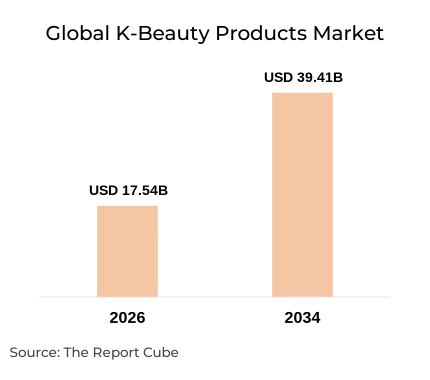
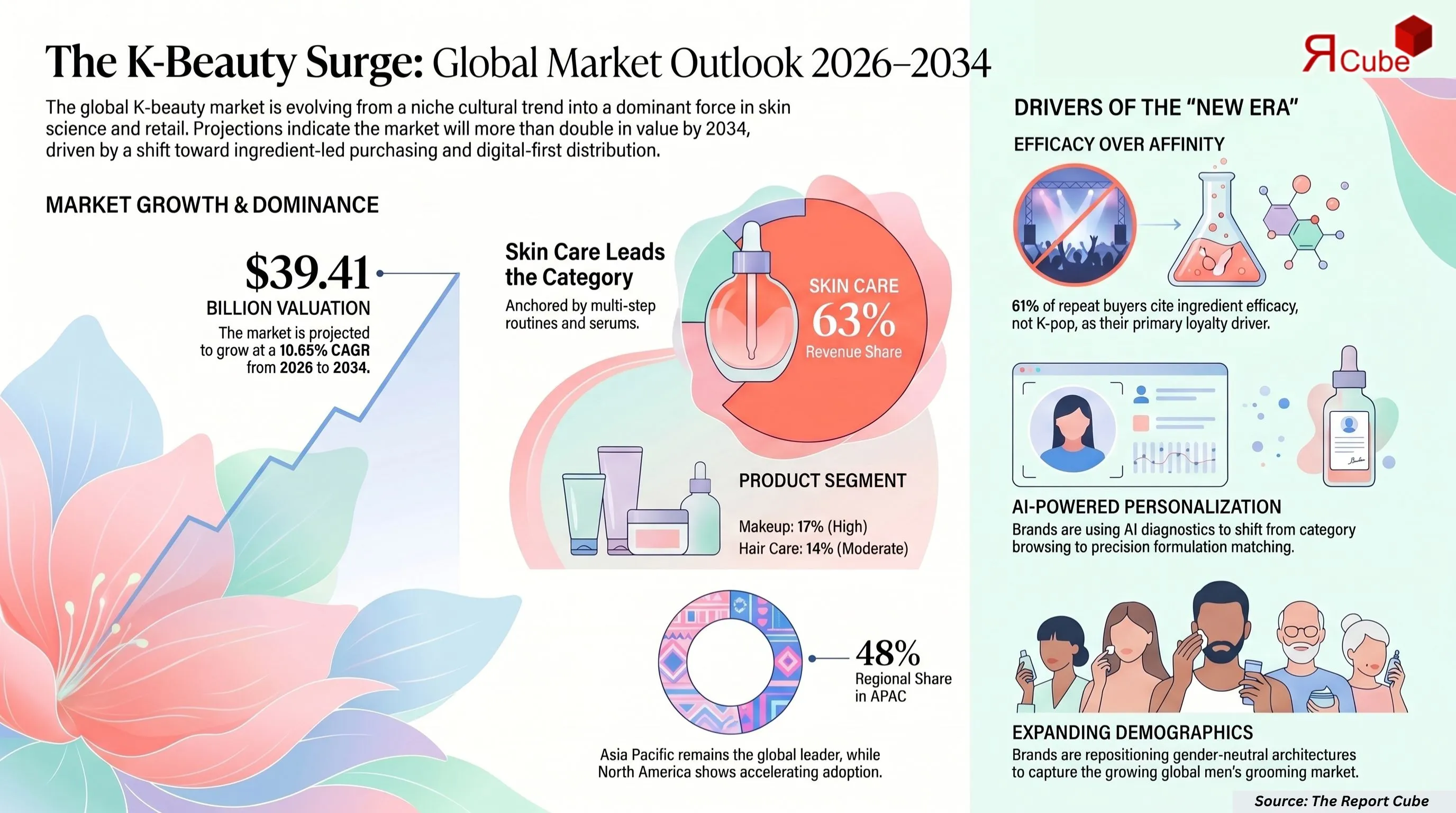
- The global K-beauty products market is projected to reach USD 39.41 billion by 2034, growing at a 10.65% CAGR from 2026.
- Skin care commands the largest revenue share, driven by consumer demand for multi-step routines and ingredient-forward formulations.
- Online distribution channels are the fastest-growing segment, accelerated by K-pop culture, social media influence, and cross-border e-commerce.
- Asia Pacific leads regional revenue; North America and Europe show accelerating adoption rates through 2034.
Global K-Beauty Products Market Insights & Analysis
K-beauty no longer functions as a niche import category, it has restructured global consumer expectations around skin science, routine transparency, and ingredient specificity. The market, valued at USD 17.54 billion in 2026, is forecast to more than double to USD 39.41 billion by 2034 at a 10.65% CAGR (Arizton, 2026). That pace of expansion reflects structural demand shifts, not a temporary trend cycle.
The growth engine sits at the intersection of three forces. First, the global spread of K-pop and Korean drama content has converted entertainment audiences into active beauty consumers, a mechanism documented across Southeast Asia, the United States, and Western Europe. Second, consumers have shifted from brand-led purchasing to ingredient-led purchasing; K-beauty's longstanding emphasis on active ingredients, niacinamide, centella asiatica, hyaluronic acid, snail secretion filtrate, maps precisely onto this behaviour. Third, the post-pandemic skincare boom validated premium, multi-step routines that were previously perceived as culturally specific. K-pop beauty market has become a studied category for global FMCG strategists tracking cultural-to-commerce conversion rates.
The market is not uniform. Product performance differs sharply by channel, geography, and consumer demographic. Online retail has absorbed the fastest share gains, given its ability to support discovery, review ecosystems, and low-barrier cross-border purchasing. Meanwhile, specialty retailers, Sephora, Olive Young flagships, and regional independents, maintain premium positioning and high basket values. Brands navigating both channel types without cannibalising margin face a distribution strategy inflection point that will define competitive rank through 2034.
Global K-Beauty Products Market Dynamics
Key Market Driver: Global Cultural Penetration of Korean Entertainment Content
K-beauty's commercial rise is inseparable from Korean soft power, but the dependency is shrinking. Spend on Korean beauty across non-Asian markets grew 18% year-on-year in 2024 (Korea International Trade Association, 2024), yet survey data from Mintel (2024) indicates that 61% of repeat K-beauty purchasers cite ingredient efficacy, not cultural affinity, as the primary repurchase reason. This shift from aspirational to functional loyalty widens the addressable market beyond the K-pop fan base and reduces churn risk for brands as entertainment trends evolve.
Major Industry Challenge: Counterfeit Products and Grey-Market Distribution
K-beauty's premiumisation creates a persistent counterfeiting problem that erodes both brand equity and consumer safety. The Korea Customs Service reported seizure of KRW 43.2 billion worth of counterfeit cosmetics in 2023 alone, with online marketplaces accounting for 68% of interception volume (Korea Customs Service, 2023). For legitimate brands, grey-market pricing undermines MAP enforcement, distorts channel economics, and creates regulatory exposure in markets with strict cosmetic ingredient registration, particularly the EU under Regulation (EC) No 1223/2009.
Emerging Trend: Personalisation Through AI-Powered Skin Diagnostics
K-beauty brands are deploying AI-driven skin diagnostic tools at scale, both in-store and through mobile applications, to shift the purchase journey from category browsing to precision formulation matching. Amorepacific's diagnostic platform logged over 3 million skin scans across its brand portfolio in 2023 (Amorepacific Annual Report, 2023). This capability reduces return rates, increases average order value, and generates proprietary consumer data assets, a compounding competitive advantage that smaller entrants cannot replicate without equivalent R&D investment.
Emerging Opportunity: Men's Grooming and Gender-Neutral Formulation
Male skincare in South Korea carries a 40-year cultural normalisation history that the rest of the world is now accelerating through. The global men's skincare market is projected to reach USD 18.9 billion by 2027 (Allied Market Research, 2023), and K-beauty brands, with existing gender-neutral product architectures, are positioned to capture disproportionate share. Brands including COSRX, Some By Mi, and Innisfree have launched or repositioned SKUs explicitly targeting male and non-binary consumers across the US and European markets through 2024–2025.
Need Specific Data, Let’s Customize the Report for You
Request CustomizationGlobal K-Beauty Products Market Segment-wise Analysis
By Product
Skin care dominates the global K-beauty products market, holding an estimated 62–65% revenue share in 2026. The segment's performance is anchored by the multi-step routine structure, cleansers, toners, essences, ampoules, serums, moisturisers, and SPF, which drives high per-consumer SKU counts and frequent repurchase cycles. Sheet masks remain a volume leader within skin care, but serum and ampoule sub-categories are recording the fastest unit value growth as consumers trade up to active-ingredient concentrations.
|
Product Segment |
Estimated Share (2026) |
Growth Outlook |
Dominant Brands |
|---|---|---|---|
|
Skin Care |
63% |
High |
Laneige, Sulwhasoo, COSRX, Dr. Jart+ |
|
Hair Care |
14% |
Moderate |
La'dor, Mise-en-scène, DP Hue |
|
Makeup |
17% |
High |
Clio, Etude House, Romand |
|
Others (fragrances, body) |
6% |
Moderate |
Various |
Hair care is the segment most likely to outperform in non-Asian markets through 2034, driven by growing consumer interest in scalp health, a category K-beauty brands pioneered with scalp-specific toners and ampoules, and by the cross-cultural applicability of bond-repair formulations. Makeup's growth is tied closely to social commerce and short-form video, where Korean lip and blush aesthetics generate disproportionate organic discovery.
By Distribution Channel
Online channels now represent the fastest-growing distribution segment in the global K-beauty market, projected to expand at a CAGR exceeding 13% through 2034. Social commerce platforms, TikTok Shop, Instagram Shopping, Naver SmartStore, have compressed the discovery-to-purchase journey from weeks to minutes, disproportionately benefitting brands with strong content programmes and influencer ecosystems.
|
Distribution Channel |
Estimated Share (2026) |
Growth Tag |
Key Brand Examples |
|---|---|---|---|
|
Online |
31% |
Fastest |
COSRX, Anua, Some By Mi |
|
Specialty Retailers |
24% |
High |
Sulwhasoo, Dr. Jart+, Laneige |
|
Supermarkets & Hypermarkets |
18% |
Moderate |
Innisfree, Nature Republic |
|
Mass Merchandisers |
12% |
Moderate |
Etude House, Missha |
|
Pharmacy & Drug Stores |
9% |
Moderate |
COSRX, Benton |
|
Convenience Stores |
4% |
Low |
Face Shop, Holika Holika |
|
Others |
2% |
Low |
Varied |
Specialty retailers, anchored by CJ OliveYoung's domestic and international expansion, including flagships in the US, Japan, and Southeast Asia, sustain high average transaction values and strong brand-building environments. CJ OliveYoung's US entry in 2023 demonstrated that the format travels; it reported 200,000+ unique visitors in its first six months of operation (CJ OliveYoung Investor Day, 2024). Pharmacy and drug store channels are an underpenetrated opportunity for science-backed K-beauty SKUs, particularly in markets where consumers trust pharmacist-adjacent shelf placement for skincare with active dermatological claims.
Regional Projection of the Global K-Beauty Products Market
|
Region |
Estimated Share (2026) |
Key Driver |
Gap / Risk |
|---|---|---|---|
|
Asia Pacific |
48% |
Domestic demand + regional export hub |
Market saturation in South Korea; price competition from J-beauty and C-beauty |
|
North America |
22% |
Cultural spillover, online adoption |
Regulatory variation by state; counterfeit volume on marketplaces |
|
Europe |
16% |
EU clean beauty alignment with K-beauty formulation ethos |
Ingredient registration complexity under EU Cosmetics Regulation |
|
Latin America |
8% |
Young demographic + rising disposable income |
Logistics cost; import duty structures |
|
Middle East & Africa |
4% |
Halal-compliant product demand; e-commerce infrastructure growth |
Low brand awareness outside UAE and Saudi Arabia |
|
Rest of World |
2% |
Emerging online channels |
Distribution underdevelopment |
- Asia Pacific commands nearly half the global market, with South Korea as the originating hub and Southeast Asia, particularly Indonesia, Thailand, Vietnam, and the Philippines, as the fastest-growing regional sub-market. The Asian beauty supplements market is increasingly intersecting with topical K-beauty, as ingestible collagen and skin health positioning align with K-beauty's inside-out skin wellness narrative.
- North America is the highest-value expansion market outside Asia. US consumers spent an estimated USD 2.1 billion on K-beauty products in 2024 (KITA, 2024), driven by Gen Z and millennial shoppers who cross-reference TikTok reviews, Reddit ingredient threads, and Amazon ratings before purchasing. Canada mirrors US trends with a 6–8-week lag.
- Europe's growth is structurally supported by ingredient overlap, K-beauty's low-irritant, high-moisturise formulation philosophy aligns with the EU clean beauty movement. However, EU Regulation (EC) No 1223/2009 requires Cosmetic Product Notification Portal (CPNP) registration for every SKU, creating a market entry cost that filters smaller brands and creates a moderate consolidation advantage for established players.
Global K-Beauty Products Market, Recent Developments (2025)
- March 2025, Amorepacific launched a new AI-assisted personalised serum system under the Sulwhasoo brand in the US, enabling consumers to configure active ingredient ratios via a skin scan at Nordstrom counters.
- February 2025, CJ OliveYoung opened its second US flagship store in Los Angeles, following its New York debut, as part of a stated plan to establish 10 North American locations by 2027 (CJ OliveYoung Press Release, February 2025).
- January 2025, COSRX expanded its Amazon US storefront to include a subscription refill programme for its flagship snail mucin serum range, targeting retention in the direct-to-consumer channel.
Global K-Beauty Products Market Future Outlook (2034)
K-beauty's forecast trajectory to USD 39.41 billion by 2034 depends on three parallel shifts that are already in motion. Brands that position ahead of these shifts will compound their channel and margin advantages. Those that do not will find the market increasingly difficult to enter as consolidation accelerates.
First, the ingredient economy will deepen. Consumer-level fluency with actives, retinal vs. retinol vs. retinoids; niacinamide concentrations; ceramide molecular weight variants, will continue to rise, raising the baseline formulation expectation for any brand seeking a premium price point. K-beauty brands with proprietary fermentation or biotechnology platforms, including Amorepacific's ginseng-derived actives and COSRX's clinically validated mucin concentration standards, carry durable formulation advantages over white-label competitors.
Second, regulatory convergence will function as a market barrier, not just a compliance cost. EU, US FDA, and Southeast Asian regulatory bodies are converging on more stringent ingredient disclosure and safety testing requirements. Brands with existing compliance infrastructure across multiple jurisdictions will enter new markets at lower cost per SKU, making geographic expansion a function of brand investment rather than regulatory rebuild.
Third, channel fragmentation will accelerate before it consolidates. Social commerce, retail media networks, direct subscription models, and AI-personalisation engines will each claim audience segments through 2028–2030. After that inflection point, brands with sufficient data assets will rationalise their channel portfolios around highest-margin, highest-loyalty segments, a shift that will likely advantage specialty retail and owned DTC over marketplace dependency.
Korea's government trade promotion body, KOTRA, has identified beauty as a strategic export sector with dedicated K-beauty market development programmes active across 15 countries through 2026 (KOTRA, 2024 Strategy Roadmap). State-level support in logistics, exhibition presence, and overseas market entry funding reduces the capital requirement for mid-tier K-beauty brands expanding internationally, widening the competitive field and sustaining category-level volume growth through the forecast window.
Global K-Beauty Products Market Report Coverage
|
Report Features |
Details |
|---|---|
|
Market Size (Value, 2026) |
USD 17.54 Billion |
|
Market Size (Value, 2034) |
USD 39.41 Billion |
|
Forecast Period |
2026-2034 |
|
CAGR |
10.65% |
|
Base Year |
2026 |
|
Historical Data |
2021–2025 |
|
Customisation |
Available |
|
Segments Covered |
By Product, By Distribution Channel, By End-user |
|
Regions Covered |
Asia Pacific, North America, Europe, Latin America, Middle East & Africa, Rest of World |
|
Key Companies |
CJ OliveYoung, Amorepacific Corporation, LG Household & Health Care, Laneige, Sulwhasoo, COSRX, Dr. Jart+, Etude House, Clio Cosmetics, Missha, The Face Shop, Nature Republic, Banila Co, Holika Holika |
|
Report Format |
PPT, PDF & Excel |
Why Choose This Report?
- Covers 2026-2034 with verified base-year data anchored to KITA and KCCA primary trade statistics, not secondary market aggregators.
- Provides distribution channel share tables with brand-level examples for each of the seven channels, enabling direct go-to-market benchmarking.
- Includes a dedicated section on counterfeit and grey-market risk with regulatory mitigation pathways across EU, US, and APAC jurisdictions.
- Profiles 14 named key players with strategic action summaries drawn from investor presentations and official press releases through Q1 2025.
- Delivers regional projections for six geographies with identified growth gaps and barriers, not aggregate global forecasts only.
- Maps the AI personalisation and ingredient-science trends reshaping brand differentiation through 2030.
- Supplied in PPT, PDF, and Excel formats to support cross-functional use across strategy, marketing, and investor relations teams.
Table of Contents
- Introduction
- Objective of the study
- Product Definition
- Market Segmentation
- Study Variables
- Research Methodology
- Secondary Data Points
- Companies Interviewed
- Primary Data Points
- Breakdown of Primary Interviews
- Secondary Data Points
- Executive Summary
- Market Dynamics
- Drivers
- Challenges
- Opportunity Assessment
- Recent Trends and Developments
- Policy and Regulatory Landscape
- Global K-Beauty Products Market Overview and Forecast Analysis (2021-2034)
- Market Size, By Value, By growth rate (CAGR/USD Billions)
- Demand - Supply Trends
- Market Share, By Product
- Skin Care
- Hair Care
- Makeup
- Others
- Market Share, By Distribution Channel
- Supermarkets & Hypermarkets
- Mass Merchandiser
- Specialty Retailer
- Convenience Stores
- Online
- Pharmacy & Drug Stores
- Others
- Market Share, By End-user
- Women
- Men
- Market Share, By Region
- Asia Pacific
- North America
- Europe
- Latin America
- Rest of World
- Market Share, By Company
- Revenue Shares
- Competition Characteristics
- North America K-Beauty Products Market Overview (2021-2034)
- Market Size, By Value (in USD Billions)
- Market Share, By Product
- Market Share, By Distribution Channel
- Market Share, By End-user
- By Country
- The US
- Canada
- Mexico
- The US K-Beauty Products Market Overview (2021-2034)
- Market Share, By Product
- Market Share, By Distribution Channel
- Market Share, By End-user
- Canada K-Beauty Products Market Overview (2021-2034)
- Market Share, By Product
- Market Share, By Distribution Channel
- Market Share, By End-user
- Mexico K-Beauty Products Market Overview (2021-2034)
- Market Share, By Product
- Market Share, By Distribution Channel
- Market Share, By End-user
- South America K-Beauty Products Market Overview (2021-2034)
- Market Size, By Value (in USD Billions)
- Market Share, By Product
- Market Share, By Distribution Channel
- Market Share, By End-user
- By Country
- Brazil
- Argentina
- Rest of South America
- Brazil K-Beauty Products Market Overview (2021-2034)
- Market Share, By Product
- Market Share, By Distribution Channel
- Market Share, By End-user
- Argentina K-Beauty Products Market Overview (2021-2034)
- Market Share, By Product
- Market Share, By Distribution Channel
- Market Share, By End-user
- Europe K-Beauty Products Market Overview (2021-2034)
- Market Size, By Value (in USD Billions)
- By Product
- By Distribution Channel
- By End-user
- By Country
- Germany
- The UK
- France
- Spain
- Italy
- Rest of Europe
- Germany K-Beauty Products Market Overview (2021-2034)
- Market Share, By Product
- Market Share, By Distribution Channel
- Market Share, By End-user
- France K-Beauty Products Market Overview (2021-2034)
- Market Share, By Product
- Market Share, By Distribution Channel
- Market Share, By End-user
- The UK K-Beauty Products Market Overview (2021-2034)
- Market Share, By Product
- Market Share, By Distribution Channel
- Market Share, By End-user
- Spain K-Beauty Products Market Overview (2021-2034)
- Market Share, By Product
- Market Share, By Distribution Channel
- Market Share, By End-user
- Italy K-Beauty Products Market Overview (2021-2034)
- Market Share, By Product
- Market Share, By Distribution Channel
- Market Share, By End-user
- The Middle East & Africa K-Beauty Products Market Overview (2021-2034)
- Market Size, By Value (in USD Billions)
- By Product
- By Distribution Channel
- By End-user
- By Country
- The UAE
- Saudi Arabia
- South Africa
- Rest of the Middle East & Africa
- The UAE K-Beauty Products Market Overview (2021-2034)
- Market Share, By Product
- Market Share, By Distribution Channel
- Market Share, By End-user
- Saudi Arabia K-Beauty Products Market Overview (2021-2034)
- Market Share, By Product
- Market Share, By Distribution Channel
- Market Share, By End-user
- South Africa K-Beauty Products Market Overview (2021-2034)
- Market Share, By Product
- Market Share, By Distribution Channel
- Market Share, By End-user
- Asia-Pacific K-Beauty Products Market Overview (2021-2034)
- Market Size, By Value (in USD Billions)
- By Product
- By Distribution Channel
- By End-user
- By Country
- China
- India
- Japan
- South Korea
- Australia
- Rest of Asia-Pacific
- China K-Beauty Products Market Overview (2021-2034)
- Market Share, By Product
- Market Share, By Distribution Channel
- Market Share, By End-user
- India K-Beauty Products Market Overview (2021-2034)
- Market Share, By Product
- Market Share, By Distribution Channel
- Market Share, By End-user
- Japan K-Beauty Products Market Overview (2021-2034)
- Market Share, By Product
- Market Share, By Distribution Channel
- Market Share, By End-user
- South Korea K-Beauty Products Market Overview (2021-2034)
- Market Share, By Product
- Market Share, By Distribution Channel
- Market Share, By End-user
- Austraila K-Beauty Products Market Overview (2021-2034)
- Market Share, By Product
- Market Share, By Distribution Channel
- Market Share, By End-user
- Competitive Outlook (Company Profile - Partial List)
- CJ OliveYoung
- Company Overview
- Business Segments
- Strategic Alliances/Partnerships
- Recent Developments
- Laneige
- Company Overview
- Business Segments
- Strategic Alliances/Partnerships
- Recent Developments
- Sulwhasoo
- Company Overview
- Business Segments
- Strategic Alliances/Partnerships
- Recent Developments
- Etude House
- Company Overview
- Business Segments
- Strategic Alliances/Partnerships
- Recent Developments
- LG Household & Health Care
- Company Overview
- Business Segments
- Strategic Alliances/Partnerships
- Recent Developments
- Amorepacific Corporation
- Company Overview
- Business Segments
- Strategic Alliances/Partnerships
- Recent Developments
- The Face Shop
- Company Overview
- Business Segments
- Strategic Alliances/Partnerships
- Recent Developments
- Nature Republic
- Company Overview
- Business Segments
- Strategic Alliances/Partnerships
- Recent Developments
- COSRX
- Company Overview
- Business Segments
- Strategic Alliances/Partnerships
- Recent Developments
- Clio Cosmetics
- Company Overview
- Business Segments
- Strategic Alliances/Partnerships
- Recent Developments
- Missha
- Company Overview
- Business Segments
- Strategic Alliances/Partnerships
- Recent Developments
- Dr. Jart+
- Company Overview
- Business Segments
- Strategic Alliances/Partnerships
- Recent Developments
- Banila Co
- Company Overview
- Business Segments
- Strategic Alliances/Partnerships
- Recent Developments
- Holika Holika
- Company Overview
- Business Segments
- Strategic Alliances/Partnerships
- Recent Developments
- Others
- CJ OliveYoung
- Disclaimer
Top Key Players & Market Share Outlook
- CJ OliveYoung
- Laneige
- Sulwhasoo
- Etude House
- LG Household & Health Care
- Amorepacific Corporation
- The Face Shop
- Nature Republic
- COSRX
- Clio Cosmetics
- Missha
- Dr. Jart+
- Banila Co
- Holika Holika
- Others
Frequently Asked Questions






