



Build Your Custom Market Intelligence Report
Customize Your ReportMiddle East Kamikaze Drones Market Key Highlights
By Type:
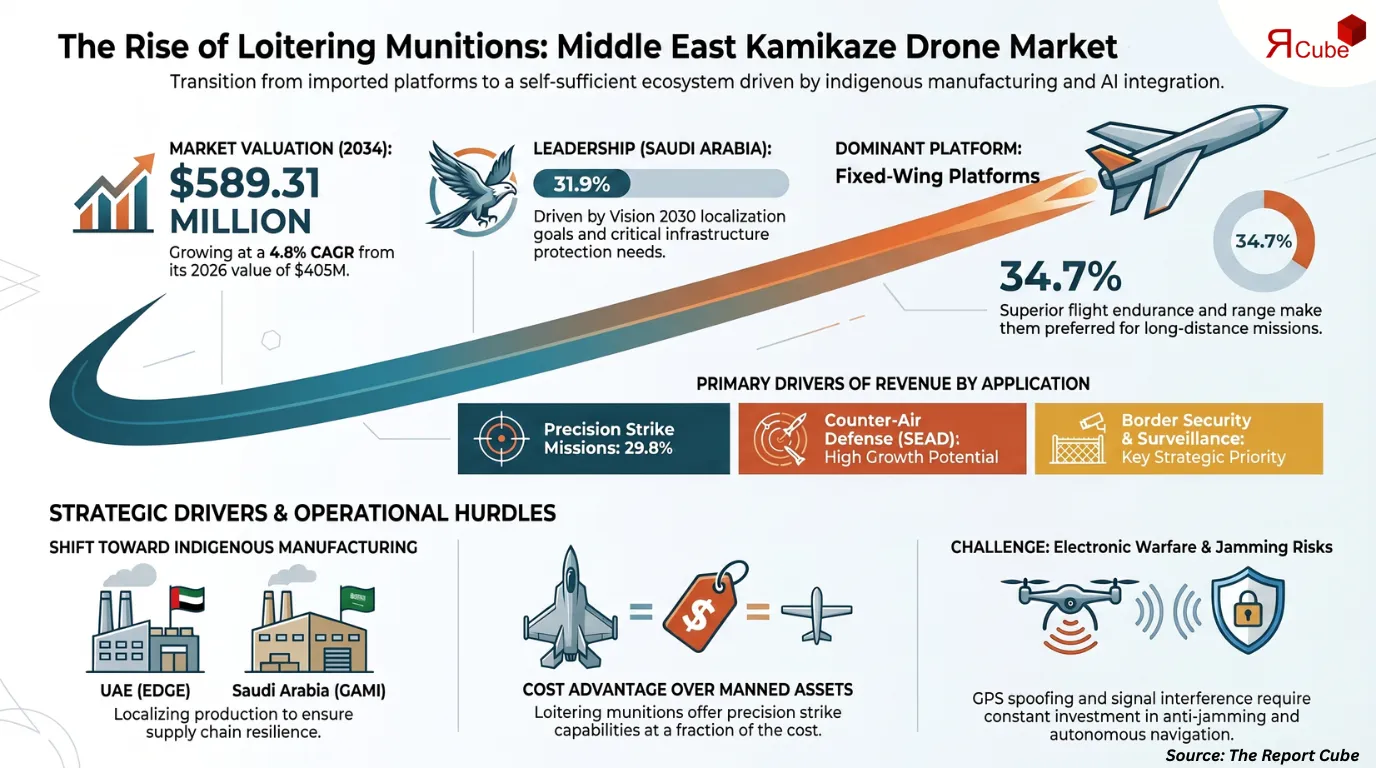
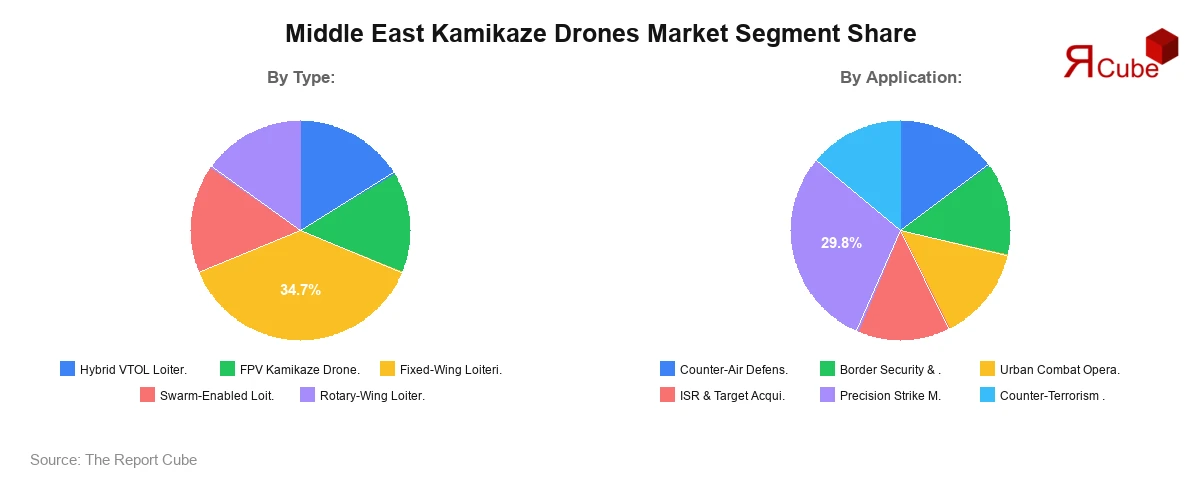
Fixed-Wing Loitering Munition segment leads the market with approximately 34.7% market share.
By Application:
Precision Strike Missions segment dominates the market with nearly 29.8% of total revenue.
Countries Outlook:
Saudi Arabia dominates the Middle East Kamikaze Drones Market with an estimated 31.9% share.
Middle East Kamikaze Drones Market Insights & Analysis
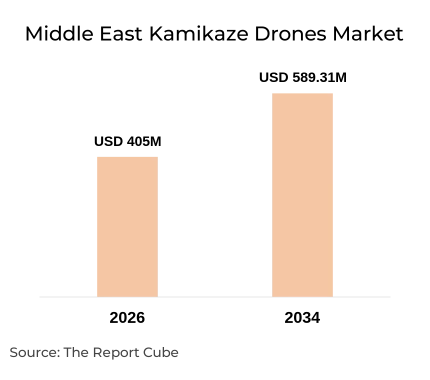
The Middle East Kamikaze Drones Market is anticipated to register a CAGR of around 4.8% during the forecast period 2026-2034. The market size is valued at USD 405 million in 2026 and is projected to reach USD 589.31 million by 2034. Procurement priorities across the Middle East continue shifting toward precision-guided unmanned systems capable of delivering tactical advantages while reducing operational costs. Loitering munitions have become an essential component of modern military doctrine because they combine intelligence gathering, target identification, and strike capability within a single platform. Their operational flexibility has encouraged wider deployment across border surveillance, suppression of enemy air defenses, urban warfare, and counter-terrorism missions. Rising security concerns, evolving asymmetric threats, and the need for rapid battlefield response continue influencing procurement decisions across Saudi Arabia, the United Arab Emirates, Israel, Egypt, Qatar, and neighboring defense markets.
Regional governments are steadily increasing investment in indigenous drone manufacturing to strengthen supply chain resilience and reduce reliance on imported military equipment. Saudi Arabia's defense localization initiatives under Vision 2030 and the UAE's continued support for domestic defense manufacturers have accelerated development of next-generation loitering munitions equipped with advanced electro-optical payloads, encrypted communications, autonomous navigation, and electronic warfare protection. Defense companies are also focusing on modular designs that simplify maintenance while allowing payload customization for different operational scenarios. Recent procurement programs indicate growing demand for medium-range and long-range kamikaze drones capable of operating in GPS-contested environments. These technology upgrades, combined with increasing collaboration between regional manufacturers and international defense firms, are expected to support stable market expansion throughout the forecast period.
Middle East Kamikaze Drones Market Impact Analysis
| Factor | Type | Specific Impact on Market | Magnitude | Business Implication |
|---|---|---|---|---|
| Persistent Regional Conflicts | Market | Active tensions drive demand for expendable precision strike tools | High | Supports rapid procurement cycles and recurring defense contracts |
| Shift Toward Autonomous Warfare | Technological | AI enabled guidance improves accuracy and mission success rates | High | Rewards firms investing in smart navigation and target recognition |
| Cost Advantage Versus Manned Assets | Market | Lower unit cost than jets increases deployment willingness in battle | High | Encourages bulk orders and portfolio design focused on affordability |
| Local Manufacturing Capabilities | Competitive | Regional players scale domestic production for export and supply | Medium | Intensifies competition and pushes innovation in design and payloads |
| Regulatory And Ethical Scrutiny | Regulatory | Legal debates on autonomy may slow adoption or restrict usage zones | Medium | Requires compliance focused product features and robust usage doctrines |
| Integration With Drone Analytics | Technological | Advanced analytics enhance targeting, damage assessment and planning | Medium | Creates demand for bundled hardware software and data services |
| Global Arms Race Dynamics | Environmental | Perceived capability gaps push states to expand kamikaze fleets fast | High | Drives long term program funding and multi year supply agreements |
Middle East Kamikaze Drones Market Dynamics
Key Driver: Defense Procurement Prioritizes Precision Strike Capabilities
Military modernization programs across the Middle East increasingly emphasize precision engagement systems that improve operational effectiveness without exposing personnel to unnecessary battlefield risks. Kamikaze drones have emerged as an attractive solution because they provide reconnaissance, target confirmation, and precision attack capabilities within a single mission profile. Their ability to engage moving targets with minimal collateral damage has strengthened procurement across land forces, special operations units, and border security agencies. Countries facing persistent regional security challenges continue allocating larger defense budgets toward loitering munitions that can be rapidly deployed in both conventional and irregular warfare environments.
National defense strategies are also encouraging long-term investment in domestic production capabilities rather than depending entirely on imported platforms. Local manufacturing partnerships, technology transfer agreements, and expanded research programs are helping regional companies improve production capacity and system integration capabilities. Continuous improvements in guidance systems, endurance, secure communications, and mission software are increasing confidence among defense agencies, making kamikaze drones an integral element of future battlefield planning across the Middle East.
Industry Trend: Indigenous Manufacturing Reshapes Regional Defense Supply Chains
Governments across the Gulf are steadily transforming their defense industries by expanding local production of unmanned combat systems. Instead of relying solely on overseas suppliers, regional manufacturers are developing loitering munitions tailored to desert operations, long-distance surveillance, and electronic warfare environments. Companies are investing in lightweight composite materials, hybrid propulsion systems, and modular payload architectures that improve operational flexibility while reducing maintenance requirements. These developments are strengthening local industrial capabilities and creating a more resilient regional defense ecosystem.
Another significant trend is the growing integration of autonomous flight management, secure data links, multi-sensor payloads, and anti-jamming technologies into new-generation kamikaze drones. Military exercises conducted across the Gulf increasingly include loitering munitions as part of integrated air and land operations, reflecting their expanding tactical role. Manufacturers are also enhancing interoperability with command-and-control networks, enabling faster target acquisition and coordinated battlefield response during complex military operations.
Book your FREE 30-minute expert consultation today
Contact UsMajor Challenge: Electronic Warfare and Component Availability Remain Critical Constraints
Operational performance of loitering munitions depends heavily on reliable navigation systems, secure communications, and high-performance electronic components. Access to advanced processors, imaging sensors, navigation modules, and encrypted communication equipment remains constrained by international export regulations and supply chain disruptions. Procurement delays associated with specialized aerospace components can extend development timelines while increasing manufacturing costs for regional defense companies seeking greater technological independence.
Battlefield conditions have also become increasingly challenging as armed forces invest heavily in electronic warfare capabilities designed to disrupt unmanned systems. GPS spoofing, signal jamming, cyber interference, and advanced air defense networks require manufacturers to continuously improve mission resilience through alternative navigation methods, encrypted communication protocols, and intelligent flight control software. Maintaining technological superiority under these conditions demands sustained research investment, creating cost pressures across the industry.
Opportunity: Export-Oriented Defense Manufacturing Creates Long-Term Growth Potential
Regional defense manufacturers are expanding beyond domestic procurement by positioning locally developed loitering munitions for international markets. Competitive production costs, government-backed industrial programs, and increasing technological maturity have strengthened export prospects across Africa, Central Asia, and selected European defense markets. Countries seeking affordable precision strike systems are showing growing interest in combat-proven platforms manufactured within the Middle East, particularly those offering modular payloads and flexible deployment options.
Future opportunities are expected to emerge from continued investment in autonomous targeting, swarm-enabled operations, hybrid propulsion, and artificial intelligence-assisted mission management. These capabilities will allow manufacturers to address evolving operational requirements while improving export competitiveness. As regional production capacity expands and defense partnerships deepen, locally developed kamikaze drone platforms are expected to secure a stronger presence in the global loitering munitions market over the coming decade.
Middle East Kamikaze Drones Market Segment-wise Analysis
By Type:
- Hybrid VTOL Loitering Munition
- FPV Kamikaze Drones
- Fixed-Wing Loitering Munition
- Swarm-Enabled Loitering Munitions
- Rotary-Wing Loitering Munition
Fixed-Wing Loitering Munition held the largest share of approximately 34.7% in the Middle East Kamikaze Drones Market in 2026, reflecting its widespread adoption across modern military operations. These systems offer significantly longer flight endurance and greater operational range than rotary-wing or FPV variants, enabling armed forces to monitor large operational areas before engaging designated targets. Their ability to combine real-time intelligence gathering with precision strike capability makes them highly effective for border surveillance, strategic infrastructure protection, suppression of enemy air defenses, and long-range tactical missions. Military organizations across Saudi Arabia, Israel, the United Arab Emirates, and Egypt continue integrating fixed-wing loitering munitions into their operational inventories as part of broader defense modernization programs.
Manufacturers are continuously enhancing fixed-wing platforms through lightweight composite airframes, improved propulsion systems, anti-jamming navigation, encrypted communication links, and multi-sensor payload integration. Many next-generation systems are designed to operate in GPS-denied environments while maintaining stable target tracking and mission accuracy. Their relatively lower operating costs compared with conventional precision-guided missiles further strengthen procurement across regional defense agencies seeking cost-effective strike capabilities. Ongoing investments in indigenous production facilities and collaborative defense development programs are expected to reinforce the leadership of this segment throughout the forecast period.
By Application:
- Counter-Air Defense Suppression (SEAD)
- Border Security & Surveillance
- Urban Combat Operations
- ISR & Target Acquisition
- Precision Strike Missions
- Counter-Terrorism Operations
Precision Strike Missions accounted for nearly 29.8% of total market revenue in 2026, making it the leading application segment across the Middle East Kamikaze Drones Market. Regional armed forces increasingly rely on loitering munitions to neutralize high-value targets with greater accuracy while minimizing collateral damage and reducing risks to personnel. These systems provide operators with the ability to identify, verify, and engage moving or concealed targets during a single mission, making them highly valuable for modern combat operations. Their growing deployment across border conflicts, urban warfare, and counter-terrorism operations has significantly strengthened demand for advanced kamikaze drones equipped with precision-guided attack capabilities.
Recent battlefield experiences have accelerated investment in autonomous targeting technologies, electro-optical sensors, thermal imaging systems, and secure data transmission that improve strike accuracy under challenging operational conditions. Integration with command-and-control networks enables real-time mission updates and coordinated engagement across multiple military units. Defense agencies also favor loitering munitions because they deliver precision effects at considerably lower operational costs than many traditional guided weapon systems. As regional militaries continue expanding their precision warfare capabilities, this application is expected to remain the primary source of demand during the forecast period.
Regional Projection of Middle East Kamikaze Drones Industry
- Saudi Arabia
- United Arab Emirates
- South Africa
- Egypt
- Qatar
- Kuwait
- Oman
- Kenya
- Tanzania
- Rest of the Middle East & Africa
Saudi Arabia represented the largest country market with an estimated 31.9% share in 2026, supported by sustained investments in defense modernization and domestic aerospace manufacturing. The Kingdom continues strengthening its unmanned combat capabilities through long-term procurement programs focused on advanced loitering munitions, tactical unmanned aerial systems, and precision-guided weapons. Rising defense expenditure, combined with increasing emphasis on protecting critical infrastructure, extensive land borders, and strategic energy assets, continues to support demand for kamikaze drone systems across multiple branches of the armed forces.
Government initiatives promoting defense localization under Vision 2030 have accelerated partnerships between international defense manufacturers and Saudi companies, expanding local production, technology transfer, and research capabilities. Investments in autonomous navigation, electronic warfare resilience, secure communications, and advanced payload technologies are enhancing the operational performance of domestically supported platforms. The country's commitment to developing a self-reliant defense industry, alongside continuous military modernization, is expected to preserve Saudi Arabia's leading position in the Middle East Kamikaze Drones Market throughout the forecast period.
Need insights for a specific region within this market?
Request Regional DataMiddle East & Africa Kamikaze Drones Market – Countries Analysis
The regional kamikaze drones market differs by threat level, defence budgets, and local defence-industrial ambitions.
| Country / Cluster | Demand Level | Key Areas | System Dominance | Core Demand Logic | Growth Nature |
|---|---|---|---|---|---|
| Saudi Arabia | Very High | Riyadh, Eastern Province | Imported & local Shahed-style LM | Post-2026 Iran strike deterrence | Rapid capability build-up |
| United Arab Emirates | Very High | Abu Dhabi, critical energy hubs | EDGE-linked loitering munitions | Layered defence and export focus | Innovation-led scaling |
| South Africa | Medium | Pretoria, Cape Town defence belt | Locally engineered tactical LM | Defence R&D and niche exports | Technology-driven growth |
| Egypt | High | Suez, Sinai, Western Desert | Imported LM with local assembly | Border security and counter terror | Steady modernization trend |
| Qatar | High | Doha, airbase perimeters | Allied-supplied kamikaze drones | Base protection and rapid response | Budget-backed expansion |
| Kuwait | Medium | Kuwait City, oil corridor | Imported LM with C-UAS pairing | Missile–drone threat post Iran war | Cautious but rising demand |
| Oman | Medium | Muscat, coastal energy sites | Small inventory of attack LM | Deterrence and coastal defence | Gradual procurement curve |
| Kenya | Medium | Nairobi, border belts | Light tactical LM for ISR-strike | Counter insurgency and border gaps | Mission-driven adoption |
| Tanzania | Low | Dar es Salaam, coastal axis | Small imported LM batches | Limited high-end defence budgets | Slow, budget-bound growth |
| Rest of Middle East & Africa | High | Nigeria, Morocco, regional hubs | Mixed Turkish, Iranian, local LM | Border defence and proxy conflicts | Fragmented but strong CAGR |
Government Initiatives & Policies
- Saudi Arabia Vision 2030 Defense Localization Program: Saudi Arabia continues expanding defense localization through the General Authority for Military Industries (GAMI), targeting over 50% localization of military spending while strengthening domestic production of unmanned aerial systems and advanced defense technologies.
- UAE EDGE and Tawazun Industrial Development Programs (2025-2026): The UAE continues supporting indigenous defense manufacturing through strategic procurement, research funding, and industrial partnerships that accelerate development of autonomous unmanned combat systems, loitering munitions, and AI-enabled defense technologies.
Middle East Kamikaze Drones Industry Recent Developments
- 2026: EDGE Group PJSC expanded the international deployment of its locally developed loitering munition portfolio by strengthening export partnerships and showcasing advanced autonomous strike systems featuring enhanced endurance, AI-enabled navigation, anti-jamming capabilities, and modular payload configurations for regional and international defense customers.
- 2025: Israel Aerospace Industries Ltd. continued advancing its loitering munition product portfolio by integrating improved autonomous mission planning, secure communications, enhanced electro-optical targeting, and electronic warfare resilience to address evolving operational requirements across modern combat environments.
- 2025: Baykar Teknoloji Anonim Şirketi accelerated investments in unmanned combat technologies by expanding production capacity and strengthening integration between unmanned aerial platforms, smart munitions, and network-centric battlefield management systems for regional defense customers.
Why Choose This Report?
- Provides a comprehensive overview of the overall market analysis, encompassing key trends, consumer behavior analysis, and risk assessment to support strategic decision-making.
- Provides accurate, up-to-date insights into market size, segmentation, and emerging opportunities, helping organizations minimize risk while capitalizing on growth opportunities.
- Gives a deep understanding of target end-user requirements, procurement trends, defense modernization programs, and technology adoption for enhanced product development and market positioning.
- Delivers competitive analysis and benchmarking, uncovering the strengths, product strategies, partnerships, and innovation capabilities of leading market participants.
- Consolidates comprehensive market intelligence, reducing research efforts and enabling faster strategic planning for stakeholders.
- Facilitates customized market segmentation and risk mitigation strategies aligned with specific business objectives, investment priorities, and regional expansion plans.
- Assists in identifying both existing market challenges and untapped growth opportunities across defense procurement, indigenous manufacturing, and export markets.
- Provides valuable information based on verified industry developments, procurement trends, government initiatives, company activities, and evolving customer demand.
Table of Contents
- Introduction
- Objective of the Study
- Product and Category Definition
- Market Segmentation
- Study Variables
- Research Methodology
- Secondary Data Points
- Breakdown of Secondary Sources
- Primary Data Points
- Breakdown of Primary Interviews
- Secondary Data Points
- Executive Summary
- Market Dynamics
- Emerging Opportunities
- Adoption Trends
- Demand Drivers
- Disruption Analysis (Challenges)
- Industry Analysis & Strategic Insights
- Supply/Value Chain Analysis
- Pricing Analysis
- Go-To-Market (GTM) Strategy
- BCG Matrix
- Recent Trends and Developments
- Import and Export Analysis
- Regulatory and Policy Landscape
- Country-wise policies
- Government Initiatives
- Middle East Kamikaze Drones Market Overview and Forecast Analysis (2021-2034)
- Market Size, By Value and Growth Rate (CAGR/USD Billion)
- Market Share, By Type
- Hybrid VTOL Loitering Munition
- FPV Kamikaze Drones
- Fixed-Wing Loitering Munition
- Swarm-Enabled Loitering Munitions
- Rotary-Wing Loitering Munition
- Market Share, By Range
- Short-Range (Upto 20 km)
- Medium-Range (20-100 km)
- Long-Range (Above 100 km)
- Market Share, By Launch Mode
- VTOL
- Hand-Launched
- Catapult-Launched
- Tube-Launched
- Market Share, By Mode of Operation
- Semi-Autonomous
- Autonomous
- Market Share, By Payload Type
- Multi-Role Payload
- Anti-Radiation
- Anti-Personnel
- Anti-Armor
- Market Share, By Propulsion Type
- Fuel Powered
- Hybrid Powered
- Electric Powered
- Market Share, By Application
- Counter-Air Defense Suppression (SEAD)
- Border Security & Surveillance
- Urban Combat Operations
- ISR & Target Acquisition
- Precision Strike Missions
- Counter-Terrorism Operations
- Market Share, By End User
- Naval Forces
- Air Force
- Army / Land Forces
- Special Operations Forces
- Market Share, By Country
- Saudi Arabia
- United Arab Emirates
- South Africa
- Egypt
- Qatar
- Kuwait
- Oman
- Kenya
- Tanzania
- Rest of the Middle East & Africa
- Market Share, By Company
- Revenue Shares & Analysis
- Competitive Landscape
- Saudi Arabia Kamikaze Drones Market Overview and Forecast Analysis (2021-2034)
- Market Size, By Value and Growth Rate (CAGR/USD Billion/Million)
- Market Share, By Type
- Market Share, By Range
- Market Share, By Launch Mode
- Market Share, By Mode of Operation
- Market Share, By Payload Type
- Market Share, By Propulsion Type
- Market Share, By Application
- Market Share, By End User
- United Arab Emirates Kamikaze Drones Market Overview and Forecast Analysis (2021-2034)
- Market Size, By Value and Growth Rate (CAGR/USD Billion/Million)
- Market Share, By Type
- Market Share, By Range
- Market Share, By Launch Mode
- Market Share, By Mode of Operation
- Market Share, By Payload Type
- Market Share, By Propulsion Type
- Market Share, By Application
- Market Share, By End User
- South Africa Kamikaze Drones Market Overview and Forecast Analysis (2021-2034)
- Market Size, By Value and Growth Rate (CAGR/USD Billion/Million)
- Market Share, By Type
- Market Share, By Range
- Market Share, By Launch Mode
- Market Share, By Mode of Operation
- Market Share, By Payload Type
- Market Share, By Propulsion Type
- Market Share, By Application
- Market Share, By End User
- Egypt Kamikaze Drones Market Overview and Forecast Analysis (2021-2034)
- Market Size, By Value and Growth Rate (CAGR/USD Billion/Million)
- Market Share, By Type
- Market Share, By Range
- Market Share, By Launch Mode
- Market Share, By Mode of Operation
- Market Share, By Payload Type
- Market Share, By Propulsion Type
- Market Share, By Application
- Market Share, By End User
- Qatar Kamikaze Drones Market Overview and Forecast Analysis (2021-2034)
- Market Size, By Value and Growth Rate (CAGR/USD Billion/Million)
- Market Share, By Type
- Market Share, By Range
- Market Share, By Launch Mode
- Market Share, By Mode of Operation
- Market Share, By Payload Type
- Market Share, By Propulsion Type
- Market Share, By Application
- Market Share, By End User
- Kuwait Kamikaze Drones Market Overview and Forecast Analysis (2021-2034)
- Market Size, By Value and Growth Rate (CAGR/USD Billion/Million)
- Market Share, By Type
- Market Share, By Range
- Market Share, By Launch Mode
- Market Share, By Mode of Operation
- Market Share, By Payload Type
- Market Share, By Propulsion Type
- Market Share, By Application
- Market Share, By End User
- Oman Kamikaze Drones Market Overview and Forecast Analysis (2021-2034)
- Market Size, By Value and Growth Rate (CAGR/USD Billion/Million)
- Market Share, By Type
- Market Share, By Range
- Market Share, By Launch Mode
- Market Share, By Mode of Operation
- Market Share, By Payload Type
- Market Share, By Propulsion Type
- Market Share, By Application
- Market Share, By End User
- Kenya Kamikaze Drones Market Overview and Forecast Analysis (2021-2034)
- Market Size, By Value and Growth Rate (CAGR/USD Billion/Million)
- Market Share, By Type
- Market Share, By Range
- Market Share, By Launch Mode
- Market Share, By Mode of Operation
- Market Share, By Payload Type
- Market Share, By Propulsion Type
- Market Share, By Application
- Market Share, By End User
- Tanzania Kamikaze Drones Market Overview and Forecast Analysis (2021-2034)
- Market Size, By Value and Growth Rate (CAGR/USD Billion/Million)
- Market Share, By Type
- Market Share, By Range
- Market Share, By Launch Mode
- Market Share, By Mode of Operation
- Market Share, By Payload Type
- Market Share, By Propulsion Type
- Market Share, By Application
- Market Share, By End User
- Competitive Analysis, 2026
- Market Share of Key Players
- Competitive Mapping for Each Segment and Companies Operating Countryally
- Saudi Arabia Kamikaze Drones Companies Share & Competitive Analysis, 2026
- United Arab Emirates Kamikaze Drones Companies Share & Competitive Analysis, 2026
- South Africa Kamikaze Drones Companies Share & Competitive Analysis, 2026
- Egypt Kamikaze Drones Companies Share & Competitive Analysis, 2026
- Qatar Kamikaze Drones Companies Share & Competitive Analysis, 2026
- Kuwait Kamikaze Drones Companies Share & Competitive Analysis, 2026
- Oman Kamikaze Drones Companies Share & Competitive Analysis, 2026
- Kenya Kamikaze Drones Companies Share & Competitive Analysis, 2026
- Tanzania Kamikaze Drones Companies Share & Competitive Analysis, 2026
- Company Profile (Partial List)
- WB Electronics S.A.
- Company Overview
- Product Portfolio
- Strategic Alliances/Partnerships
- Recent Developments
- Baykar Teknoloji Anonim Şirketi
- Company Overview
- Product Portfolio
- Strategic Alliances/Partnerships
- Recent Developments
- Abu Dhabi Autonomous Systems Investments LLC (ADASI)
- Company Overview
- Product Portfolio
- Strategic Alliances/Partnerships
- Recent Developments
- EDGE Group PJSC
- Company Overview
- Product Portfolio
- Strategic Alliances/Partnerships
- Recent Developments
- Turkish Aerospace Industries Anonim Şirketi
- Company Overview
- Product Portfolio
- Strategic Alliances/Partnerships
- Recent Developments
- Rafael Advanced Defense Systems Ltd.
- Company Overview
- Product Portfolio
- Strategic Alliances/Partnerships
- Recent Developments
- AeroVironment, Inc.
- Company Overview
- Product Portfolio
- Strategic Alliances/Partnerships
- Recent Developments
- ZALA Aero Group LLC
- Company Overview
- Product Portfolio
- Strategic Alliances/Partnerships
- Recent Developments
- Elbit Systems Ltd.
- Company Overview
- Product Portfolio
- Strategic Alliances/Partnerships
- Recent Developments
- STM Savunma Teknolojileri Mühendislik ve Ticaret A.Ş.
- Company Overview
- Product Portfolio
- Strategic Alliances/Partnerships
- Recent Developments
- Israel Aerospace Industries Ltd.
- Company Overview
- Product Portfolio
- Strategic Alliances/Partnerships
- Recent Developments
- UVision Air Ltd.
- Company Overview
- Product Portfolio
- Strategic Alliances/Partnerships
- Recent Developments
- Others (Partial List)
- WB Electronics S.A.
- Contact Us and Disclaimer
Top Key Players & Market Share Outlook
- WB Electronics S.A.
- Baykar Teknoloji Anonim Şirketi
- Abu Dhabi Autonomous Systems Investments LLC (ADASI)
- EDGE Group PJSC
- Turkish Aerospace Industries Anonim Şirketi
- Rafael Advanced Defense Systems Ltd.
- AeroVironment, Inc.
- ZALA Aero Group LLC
- Elbit Systems Ltd.
- STM Savunma Teknolojileri Mühendislik ve Ticaret A.Ş.
- Israel Aerospace Industries Ltd.
- UVision Air Ltd.
- Others
Frequently Asked Questions






