


Build Your Custom Market Intelligence Report
Customize Your ReportKey Takeaways
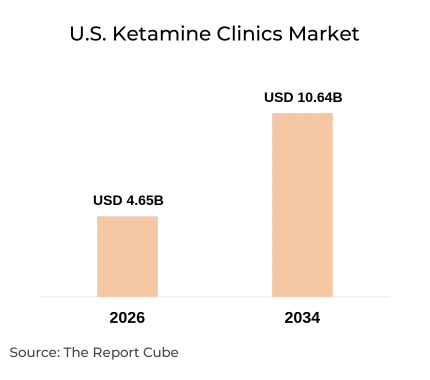
- U.S. Ketamine Clinics Market is valued at USD 4.65 billion in 2026.
- The market is projected to reach USD 10.64 billion by 2034 at a CAGR of 10.90%.
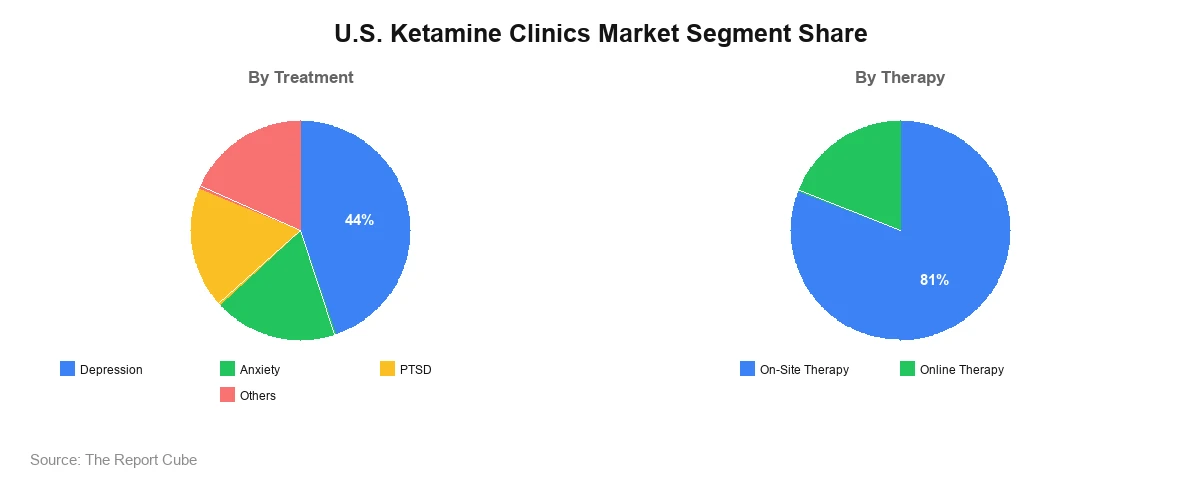
- Depression leads the treatment segment with an estimated 44% share in 2026.
- On-site therapy leads the therapy segment with an estimated 81% share in 2026.
- North is the leading region with an estimated 32% share in 2026.
- Better U, Innerwell, Mindbloom, Klarisana Health and Beckley Clinical are among the supplied key players.
- Telehealth-supported hybrid care is an important trend shaping clinic service models.
Market Overview
Ketamine clinics are specialized outpatient facilities that administer ketamine and related therapies, including esketamine, under clinical supervision. Services commonly address treatment-resistant depression, anxiety, post-traumatic stress disorder and other mental health conditions. Treatment may involve intravenous, intramuscular or supervised administration, combined with screening, monitoring and psychotherapy support delivered by physicians, nurses and mental health professionals.
The U.S. Ketamine Clinics Market Analysis shows demand shaped by treatment-resistant depression, supervised treatment requirements and growing interventional psychiatry capacity. The FDA approved SPRAVATO as monotherapy for treatment-resistant depression in January 2025, and the agency requires administration in certified healthcare settings with at least two hours of patient monitoring afterward.
Patients and providers increasingly pursue ketamine services because of limited response to conventional antidepressants, the availability of supervised care and expanding telehealth-supported models. Clinics are combining on-site treatment with remote consultations and related interventional services. The U.S. Ketamine Clinics Market is projected to grow at a CAGR of 10.90% during 2026–2034.
U.S. Ketamine Clinics Market Dynamics
Demand in this sector is shaped by treatment-resistant depression services, interventional psychiatry capacity, telehealth-supported care models, insurance reimbursement and federal controlled-substance rules. Clinical monitoring requirements and the regulatory status of off-label ketamine influence operating costs and service design, supporting U.S. Ketamine Clinics Market Growth while creating compliance demands for providers.
|
Factor |
Type |
Specific Impact on Market |
Magnitude |
|---|---|---|---|
|
Treatment-resistant depression demand |
Driver |
Supports demand for supervised treatment and specialized depression providers |
High |
|
Supervised esketamine infrastructure |
Driver |
Certified settings and post-dose monitoring requirements sustain demand for clinic capacity |
Medium–High |
|
Veteran and underserved populations |
Opportunity |
Creates room for expansion into specialized patient groups through payer-supported programs |
Medium |
|
Regulatory and reimbursement limits for off-label ketamine |
Challenge |
Compliance needs and self-pay reliance restrict access and raise operating requirements |
Medium–High |
|
Hybrid and telehealth-supported care |
Trend |
Temporary telemedicine flexibilities support remote consultations combined with supervision |
Medium–High |
U.S. Ketamine Clinics Market Growth Drivers
Treatment-resistant depression creates a defined patient population for supervised interventions. The FDA’s January 2025 approval of SPRAVATO as monotherapy widened the approved treatment pathway for this condition. Providers with certified facilities, trained clinicians and monitoring protocols are positioned to serve patients who have not responded adequately to multiple oral antidepressants.
The FDA states that SPRAVATO must be administered in a certified healthcare setting under the SPRAVATO REMS program, with patients monitored for at least two hours afterward. This requirement sustains demand for dedicated treatment rooms, qualified healthcare professionals and clinical monitoring infrastructure, which supports structured clinic operations across supervised treatment settings.
U.S. Ketamine Clinics Market Opportunities
Veteran and military populations represent an identifiable expansion area for providers offering treatment for depression and post-traumatic stress disorder. Clinics that establish relationships with community care frameworks and locate near military communities may reach patients with limited access to specialized services. This remains a qualitative assessment, as supporting utilization data requires further validation.
Insurance access offers a second opportunity. Benefit verification, prior authorization support and standardized clinical pathways can reduce administrative friction for patients and improve scheduling predictability for operators. Providers with integrated billing capabilities and payer relationships may build more scalable treatment models, particularly for FDA-approved esketamine, where an established reimbursement pathway exists.
U.S. Ketamine Clinics Industry Challenges
The FDA states that ketamine is not approved for treating psychiatric disorders and that compounded ketamine products are not FDA-approved. The agency has cited risks including sedation, dissociation, changes in vital signs and misuse when treatment lacks appropriate supervision, which raises compliance, screening and monitoring requirements for clinic operators nationwide.
Reimbursement differs between FDA-approved esketamine and off-label ketamine services, creating separate commercial treatment models with distinct revenue profiles. Intravenous, intramuscular and other off-label ketamine treatments often face greater coverage limitations, increasing reliance on self-pay patients. Out-of-pocket costs can restrict access for lower-income patients and complicate demand forecasting for operators dependent on cash-pay revenue.
Need Specific Data, Let’s Customize the Report for You
Request CustomizationU.S. Ketamine Clinics Market Trends
Among the U.S. Ketamine Clinics Market Trends, hybrid care models are gaining attention as telemedicine rules evolve. According to the DEA and HHS, temporary telemedicine flexibilities for prescribing controlled medications run through December 31, 2026, allowing eligible practitioners to prescribe through qualifying encounters, which supports remote consultations combined with appropriate clinical supervision.
Clinics are also broadening service portfolios by pairing ketamine treatment with other interventional mental health services, including transcranial magnetic stimulation. This direction reflects a shift from single-service providers toward multi-modality practices able to serve patients with different clinical needs, although the pace of adoption across operators requires further independent verification.
U.S. Ketamine Clinics Market Segment Analysis
The U.S. Ketamine Clinics Market is segmented by treatment indication and therapy delivery format, reflecting differences in clinical needs and care models. Leading-segment shares below are the supplied 2026 estimates.
By Treatment
- Depression
- Anxiety
- PTSD
- Others
Depression leads the treatment segment with an estimated 44% share in 2026, a position that shapes U.S. Ketamine Clinics Market Share across clinic operators. Demand is driven by treatment-resistant depression, the approved esketamine pathway for that indication and the need for supervised administration with post-dose monitoring. Mindbloom and Klarisana Health are among the operators offering ketamine-based mental health services. Anxiety follows as a related indication, supported by overlapping patient populations and clinics that screen for co-occurring mood and anxiety symptoms. PTSD represents a distinct application with specialized clinical protocols, although coverage and treatment approaches vary by provider. Others include additional psychiatric indications treated under varying clinical protocols at individual clinics. Evidence identifying the fastest-growing treatment category was not supplied, so no growth ranking is assigned.
By Therapy
- On-Site Therapy
- Online Therapy
On-site therapy leads the therapy segment with an estimated 81% share in 2026, reflecting the need for clinician-supervised dosing, vital-sign monitoring and post-treatment observation, particularly for esketamine administered in certified healthcare settings. Providers such as NY Ketamine Infusions, Ketamine Clinics Los Angeles and Vitalitas operate facility-based infusion services. Online therapy follows, supported by telehealth consultations, remote screening and evolving telemedicine prescribing flexibilities, with operators such as Mindbloom offering at-home or hybrid care models. Its role varies by clinical protocol and state requirements. Growth in online delivery is not quantified in the supplied data, so no fastest-growing designation is made.
Regional Analysis
|
Region |
Estimated Market Share |
Key Growth Factors |
Industry Trends |
|---|---|---|---|
|
West |
- |
Metropolitan clinic networks and established operators such as Ketamine Clinics Los Angeles |
Mix of on-site and telehealth-supported services |
|
Southwest |
- |
Multi-state operator presence, including Klarisana Health in Texas and New Mexico |
Multi-location clinic expansion |
|
North |
32% |
Large metropolitan populations and established on-site infrastructure, including NY Ketamine Infusions |
Facility-based treatment with specialized practitioner access |
|
Midwest |
- |
Regional access to supervised treatment and telehealth-supported consultations |
Hybrid care adoption subject to state requirements |
North is the leading region with an estimated 32% share in 2026, supported by large metropolitan populations, established on-site treatment infrastructure and the presence of providers such as NY Ketamine Infusions. Concentrated clinical capacity and access to specialized practitioners support facility-based treatment, though regional share estimates remain subject to validation.
Shares for West, Southwest and Midwest were not supplied and are not estimated here. Regional differences are expected to reflect state telemedicine and controlled-substance requirements, payer coverage for esketamine, clinic density and operator presence, including Ketamine Clinics Los Angeles in the West and Klarisana Health in Texas and New Mexico.
Market Share & Competitive Landscape
The U.S. Ketamine Clinics Market includes multi-state operators, telehealth-supported providers and independent infusion clinics. The table summarizes the supplied companies by general capability and relevant segment. It does not represent numerical market share, and company details should be validated before publication.
|
Company |
Competitive Strength |
Primary Segment Served |
|---|---|---|
|
Better U, Inc. |
Ketamine-based mental health treatment services; details require verification |
Depression and related mental health treatment |
|
Innerwell (KBS Inc.) |
Ketamine and psychedelic-assisted therapy with telehealth-supported care |
Depression and anxiety; online and hybrid therapy |
|
Ketamine Clinics Los Angeles |
Facility-based ketamine infusion services in Los Angeles |
On-site therapy for depression and anxiety |
|
Klarisana Health |
Multi-state clinic network offering intravenous ketamine and esketamine services |
On-site therapy for depression and PTSD |
|
Klarity Clinic (Tebra Inc.) |
Ketamine clinic operator associated with Tebra Inc. |
Depression-focused treatment |
|
Mindbloom Inc. |
At-home ketamine treatment with telehealth access |
Online and hybrid therapy for mental health conditions |
|
Beckley Clinical |
Ketamine clinic operator; details require verification |
Mental health treatment |
|
NY Ketamine Infusions |
Infusion-based ketamine services in New York |
On-site therapy |
|
Stella MSO LLC dba Field Trip Health |
Clinic-based ketamine-assisted psychotherapy |
On-site therapy for depression and related conditions |
|
Vitalitas |
Ketamine infusion center operations in Denver |
On-site therapy |
Key Companies in the U.S. Ketamine Clinics Market
Mindbloom Inc.: Mindbloom, Inc. is headquartered in New York and began virtual ketamine care around 2019–2020, building an at-home treatment model supported by remote clinician oversight. An August 2026 job listing for an Austin, Texas clinic role indicates in-person service development. Its competitive strength lies in telehealth access and hybrid care delivery.
Klarisana Health: Klarisana is a multi-state ketamine clinic operator with locations in Texas, Colorado and New Mexico, including a Spravato-certified clinic in Longmont, Colorado. Headquarters and 2024–2025 expansion details could not be verified. Its competitive strength lies in combined intravenous ketamine and insurance-eligible esketamine services across several metropolitan areas.
Recent Developments
|
Year / Month |
Company |
Development |
|---|---|---|
|
January 2025 |
Johnson & Johnson (SPRAVATO) / FDA |
FDA approved SPRAVATO as monotherapy for adults with treatment-resistant depression. |
|
2025 (effective through December 2026) |
DEA and HHS |
Extended temporary telemedicine flexibilities for prescribing Schedule II–V controlled medications through December 31, 2026. |
U.S. Ketamine Clinics Market Future Outlook
The U.S. Ketamine Clinics Market Forecast indicates expansion from USD 4.65 billion in 2026 to USD 10.64 billion by 2034 at a CAGR of 10.90%, based on supplied estimates. Growth is expected to depend on treatment-resistant depression demand, esketamine access, hybrid care adoption and operator capacity. These values are projections rather than verified outcomes and remain sensitive to reimbursement and regulatory conditions.
Competitive activity may center on multi-service clinics, payer-supported treatment pathways and remote screening combined with on-site administration. Technology investment may also focus on patient monitoring, scheduling and outcome tracking tools. Risks include regulatory uncertainty around off-label and compounded ketamine, expiration or revision of telemedicine flexibilities after December 2026, limited reimbursement, safety oversight and workforce availability. Actual outcomes will depend on clinical evidence, regulation, payer policy and operator execution.
U.S. Ketamine Clinics Market Report Coverage
This U.S. Ketamine Clinics Market Report summarizes the supplied valuation, forecast assumptions, segmentation, regional framework and competitive ecosystem.
|
Parameter |
Details |
|---|---|
|
Market Name |
U.S. Ketamine Clinics Market |
|
Market Size 2026 |
USD 4.65 billion |
|
Market Size 2034 |
USD 10.64 billion |
|
Forecast Period |
2026–2034 |
|
CAGR |
10.90% |
|
Base Year |
2026 |
|
Historical Years |
2021–2025 |
|
Forecast Years |
2026–2034 |
|
Segments Covered |
By Treatment; By Therapy |
|
Regions Covered |
West, Southwest, North, Midwest |
|
Key Companies |
Better U, Inc.; Innerwell (KBS Inc.); Ketamine Clinics Los Angeles; Klarisana Health; Klarity Clinic; Mindbloom Inc.; Beckley Clinical; NY Ketamine Infusions; Stella MSO LLC dba Field Trip Health; Vitalitas |
|
Customization |
Available as per client requirements |
Why Choose This U.S. Ketamine Clinics Market Report?
- Covers U.S. ketamine clinic operations across treatment indications and therapy delivery formats.
- Presents the supplied 2026 valuation, 2034 forecast and 10.90% CAGR with stated assumptions.
- Segments the market by treatment and therapy to support service planning and positioning.
- Provides regional context across West, Southwest, North and Midwest, with unsupplied shares identified.
- Profiles supplied key companies by capability and primary segment served.
- Reviews telehealth, multi-service care and supervised-treatment trends relevant to clinic operators.
- Summarizes FDA, DEA and HHS policy context relevant to clinical and reimbursement decisions.
Table of Contents
- Introduction
- Objective of the Study
- Product Definition
- Market Segmentation
- Study Variables
- Research Methodology
- Secondary Data Points
- Companies Interviewed
- Primary Data Points
- Breakdown of Primary Interviews
- Secondary Data Points
- Executive Summary
- Market Dynamics
- Drivers
- Challenges
- Opportunity Assessment
- Recent Trends and Developments
- Policy and Regulatory Landscape
- U.S. Non-alcoholic Steatohepatitis Biomarkers Market Overview and Forecast Analysis (2021-2034)
- Market Size, By Value, By Growth Rate (CAGR/USD Billions)
- Demand – Supply Trends
- Market Share, By Type
- Serum Biomarkers
- Hepatic Fibrosis Biomarkers
- Apoptosis Biomarkers
- Oxidative Stress Biomarkers
- Others
- Market Share, By End-use
- Pharma & CRO Industry
- Hospitals
- Diagnostic Labs
- Academic Research Institutes
- Market Share, By Region
- West
- Southwest
- North
- Midwest
- Market Share, By Competitors
- Competition Characteristics
- Revenue Shares
- Serum Biomarkers U.S. Non-alcoholic Steatohepatitis Biomarkers Market Overview, 2021-2034F
- By Value (USD Million)
- By End-use – Market Size & Forecast 2021-2034, USD Million
- Pharma & CRO Industry
- Hospitals
- Diagnostic Labs
- Academic Research Institutes
- Hepatic Fibrosis Biomarkers U.S. Non-alcoholic Steatohepatitis Biomarkers Market Overview, 2021-2034F
- By Value (USD Million)
- By End-use – Market Size & Forecast 2021-2034, USD Million
- Pharma & CRO Industry
- Hospitals
- Diagnostic Labs
- Academic Research Institutes
- Apoptosis Biomarkers U.S. Non-alcoholic Steatohepatitis Biomarkers Market Overview, 2021-2034F
- By Value (USD Million)
- By End-use – Market Size & Forecast 2021-2034, USD Million
- Pharma & CRO Industry
- Hospitals
- Diagnostic Labs
- Academic Research Institutes
- Oxidative Stress Biomarkers U.S. Non-alcoholic Steatohepatitis Biomarkers Market Overview, 2021-2034F
- By Value (USD Million)
- By End-use – Market Size & Forecast 2021-2034, USD Million
- Pharma & CRO Industry
- Hospitals
- Diagnostic Labs
- Academic Research Institutes
- Others U.S. Non-alcoholic Steatohepatitis Biomarkers Market Overview, 2021-2034F
- By Value (USD Million)
- By End-use – Market Size & Forecast 2021-2034, USD Million
- Pharma & CRO Industry
- Hospitals
- Diagnostic Labs
- Academic Research Institutes
- Competitive Outlook (Company Profile – Partial List)
- GENFIT
- Company Overview
- Business Segments
- Strategic Alliances/Partnerships
- Recent Developments
- Prometheus Laboratories.
- Company Overview
- Business Segments
- Strategic Alliances/Partnerships
- Recent Developments
- Siemens Medical Solutions USA Inc.
- Company Overview
- Business Segments
- Strategic Alliances/Partnerships
- Recent Developments
- Quest Diagnostics
- Company Overview
- Business Segments
- Strategic Alliances/Partnerships
- Recent Developments
- AstraZeneca
- Company Overview
- Business Segments
- Strategic Alliances/Partnerships
- Recent Developments
- Laboratory Corporation of America Holdings.
- Company Overview
- Business Segments
- Strategic Alliances/Partnerships
- Recent Developments
- Pfizer Inc.
- Company Overview
- Business Segments
- Strategic Alliances/Partnerships
- Recent Developments
- Bristol-Myers Squibb Company
- Company Overview
- Business Segments
- Strategic Alliances/Partnerships
- Recent Developments
- GENFIT
- Contact Us & Disclaimer
Top Key Players & Market Share Outlook
- ketamine-clinics-market-us
Frequently Asked Questions