


Build Your Custom Market Intelligence Report
Customize Your ReportKey Highlights
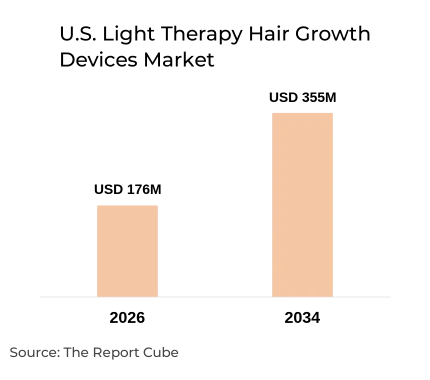
- The U.S. Light Therapy Hair Growth Devices Market was valued at USD 176 million in 2026.
- Market size is forecast to reach USD 355 million by 2034.
- The market is projected to expand at a CAGR of 9.17% during 2026-2034.
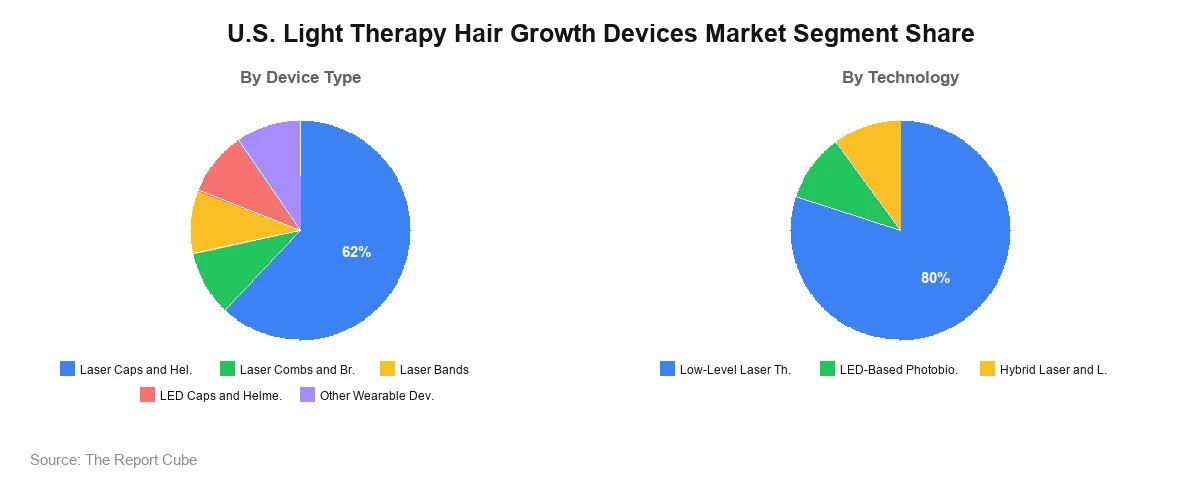
- By device type, Caps and Helmets led with an estimated 62% share in 2026.
- Demand for non-invasive hair-loss treatment, particularly for androgenetic alopecia, is the major growth driver.
- FDA 510(k) clearances, including a July 2026 clearance for a red-light hair growth cap, show continued product entry.
- HairMax, iRestore, Capillus, Theradome and Illumiflow are identifiable participants; no verified company ranking is available.
Market Outlook
The U.S. Light Therapy Hair Growth Devices Market covers devices that use low-level light therapy, mainly red-light lasers and LEDs, to support treatment of androgenetic alopecia and other hair thinning. Products include caps, helmets, combs, brushes and bands for home use, which makes the category relevant to consumer healthcare and medical aesthetics.
Demand comes from consumers seeking non-invasive, non-pharmaceutical hair-loss management. Devices are purchased mainly online and used at home, with dermatology clinics and hair restoration centres acting as a smaller professional channel. Androgenetic alopecia is the principal application, supported by the strongest clinical evidence in published literature.
Competition spans established laser specialists and newer LED-based entrants, while pharmaceutical treatments and hair transplantation compete for the same consumer spending. Opportunities lie in affordable LED devices, female-focused products and clinic partnerships. Long-term growth depends on clinical credibility, pricing and consistent treatment outcomes.
Government Regulations
The U.S. Food and Drug Administration regulates light-based hair-growth devices. They are classified under the device name Laser, Comb, Hair, regulation 21 CFR 890.5500, product code OAP, and are generally marketed through the 510(k) premarket notification pathway. A 510(k) clearance means a device has been found substantially equivalent to a legally marketed predicate for its stated intended use. It is not FDA approval and does not prove superior efficacy. Clearances apply to individual device models, so manufacturers must document each product separately, including design, safety and labelling. FDA records show clearances in December 2021 (iRestore ID-500), November 2024 (a hair growth comb), June 2025 (a red-light cap) and July 2026 (a hair growth cap). These requirements raise entry barriers, favour operators with regulatory and quality systems, and let buyers distinguish cleared products from unverified, lower-priced alternatives.
U.S. Light Therapy Hair Growth Devices Market Dynamics
Demand is shaped by consumer interest in non-invasive hair restoration, published clinical research on low-level light therapy, FDA product clearances and the shift to home-use devices. Affordability and uneven evidence across products moderate adoption. The table summarizes the principal factors.
|
Factor |
Type |
Specific Impact on Market |
Magnitude |
|---|---|---|---|
|
Demand for non-invasive hair-loss treatment |
Driver |
Supports adoption of home-use laser and LED devices |
High |
|
FDA-cleared product development |
Driver |
Strengthens category credibility and product differentiation |
Medium–High |
|
High device prices |
Challenge |
Limits adoption among price-sensitive consumers |
Medium–High |
|
Variable clinical evidence across products |
Challenge |
Creates consumer uncertainty and reputational risk |
Medium |
|
Wearable, hands-free devices |
Trend |
Improves convenience and supports premium positioning |
Medium |
|
Affordable LED devices and clinic partnerships |
Opportunity |
Widens the customer base and professional distribution |
Medium |
Growth Drivers: Rising Demand for Non-Invasive Hair-Loss Treatments
Consumers with pattern hair loss increasingly consider alternatives and complements to conventional treatments. Low-level light therapy avoids surgery, and home-use formats make regular sessions convenient. A 2025 systematic review and meta-analysis of 38 studies, covering 3,098 patients, found statistically significant improvements in hair density versus placebo in androgenetic alopecia patients (PubMed, February 2025). This evidence supports demand for wearable devices, though results should not be generalized to every product or every type of hair loss.
Market Opportunities: Affordable Home-Use LED Devices
Manufacturers can address price-sensitive consumers with mid-priced LED caps, helmets and wearable devices. The supplied estimates assume LED-based devices hold about 20% of 2026 revenue and grow faster than laser-based products, though this remains a modeled scenario rather than an observed trend. The opportunity depends on clear technical specifications, product safety, comfort and credible evidence for the intended indication. Clinic partnerships and treatment-tracking features could strengthen consumer trust and repeat use.
Industry Challenges: Affordability and Variable Clinical Evidence
Premium laser caps and helmets require a significant upfront payment, which can deter first-time buyers when lower-cost treatments exist. Devices also differ in specifications, treatment protocols and evidence. The 2025 review found insufficient evidence to run comparable meta-analyses for several alopecia types other than androgenetic alopecia. This creates uncertainty for buyers, increases the importance of credible, product-specific claims and exposes brands to reputational risk when advertised outcomes are not achieved.
Need Specific Data, Let’s Customize the Report for You
Request CustomizationMarket Trends: Wearable Devices and Expanding Product Variety
Manufacturers are moving toward wearable, hands-free caps and helmets that deliver scalp-wide treatment without manual operation. FDA records for 2024 to 2026 show additional combs, caps and other configurations, indicating continued product development and entry. More choice is likely to increase price competition and encourage differentiation through LED and hybrid technologies, comfort, session scheduling and warranty support. The pace of future adoption is not independently verified.
U.S. Light Therapy Hair Growth Devices Market Segment Analysis
The market is segmented by device type, technology, end user, distribution channel and application. All supplied segments are listed below. Detailed analysis covers the two leading segments in each category, and shares are shown only for the leading segment, based on supplied 2026 analyst estimates.
By Device Type
- Laser Caps and Helmets
- Laser Combs and Brushes
- Laser Bands
- LED Caps and Helmets
- Other Wearable Devices
Caps and helmets lead the device type category with an estimated 62% share in 2026. Hands-free scalp coverage and a relatively complete treatment session drive demand, especially among consumers seeking a premium home-use option. Combs and brushes form the second-largest group, valued for lower prices, portability and an established clinical history. Bands and other wearable devices are expected to expand as manufacturers innovate, although this is a modeled assumption rather than an established trend. The segment-level allocation of LED variants is not separately supplied.
By Technology
- Low-Level Laser Therapy (LLLT)
- LED-Based Photobiomodulation
- Hybrid Laser and LED Systems
Laser-based devices lead the technology category with an estimated 80% share in 2026. They have an established commercial presence, identifiable FDA-cleared products and the larger body of clinical research. LED-based devices rank second and may gain ground as manufacturers develop affordable wearable systems. Hybrid laser and LED systems are mentioned briefly because supplied estimates do not assign them a separate share; they should be classified by principal light source to prevent double counting.
U.S. Light Therapy Hair Growth Devices Market Regional Analysis
Regional market shares for the United States were not supplied, and no approved government or international source publishes revenue by region for this device category. Regional differences are expected to reflect population, income, clinic density and online retail access, but no shares are estimated here.
|
Region |
Key Growth Factors |
Industry Trends |
|---|---|---|
|
West |
Large metropolitan populations and dermatology and aesthetics clinic presence |
Online purchasing combined with clinic recommendations |
|
Southwest |
Expanding urban populations and consumer healthcare spending |
Growing online device adoption |
|
North |
Dense metropolitan markets and specialist practitioner access |
Mix of direct-to-consumer and professional channels |
|
Midwest |
Regional access to online retail and dermatology services |
Home-use devices as a convenient alternative to clinic visits |
Competitive Landscape
The competitive landscape comprises established laser specialists, newer device entrants and alternative hair-loss treatment providers. Competition rests on FDA clearance, clinical evidence, laser diode or LED configuration, comfort, price, warranty and distribution. The table lists identifiable participants and does not represent market share or a verified ranking.
|
Company |
Competitive Strength |
Primary Segment Served |
|---|---|---|
|
HairMax |
Established product range and published clinical history |
Combs, bands, caps; androgenetic alopecia |
|
iRestore |
FDA-cleared wearable system history |
Laser caps and helmets; home-use consumers |
|
Capillus |
Specialized laser cap portfolio |
Laser caps; premium home-use |
|
Theradome |
Dedicated wearable laser helmet technology |
Laser helmets; home-use |
|
Illumiflow |
Home-use laser cap with an FDA 510(k) record |
Laser caps; home-use |
HairMax: HairMax is a specialist in at-home laser hair-growth technology, offering laser combs, bands, caps and helmets. The company reports multiple FDA clearances, with its LaserComb first cleared in 2007, and cites published clinical studies. Its breadth across price points and device formats gives it a recognized position in the category, although company-specific U.S. revenue and share are not publicly verified.
iRestore: iRestore markets wearable laser hair-growth systems for home use. Its ID-500 Hair Growth System received FDA 510(k) clearance on December 22, 2021. Its competitive position rests on this regulatory record and a focus on hands-free caps and helmets, which fit the largest estimated device segment. Company-specific sales and market share are not verified from approved sources.
Recent Developments and Updates
- July 2026: The FDA recorded a 510(k) clearance (K261675) on July 17, 2026 for a CHZL red-light therapy hair growth cap, adding to the regulated product landscape and signalling continued entry of new wearable devices.
- June 2025: The FDA recorded a 510(k) clearance (K250467) on June 5, 2025 for a red-light hair growth cap. The decision indicates ongoing product development, though it does not measure sales growth.
- February 2025: A systematic review and meta-analysis in Dermatologic Surgery, indexed by PubMed, reported significant hair density gains with low-level light therapy in androgenetic alopecia patients, supporting the clinical relevance of the category.
U.S. Light Therapy Hair Growth Devices Market Future Outlook
The U.S. Light Therapy Hair Growth Devices Market is expected to grow from USD 176 million in 2026 to USD 355 million by 2034 at a CAGR of 9.17%. Wearable designs, LED innovation, female-focused products and clinic partnerships offer opportunities. Growth is expected to moderate as the category matures and penetration rises.
Competitive activity is likely to center on product-specific clinical evidence, affordability and wider distribution. Risks include pharmaceutical and surgical alternatives, low-cost unverified products, regulatory compliance costs, high customer acquisition costs and consumer dissatisfaction. Long-term performance will depend on whether manufacturers deliver validated performance, convenience and competitive pricing, rather than generic red-light claims.
U.S. Light Therapy Hair Growth Devices Market Report Coverage
This report summarizes the supplied market valuation, forecast, segmentation, regional framework and competitive landscape for the U.S. Light Therapy Hair Growth Devices Market.
|
Parameter |
Details |
|---|---|
|
Market Name |
U.S. Light Therapy Hair Growth Devices Market |
|
Market Size (Base Year) |
USD 176 million (2026) |
|
Market Size (Forecast Year) |
USD 355 million (2034) |
|
CAGR |
9.17% (2026–2034) |
|
Base Year |
2026 |
|
Historical Period |
2021–2025 |
|
Forecast Period |
2026–2034 |
|
Geographic Scope |
United States |
|
Segmentation |
By Device Type; By Technology; By End User; By Distribution Channel; By Application |
|
Regions Covered |
West, Southwest, North, Midwest |
|
Key Companies |
HairMax; iRestore; Capillus; Theradome; Illumiflow |
|
Customization |
Available as per requirement |
Why Choose This U.S. Light Therapy Hair Growth Devices Market Report?
- Presents the supplied 2026 valuation, 2034 forecast and 9.17% CAGR with stated assumptions.
- Segments the market by device type, technology, end user, distribution channel and application.
- Reviews drivers, opportunities, challenges and trends supported by FDA and clinical evidence.
- Provides regional context for West, Southwest, North and Midwest, with unavailable shares identified.
- Profiles identifiable manufacturers by capability and primary segment served.
- Summarizes emerging opportunities, including affordable LED devices and clinic partnerships.
- Supports product, pricing, regulatory and distribution decisions for manufacturers and investors.
Table of Contents
- Introduction
- Objective of the Study
- Product Definition
- Market Segmentation
- Study Variables
- Research Methodology
- Secondary Data Points
- Companies Interviewed
- Primary Data Points
- Breakdown of Primary Interviews
- Secondary Data Points
- Executive Summary
- Market Dynamics
- Drivers
- Challenges
- Opportunity Assessment
- Recent Trends and Developments
- Policy and Regulatory Landscape
- U.S. Light Therapy Hair Growth Devices Market' Market Overview and Forecast Analysis (2021-2034)
- Market Size, By Value, By Growth Rate (CAGR/USD Millions)
- Demand – Supply Trends
- Market Share, By Device Type
- Laser Caps And Helmets
- Laser Combs And Brushes
- Laser Bands
- LED Caps And Helmets
- Other Wearable Devices
- Market Share, By Technology
- Low-Level Laser Therapy (LLLT)
- LED-Based Photobiomodulation
- Hybrid Laser And LED Systems
- Market Share, By End User
- Male Consumers
- Female Consumers
- Market Share, By Distribution Channel
- Direct-To-Consumer Websites
- Online Marketplaces
- Specialty Retailers
- Dermatology Clinics And Hair Restoration Centres
- Market Share, By Application
- Androgenetic Alopecia
- Female Pattern Hair Loss
- Other Hair-Thinning Conditions
- Market Share, By Competitors
- Competition Characteristics
- Revenue Shares
- By Region
- West
- Southwest
- North
- Midwest
- Laser Caps And Helmets U.S. Light Therapy Hair Growth Devices Market' Market Overview, 2021-2034F
- By Value (USD Million)
- By Technology – Market Size & Forecast 2021-2034, USD Million
- Low-Level Laser Therapy (LLLT)
- LED-Based Photobiomodulation
- Hybrid Laser And LED Systems
- Laser Combs And Brushes U.S. Light Therapy Hair Growth Devices Market' Market Overview, 2021-2034F
- By Value (USD Million)
- By Technology – Market Size & Forecast 2021-2034, USD Million
- Low-Level Laser Therapy (LLLT)
- LED-Based Photobiomodulation
- Hybrid Laser And LED Systems
- Laser Bands U.S. Light Therapy Hair Growth Devices Market' Market Overview, 2021-2034F
- By Value (USD Million)
- By Technology – Market Size & Forecast 2021-2034, USD Million
- Low-Level Laser Therapy (LLLT)
- LED-Based Photobiomodulation
- Hybrid Laser And LED Systems
- LED Caps And Helmets U.S. Light Therapy Hair Growth Devices Market' Market Overview, 2021-2034F
- By Value (USD Million)
- By Technology – Market Size & Forecast 2021-2034, USD Million
- Low-Level Laser Therapy (LLLT)
- LED-Based Photobiomodulation
- Hybrid Laser And LED Systems
- Other Wearable Devices U.S. Light Therapy Hair Growth Devices Market' Market Overview, 2021-2034F
- By Value (USD Million)
- By Technology – Market Size & Forecast 2021-2034, USD Million
- Low-Level Laser Therapy (LLLT)
- LED-Based Photobiomodulation
- Hybrid Laser And LED Systems
- Competitive Outlook (Company Profile – Partial List)
- HairMax
- Company Overview
- Business Segments
- Strategic Alliances/Partnerships
- Recent Developments
- iRestore
- Company Overview
- Business Segments
- Strategic Alliances/Partnerships
- Recent Developments
- Capillus
- Company Overview
- Business Segments
- Strategic Alliances/Partnerships
- Recent Developments
- Theradome
- Company Overview
- Business Segments
- Strategic Alliances/Partnerships
- Recent Developments
- Illumiflow
- Company Overview
- Business Segments
- Strategic Alliances/Partnerships
- Recent Developments
- HairMax
- Contact Us & Disclaimer
Top Key Players & Market Share Outlook
- HairMax
- iRestore
- Capillus
- Theradome
- Illumiflow
Frequently Asked Questions