


Build Your Custom Market Intelligence Report
Customize Your ReportKey Takeaways
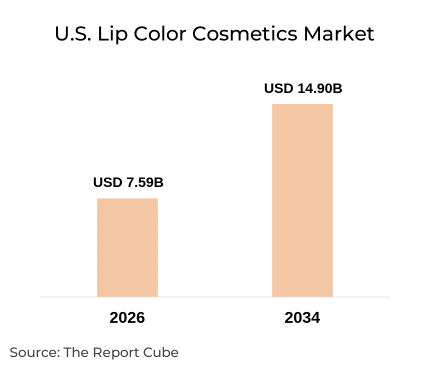
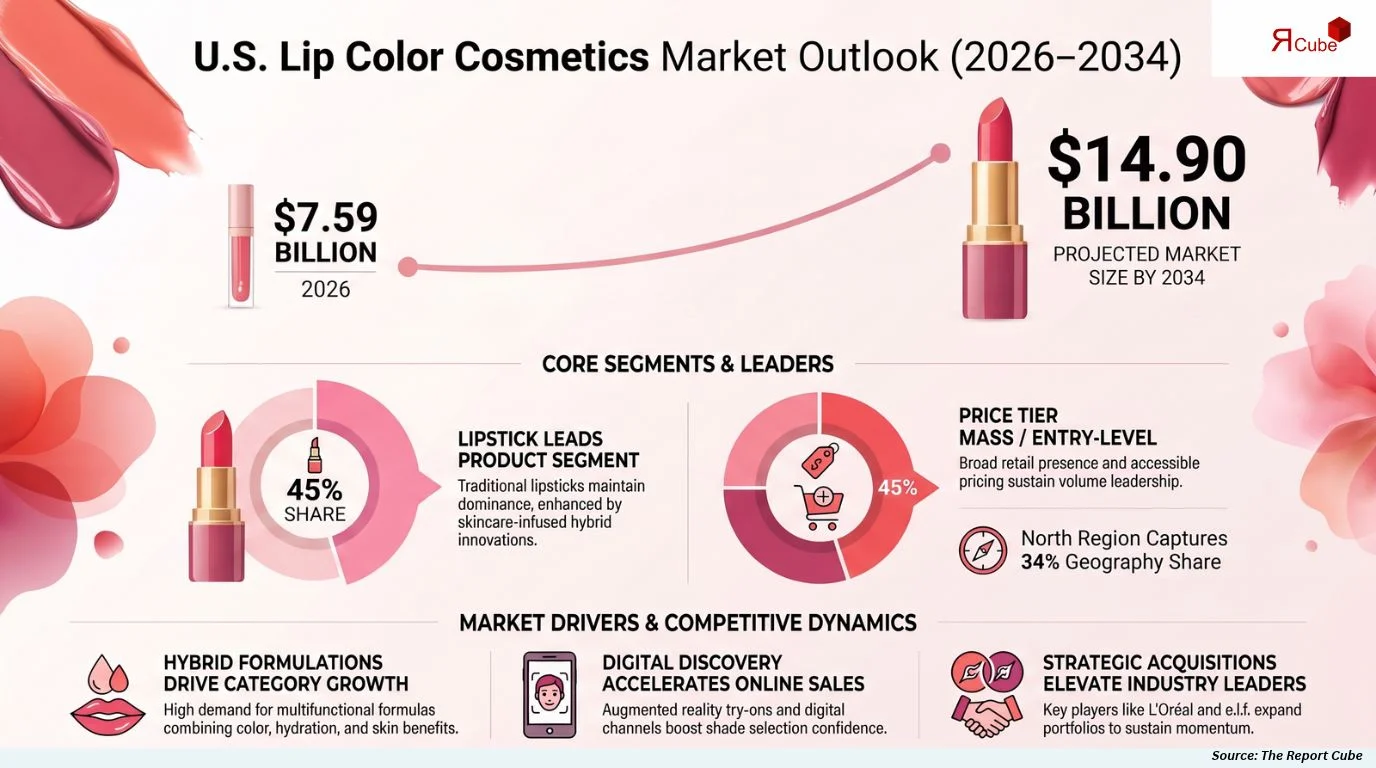
- U.S. lip color cosmetics market valued at USD 7.59 billion in 2026, reflecting the base-year estimate.
- Industry projected to reach USD 14.90 billion by 2034 at an 8.80% CAGR.
- Lipstick leads the product type segment with an estimated 45% share in 2026.
- Mass / entry-level products lead the price tier segment with an estimated 45% share.
- North holds the largest regional position with an estimated 34% share in 2026.
- Key companies include L’Oréal, The Estée Lauder Companies, Coty, Revlon, e.l.f. Beauty, and Shiseido.
- Hybrid lip formats combining color, hydration, and shine continue to gain commercial momentum.
Market Overview
Lip color cosmetics are color-bearing products applied to the lips for definition, shade, shine and finish. The category covers lipsticks, glosses, tints and liners, which are sold in conventional and organic or natural formulations. These products serve everyday grooming, occasion wear and professional makeup applications, and are available across mass, mid-tier and premium price points.
This U.S. Lip Color Cosmetics Market Analysis shows a category valued at USD 7.59 billion in 2026. Circana reported that prestige lip product sales rose 3% in the first half of 2025, while lip products were the only growth area for mass makeup. Lip oils, tinted treatments, liners and glosses are widening product choice.
Consumers are drawn to lip products that combine color with hydration, shine and wear, while online discovery and virtual try-on tools support shade selection. Treatment-oriented glosses, tints and oils are gaining relevance alongside traditional lipstick formats across retail channels. The market is projected to grow at a CAGR of 8.80% during 2026–2034.
Market Dynamics
U.S. Lip Color Cosmetics Market Growth is shaped by product innovation, digital discovery, regulatory requirements and competitive intensity. Consumer interest in multifunctional lip formats influences demand, while pricing and adoption vary across mass, mid-tier and premium offerings. Compliance obligations and rapid product turnover influence supply decisions.
|
Factor |
Type |
Specific Impact on Market |
Magnitude |
|---|---|---|---|
|
Hybrid and treatment-oriented lip products |
Driver |
Expands innovation across oils, tints, glosses, and liners |
High (qualitative) |
|
Digital discovery and virtual try-on |
Driver |
Supports online shade selection and consumer engagement |
Medium–High (qualitative) |
|
Lip color and skincare hybrids |
Opportunity |
Enables differentiated, multifunctional product development |
High (qualitative) |
|
E-commerce and virtual shade matching |
Opportunity |
Improves online discovery and shade confidence |
Medium (qualitative) |
|
Regulatory compliance and product safety |
Challenge |
Raises documentation, substantiation, and reporting requirements |
Medium (qualitative) |
|
Intense competition and rapid innovation |
Challenge |
Requires continual differentiation in shades, textures, and packaging |
High (qualitative) |
|
Ingredient transparency and safety focus |
Trend |
Increases importance of compliant formulations and accurate claims |
Medium (qualitative) |
U.S. Lip Color Cosmetics Market Growth Drivers
Demand for innovative lip products and hybrid formulations is a central driver. Circana data showed lip products contributed to prestige makeup sales in the first half of 2025 and were the only makeup area growing in mass. Lip oils, hybrid tint-and-skincare products, liners and treatment-oriented formats are supporting commercial momentum.
Digital beauty discovery and online shopping are reshaping how consumers evaluate lip color. E-commerce growth and augmented-reality virtual try-on technologies provide brands with additional ways to showcase shades and engage consumers. These tools support online purchasing decisions, particularly in a category where shade selection is central to the product choice process.
U.S. Lip Color Cosmetics Market Opportunities
Hybrid lip color and skincare products create room for differentiated offerings. Consumers are showing interest in lip products that combine color with hydration, shine, barrier care and longer wear. This supports opportunities for brands to develop lip tints, tinted oils, treatment-oriented glosses and multifunctional formulations that address several needs in one product.
E-commerce and virtual shade matching offer a second opportunity. Augmented-reality virtual try-ons help consumers preview makeup online, and lip color brands can pair them with creator-led demonstrations and personalized product recommendations. These tools may improve online discovery and reduce uncertainty when consumers choose shades, although the commercial impact has not been quantified.
U.S. Lip Color Cosmetics Industry Challenges
Regulatory compliance and product safety remain operating considerations for lip color manufacturers. According to the U.S. Food and Drug Administration (FDA), the Modernization of Cosmetics Regulation Act of 2022 introduced additional requirements and authorities covering facility registration, product listing, safety substantiation and adverse-event reporting, which responsible businesses must address when developing and marketing products.
Intense competition and rapid product innovation require brands to differentiate continually through shades, textures, formulations, packaging and consumer experience. Continuing launches across lip tints, liners, oils, glosses and treatment-oriented products raise the pace of product development. This is a qualitative competitive assessment, not a quantified measure of competitive pressure in the category.
Need Specific Data, Let’s Customize the Report for You
Request CustomizationU.S. Lip Color Cosmetics Market Trends
U.S. Lip Color Cosmetics Market Trends point toward hybrid and treatment-oriented products. Lip oils, balms, stains, liners and treatment formats are gaining momentum alongside traditional lipstick, while product development increasingly combines hydration, color, shine and wear performance in multifunctional lip cosmetics. These formats allow brands to address cosmetic and care preferences within a single lip product.
Greater emphasis on cosmetic safety and ingredient transparency is also shaping product development. According to the FDA, cosmetics marketed in the United States must comply with applicable safety and labeling requirements, and cosmetic color additives must be approved for their intended uses. Formulation compliance, ingredient documentation and accurate product claims therefore remain important for manufacturers and brands.
U.S. Lip Color Cosmetics Market Segment Analysis
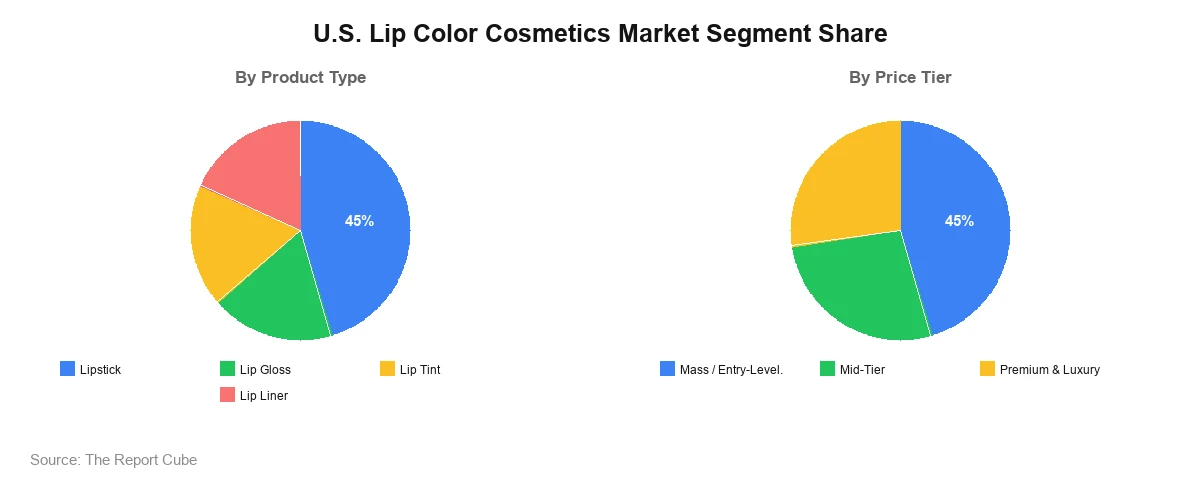
The U.S. Lip Color Cosmetics Market is segmented by product type, price tier, formulation and distribution channel, reflecting how products are formulated, priced and sold. U.S. Lip Color Cosmetics Market Share is led by lipstick by product type and by mass / entry-level products by price tier, based on 2026 estimates.
By Product Type
- Lipstick
- Lip Gloss
- Lip Tint
- Lip Liner
Lipstick leads the segment with an estimated 45% share in 2026, supported by its position as the traditional core lip color format and by continuing formulation innovation. Maybelline New York Serum Lipstick, cited by L’Oréal among makeup growth drivers in its 2026 half-year results, illustrates how brands are adding skincare-oriented attributes to the format. Lip gloss is supported by demand for shine and treatment-oriented products, while lip tint benefits from lightweight color and hybrid tint-and-skincare formats. Lip liner is gaining attention as consumers adopt layered lip looks and contouring routines. Together, these formats reflect a shift toward multifunctional lip routines across U.S. retail channels.
By Price Tier
- Mass / Entry-Level
- Mid-Tier
- Premium & Luxury
Mass / Entry-Level leads the segment with an estimated 45% share in 2026, supported by broad retail availability, accessible price points and sustained lip product innovation. e.l.f. Beauty, Coty’s CoverGirl and Rimmel brands, and L’Oréal’s Maybelline New York and NYX Professional Makeup compete in value-oriented color cosmetics. Mid-Tier products sit between accessible and prestige offerings, balancing price with differentiated formulations and brand positioning. Premium & Luxury is represented by prestige-focused companies such as The Estée Lauder Companies, Chanel, LVMH and Shiseido, where lip products draw on brand equity, packaging and prestige retail presence to support higher price points.
Regional Analysis
|
Region |
Estimated Market Share |
Key Growth Factors |
Industry Trends |
|---|---|---|---|
|
North |
34% (2026) |
Largest regional position; national demand for hybrid lip formats and online discovery |
Growth in lip oils, liners, and treatment-oriented products |
|
West |
- |
National demand for innovative lip products and e-commerce adoption |
Virtual try-on and creator-led product discovery |
|
Southwest |
- |
National demand for innovative lip products and e-commerce adoption |
Shift toward multifunctional lip color and care products |
|
Midwest |
- |
National demand for innovative lip products and e-commerce adoption |
Compliance-led emphasis on ingredient transparency |
North leads the U.S. market with an estimated 34% share in 2026, making it the largest regional contributor. Estimated shares for the West, Southwest and Midwest have not been validated for this edition. Lip color demand across all four regions follows national themes, including hybrid lip products, liners, oils and treatment-oriented formats.
FDA safety and labeling requirements apply nationwide, although individual state laws may add further obligations. E-commerce and virtual try-on tools further reduce the dependence of shade discovery on physical store location, although the effect on regional share has not been quantified. Region-level retail structure and consumer preferences require validation before regional growth rates are assigned.
Market Share & Competitive Landscape
The U.S. lip color landscape includes global beauty groups, mass-market cosmetics specialists and prestige houses competing through formulation innovation, shade range and distribution. Competitive positioning below reflects portfolio focus and publicly reported activity rather than numerical market share.
|
Company |
Competitive Strength |
Primary Segment Served |
|---|---|---|
|
L’Oréal S.A. |
Mass-to-luxury portfolio; Maybelline New York Serum Lipstick and NYX Professional Makeup cited as 2026 makeup growth contributors |
Mass / Entry-Level and Premium & Luxury |
|
The Estée Lauder Companies Inc. |
Prestige beauty portfolio with established luxury positioning |
Premium & Luxury |
|
Coty Inc. |
CoverGirl, Rimmel, Max Factor, and Sally Hansen brands; consumer beauty review under way |
Mass / Entry-Level |
|
Revlon Inc. |
Long-established color cosmetics brand in mass retail |
Mass / Entry-Level |
|
e.l.f. Beauty Inc. |
Value-focused, digital-led model; fiscal 2026 net sales up 25% |
Mass / Entry-Level |
|
Shiseido Company Limited |
Prestige beauty group with international presence |
Premium & Luxury |
|
LVMH Moët Hennessy Louis Vuitton SE |
Luxury perfumes and cosmetics portfolio |
Premium & Luxury |
|
Chanel Limited |
Luxury house with prestige beauty offering |
Premium & Luxury |
|
Milani Cosmetics |
Affordable color cosmetics brand |
Mass / Entry-Level |
|
Kendo Brands |
Beauty brand incubator and developer of prestige makeup brands |
Mid-Tier and Premium & Luxury |
Key Companies in the U.S. Lip Color Cosmetics Market
e.l.f. Beauty Inc.: e.l.f. Beauty, Inc. is headquartered in Oakland, California, and markets cosmetics and skincare through retail and e-commerce channels. The company reported fiscal 2026 net sales of USD 1.64 billion, up 25%, helped by the August 2025 rhode acquisition. Its value-focused, digital-led model supports competitiveness in mass lip color.
L’Oréal S.A.: L’Oréal S.A. is headquartered in Clichy, France, and operates consumer, luxury, professional and dermatological beauty divisions. Its 2026 half-year results cited Maybelline New York Serum Lipstick and NYX Professional Makeup as makeup growth contributors. A portfolio spanning mass to luxury tiers supports its competitiveness in U.S. lip color.
Recent Developments
|
Year / Month |
Company |
Development |
|---|---|---|
|
2025 / August |
e.l.f. Beauty |
Completed the acquisition of rhode, adding the brand to its multi-brand portfolio. |
|
2025 / September |
Coty |
Launched a strategic review of its Consumer Beauty division, including CoverGirl and Rimmel, to consider partnerships, divestitures or spin-offs. |
|
2026 / February |
Coty |
Introduced the “Coty.Curated” framework, with investments focused behind core cosmetics franchises under CoverGirl and Rimmel. |
|
2026 / July |
L’Oréal |
Reported 2026 half-year results on July 29, citing Maybelline New York Serum Lipstick among makeup growth drivers. |
|
2026 |
Coty |
Announced plans for fewer, higher-impact fiscal 2027 launches, including Rimmel’s Oh My Gloss! Slip Stick (announced plan, not a completed launch). |
Market Future Outlook
The U.S. Lip Color Cosmetics Market Forecast indicates growth from USD 7.59 billion in 2026 to USD 14.90 billion by 2034, equivalent to an 8.80% CAGR. Expansion is expected to depend on continued innovation in hybrid lip formats, wider use of digital shade discovery and sustained demand across mass, mid-tier and premium products. These projections are estimates and depend on consumer demand and category execution.
Competitive dynamics may shift as brands refine portfolios, simplify assortments and invest in core franchises. Coty’s consumer beauty review, e.l.f. Beauty’s multi-brand expansion and L’Oréal’s lipstick innovation illustrate active portfolio and product strategies. Compliance with FDA requirements, ingredient documentation and product safety substantiation will remain operating considerations, while intense competition may pressure differentiation across lip tints, liners, oils, glosses and lipsticks.
U.S. Lip Color Cosmetics Market Report Coverage
This U.S. Lip Color Cosmetics Market Report summarizes the scope, segmentation and forecast parameters covered.
|
Parameter |
Details |
|---|---|
|
Market Name |
U.S. Lip Color Cosmetics Market |
|
Market Size 2026 |
USD 7.59 Billion |
|
Market Size 2034 |
USD 14.90 Billion |
|
Forecast Period |
2026–2034 |
|
CAGR |
8.80% |
|
Base Year |
2026 |
|
Historical Years |
2021–2025 |
|
Forecast Years |
2026–2034 |
|
Segments Covered |
By Product Type, By Price Tier, By Formulation, By Distribution Channel |
|
Regions Covered |
West, Southwest, North, Midwest |
|
Key Companies |
L’Oréal S.A., The Estée Lauder Companies Inc., Coty Inc., Revlon Inc., e.l.f. Beauty Inc., Shiseido Company Limited, LVMH Moët Hennessy Louis Vuitton SE, Chanel Limited, Milani Cosmetics, Kendo Brands |
|
Customization |
Available as per client requirements |
Why Choose This U.S. Lip Color Cosmetics Market Report?
- Defines market scope across lipstick, lip gloss, lip tint, and lip liner products.
- Presents 2026 and 2034 market size estimates with an 8.80% CAGR forecast.
- Segments the market by product type, price tier, formulation, and distribution channel.
- Provides regional perspective across the West, Southwest, North, and Midwest.
- Profiles ten key companies shaping the U.S. lip color competitive landscape.
- Reviews trends in hybrid lip products, digital discovery, and cosmetic regulation.
- Supports product, channel, and portfolio planning with segment and forecast context.
Table of Contents
- Introduction
- Objective of the Study
- Product Definition
- Market Segmentation
- Study Variables
- Research Methodology
- Secondary Data Points
- Companies Interviewed
- Primary Data Points
- Breakdown of Primary Interviews
- Secondary Data Points
- Executive Summary
- Market Dynamics
- Drivers
- Challenges
- Opportunity Assessment
- Recent Trends and Developments
- Policy and Regulatory Landscape
- U.S. Lip Color Cosmetics Market Overview and Forecast Analysis (2021-2034)
- Market Size, By Value, By Growth Rate (CAGR/USD Billions)
- Demand – Supply Trends
- Market Share, By Product Type
- Lipstick
- Lip Gloss
- Lip Tint
- Lip Liner
- Market Share, By Price Tier
- Mass / Entry-Level
- Mid-Tier
- Premium & Luxury
- Market Share, By Formulation
- Conventional
- Organic & Natural
- Market Share, By Distribution Channel
- Specialty Beauty Stores
- Online / E-Commerce
- Pharmacies & Drugstores
- Hypermarkets & Supermarkets
- Market Share, By Region
- West
- Southwest
- North
- Midwest
- Market Share, By Competitors
- Competition Characteristics
- Revenue Shares
- Lipstick U.S. Lip Color Cosmetics Market Overview, 2021-2034F
- By Value (USD Million)
- By Price Tier – Market Size & Forecast 2021-2034, USD Million
- Mass / Entry-Level
- Mid-Tier
- Premium & Luxury
- Lip Gloss U.S. Lip Color Cosmetics Market Overview, 2021-2034F
- By Value (USD Million)
- By Price Tier – Market Size & Forecast 2021-2034, USD Million
- Mass / Entry-Level
- Mid-Tier
- Premium & Luxury
- Lip Tint U.S. Lip Color Cosmetics Market Overview, 2021-2034F
- By Value (USD Million)
- By Price Tier – Market Size & Forecast 2021-2034, USD Million
- Mass / Entry-Level
- Mid-Tier
- Premium & Luxury
- Lip Liner U.S. Lip Color Cosmetics Market Overview, 2021-2034F
- By Value (USD Million)
- By Price Tier – Market Size & Forecast 2021-2034, USD Million
- Mass / Entry-Level
- Mid-Tier
- Premium & Luxury
- Competitive Outlook (Company Profile – Partial List)
- L’Oréal S.A.
- Company Overview
- Business Segments
- Strategic Alliances/Partnerships
- Recent Developments
- The Estée Lauder Companies Inc.
- Company Overview
- Business Segments
- Strategic Alliances/Partnerships
- Recent Developments
- Coty Inc.
- Company Overview
- Business Segments
- Strategic Alliances/Partnerships
- Recent Developments
- Revlon Inc.
- Company Overview
- Business Segments
- Strategic Alliances/Partnerships
- Recent Developments
- e.l.f. Beauty Inc.
- Company Overview
- Business Segments
- Strategic Alliances/Partnerships
- Recent Developments
- Shiseido Company Limited
- Company Overview
- Business Segments
- Strategic Alliances/Partnerships
- Recent Developments
- LVMH Moët Hennessy Louis Vuitton SE
- Company Overview
- Business Segments
- Strategic Alliances/Partnerships
- Recent Developments
- Chanel Limited
- Company Overview
- Business Segments
- Strategic Alliances/Partnerships
- Recent Developments
- Milani Cosmetics
- Company Overview
- Business Segments
- Strategic Alliances/Partnerships
- Recent Developments
- Kendo Brands
- Company Overview
- Business Segments
- Strategic Alliances/Partnerships
- Recent Developments
- L’Oréal S.A.
- Contact Us & Disclaimer
Top Key Players & Market Share Outlook
- L’Oréal S.A.
- The Estée Lauder Companies Inc.
- Coty Inc.
- Revlon Inc.
- e.l.f. Beauty Inc.
- Shiseido Company Limited
- LVMH Moët Hennessy Louis Vuitton SE
- Chanel Limited
- Milani Cosmetics
- Kendo Brands
Frequently Asked Questions