



Build Your Custom Market Intelligence Report
Customize Your ReportJapan Liquid Detergent Market Key Highlights
By Product Category:
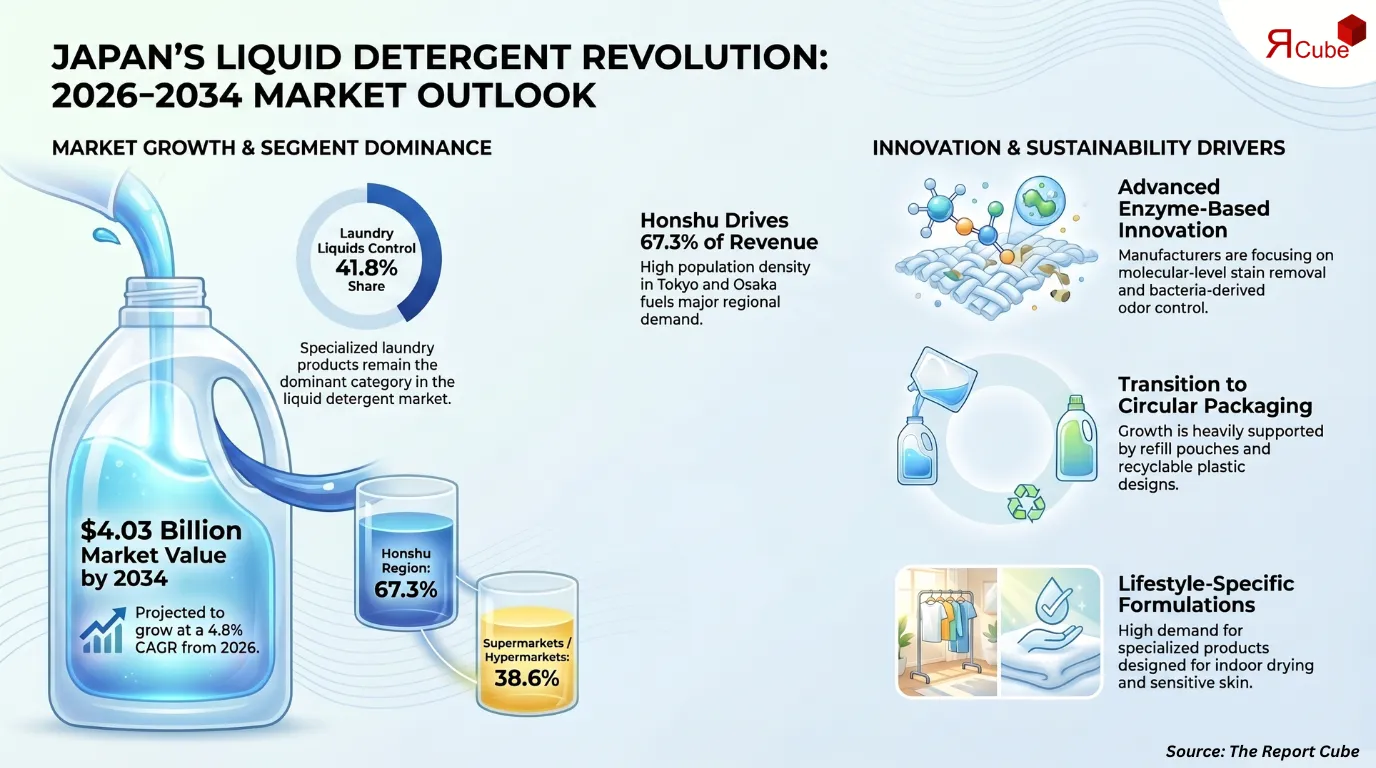
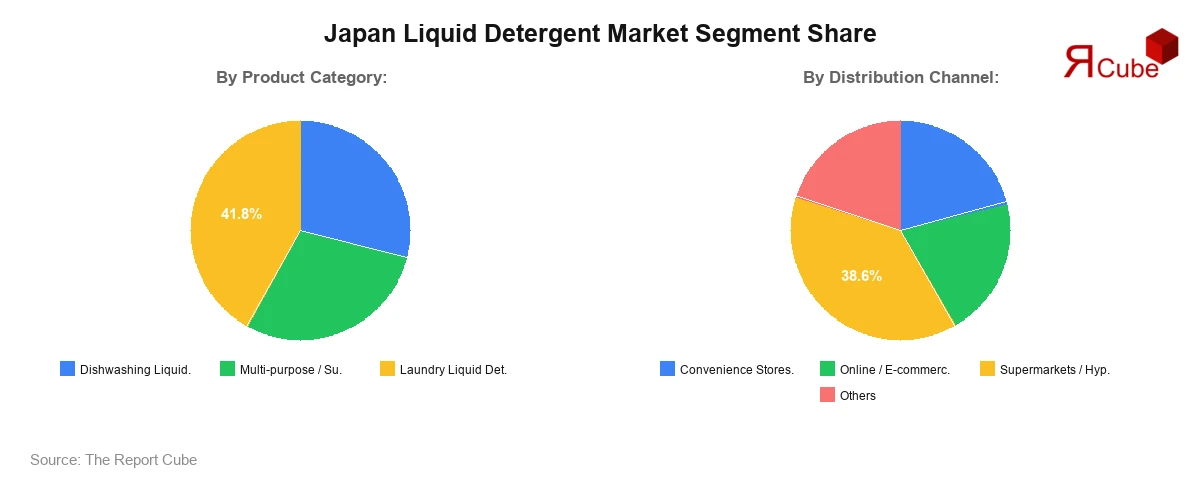
Laundry Liquid Detergent segment leads the market with nearly 41.8% share.
By Distribution Channel:
Supermarkets / Hypermarkets segment dominates the market with approximately 38.6% of revenue.
Regional Outlook:
Honshu region dominates the Japan Liquid Detergent Market with around 67.3% share.
Japan Liquid Detergent Market Insights & Analysis
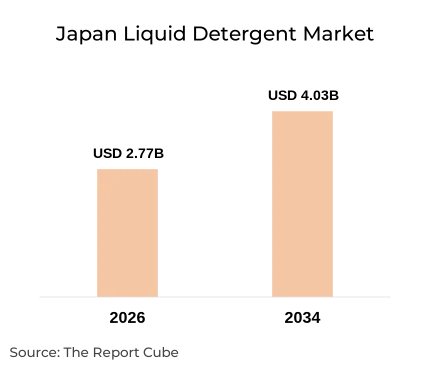
The Japan Liquid Detergent Market is anticipated to register a CAGR of around 4.8% during the forecast period 2026-2034. The market size is valued at USD 2.77 billion in 2026 and is projected to reach USD 4.03 billion by 2034. Rising demand for premium cleaning solutions, compact liquid formulations, and environmentally responsible household products continues to reshape the market landscape. Japanese consumers increasingly prefer liquid detergents over traditional powder variants due to superior solubility, convenience, fabric care performance, and compatibility with modern high-efficiency washing machines. Growth in single-person households and urban apartment living has also strengthened demand for concentrated and refillable detergent products.
Industry competition is increasingly centered on enzyme innovation, odor elimination performance, and sustainable packaging. Leading manufacturers are investing heavily in bio-based ingredients, recyclable refill pouches, and low-carbon production systems. Product launches from Lion Corporation and Kao Corporation during 2025-2026 demonstrate a clear shift toward specialized formulations targeting indoor drying conditions, antibacterial protection, and advanced stain removal technologies. Government-backed plastic resource circulation initiatives are further encouraging manufacturers to redesign detergent packaging, creating new opportunities across premium laundry liquid detergent, dishwashing liquid detergent, and multi-purpose surface cleaning liquid detergent segments.
Japan Liquid Detergent Market Impact Analysis
| Factor | Type | Specific Impact on Market | Magnitude | Business Implication |
|---|---|---|---|---|
| Shift from Powder to Liquid Formats | Market | Consumers increasingly replace powder detergents with liquids for convenience and better stain removal. | High | Supports volume and value growth for liquid SKUs and justifies portfolio focus on liquids over powders. |
| Demand for High-Efficiency Concentrated Products | Technological | Concentrated and high-efficiency liquids gain traction as smaller doses suit compact homes and modern washers. | High | Enables premium pricing and margin expansion through concentrated, high-performance formulations. |
| Rising Preference for Eco-Friendly Formulations | Environmental | Growing awareness drives demand for biodegradable, low-chemical liquids and bio-based ingredients. | High | Rewards brands investing in green chemistry, certifications, and sustainable positioning. |
| Aging Population and Skin-Sensitive Needs | Consumer | Older and health-conscious users favor mild, low-foam, fragrance-free liquid detergents. | Medium | Creates niche but profitable segments for hypoallergenic and dermatologically tested variants. |
| Intensifying Brand and Private Label Competition | Competitive | Global players and retailer brands compete on innovation, price, and promotions in a mature market. | Medium | Requires continuous product upgrades and differentiated branding to defend share and pricing power. |
| Growth of E-Commerce and Omnichannel Retail | Market | Online platforms expand detergent reach and enable subscription and bulk purchase models. | Medium | Encourages digital-first campaigns, online-exclusive packs, and recurring order programs. |
| Regulatory Focus on Chemical Safety and Emissions | Regulatory | Stricter rules on surfactants and environmental load push reformulation and compliance costs. | Medium | Favors compliant, innovation-led firms and can raise barriers for low-quality imports. |
Japan Liquid Detergent Market Dynamics
Key Driver: Growing Consumer Preference for High-Performance and Convenient Cleaning Products
Japanese consumers increasingly seek cleaning solutions that combine convenience, hygiene, and superior cleaning efficiency. The widespread adoption of automatic washing machines, compact urban lifestyles, and limited laundry drying space have accelerated demand for liquid detergent products capable of removing odors, bacteria, and stubborn stains in a single wash cycle. Consumer surveys conducted by retail associations indicate that more than 70% of Japanese households now regularly purchase liquid laundry detergents, reflecting a structural shift away from powder-based products.
Manufacturers continue introducing concentrated detergent technologies that reduce dosage requirements while maintaining cleaning effectiveness. Advanced enzyme systems, antibacterial additives, and odor-neutralizing technologies have become major purchase drivers among households. The growing popularity of refill pouches and eco-friendly packaging also supports long-term market growth by aligning convenience with sustainability goals, strengthening overall liquid detergent market demand across residential and commercial applications.
Industry Trends: Expansion of Sustainable Packaging and Enzyme-Based Formulations
Sustainability has become a major competitive factor across Japan's household cleaning industry. Detergent producers are rapidly transitioning toward recyclable packaging formats, lightweight refill systems, and reduced-plastic container designs. The introduction of design certification programs under Japan's Plastic Resource Circulation framework is encouraging brands to develop packaging solutions that meet future procurement and recycling requirements.
At the same time, enzyme-based liquid detergents are gaining significant market share due to their ability to deliver deeper cleaning performance at lower washing temperatures. Recent launches such as Lion's NANOX One Super Enzyme Complete Gel highlight the industry's focus on molecular-level stain removal and odor control. Bio-based ingredients, plant-derived surfactants, and concentrated formulations are also attracting environmentally conscious consumers, creating new premiumization opportunities across laundry and surface cleaning categories.
Book your FREE 30-minute expert consultation today
Contact UsMajor Challenge: Rising Raw Material Costs and Intense Brand Competition
Manufacturers operating in Japan's liquid detergent industry continue facing pressure from fluctuating raw material prices, packaging costs, and transportation expenses. Surfactants, specialty enzymes, fragrances, and recycled plastic materials have experienced periodic supply chain volatility, creating margin challenges for both domestic and international detergent brands.
Market saturation within urban regions further intensifies competition among established players. Companies must continuously invest in research, product innovation, and promotional activities to maintain shelf visibility and consumer loyalty. Private-label cleaning products offered by retail chains are also becoming more sophisticated, increasing pricing pressure on premium detergent manufacturers. Balancing innovation investment with profitability remains a critical challenge throughout the forecast period.
Opportunity: Specialized Detergent Solutions for Lifestyle-Specific Applications
Consumer preferences in Japan increasingly favor purpose-built cleaning products designed for specific usage occasions. Indoor drying detergents, sensitive skin formulations, antibacterial laundry solutions, and fragrance-controlled products are emerging as high-growth subcategories. These specialized variants command premium pricing and generate higher consumer retention compared to traditional general-purpose detergents.
Growing awareness of hygiene standards in commercial facilities, healthcare centers, hospitality establishments, and food service environments is creating additional opportunities for industrial and commercial liquid detergent suppliers. Innovation around bio-based detergents, refill systems, concentrated formulas, and smart dispensing technologies is expected to unlock new revenue streams while supporting sustainability objectives throughout the Japan liquid detergent market forecast period.
Japan Liquid Detergent Market Segment-wise Analysis
By Product Category:
- Dishwashing Liquid Detergent
- Multi-purpose / Surface Cleaning Liquid Detergent
- Laundry Liquid Detergent
Laundry Liquid Detergent represents the largest product category, accounting for approximately 41.8% of total market revenue in 2026. The segment benefits from widespread household adoption, increasing demand for concentrated formulations, and continuous product innovation focused on odor elimination and fabric protection.
Japan's unique indoor drying culture has accelerated the development of specialized laundry detergents capable of preventing bacterial growth and musty odors. Premium enzyme-based products continue gaining popularity among consumers seeking superior stain removal and hygiene performance. Strong replacement demand, growing preference for refill pouch packaging, and the introduction of compact detergent technologies are expected to sustain leadership of the laundry liquid detergent segment throughout the forecast period.
By Distribution Channel:
- Convenience Stores
- Online / E-commerce
- Supermarkets / Hypermarkets
- Others
Supermarkets and Hypermarkets maintain the leading distribution channel position with nearly 38.6% market share. These retail formats provide extensive product visibility, promotional campaigns, and immediate product availability, making them the preferred purchasing destination for detergent products.
Consumers often compare multiple brands, package sizes, and pricing options within a single location, encouraging higher transaction volumes. While online detergent sales continue expanding due to subscription services and direct-to-consumer channels, supermarkets remain critical for new product launches and brand discovery. Large retail chains also support premium detergent categories through dedicated sustainability and eco-product sections, contributing to strong category growth.
Regional Projection of Japan Liquid Detergent Industry
- Hokkaido
- Honshu
- Shikoku
- Kyushu
Honshu dominates the Japan Liquid Detergent Market with approximately 67.3% revenue share. The region hosts major metropolitan centers including Tokyo, Osaka, Nagoya, and Yokohama, creating substantial residential and commercial detergent consumption. High population density, greater purchasing power, and stronger adoption of premium cleaning products contribute significantly to regional demand.
Consumer preference for sustainable household products is particularly pronounced in urban areas, encouraging sales of refill pouches, concentrated detergents, and bio-based formulations. Retail infrastructure across Honshu remains highly developed, enabling efficient distribution of both domestic and international detergent brands. Continued innovation from leading manufacturers headquartered within the region is expected to reinforce Honshu's market leadership position through 2034.
Need insights for a specific region within this market?
Request Regional DataJapan Liquid Detergent Market Regional Analysis
The Japan liquid detergent market varies significantly across regions due to diverse population density, urbanization levels, and consumer preferences.
| Region | Demand Level | Key Areas | System Dominance | Core Demand Logic | Growth Nature |
|---|---|---|---|---|---|
| Hokkaido | Low to Medium | Sapporo, Hakodate | Concentrated liquid detergent | Cold climate requires powerful cleaning agents | Eco-friendly adoption |
| Honshu (Kanto, Kansai, Chubu) | Extremely High | Tokyo, Osaka, Yokohama | Premium liquid & pods | Dense urban population & high disposable income | Innovation-driven growth |
| Shikoku | Low | Matsuyama, Takamatsu | Standard liquid detergent | Aging population prefers ease-of-use products | Senior-friendly formats |
| Kyushu-Okinawa | Medium to High | Fukuoka, Kitakyushu, Naha | Liquid & gel detergent | Subtropical climate & tourism-driven demand | Tourism & sustainability |
Government Initiatives & Policies
- Plastic Resource Circulation Act Design Certification Program (2026): Japan's Ministry of Economy, Trade and Industry introduced the first certification framework for household detergent containers that meet advanced recyclability and plastic reduction standards, supporting circular packaging adoption across consumer goods sectors.
- Green Procurement Policy Update (2026): Japan expanded procurement guidelines encouraging government agencies to prioritize environmentally responsible products, creating new opportunities for certified detergent packaging and sustainable cleaning product suppliers.
Japan Liquid Detergent Industry Recent Developments
- 2026: Kao Corporation received Plastic Design Certification for Attack ZERO, EMAL, and Bioré u product lines under Japan's Plastic Resource Circulation Act. The achievement strengthens Kao's sustainability leadership while improving eligibility for environmentally focused procurement programs and reinforcing circular packaging adoption across the detergent industry.
- 2025: Lion Corporation launched the fully renewed NANOX One Super Enzyme Complete Gel featuring a newly developed enzyme designed to break down bacteria-derived DNA responsible for deep odor formation and fabric yellowing. The innovation elevates performance standards within Japan's premium concentrated laundry detergent segment.
- 2025: Lion Corporation introduced NANOX One Heyaboshi, a specialized indoor-drying liquid detergent formulated for Japan's humid indoor laundry environment. The launch validates indoor drying as a distinct demand category and strengthens premium detergent market segmentation through lifestyle-specific cleaning solutions.
Why Choose This Report?
- Provides a comprehensive overview of the overall market analysis, encompassing key trends, consumer behavior analysis, and risk assessment to support strategic decision-making.
- Provides accurate, up-to-date insights into market size, segmentation, and emerging opportunities, helping to minimize risk & capitalizing on growth.
- Gives deep understanding of target audience preferences, investment habits, and communication channels for enhanced product development & marketing effectiveness.
- Delivers competitive analysis & benchmarking, uncovering the strengths & weaknesses of market competitors to guide strategies.
- Consolidate comprehensive market intelligence, reducing reasoning & streamlining research efforts.
- Facilitates customized market segmentation & risk mitigation strategies, fine-tuned to the business objectives.
- Aids in identifying both market challenges & untapped opportunities within the industry to drive long-term business growth.
- Provides valuable information based on actual customer data & search trends.
Table of Contents
- Introduction
- Objective of the Study
- Product and Category Definition
- Market Segmentation
- Study Variables
- Research Methodology
- Secondary Data Points
- Breakdown of Secondary Sources
- Primary Data Points
- Breakdown of Primary Interviews
- Secondary Data Points
- Executive Summary
- Market Dynamics
- Emerging Opportunities
- Adoption Trends
- Demand Drivers
- Disruption Analysis (Challenges)
- Industry Analysis & Strategic Insights
- Supply/Value Chain Analysis
- Pricing Analysis
- Go-To-Market (GTM) Strategy
- BCG Matrix
- Recent Trends and Developments
- Import and Export Analysis
- Regulatory and Policy Landscape
- Region-wise Policies
- Government Initiatives
- Japan Liquid Detergent Market Overview and Forecast Analysis (2021-2034)
- Market Size, By Value, By Growth Rate (CAGR/USD Billion)
- Market Share, By Product Category
- Dishwashing Liquid Detergent
- Multi-purpose / Surface Cleaning Liquid Detergent
- Laundry Liquid Detergent
- Market Share, By Formulation Type
- Enzyme-based
- Conventional
- Bio-based / Organic
- Market Share, By Packaging Type
- Refill Pouches
- Dispensers / Bulk Packaging
- Bottles
- Market Share, By Distribution Channel
- Convenience Stores
- Online / E-commerce
- Supermarkets / Hypermarkets
- Others
- Market Share, By Concentration Type
- Ultra-Concentrated / Compact
- Standard Liquid
- Concentrated Liquid
- Market Share, By End User
- Industrial
- Residential
- Commercial
- Market Share, By Region
- Hokkaido
- Honshu
- Shikoku
- Kyushu
- Market Share, By Company
- Revenue Shares & Analysis
- Competitive Landscape
- Hokkaido Liquid Detergent Market Overview and Forecast Analysis (2021-2034)
- Market Size, By Value, By Growth Rate (CAGR/USD Billion/Million)
- Market Share, By Product Category
- Market Share, By Formulation Type
- Market Share, By Packaging Type
- Market Share, By Distribution Channel
- Market Share, By Concentration Type
- Market Share, By End User
- Honshu Liquid Detergent Market Overview and Forecast Analysis (2021-2034)
- Market Size, By Value, By Growth Rate (CAGR/USD Billion/Million)
- Market Share, By Product Category
- Market Share, By Formulation Type
- Market Share, By Packaging Type
- Market Share, By Distribution Channel
- Market Share, By Concentration Type
- Market Share, By End User
- Shikoku Liquid Detergent Market Overview and Forecast Analysis (2021-2034)
- Market Size, By Value, By Growth Rate (CAGR/USD Billion/Million)
- Market Share, By Product Category
- Market Share, By Formulation Type
- Market Share, By Packaging Type
- Market Share, By Distribution Channel
- Market Share, By Concentration Type
- Market Share, By End User
- Kyushu Liquid Detergent Market Overview and Forecast Analysis (2021-2034)
- Market Size, By Value, By Growth Rate (CAGR/USD Billion/Million)
- Market Share, By Product Category
- Market Share, By Formulation Type
- Market Share, By Packaging Type
- Market Share, By Distribution Channel
- Market Share, By Concentration Type
- Market Share, By End User
- Competitive Analysis, 2026
- Market Share of Key Players
- Competitive Mapping for Each Segment and Companies Operating Regionally
- Hokkaido Liquid Detergent Companies Share & Competitive Analysis, 2026
- Honshu Liquid Detergent Companies Share & Competitive Analysis, 2026
- Shikoku Liquid Detergent Companies Share & Competitive Analysis, 2026
- Kyushu Liquid Detergent Companies Share & Competitive Analysis, 2026
- Company Profile (Partial List)
- Procter & Gamble Japan K.K.
- Company Overview
- Product Portfolio
- Strategic Alliances/Partnerships
- Recent Developments
- Kao Corporation
- Company Overview
- Product Portfolio
- Strategic Alliances/Partnerships
- Recent Developments
- Lion Corporation
- Company Overview
- Product Portfolio
- Strategic Alliances/Partnerships
- Recent Developments
- Unilever PLC
- Company Overview
- Product Portfolio
- Strategic Alliances/Partnerships
- Recent Developments
- Henkel AG & Co. KGaA
- Company Overview
- Product Portfolio
- Strategic Alliances/Partnerships
- Recent Developments
- Reckitt Benckiser Group plc
- Company Overview
- Product Portfolio
- Strategic Alliances/Partnerships
- Recent Developments
- Colgate-Palmolive Company
- Company Overview
- Product Portfolio
- Strategic Alliances/Partnerships
- Recent Developments
- Church & Dwight Co., Inc.
- Company Overview
- Product Portfolio
- Strategic Alliances/Partnerships
- Recent Developments
- S. C. Johnson & Son, Inc.
- Company Overview
- Product Portfolio
- Strategic Alliances/Partnerships
- Recent Developments
- The Clorox Company
- Company Overview
- Product Portfolio
- Strategic Alliances/Partnerships
- Recent Developments
- Others (Partial List)
- Procter & Gamble Japan K.K.
- Contact Us and Disclaimer
Top Key Players & Market Share Outlook
- Henkel AG & Co. KGaA
- Church & Dwight Co., Inc.
- Kao Corporation
- The Clorox Company
- Lion Corporation
- Colgate-Palmolive Company
- S. C. Johnson & Son, Inc.
- Reckitt Benckiser Group plc
- Unilever PLC
- Procter & Gamble Japan K.K.
Frequently Asked Questions






