



Build Your Custom Market Intelligence Report
Customize Your ReportJapan Healthcare Technology Market Key Highlights
By Solution:
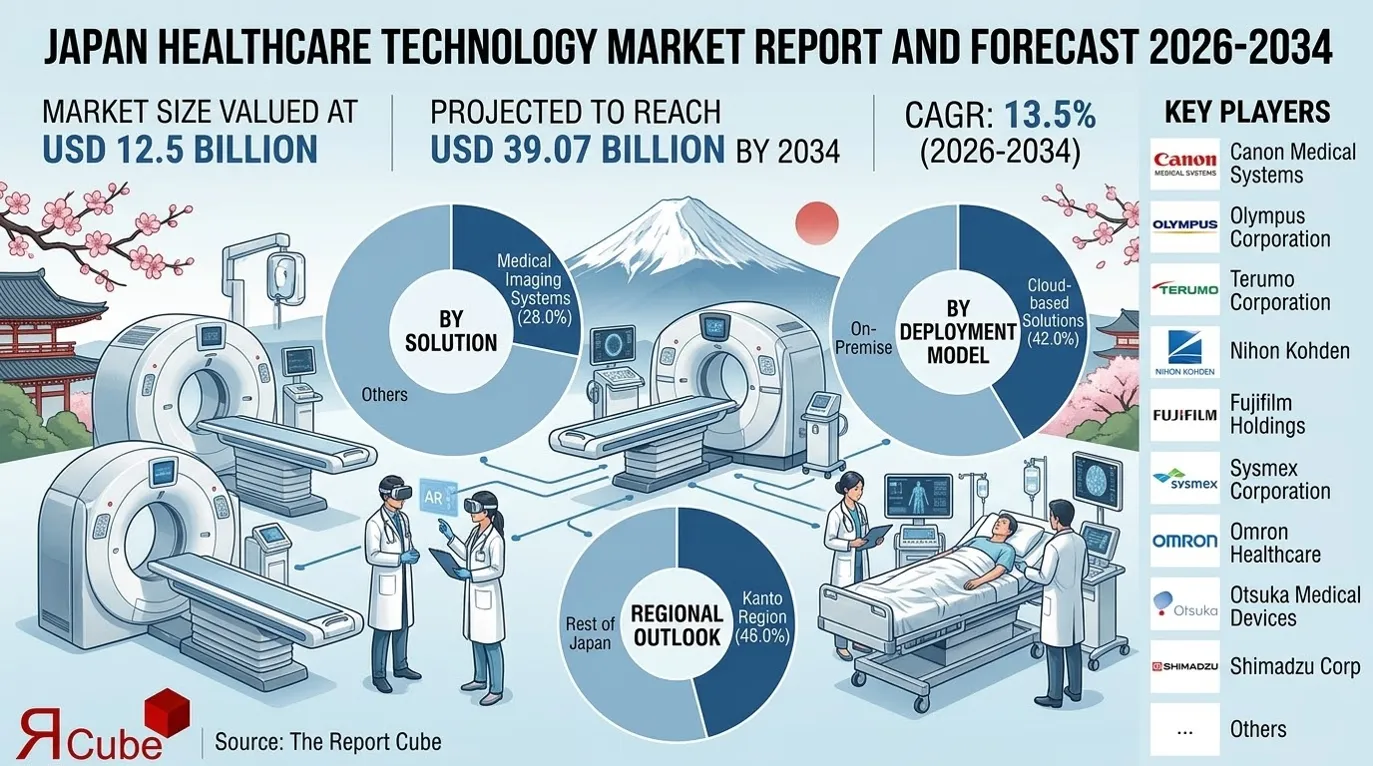
Medical Imaging Systems segment lead the market, with around 28% share.
By Deployment Model:
Cloud-based Solutions segment dominate the market, accounting for nearly 42% of total revenue.
Regional Outlook:
Kanto region dominates the Japan healthcare technology market, with around 46% share.
Japan Healthcare Technology Market Insights & Analysis
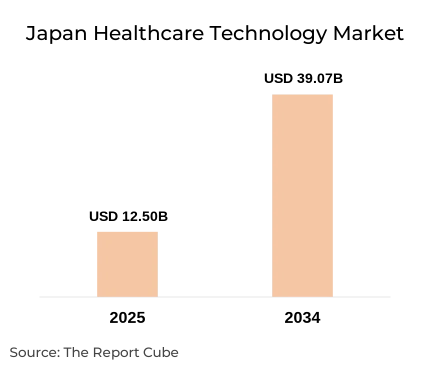
The Japan Healthcare Technology Market is anticipated to register a 13.5% during 2026-2034. the market size was valued at USD 12.5 billion and is projected to reach USD 39.07 billion by 2034. The market reflects Japan’s strong focus on integrating advanced technology into its healthcare ecosystem, driven by the country’s rapidly aging population, where over 29% of citizens were aged 65 or above in 2025. This demographic shift is creating measurable demand for remote monitoring, AI diagnostics, and automated care solutions that reduce dependency on manual healthcare services.
Investment activity in 2025 shows a clear acceleration in digital health infrastructure. The Japanese government allocated over USD 2.3 billion toward digital health transformation programs, including nationwide electronic health record integration and AI-assisted clinical decision tools. Private sector participation is equally strong, with leading firms expanding R&D spending by nearly 18% year-over-year to develop AI-powered imaging, robotics-assisted surgery, and cloud-based healthcare platforms. This investment pattern is not isolated; it connects directly to increasing hospital digitization rates, which reached nearly 72% adoption across urban facilities in 2025.
Japan Healthcare Technology Market Dynamics
Key Driver: Rising Aging Population Driving Demand for Advanced Healthcare Solutions
Japan’s aging demographic remains the strongest force shaping the healthcare technology market. By 2025, nearly one in three individuals required continuous or periodic medical care, which has significantly increased the need for automated monitoring systems and AI-supported diagnostics. Hospitals are facing capacity constraints, leading to higher adoption of remote patient monitoring tools that reduce in-hospital burden. This shift is closely tied to the rise in chronic diseases such as cardiovascular conditions and diabetes, which account for over 60% of healthcare spending in Japan.
Technology is playing a central role in addressing these challenges. AI-enabled diagnostic tools have improved early detection rates by approximately 22%, particularly in oncology and cardiology. Robotics-assisted surgeries have also seen steady growth, with more than 400,000 procedures conducted using robotic systems in 2025. These advancements are not only improving patient outcomes but also optimizing operational efficiency across healthcare facilities, creating a sustainable growth environment for the market.
Book your FREE 30-minute expert consultation today
Contact UsIndustry Trends: Rapid Expansion of Digital Health Platforms and AI Integration
Digital health platforms are transforming how healthcare services are delivered across Japan. The adoption of cloud-based healthcare systems increased by over 40% in 2025, driven by the need for real-time data access and integrated care delivery. Hospitals and clinics are increasingly shifting toward centralized digital systems that allow seamless communication between departments, improving workflow efficiency and patient outcomes.
AI integration is another defining trend, particularly in imaging and diagnostics. AI-assisted radiology tools now support over 65% of imaging procedures in major hospitals, reducing diagnosis time by nearly 30%. This trend connects directly with Japan’s broader push toward smart healthcare infrastructure under national innovation programs. As a result, the market is evolving toward predictive and preventive care models rather than reactive treatment approaches.
Major Challenge: High Implementation Costs and Integration Complexity
The adoption of advanced healthcare technologies in Japan comes with significant cost implications. Implementing AI-driven systems, cloud platforms, and advanced imaging equipment requires substantial upfront investment, which can strain smaller healthcare providers. On average, hospitals spend 18-22% more on infrastructure upgrades when transitioning to digital systems compared to maintaining traditional setups.
Integration complexity further adds to this challenge. Many healthcare facilities operate on legacy systems that are not compatible with modern digital platforms, leading to delays in implementation. Data interoperability remains a concern, particularly when integrating electronic health records across multiple institutions. These challenges slow down adoption rates in rural and mid-sized healthcare facilities, creating a gap in technology accessibility across regions.
Opportunity: Expansion of Remote Care and Home Healthcare Technologies
The growing preference for home-based healthcare presents a strong opportunity for market expansion. By 2025, home healthcare adoption increased by nearly 28%, driven by the aging population’s preference for receiving care in familiar environments. Remote monitoring devices and teleconsultation platforms are enabling continuous patient supervision without requiring hospital visits.
This shift is supported by advancements in wearable technology and IoT-enabled medical devices. These tools allow real-time health tracking, improving early intervention rates and reducing hospital readmissions by approximately 15%. As Japan continues to invest in digital infrastructure, home healthcare solutions are expected to play a central role in reshaping care delivery models and expanding market reach.
Japan Healthcare Technology Market Segment-wise Analysis
By Solution:
- Healthcare IT Services
- Healthcare Software
- Medical Imaging Systems
- In-vitro Diagnostic Systems
- Patient Monitoring Systems
- Therapeutic Devices
- Digital Health Platforms
The medical imaging systems segment dominates the market, accounting for approximately 28% share in 2025. This dominance is closely tied to Japan’s leadership in precision diagnostics and strong export capabilities in imaging technologies. Hospitals across the country rely heavily on advanced imaging systems such as MRI, CT scanners, and ultrasound devices to support early disease detection and accurate diagnosis. The demand is further amplified by the rising prevalence of chronic diseases, where imaging plays a critical role in monitoring disease progression.
Technological innovation has significantly enhanced this segment’s growth. AI-powered imaging solutions have reduced scan interpretation time by nearly 30%, improving workflow efficiency in hospitals. Companies are also focusing on developing compact and portable imaging devices, which are increasingly used in outpatient and home care settings. This evolution reflects a broader shift toward accessible and efficient diagnostic solutions, reinforcing the segment’s leadership position.
By Deployment Model:
- On-premise Solutions
- Cloud-based Solutions
- Hybrid Solutions
Cloud-based solutions lead this segment, contributing nearly 42% of total market revenue in 2025. The shift toward cloud infrastructure is driven by the need for real-time data access, scalability, and cost efficiency. Healthcare providers are increasingly adopting cloud platforms to manage patient records, enable telemedicine services, and support AI-driven analytics. This transition is particularly strong in urban regions, where digital infrastructure is more advanced.
The growing volume of healthcare data is further accelerating cloud adoption. Hospitals generate vast amounts of patient data daily, and cloud solutions provide the flexibility to store and analyze this information efficiently. Security enhancements and regulatory support have also improved confidence in cloud-based systems, making them a preferred choice for modern healthcare facilities.
Regional Projection of Japan Healthcare Technology Industry
- Hokkaido
- Tohoku
- Kanto
- Shikoku
- Others
The Kanto region dominates the market, holding approximately 46% share in 2025. This leadership is driven by the presence of major metropolitan areas such as Tokyo, where healthcare infrastructure is highly advanced. The region accounts for the highest concentration of hospitals, research institutions, and technology companies, creating a strong ecosystem for healthcare innovation.
Investment levels in Kanto are significantly higher compared to other regions, with over 50% of healthcare technology funding directed toward this area in 2025. The adoption of digital health platforms and AI-driven diagnostics is also more advanced, supported by better connectivity and infrastructure. This regional advantage ensures that Kanto remains at the forefront of healthcare technology advancements in Japan.
Government Initiatives & Policies
- Japan Digital Transformation in Healthcare Program (2025): Focuses on nationwide EHR integration and AI-driven diagnostics to improve care delivery efficiency.
- Society 5.0 Healthcare Innovation Initiative: Promotes robotics, telemedicine, and IoT-enabled healthcare systems for aging population management.
Japan Healthcare Technology Market Recent Developments
- 2025: Canon Medical Systems introduced next-generation CT technologies at RSNA 2025, including photon-counting CT and AI-driven reconstruction systems. These innovations enhance diagnostic accuracy while improving workflow efficiency through multi-position scanning capabilities.
- 2025: Sysmex Corporation launched new HISCL Aldosterone and Renin assay kits in Japan, strengthening its diagnostic portfolio. These solutions support early detection of hypertension-related conditions and expand specialized testing capabilities in clinical laboratories.
- 2025: Fujifilm Holdings showcased advanced AI-powered imaging innovations, including MRI systems with enhanced image quality and reduced scan times. The developments aim to improve clinical efficiency and patient outcomes through automation and precision diagnostics.
- 2025: Omron Healthcare expanded its remote monitoring ecosystem by introducing next-generation wearable blood pressure devices integrated with cloud platforms, enabling continuous patient tracking and improved chronic disease management.
- 2025: Hitachi High-Tech advanced its diagnostic imaging solutions by integrating AI-based analytics into laboratory systems, enhancing accuracy and enabling faster clinical decision-making across healthcare institutions.
Need insights for a specific region within this market?
Request Regional DataWhy Choose This Report?
- Provides a comprehensive overview of the overall market analysis, encompassing key trends, consumer behavior analysis, and risk assessment to support strategic decision-making.
- Provides accurate, up-to-date insights into market size, segmentation, and emerging opportunities, helping to minimize risk & capitalizing on growth.
- Gives deep understanding of target audience preferences, investment habits, and communication channels for enhanced product development & marketing effectiveness.
- Delivers competitive analysis & benchmarking, uncovering the strengths & weaknesses of market competitors to guide strategies.
- Consolidate comprehensive market intelligence, reducing reasoning & streamlining research efforts.
- Facilitates customized market segmentation & risk mitigation strategies, fine-tuned to the business objectives.
- Aids in identifying both market challenges & untapped opportunities within the industry to drive long-term business growth.
- Provides valuable information based on actual customer data & search trends.
Table of Contents
- Introduction
- Objective of the Study
- Product and Category Definition
- Market Segmentation
- Study Variables
- Research Methodology
- Secondary Data Points
- Breakdown of Secondary Sources
- Primary Data Points
- Breakdown of Primary Interviews
- Secondary Data Points
- Executive Summary
- Market Dynamics
- Drivers
- Challenges
- Opportunity Assessment
- Recent Trends and Developments
- Regulatory and Policy Landscape
- Japan Healthcare Technology Market Overview (2021-2034)
- Market Size, By Value (USD Billion)
- Market Share, By Solution
- Healthcare IT Services
- Healthcare Software
- Medical Imaging Systems
- In‑vitro Diagnostic Systems
- Patient Monitoring Systems
- Therapeutic Devices
- Digital Health Platforms
- Market Share, By Deployment Model
- On‑premise Solutions
- Cloud‑based Solutions
- Hybrid Solutions
- Market Share, By Application
- Hospital Information Systems
- Electronic Health Records
- Telemedicine and Teleconsultation
- Remote Patient Monitoring
- Diagnostic Imaging
- Surgical and Interventional Care
- Home Healthcare
- Clinical Decision Support
- Others
- Market Share, By End User
- Hospitals and Clinics
- Diagnostic Centers
- Ambulatory Care Centers
- Home Care Settings
- Research and Academic Institutions
- Market Share, By Region
- Hokkaido
- Tohoku
- Kanto
- Shikoku
- Others
- Market Share, By Company
- Revenue Shares and Analysis
- Competitive Landscape
- Hokkaido Healthcare Technology Market
- Market Size, By Value (USD Billion/Million)
- Market Share, By Solution
- Market Share, By Deployment Model
- Market Share, By Application
- Market Share, By End User
- Tohoku Healthcare Technology Market
- Market Size, By Value (USD Billion/Million)
- Market Share, By Solution
- Market Share, By Deployment Model
- Market Share, By Application
- Market Share, By End User
- Kanto Healthcare Technology Market
- Market Size, By Value (USD Billion/Million)
- Market Share, By Solution
- Market Share, By Deployment Model
- Market Share, By Application
- Market Share, By End User
- Shikoku Healthcare Technology Market
- Market Size, By Value (USD Billion/Million)
- Market Share, By Solution
- Market Share, By Deployment Model
- Market Share, By Application
- Market Share, By End User
- Competitive Outlook and Company Profiles
- Canon Medical Systems
- Company Overview
- Product Portfolio
- Strategic Alliances/Partnerships
- Recent Developments
- Olympus Corporation
- Company Overview
- Product Portfolio
- Strategic Alliances/Partnerships
- Recent Developments
- Terumo Corporation
- Company Overview
- Product Portfolio
- Strategic Alliances/Partnerships
- Recent Developments
- Nihon Kohden
- Company Overview
- Product Portfolio
- Strategic Alliances/Partnerships
- Recent Developments
- Fujifilm Holdings
- Company Overview
- Product Portfolio
- Strategic Alliances/Partnerships
- Recent Developments
- Sysmex Corporation
- Company Overview
- Product Portfolio
- Strategic Alliances/Partnerships
- Recent Developments
- Omron Healthcare
- Company Overview
- Product Portfolio
- Strategic Alliances/Partnerships
- Recent Developments
- Otsuka Medical Devices
- Company Overview
- Product Portfolio
- Strategic Alliances/Partnerships
- Recent Developments
- Shimadzu Corp
- Company Overview
- Product Portfolio
- Strategic Alliances/Partnerships
- Recent Developments
- Hitachi High-Tech
- Company Overview
- Product Portfolio
- Strategic Alliances/Partnerships
- Recent Developments
- Asahi Intecc
- Company Overview
- Product Portfolio
- Strategic Alliances/Partnerships
- Recent Developments
- Teijin Pharma
- Company Overview
- Product Portfolio
- Strategic Alliances/Partnerships
- Recent Developments
- M3, Inc.
- Company Overview
- Product Portfolio
- Strategic Alliances/Partnerships
- Recent Developments
- TOP Corporation
- Company Overview
- Product Portfolio
- Strategic Alliances/Partnerships
- Recent Developments
- CMIC Group
- Company Overview
- Product Portfolio
- Strategic Alliances/Partnerships
- Recent Developments
- Menicon Co., Ltd.
- Company Overview
- Product Portfolio
- Strategic Alliances/Partnerships
- Recent Developments
- PHC Holdings
- Company Overview
- Product Portfolio
- Strategic Alliances/Partnerships
- Recent Developments
- Others
- Canon Medical Systems
- Contact Us and Disclaimer
Top Key Players & Market Share Outlook
- Canon Medical Systems
- Olympus Corporation
- Terumo Corporation
- Nihon Kohden
- Fujifilm Holdings
- Sysmex Corporation
- Omron Healthcare
- Otsuka Medical Devices
- Shimadzu Corp
- Hitachi High-Tech
- Asahi Intecc
- Teijin Pharma
- M3, Inc.
- TOP Corporation
- CMIC Group
- Menicon Co., Ltd.
- PHC Holdings
Frequently Asked Questions






