




Build Your Custom Market Intelligence Report
Customize Your ReportJapan Remote Patient Monitoring Market Statistics and Insights
Market Insight
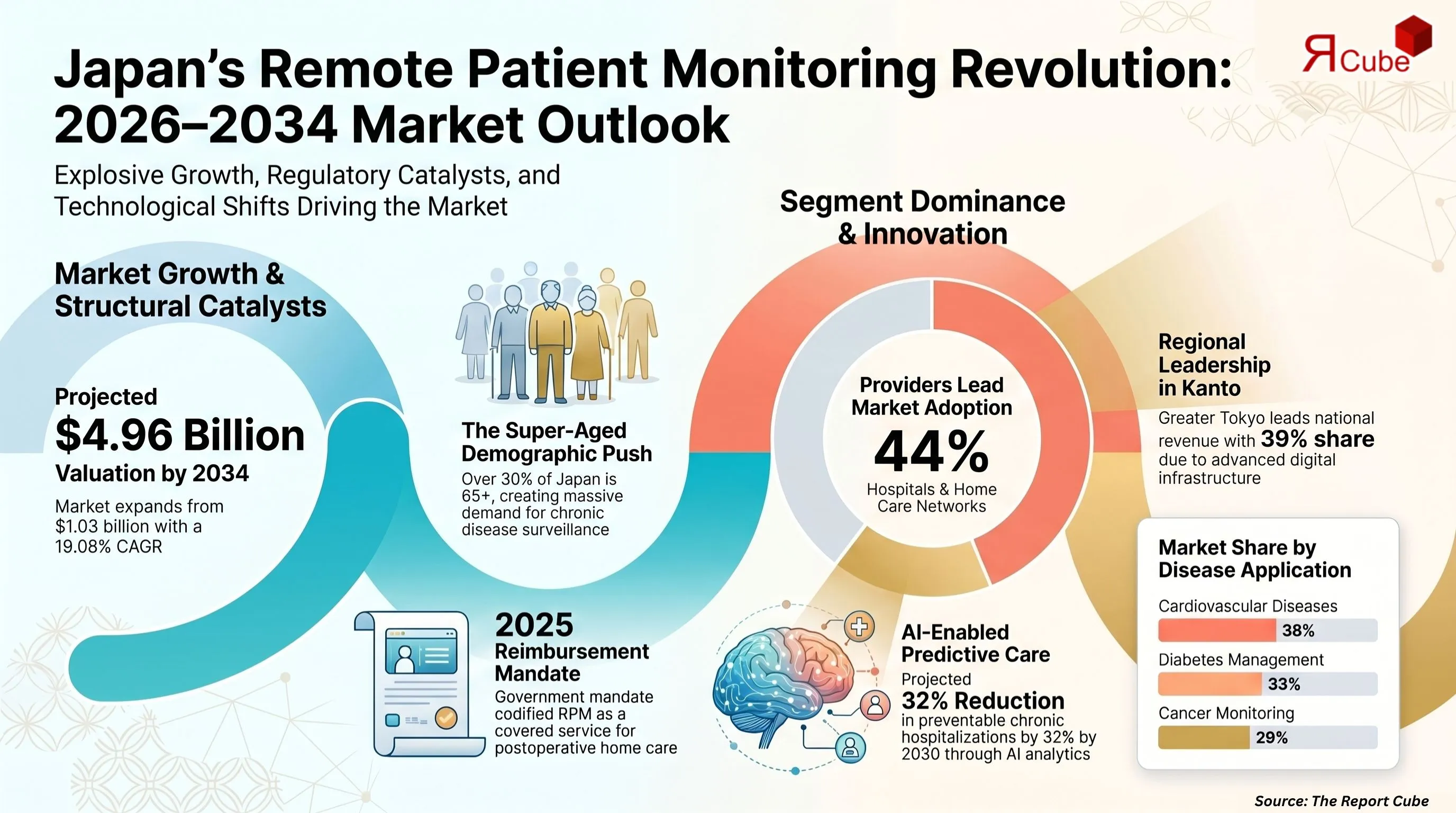
- Japan Remote Patient Monitoring Market was valued at USD 1.03 billion in 2025.
- The market is projected to reach USD 4.96 billion by 2034.
- The market is anticipated to register a 19.08% CAGR during 2026–2034.
By End-User
- Providers segment dominates, capturing approximately 44% of total market share.
Key Players
- More than 10 companies are actively engaged in producing Japan Remote Patient Monitoring solutions.
- Top 5 companies acquired around 58% of the market share.
- Philips, Medtronic, GE Healthcare, Abbott, Boston Scientific, and others.
By Application
- Cardiovascular Diseases leads application segment, holding approximately 38% market share.
Japan Remote Patient Monitoring Market Insights & Analysis
The Japan Remote Patient Monitoring Market is anticipated to register a 19.08% CAGR during 2026–2034. The market size was valued at USD 1.03 billion in 2025 and is projected to reach USD 4.96 billion by 2034. Japan's rapidly aging demographic, with over 30% of the population aged 65 and above, is creating an unprecedented demand for continuous, non-intrusive health surveillance technologies. Remote patient monitoring (RPM) addresses this structural need by enabling real-time tracking of vital parameters outside hospital walls.
The Japanese Ministry of Health, Labour and Welfare's August 2025 mandate requiring remote monitoring for all postoperative home care as a standard reimbursable service was a watershed regulatory moment, dramatically accelerating institutional adoption. Meanwhile, private capital continues to flow into the ecosystem, global medtech companies including Medtronic and Philips deepened their Japan footprint through strategic alliances with local telehealth platforms in early 2026, underscoring investor confidence. The convergence of government reimbursement reform, technological maturation, and a chronic disease burden spanning diabetes, cardiovascular conditions, and oncology is collectively positioning Japan as one of Asia Pacific's most dynamic RPM markets.
Japan Remote Patient Monitoring Market Dynamics
Key Market Driver Aging Population Driving Chronic Disease Demand
Japan's super-aged society is the single most powerful structural force propelling RPM adoption. With over 30% of citizens aged 65 or older in 2025, a proportion unmatched among G7 economies, the nation faces a compounding burden of multimorbidity. Elderly patients managing simultaneous conditions such as hypertension, type 2 diabetes, and cardiac arrhythmias require uninterrupted physiological surveillance that traditional outpatient settings cannot cost-effectively deliver. RPM platforms fill this gap by enabling continuous data streams from wearable biosensors and connected diagnostic devices to centralized clinical dashboards. Healthcare providers across Japan reported a 27% reduction in unplanned hospital readmissions among elderly cohorts using structured RPM programs in 2024, reinforcing the technology's clinical and economic value proposition.
Major Industry Challenge Fragmented EHR Interoperability Across Providers
Despite robust RPM device adoption, Japan's healthcare IT infrastructure remains fragmented across hospital networks, community clinics, and home care operators. The absence of a unified electronic health record (EHR) exchange standard means that patient data generated by RPM devices frequently exists in siloed repositories, limiting care coordination and reducing the clinical value of continuous monitoring. The International Standards Organization's August 2025 directive mandating a universal data exchange format for remote monitoring hardware marked a significant step forward, but full implementation across Japan's diverse provider ecosystem is expected to take three to five years. Interoperability gaps also complicate reimbursement claims processing, creating administrative friction that slows broader uptake among smaller community healthcare operators.
Emerging Trend Shaping Outlook AI-Enabled Predictive Analytics Transforming Clinical Workflows
Artificial intelligence integration is shifting RPM from a passive data collection exercise to an active clinical decision support function. In November 2025, Siemens Healthineers launched the Guardian-AI platform, which employs large language model-based analytics to deliver real-time decision support for virtual care environments. Japanese RPM vendors are embedding predictive deterioration algorithms that flag cardiovascular or glycemic risk events 12–48 hours before symptomatic onset, allowing early intervention and avoiding emergency admissions.
Omron Healthcare's 2025 launch of a real-time vital signs wearable explicitly designed for Japan's aging population further illustrates how AI-driven product development is being calibrated to demographic specificities. By 2030, AI-powered RPM platforms are projected to reduce preventable chronic disease hospitalizations in Japan by up to 32%.
Need Specific Data, Let’s Customize the Report for You
Request CustomizationJapan Remote Patient Monitoring Market Segment-wise Analysis
Japan's RPM market exhibits clearly differentiated growth patterns across both its end-user and application dimensions. Structural factors including reimbursement policy evolution, disease prevalence data, and technology adoption curves are shaping segment dynamics in distinct ways, with particular strength emerging among institutional providers and cardiovascular disease management programs.
By End-User
- Payers
- Providers
- Patients
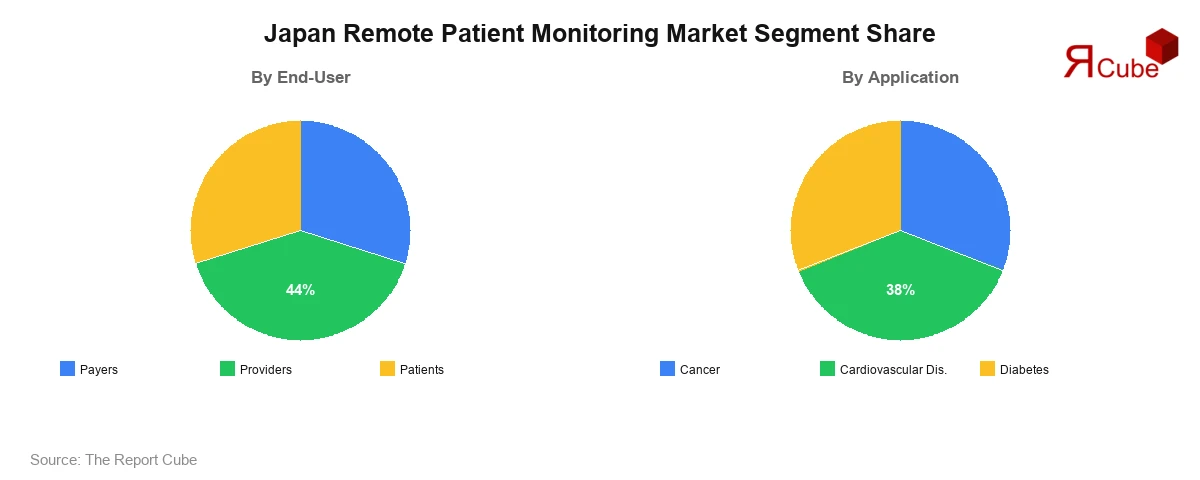
The Providers segment commands the largest share of the Japan Remote Patient Monitoring market, accounting for approximately 44% of total revenue in 2026. Hospitals, specialty clinics, and home care networks represent the primary institutional adopters, driven by the August 2025 reimbursement mandate that codified RPM as a covered postoperative service. Providers are deploying RPM to manage patient loads more efficiently and reduce costly inpatient stays, particularly in cardiology and endocrinology departments.
The Payers segment, holding approximately 31% of market share, is gaining momentum as insurance entities formalize reimbursement frameworks for digitally delivered care. Private insurers are piloting outcome-based payment models that reward RPM-driven improvements in chronic disease control metrics. The Patients segment, representing approximately 25% of the market, reflects the growing direct-to-consumer RPM adoption driven by health-conscious individuals managing wellness and chronic conditions through connected wearables and mobile health applications.
By Application
- Cancer
- Cardiovascular Diseases
- Diabetes
Cardiovascular Diseases constitute the leading application segment, accounting for approximately 38% of Japan's RPM market revenue. Japan's high prevalence of hypertension and cardiac arrhythmias, combined with the widespread use of implantable cardiac devices that transmit continuous rhythm data, underpins this segment's dominance. Biotronik and Boston Scientific have deepened their cardiac telemonitoring capabilities in Japan with enhanced remote follow-up platforms for implantable cardioverter defibrillator patients.
Diabetes management ranks as the second largest application, representing approximately 33% of market share. Japan has one of Asia's highest rates of type 2 diabetes, with over 10 million diagnosed patients requiring ongoing glycemic surveillance. Abbott's continuous glucose monitoring systems have seen accelerating uptake across Japanese hospital and home care settings. The Cancer monitoring segment, holding approximately 29% share, is the fastest growing application, driven by expanded use of RPM in oncology symptom management, post-chemotherapy monitoring, and palliative care support programs.
Regional Projection of Japan Remote Patient Monitoring Market
Japan's RPM market landscape is shaped by distinctive regional healthcare infrastructure and demographic concentrations across the country's major administrative regions:
- Kanto Region
- Kansai Region
- Chubu Region
- Kyushu Region
The Kanto Region, home to the Greater Tokyo metropolitan area, leads the Japan Remote Patient Monitoring market with approximately 39% of national revenue, driven by the highest concentration of tertiary hospitals, digital health startups, and insurance payer networks in the country. Tokyo-based healthcare institutions have been among the earliest adopters of AI-integrated RPM platforms, supported by superior broadband and 5G connectivity infrastructure. The Kansai Region follows with approximately 22% market share, buoyed by Osaka's role as a medtech manufacturing hub and Kyoto's academic healthcare research institutions.
Japan Remote Patient Monitoring Market: Recent Development (2025)
- Philips expanded Japan RPM platform partnerships, reporting 14% revenue growth in Asia Pacific operations.
- Omron Healthcare launched a real-time wearable vital signs device tailored specifically for Japan's elderly population.
- Medtronic integrated advanced AI analytics into its Japan cardiac RPM suite, improving clinical decision timelines.
- Abbott reported a 19% increase in Japanese continuous glucose monitor sales, driven by hospital procurement programs.
Japan Remote Patient Monitoring Market Future Outlook (2034)
The Japan Remote Patient Monitoring market is poised for substantial long-term expansion, projected to achieve a value of USD 4.96 billion by 2034 at a 19.08% CAGR. Growth will be anchored by the continued maturation of AI-driven predictive analytics, the integration of 5G-enabled edge computing into clinical-grade wearable devices, and the progressive broadening of reimbursement frameworks to cover preventive and wellness-oriented RPM applications.
The transition toward value-based care models will incentivize providers and payers alike to embed RPM into chronic disease management pathways for cardiovascular, metabolic, and oncological conditions. Japan's Society 5.0 national technology agenda explicitly positions digital health as a priority investment domain, suggesting continued public funding for RPM infrastructure through 2034. Strategic partnerships between multinational medtech corporations and Japanese domestic health networks will further accelerate platform localization and patient adoption.
Why Choose This Report?
- Provides a comprehensive overview of the overall market analysis, encompassing key trends, consumer behavior analysis, and risk assessment to support strategic decision-making.
- Provides accurate, up-to-date insights into market size, segmentation, and emerging opportunities, helping to minimize risk & capitalizing on growth.
- Gives deep understanding of target audience preferences, investment habits, and communication channels for enhanced product development & marketing effectiveness.
- Delivers competitive analysis & benchmarking, uncovering the strengths & weaknesses of market competitors to guide strategies.
- Consolidate comprehensive market intelligence, reducing reasoning & streamlining research efforts.
- Facilitates customized market segmentation & risk mitigation strategies, fine-tuned to the business objectives.
- Aids in identifying both market challenges & untapped opportunities within the industry to drive long-term business growth.
- Provides valuable information based on actual customer data & search trends.
Table of Contents
- Introduction
- Objective of the study
- Product Definition
- Market Segmentation
- Study Variables
- Research Methodology
- Secondary Data Points
- Companies Interviewed
- Primary Data Points
- Breakdown of Primary Interviews
- Secondary Data Points
- Executive Summary
- Market Dynamics
- Drivers
- Challenges
- Opportunity Assessment
- Recent Trends and Developments
- Policy and Regulatory Landscape
- Japan Remote Patient Monitoring Market Overview and Forecast Analysis (2021-2034)
- Market Size, By Value, By growth rate (CAGR/USD Billions)
- Demand - Supply Trends
- Market Share, By Type
- Devices
- Services
- Market Share, By End-User
- Payers
- Providers
- Patients
- Market Share, By Application
- Cancer
- Cardiovascular Diseases
- Diabetes
- Market Share, By Region
- Kanto Region
- Kansai Region
- Chubu Region
- Kyushu Region
- Market Share, By Competitors
- Competition Characteristics
- Revenue Shares
- Japan Devices Remote Patient Monitoring Market Overview, 2021-2034F
- By Value (USD Million)
- By End-User- Market Size & Forecast 2021-2034, USD Million
- By Application - Market Size & Forecast 2021-2034, USD Million
- Japan Services Remote Patient Monitoring Market Overview, 2021-2034F
- By Value (USD Million)
- By End-User- Market Size & Forecast 2021-2034, USD Million
- By Application - Market Size & Forecast 2021-2034, USD Million
- Competitive Outlook (Company Profile - Partial List)
- Philips
- Company Overview
- Business Segments
- Strategic Alliances/Partnerships
- Recent Developments
- Medtronic
- Company Overview
- Business Segments
- Strategic Alliances/Partnerships
- Recent Developments
- GE Healthcare
- Company Overview
- Business Segments
- Strategic Alliances/Partnerships
- Recent Developments
- Abbott
- Company Overview
- Business Segments
- Strategic Alliances/Partnerships
- Recent Developments
- Boston Scientific
- Company Overview
- Business Segments
- Strategic Alliances/Partnerships
- Recent Developments
- Honeywell
- Company Overview
- Business Segments
- Strategic Alliances/Partnerships
- Recent Developments
- Siemens Healthineers
- Company Overview
- Business Segments
- Strategic Alliances/Partnerships
- Recent Developments
- Biotronik
- Company Overview
- Business Segments
- Strategic Alliances/Partnerships
- Recent Developments
- Omron Healthcare
- Company Overview
- Business Segments
- Strategic Alliances/Partnerships
- Recent Developments
- Others
- Philips
- Contact Us & Disclaimer
Top Key Players & Market Share Outlook
- Philips
- Medtronic
- GE Healthcare
- Abbott
- Boston Scientific
- Honeywell
- Siemens Healthineers
- Biotronik
- Omron Healthcare
- Others
Frequently Asked Questions