



Build Your Custom Market Intelligence Report
Customize Your ReportSingapore Automotive Robotics & Automation Market Key Highlights
By Robot Type:
Articulated Robots segment leads the market, with around 42% share.
By Application:
Body Welding segment dominates the market, accounting for nearly 28% of total revenue.
Regional Outlook:
West region dominates the singapore automotive robotics & automation market, with around 36% share.
Government Initiatives & Policies
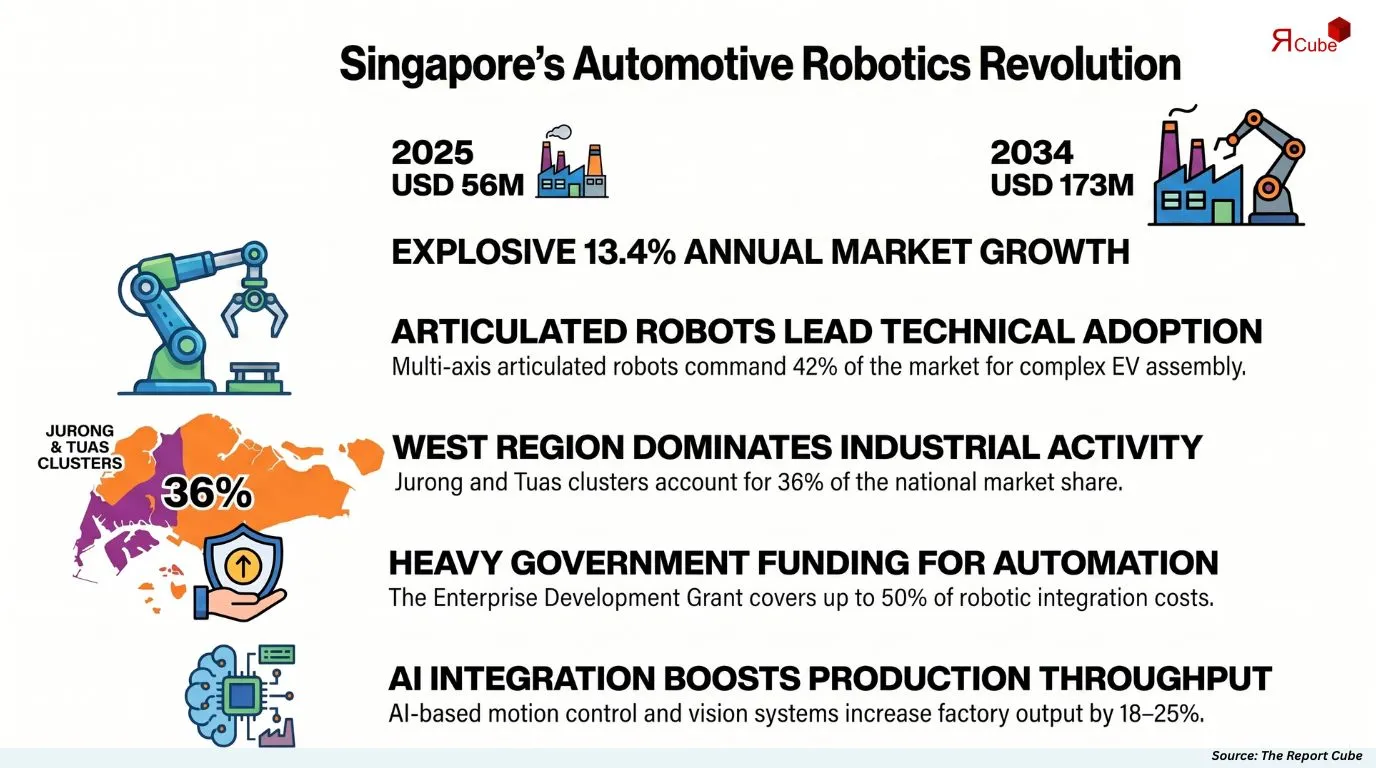
- Enterprise Development Grant (EDG) - Automation Support (Updated 2025): Supports Singapore manufacturers in adopting robotics, AI-driven automation, and smart factory upgrades with funding coverage of up to 50% of qualifying costs.
- Smart Industry Readiness Index (SIRI) & Advanced Manufacturing Training Academy (2025 Expansion): Strengthens Industry 4.0 adoption across precision engineering and automotive supply chains.
Singapore Automotive Robotics & Automation Market Insights & Analysis
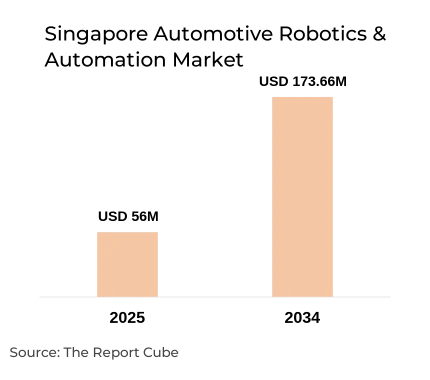
The Singapore Automotive Robotics & Automation Market is anticipated to register a CAGR: 13.4% during 2026-34. The market size was valued at USD 56 million in 2025 and is projected to reach USD 173.66 million by 2034. The market reflects Singapore’s strategic focus on high-value manufacturing, precision engineering, and Industry 4.0 transformation within automotive assembly and component production.
Singapore does not operate large-scale vehicle assembly plants compared to regional hubs, yet it plays a critical role in advanced component manufacturing, electronics integration, battery modules, and autonomous vehicle R&D. The automotive robotics ecosystem is therefore concentrated in high-precision welding cells, EV battery assembly automation, semiconductor-based automotive electronics, and intelligent inspection systems. By 2025, over 68% of medium-to-large automotive suppliers in Singapore had integrated at least one form of robotic cell into their production lines, reflecting strong automation maturity.
Investment momentum is reinforced by public-private partnerships and smart factory programs. Western Singapore, including Jurong and Tuas industrial clusters, hosts a dense concentration of robotics integrators, component manufacturers, and automation solution providers. Automotive-grade electronics production has increased by an estimated 11% year-on-year, pushing demand for articulated robots, SCARA systems, and AI-enabled vision inspection. Additionally, electric mobility infrastructure growth across Southeast Asia has driven export-oriented production of charging components and EV battery packs from Singapore-based plants, expanding automation requirements.
Collaborative robots and flexible manufacturing cells are gaining traction among Tier-2 and Tier-3 suppliers seeking scalable automation without full plant redesign. Integration of AI-based motion control, force sensing, and machine vision is enhancing production throughput by 18-25% in advanced automotive cells. These factors collectively position Singapore as a high-value automation innovation hub rather than a volume-driven automotive assembly base.
Singapore Automotive Robotics & Automation Market Dynamics
Key Driver: Advanced Manufacturing Transformation and EV Component Growth
Singapore’s national push toward advanced manufacturing is a primary growth engine for automotive robotics adoption. The precision engineering sector contributes nearly 20% of manufacturing output, with automotive electronics forming a growing subsegment. EV battery module assembly, inverter production, and sensor integration require micron-level accuracy, favoring articulated and SCARA robots. Automation improves consistency, reduces defect rates by up to 30%, and enhances export competitiveness. Rising regional EV demand further strengthens this driver, as Singapore-based facilities supply high-value modules to ASEAN markets. The integration of robotics into battery and electronic control unit assembly lines ensures traceability, safety compliance, and operational efficiency, supporting sustained double-digit growth.
Book your FREE 30-minute expert consultation today
Contact UsIndustry Trends: AI Vision, Collaborative Cells, and Autonomous Internal Logistics
Manufacturers are integrating AI-powered vision systems and autonomous mobile robots (AMRs) to enhance plant flexibility. Vision-guided robots reduce inspection cycle times by nearly 22%, particularly in quality inspection and parts machining. Collaborative robots are increasingly deployed in final assembly and kitting operations, working alongside technicians to increase throughput without expanding floor space. Autonomous internal logistics solutions, including AGVs and AMRs, streamline material handling between machining and welding cells. Smart analytics platforms connected to robot controllers enable predictive maintenance, reducing unplanned downtime by an estimated 15%. These trends reflect Singapore’s emphasis on intelligent, data-driven factory ecosystems.
Major Challenge: High Capital Investment and Skilled Workforce Requirements
Robotics integration requires substantial upfront capital expenditure, particularly for advanced articulated systems and integrated vision platforms. Full automation of a mid-sized automotive component line can require investments exceeding USD 3-5 million. Smaller suppliers often face financing constraints, slowing widespread deployment. Additionally, robotics programming, calibration, and maintenance demand highly skilled engineers. Singapore’s tight labor market increases competition for automation specialists. Although government grants offset part of the cost, return on investment timelines may extend beyond three years for smaller enterprises. Bridging skill gaps through technical training remains essential for sustainable market expansion.
Opportunity: Regional Export Hub for High-Precision Automotive Automation Solutions
Singapore is positioned to serve as a regional automation innovation hub for Southeast Asia. Local robotics integrators and motion control firms are expanding partnerships across ASEAN automotive clusters. Export of robotic cells and turnkey automation solutions is increasing, particularly for EV component production lines. Advanced force-torque sensing, precision motion modules, and AI programming platforms offer competitive advantages. By 2034, exports of automotive automation systems from Singapore could account for nearly 40% of total market revenue. Integration of digital twins and simulation platforms further enhances the country’s value proposition in high-precision robotics engineering.
Singapore Automotive Robotics & Automation Market Segment-wise Analysis
By Robot Type:
- Articulated Robots
- SCARA Robots
- Cartesian Robots
- Cylindrical Robots
- Delta Robots
- Collaborative Robots
Articulated robots account for approximately 42% of total installations in 2025, driven by their flexibility in body welding, paint automation, and complex assembly tasks. Their multi-axis configuration enables high payload capacity and precision handling in EV battery module assembly. Automotive electronics manufacturing lines rely heavily on six-axis articulated systems integrated with vision and force feedback controls. These robots improve welding accuracy and reduce material wastage by nearly 12%. While collaborative robots are expanding in final assembly tasks, articulated robots remain dominant due to versatility and compatibility with heavy-duty operations.
By Application:
- Body Welding
- Paint Automation
- Final Assembly
- Material Handling
- Parts Machining
- Quality Inspection
- Internal Logistics
Body welding represents nearly 28% of application revenue, reflecting demand for precision and structural integrity in automotive frames and EV battery casings. Automated welding cells reduce cycle times by up to 25% and maintain consistent weld penetration standards. Robotics integration ensures repeatability and compliance with international automotive quality standards. Paint automation follows closely, driven by demand for defect-free surface finishing. Meanwhile, quality inspection using AI-powered robotic vision systems is growing rapidly, particularly in semiconductor-based automotive electronics production.
Regional Projection of Singapore Automotive Robotics & Automation Industry
- West
- East
- North
- Northeast
- Central
The West region leads with around 36% share, supported by industrial estates in Jurong and Tuas. These areas host advanced manufacturing facilities and robotics integrators. Concentration of EV battery component producers and semiconductor fabrication plants drives automation demand. The East region, including Changi business clusters, focuses on aerospace and precision electronics, contributing moderate automotive automation activity. Northern and Central regions support smaller-scale suppliers and R&D laboratories. Industrial zoning and infrastructure readiness significantly influence automation adoption patterns across Singapore.
Singapore Automotive Robotics & Automation Market Recent Developments
- 2025: ABB Pte. Ltd. unveiled its roadmap toward Autonomous Versatile Robotics at automatica 2025, integrating AI vision, advanced motion control, and autonomous planning within its OmniCore platform to strengthen industrial automation performance.
- 2025: Mitsubishi Electric Asia introduced an automation solution integrating Canon’s FH-300-20 force-torque sensor with MELFA FR PLUS robots at SEMICON Southeast Asia 2025, enhancing high-precision robotic handling capabilities.
- 2025: PBA Robotics (PBA Systems) showcased advanced precision motion solutions at SEMICON Southeast Asia 2025, expanding its partner ecosystem beyond 50 automation collaborators across Asia.
- 2025: PBA Robotics (PBA Group) announced strategic collaboration with Mitsubishi Electric Japan to co-develop precision motion and factory automation technologies for scalable regional deployment.
Need insights for a specific region within this market?
Request Regional DataWhy Choose This Report?
- Provides a comprehensive overview of the overall market analysis, encompassing key trends, consumer behavior analysis, and risk assessment to support strategic decision-making.
- Provides accurate, up-to-date insights into market size, segmentation, and emerging opportunities, helping to minimize risk & capitalizing on growth.
- Gives deep understanding of target audience preferences, investment habits, and communication channels for enhanced product development & marketing effectiveness.
- Delivers competitive analysis & benchmarking, uncovering the strengths & weaknesses of market competitors to guide strategies.
- Consolidate comprehensive market intelligence, reducing reasoning & streamlining research efforts.
- Facilitates customized market segmentation & risk mitigation strategies, fine-tuned to the business objectives.
- Aids in identifying both market challenges & untapped opportunities within the industry to drive long-term business growth.
- Provides valuable information based on actual customer data & search trends.
Table of Contents
- Introduction
- Objective of the Study
- Product and Category Definition
- Market Segmentation
- Study Variables
- Research Methodology
- Secondary Data Points
- Breakdown of Secondary Sources
- Primary Data Points
- Breakdown of Primary Interviews
- Secondary Data Points
- Executive Summary
- Market Dynamics
- Drivers
- Challenges
- Opportunity Assessment
- Recent Trends and Developments
- Regulatory and Policy Landscape
- Singapore Automotive Robotics & Automation Market Overview (2021-2034)
- Market Size, By Value (USD Million)
- Market Share, By Robot Type
- Articulated Robots
- SCARA Robots
- Cartesian Robots
- Cylindrical Robots
- Delta Robots
- Collaborative Robots
- Market Share, By Application
- Body Welding
- Paint Automation
- Final Assembly
- Material Handling
- Parts Machining
- Quality Inspection
- Internal Logistics
- Market Share, By Component
- Robot Hardware
- Control Systems
- Sensors & Vision
- End Effectors
- Software & Services
- Market Share, By Automation Level
- Fixed Automation
- Flexible Cells
- Collaborative Cells
- Mobile Robotics
- Market Share, By Plant Type
- OEM Assembly
- Component Plants
- Tire & Battery
- Aftermarket Lines
- Others
- Market Share, By Region
- East
- North
- Northeast
- West
- Central
- Market Share, By Company
- Revenue Shares & Analysis
- Competitive Landscape
- East Singapore Automotive Robotics & Automation Market
- Market Size, By Value (USD Million)
- Market Share, By Robot Type
- Market Share, By Application
- Market Share, By Component
- Market Share, By Automation Level
- Market Share, By Plant Type
- North Singapore Automotive Robotics & Automation Market
- Market Size, By Value (USD Million)
- Market Share, By Robot Type
- Market Share, By Application
- Market Share, By Component
- Market Share, By Automation Level
- Market Share, By Plant Type
- Northeast Singapore Automotive Robotics & Automation Market
- Market Size, By Value (USD Million)
- Market Share, By Robot Type
- Market Share, By Application
- Market Share, By Component
- Market Share, By Automation Level
- Market Share, By Plant Type
- West Singapore Automotive Robotics & Automation Market
- Market Size, By Value (USD Million)
- Market Share, By Robot Type
- Market Share, By Application
- Market Share, By Component
- Market Share, By Automation Level
- Market Share, By Plant Type
- Central Singapore Automotive Robotics & Automation Market
- Market Size, By Value (USD Million)
- Market Share, By Robot Type
- Market Share, By Application
- Market Share, By Component
- Market Share, By Automation Level
- Market Share, By Plant Type
- Competitive Outlook and Company Profiles
- ABB Pte. Ltd.
- Company Overview
- Product Portfolio
- Strategic Alliances/Partnerships
- Recent Developments
- KUKA Industries Singapore
- Company Overview
- Product Portfolio
- Strategic Alliances/Partnerships
- Recent Developments
- Fanuc Singapore Pte. Ltd.
- Company Overview
- Product Portfolio
- Strategic Alliances/Partnerships
- Recent Developments
- Yaskawa (Singapore) Pte. Ltd.
- Company Overview
- Product Portfolio
- Strategic Alliances/Partnerships
- Recent Developments
- Mitsubishi Electric Asia
- Company Overview
- Product Portfolio
- Strategic Alliances/Partnerships
- Recent Developments
- HOPE Technik Pte. Ltd.
- Company Overview
- Product Portfolio
- Strategic Alliances/Partnerships
- Recent Developments
- PBA Robotics
- Company Overview
- Product Portfolio
- Strategic Alliances/Partnerships
- Recent Developments
- Bosch Rexroth Pte. Ltd.
- Company Overview
- Product Portfolio
- Strategic Alliances/Partnerships
- Recent Developments
- Omron Electronics Pte. Ltd.
- Company Overview
- Product Portfolio
- Strategic Alliances/Partnerships
- Recent Developments
- Schneider Electric Singapore
- Company Overview
- Product Portfolio
- Strategic Alliances/Partnerships
- Recent Developments
- Beckhoff Automation
- Company Overview
- Product Portfolio
- Strategic Alliances/Partnerships
- Recent Developments
- SESTO Robotics Pte. Ltd.
- Company Overview
- Product Portfolio
- Strategic Alliances/Partnerships
- Recent Developments
- Stäubli (Singapore) Pte. Ltd.
- Company Overview
- Product Portfolio
- Strategic Alliances/Partnerships
- Recent Developments
- Universal Robots (SEA)
- Company Overview
- Product Portfolio
- Strategic Alliances/Partnerships
- Recent Developments
- Comau
- Company Overview
- Product Portfolio
- Strategic Alliances/Partnerships
- Recent Developments
- GreyOrange Pte. Ltd.
- Company Overview
- Product Portfolio
- Strategic Alliances/Partnerships
- Recent Developments
- Augmentus
- Company Overview
- Product Portfolio
- Strategic Alliances/Partnerships
- Recent Developments
- Others
- ABB Pte. Ltd.
- Contact Us and Disclaimer
Top Key Players & Market Share Outlook
- ABB Pte. Ltd.
- KUKA Industries Singapore
- Fanuc Singapore Pte. Ltd.
- Yaskawa (Singapore) Pte. Ltd.
- Mitsubishi Electric Asia
- HOPE Technik Pte. Ltd.
- PBA Robotics
- Bosch Rexroth Pte. Ltd.
- Omron Electronics Pte. Ltd.
- Schneider Electric Singapore
- Beckhoff Automation
- SESTO Robotics Pte. Ltd.
- Stäubli (Singapore) Pte. Ltd.
- Universal Robots (SEA)
- Comau
- GreyOrange Pte. Ltd.
- Augmentus
- Others
Frequently Asked Questions






