



Build Your Custom Market Intelligence Report
Customize Your ReportSouth Africa Commercial Vehicle Market Insights & Analysis
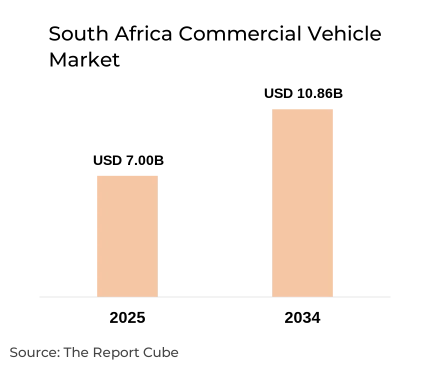
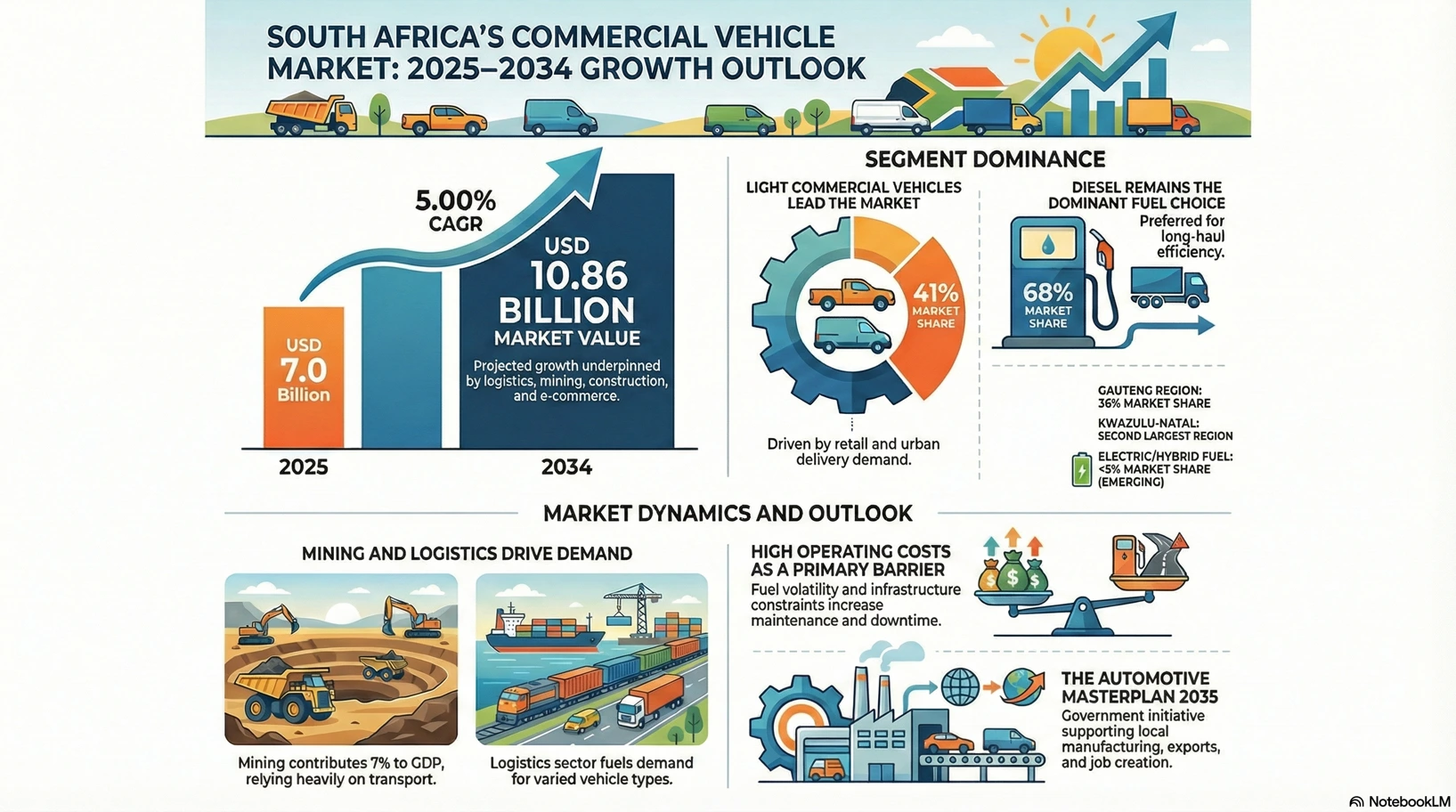
The South Africa Commercial Vehicle Market is anticipated to register a CAGR of 5.00% during the forecast period 2026&-2034. The market size was valued at USD 7.0 billion in 2025 and is projected to reach USD 10.86 billion by 2034. This steady expansion reflects rising freight movement, infrastructure development, and increased demand from construction, mining, agriculture, and retail logistics sectors across the country.
South Africa’s role as a logistics gateway for the Southern African region continues to strengthen demand for commercial vehicles, particularly trucks and pickups used for cross-border trade. Growth in e-commerce, organized retail, and last-mile delivery services has significantly increased the requirement for light and medium commercial vehicles. At the same time, ongoing investments in road rehabilitation, renewable energy projects, and urban infrastructure are supporting consistent fleet expansion among logistics operators and construction firms.
Moreover, fleet operators are gradually focusing on vehicle durability, fuel efficiency, and total cost of ownership, influencing procurement decisions. While diesel-powered vehicles remain dominant, interest in alternative fuel and hybrid commercial vehicles is slowly increasing due to fuel price volatility and sustainability goals. These interconnected factors collectively position the South Africa Commercial Vehicle Market for stable, long-term growth throughout the forecast period.
South Africa Commercial Vehicle Market Recent Developments
- 2025: Isuzu Motors South Africa expanded local production capacity to meet rising domestic and export demand.
- 2025: Toyota South Africa introduced upgraded pickup variants focused on fuel efficiency and fleet reliability.
Government Initiatives & Policies
- South African Automotive Masterplan 2035: Supports local vehicle manufacturing, exports, and job creation.
- National Freight Logistics Roadmap: Focuses on improving freight corridors and road infrastructure efficiency.
South Africa Commercial Vehicle Market Dynamics
Key Driver: Expansion of Logistics, Mining, and Construction Activities
The primary driver of the South Africa Commercial Vehicle Market is the sustained expansion of logistics, mining, and construction activities. Mining contributes over 7% to the national GDP and relies heavily on heavy-duty trucks for material transport. Simultaneously, public and private infrastructure investments in roads, housing, and energy projects are increasing demand for medium and heavy commercial vehicles. Growth in organized retail and e-commerce has also amplified demand for light commercial vehicles used in urban and regional distribution. Fleet operators prioritize reliable vehicles capable of handling long distances and challenging road conditions, further reinforcing demand. These sectors are deeply interconnected, ensuring consistent vehicle replacement cycles and new fleet additions, which collectively drive market growth.
Book your FREE 30-minute expert consultation today
Contact UsIndustry Trends: Gradual Shift Toward Fuel Efficiency and Fleet Optimization
A key trend shaping the market is the growing emphasis on fuel efficiency and fleet optimization. Rising diesel prices and operating costs have prompted fleet owners to invest in vehicles offering better mileage and lower maintenance expenses. Manufacturers are responding by introducing advanced engine technologies, improved aerodynamics, and connected vehicle features that enable real-time fleet monitoring. While diesel remains the dominant fuel type, hybrid and electric commercial vehicles are gaining attention, particularly for urban delivery applications. Additionally, leasing and fleet management services are becoming more popular, allowing businesses to reduce capital expenditure while maintaining operational flexibility. This trend is gradually transforming purchasing behavior across the market.
Major Challenge: High Operating Costs and Infrastructure Constraints
High operating costs represent a significant challenge for the South Africa Commercial Vehicle Market. Fuel price volatility, rising maintenance expenses, and increasing insurance costs directly impact fleet profitability. In addition, inconsistent road infrastructure quality in certain regions accelerates vehicle wear and tear, increasing downtime and repair costs. Smaller transport operators are particularly vulnerable, as limited access to financing restricts their ability to upgrade fleets. These challenges can delay purchasing decisions and slow adoption of newer vehicle technologies, creating short-term constraints on market growth despite favorable long-term demand fundamentals.
Opportunity: Emerging Demand for Alternative Fuel and Electric Commercial Vehicles
The gradual emergence of alternative fuel and electric commercial vehicles presents a notable opportunity for the market. Urban emission concerns, corporate sustainability targets, and government incentives are encouraging fleet operators to explore cleaner vehicle options. Electric and hybrid commercial vehicles are particularly attractive for last-mile delivery and municipal services due to lower operating costs over time. Although current adoption remains limited, improving charging infrastructure and declining battery costs are expected to support higher penetration in the coming years. Manufacturers that invest early in localized assembly and aftersales support for alternative fuel vehicles are likely to gain a competitive advantage.
South Africa Commercial Vehicle Market Segment-wise Analysis
By Vehicle Type:
- Light Commercial
- Medium Trucks
- Heavy Trucks
- Buses & Coaches
- Pickups & Vans
Light Commercial Vehicles lead the market, accounting for approximately 41% of total market share in 2025. Their dominance is driven by rising demand from retail distribution, agriculture, and urban delivery services. Pickups & Vans follow closely, benefiting from their versatility across both commercial and semi-personal use. Heavy Trucks hold a significant share due to mining and long-haul freight requirements, while Medium Trucks support regional logistics. Buses & Coaches represent a smaller but stable segment, supported by public transport and tourism recovery. This diverse vehicle mix reflects the broad-based demand structure of the market.
By Fuel Type:
- Diesel
- Petrol
- Natural Gas
- Electric
- Hybrid
Diesel-powered vehicles dominate the South Africa Commercial Vehicle Market with an estimated 68% market share, owing to their torque efficiency and suitability for long-distance hauling. Petrol vehicles maintain relevance in light commercial applications, particularly pickups and vans. Electric and hybrid vehicles collectively account for less than 5% of the market but are experiencing steady growth, especially in metropolitan areas. Natural gas vehicles remain niche due to limited fueling infrastructure. Over the forecast period, gradual diversification of fuel types is expected as sustainability considerations gain importance.
Regional Projection of South Africa Commercial Vehicle Industry
- Gauteng
- KwaZulu-Natal
- Western Cape
- Eastern Cape
- Rest of South Africa
Gauteng leads the South Africa Commercial Vehicle Market, contributing nearly 36% of total demand. As the country’s economic hub, Gauteng benefits from dense industrial activity, logistics hubs, and distribution centers. KwaZulu-Natal follows, supported by port activity and trade corridors linking Durban to inland regions. The Western Cape shows steady growth driven by agriculture, tourism, and retail logistics. Gauteng’s dominance is expected to continue through 2034 due to sustained urbanization, infrastructure investments, and concentration of fleet operators.
Need insights for a specific region within this market?
Request Regional DataWhy Choose This Report?
- Provides a comprehensive overview of the overall market analysis, encompassing key trends, consumer behavior analysis, and risk assessment to support strategic decision-making.
- Provides accurate, up-to-date insights into market size, segmentation, and emerging opportunities, helping to minimize risk & capitalizing on growth.
- Gives deep understanding of target audience preferences, investment habits, and communication channels for enhanced product development & marketing effectiveness.
- Delivers competitive analysis & benchmarking, uncovering the strengths & weaknesses of market competitors to guide strategies.
- Consolidate comprehensive market intelligence, reducing reasoning & streamlining research efforts.
- Facilitates customized market segmentation & risk mitigation strategies, fine-tuned to the business objectives.
- Aids in identifying both market challenges & untapped opportunities within the industry to drive long-term business growth.
- Provides valuable information based on actual customer data & search trends.
Table of Contents
- Introduction
- Objective of the Study
- Product and Category Definition
- Market Segmentation
- Study Variables
- Research Methodology
- Secondary Data Points
- Breakdown of Secondary Sources
- Primary Data Points
- Breakdown of Primary Interviews
- Secondary Data Points
- Executive Summary
- Market Dynamics
- Drivers
- Challenges
- Opportunity Assessment
- Recent Trends and Developments
- Regulatory and Policy Landscape
- South Africa Commercial Vehicle Market Overview (2021-2034)
- Market Size, By Value (USD Billion)
- Market Share, By Vehicle Type
- Light Commercial
- Medium Trucks
- Heavy Trucks
- Buses & Coaches
- Pickups & Vans
- Market Share, By Fuel Type
- Diesel
- Petrol
- Natural Gas
- Electric
- Hybrid
- Market Share, By Application
- Freight Logistics
- Construction
- Mining
- Public Transport
- Agriculture
- Market Share, By Sales Channel
- Direct Fleet
- Authorized Dealers
- Independent Dealers
- Market Share, By Region
- Gauteng
- KwaZulu-Natal
- Western Cape
- Eastern Cape
- Rest of South Africa
- Market Share, By Company
- Market Share, By Company
- Revenue Shares & Analysis
- Gauteng Commercial Vehicle Market
- Market Size, By Value (USD Billion)
- Market Share, By Vehicle Type
- Market Share, By Fuel Type
- Market Share, By Application
- Market Share, By Sales Channel
- KwaZulu-Natal Commercial Vehicle Market
- Market Size, By Value (USD Billion)
- Market Share, By Vehicle Type
- Market Share, By Fuel Type
- Market Share, By Application
- Market Share, By Sales Channel
- Western Cape Commercial Vehicle Market
- Market Size, By Value (USD Billion)
- Market Share, By Vehicle Type
- Market Share, By Fuel Type
- Market Share, By Application
- Market Share, By Sales Channel
- Eastern Cape Commercial Vehicle Market
- Market Size, By Value (USD Billion)
- Market Share, By Vehicle Type
- Market Share, By Fuel Type
- Market Share, By Application
- Market Share, By Sales Channel
- Rest of South Africa Commercial Vehicle Market
- Market Size, By Value (USD Billion)
- Market Share, By Vehicle Type
- Market Share, By Fuel Type
- Market Share, By Application
- Market Share, By Sales Channel
- Competitive Outlook and Company Profiles
- Toyota South Africa
- Company Overview
- Product Portfolio
- Strategic Alliances/Partnerships
- Recent Developments
- Isuzu Motors South Africa
- Company Overview
- Product Portfolio
- Strategic Alliances/Partnerships
- Recent Developments
- FAW Trucks South Africa
- Company Overview
- Product Portfolio
- Strategic Alliances/Partnerships
- Recent Developments
- Mercedes-Benz Trucks
- Company Overview
- Product Portfolio
- Strategic Alliances/Partnerships
- Recent Developments
- Volkswagen Commercial
- Company Overview
- Product Portfolio
- Strategic Alliances/Partnerships
- Recent Developments
- Ford Motor Company
- Company Overview
- Product Portfolio
- Strategic Alliances/Partnerships
- Recent Developments
- Hyundai Commercial
- Company Overview
- Product Portfolio
- Strategic Alliances/Partnerships
- Recent Developments
- Tata Commercial Vehicles
- Company Overview
- Product Portfolio
- Strategic Alliances/Partnerships
- Recent Developments
- Iveco South Africa
- Company Overview
- Product Portfolio
- Strategic Alliances/Partnerships
- Recent Developments
- Hino South Africa
- Company Overview
- Product Portfolio
- Strategic Alliances/Partnerships
- Recent Developments
- Others
- Toyota South Africa
- Contact Us and Disclaimer
Top Key Players & Market Share Outlook
- Toyota South Africa
- Isuzu Motors South Africa
- FAW Trucks South Africa
- Mercedes-Benz Trucks
- Volkswagen Commercial
- Ford Motor Company
- Hyundai Commercial
- Tata Commercial Vehicles
- Iveco South Africa
- Hino South Africa
- Others
Frequently Asked Questions