



Build Your Custom Market Intelligence Report
Customize Your ReportSub-Saharan Africa Commercial Vehicle Market Insights & Analysis
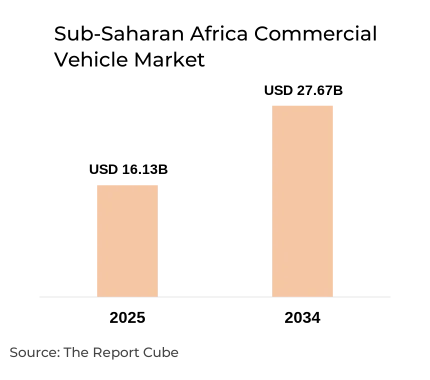
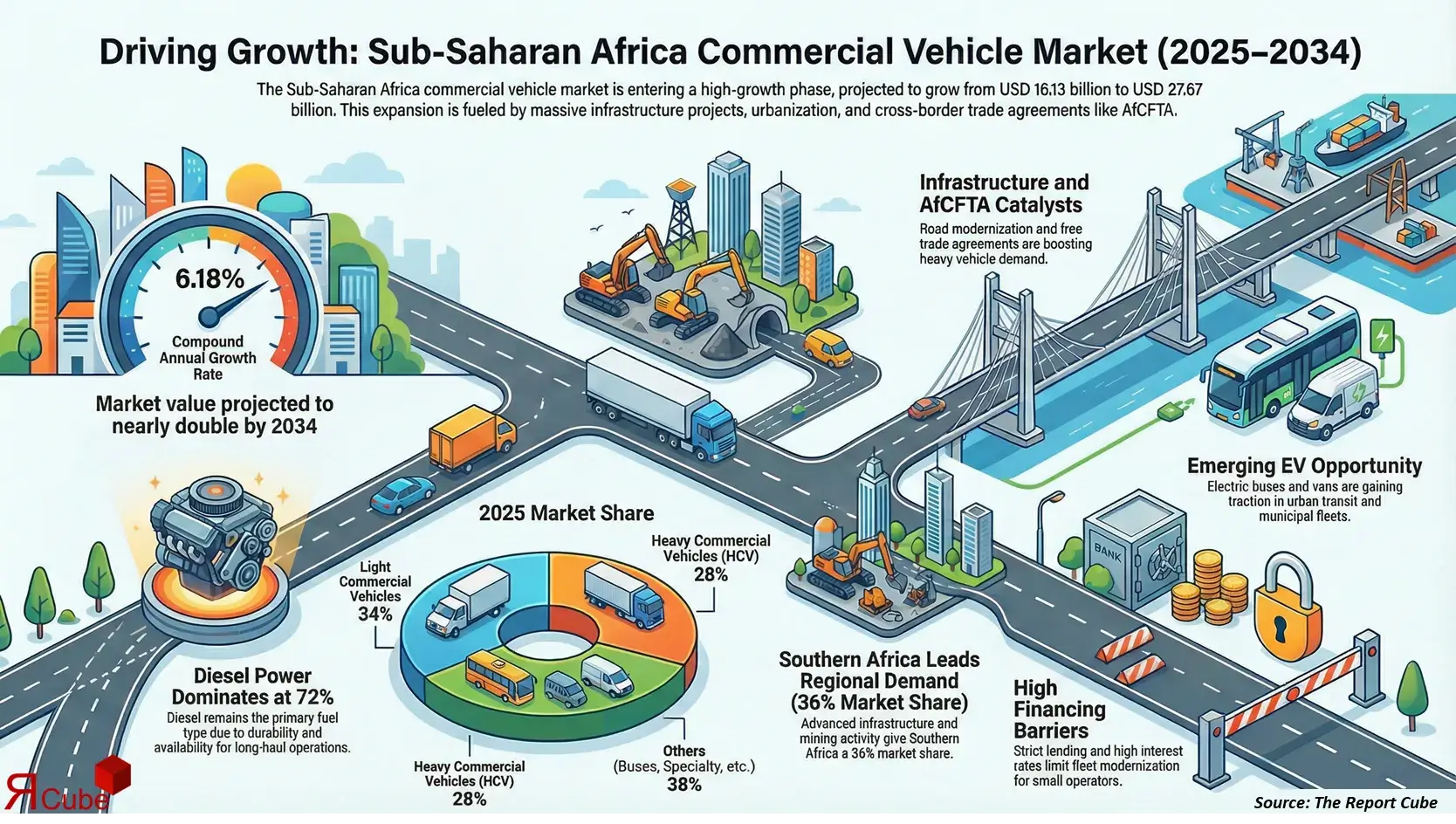
The Sub-Saharan Africa Commercial Vehicle Market is anticipated to register a CAGR of 6.18% during the forecast period 2026&-2034. The market size was valued at USD 16.13 billion in 2025 and is projected to reach USD 27.67 billion by 2034. This steady growth is closely linked to rising infrastructure development, expanding urbanization, and increasing demand for efficient goods transportation across emerging economies in the region.
Sub-Saharan Africa’s commercial vehicle ecosystem is evolving as governments prioritize road connectivity, logistics efficiency, and public transportation systems. Growing investments in mining, agriculture, construction, and cross-border trade have significantly increased demand for light, medium, and heavy commercial vehicles. In parallel, the rise of organized retail, e-commerce distribution networks, and last-mile delivery services has strengthened demand for light commercial vehicles, particularly in urban centers.
Furthermore, the market is benefiting from gradual fleet replacement cycles, increased availability of vehicle financing, and the presence of global OEMs expanding localized assembly and aftersales networks. While diesel-powered vehicles continue to dominate due to fuel availability and durability, interest in alternative fuel and electric commercial vehicles is emerging, especially for city transport and municipal fleets. Collectively, these interconnected factors position the Sub-Saharan Africa Commercial Vehicle Market as a high-growth opportunity during the forecast period.
Sub-Saharan Africa Commercial Vehicle Market Recent Developments
- 2025: Toyota Motor Corporation expanded commercial vehicle assembly operations to strengthen regional supply and reduce import dependency.
- 2025: Daimler Truck increased distribution partnerships to enhance Mercedes-Benz truck availability across East and West Africa.
Government Initiatives & Policies
- African Continental Free Trade Area (AfCFTA): Supports cross-border trade and logistics development, boosting commercial vehicle demand.
- Programme for Infrastructure Development in Africa (PIDA): Focuses on transport corridor and road network expansion.
Sub-Saharan Africa Commercial Vehicle Market Dynamics
Key Driver: Infrastructure Expansion and Trade Logistics Growth
The primary driver of the Sub-Saharan Africa Commercial Vehicle Market is large-scale infrastructure expansion combined with growing intra-regional trade. Governments across Southern, East, and West Africa are investing heavily in road construction, port modernization, and logistics corridors to support economic development. These projects directly stimulate demand for heavy commercial vehicles, medium-duty trucks, and specialty vehicles used in construction and material transport. Additionally, the implementation of AfCFTA has increased cross-border freight movement, creating sustained demand for reliable long-haul trucks. As supply chains become more structured and formalized, fleet operators are increasingly investing in new commercial vehicles to improve efficiency, safety, and payload capacity, reinforcing market growth.
Book your FREE 30-minute expert consultation today
Contact UsIndustry Trends: Rising Demand for Light Commercial Vehicles
A notable trend shaping the market is the rising demand for light commercial vehicles driven by urbanization and last-mile delivery needs. Rapid population growth in cities such as Lagos, Nairobi, Johannesburg, and Accra has increased demand for efficient urban logistics. Light commercial vehicles are preferred for their maneuverability, lower operating costs, and suitability for short-distance deliveries. Small and medium enterprises, informal traders, and e-commerce platforms are major adopters of this segment. Additionally, fleet operators are increasingly opting for standardized LCV fleets to reduce maintenance complexity. This trend complements broader logistics expansion and supports balanced growth across vehicle categories.
Major Challenge: Limited Financing and High Operating Costs
Despite strong demand fundamentals, limited access to affordable vehicle financing remains a major challenge for the market. Many small fleet owners and independent operators face high interest rates and strict lending conditions, restricting new vehicle purchases. Additionally, fluctuating fuel prices, maintenance costs, and inconsistent road infrastructure increase total cost of ownership. Imported vehicle dependency in several countries further exposes buyers to currency volatility and import duties. These constraints slow fleet modernization and may delay adoption of advanced or alternative fuel vehicles, moderating short-term market growth.
Opportunity: Gradual Adoption of Alternative Fuel and Electric Vehicles
The gradual introduction of alternative fuel and electric commercial vehicles presents a promising opportunity for the market. Governments and municipalities are beginning to explore cleaner transport solutions to reduce emissions and fuel import dependence. Electric buses and delivery vans are gaining attention for urban transit and waste management applications. While adoption remains nascent, pilot projects and public-private partnerships are laying the foundation for long-term growth. As charging infrastructure improves and vehicle costs decline, alternative fuel vehicles are expected to complement traditional diesel fleets, unlocking new growth avenues.
Sub-Saharan Africa Commercial Vehicle Market Segment-wise Analysis
By Vehicle Type:
- Light Commercial Vehicle
- Medium Commercial Vehicle
- Heavy Commercial Vehicle
- Buses & Coaches
- Specialty Vehicles
Light Commercial Vehicles dominate the market, accounting for approximately 34% of total market share in 2025. Their leadership is driven by widespread use in urban logistics, retail distribution, and small business operations. Heavy Commercial Vehicles follow closely, supported by infrastructure and mining activities, contributing nearly 28% of market share. Buses & Coaches hold a significant position due to investments in public transportation systems. Specialty vehicles, including refuse trucks and tankers, are witnessing steady demand from municipal and industrial applications, reflecting diversified end-use growth.
By Fuel Type:
- Diesel Vehicles
- Gasoline Vehicles
- Natural Gas
- Electric Vehicles
Diesel Vehicles continue to dominate the fuel type segment, holding nearly 72% of the market share due to fuel availability, durability, and suitability for long-haul operations. Gasoline vehicles maintain relevance in light-duty applications, particularly in urban areas. Natural gas vehicles are slowly emerging in select markets with supportive policies. Electric vehicles currently represent a small share but are gaining momentum in city buses and municipal fleets, supported by sustainability initiatives and pilot programs.
Regional Projection of Sub-Saharan Africa Commercial Vehicle Industry
- Southern Africa
- East Africa
- West Africa
- Central Africa
Southern Africa leads the Sub-Saharan Africa Commercial Vehicle Market, accounting for approximately 36% of regional demand. The region benefits from relatively advanced road infrastructure, strong mining activity, and established automotive assembly operations. East and West Africa follow, driven by rapid urbanization, port development, and growing consumer markets. Southern Africa’s dominance is reinforced by higher fleet replacement rates and stronger financing availability, positioning it as the most mature and stable market during the forecast period.
Need insights for a specific region within this market?
Request Regional DataWhy Choose This Report?
- Provides a comprehensive overview of the overall market analysis, encompassing key trends, consumer behavior analysis, and risk assessment to support strategic decision-making.
- Provides accurate, up-to-date insights into market size, segmentation, and emerging opportunities, helping to minimize risk & capitalizing on growth.
- Gives deep understanding of target audience preferences, investment habits, and communication channels for enhanced product development & marketing effectiveness.
- Delivers competitive analysis & benchmarking, uncovering the strengths & weaknesses of market competitors to guide strategies.
- Consolidate comprehensive market intelligence, reducing reasoning & streamlining research efforts.
- Facilitates customized market segmentation & risk mitigation strategies, fine-tuned to the business objectives.
- Aids in identifying both market challenges & untapped opportunities within the industry to drive long-term business growth.
- Provides valuable information based on actual customer data & search trends.
Table of Contents
- Introduction
- Objective of the Study
- Product and Category Definition
- Market Segmentation
- Study Variables
- Research Methodology
- Secondary Data Points
- Breakdown of Secondary Sources
- Primary Data Points
- Breakdown of Primary Interviews
- Secondary Data Points
- Executive Summary
- Market Dynamics
- Drivers
- Challenges
- Opportunity Assessment
- Recent Trends and Developments
- Regulatory and Policy Landscape
- Sub-Saharan Africa Commercial Vehicle Market Overview (2021-2034)
- Market Size, By Value (USD Billion)
- Market Share, By Vehicle Type
- Light Commercial Vehicle
- Medium Commercial Vehicle
- Heavy Commercial Vehicle
- Buses & Coaches
- Specialty Vehicles
- Market Share, By Application
- Transport & Logistics
- Construction Projects
- Mining & Quarrying
- Agriculture & Forestry
- Public Transport
- Market Share, By Fuel Type
- Diesel Vehicles
- Gasoline Vehicles
- Natural Gas
- Electric Vehicles
- Market Share, By Ownership
- Fleet Operators
- Owner-Drivers
- Leasing & Rental
- Government Fleets
- Market Share, By Region
- Southern Africa
- East Africa
- West Africa
- Central Africa
- Market Share, By Company
- Competition Characteristics
- Revenue Shares & Analysis
- Southern Africa Commercial Vehicle Market
- Market Size, By Value (USD Billion)
- Market Share, By Vehicle Type
- Market Share, By Application
- Market Share, By Fuel Type
- Market Share, By Ownership
- Market Share, By Country
- South Africa
- Zambia
- Zimbabwe
- Botswana
- Namibia
- Rest of Southern Africa
- East Africa Commercial Vehicle Market
- Market Size, By Value (USD Billion)
- Market Share, By Vehicle Type
- Market Share, By Application
- Market Share, By Fuel Type
- Market Share, By Ownership
- Market Share, By Country
- Kenya
- Tanzania
- Uganda
- Ethiopia
- Rwanda
- Rest of East Africa
- West Africa Commercial Vehicle Market
- Market Size, By Value (USD Billion)
- Market Share, By Vehicle Type
- Market Share, By Application
- Market Share, By Fuel Type
- Market Share, By Ownership
- Market Share, By Country
- Nigeria
- Ghana
- Ivory Coast
- Senegal
- Rest of West Africa
- Central Africa Commercial Vehicle Market
- Market Size, By Value (USD Billion)
- Market Share, By Vehicle Type
- Market Share, By Application
- Market Share, By Fuel Type
- Market Share, By Ownership
- Market Share, By Country
- Congo-DRC
- Congo-Brazzaville
- Cameroon
- Gabon
- Rest of Central Africa
- Competitive Outlook and Company Profiles
- Toyota Motor Corporation
- Company Overview
- Product Portfolio
- Strategic Alliances/Partnerships
- Recent Developments
- Isuzu Motors
- Company Overview
- Product Portfolio
- Strategic Alliances/Partnerships
- Recent Developments
- Tata Motors
- Company Overview
- Product Portfolio
- Strategic Alliances/Partnerships
- Recent Developments
- Daimler Truck (Mercedes-Benz)
- Company Overview
- Product Portfolio
- Strategic Alliances/Partnerships
- Recent Developments
- Volvo Trucks
- Company Overview
- Product Portfolio
- Strategic Alliances/Partnerships
- Recent Developments
- MAN Truck & Bus
- Company Overview
- Product Portfolio
- Strategic Alliances/Partnerships
- Recent Developments
- Ashok Leyland
- Company Overview
- Product Portfolio
- Strategic Alliances/Partnerships
- Recent Developments
- Hino Motors
- Company Overview
- Product Portfolio
- Strategic Alliances/Partnerships
- Recent Developments
- FAW Group
- Company Overview
- Product Portfolio
- Strategic Alliances/Partnerships
- Recent Developments
- IVECO Group
- Company Overview
- Product Portfolio
- Strategic Alliances/Partnerships
- Recent Developments
- Others
- Toyota Motor Corporation
- Contact Us and Disclaimer
Top Key Players & Market Share Outlook
- Toyota Motor Corporation
- Isuzu Motors
- Tata Motors
- Daimler Truck (Mercedes-Benz)
- Volvo Trucks
- MAN Truck & Bus
- Ashok Leyland
- Hino Motors
- FAW Group
- IVECO Group
- Others
Frequently Asked Questions






