



Build Your Custom Market Intelligence Report
Customize Your ReportJapan Robotic Nurses Market Key Highlights
By Type:
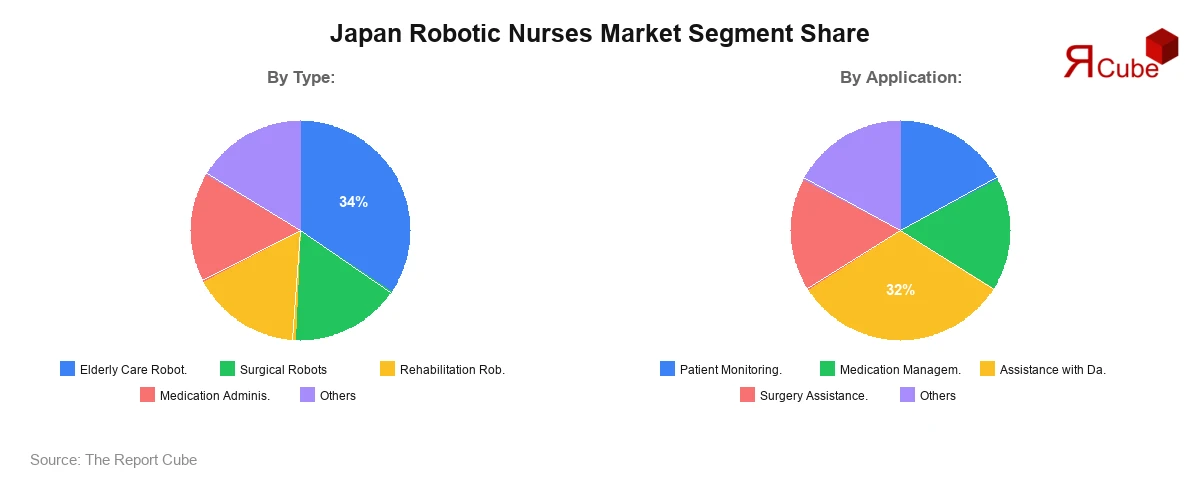
Elderly Care Robots segment leads the market with nearly 34% share.
By Application:
Assistance with Daily Activities segment dominates the market with around 32% of revenue.
Regional Outlook:
Honshu region dominates the Japan Robotic Nurses market with approximately 46% share.
Japan Robotic Nurses Market Insights & Analysis
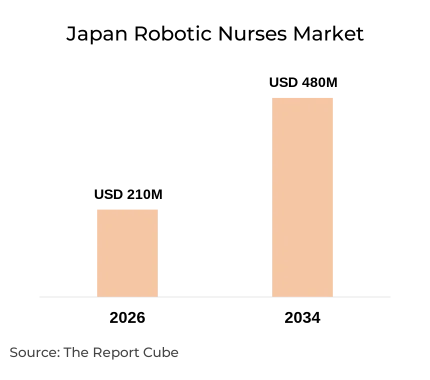
The Japan Robotic Nurses Market is anticipated to register a CAGR of around 21.3% during the forecast period 2026-2034. The market size is valued at USD 210 million in 2026 and is projected to reach USD 480 million by 2034. The strong expansion in Japan robotic nurses market size is closely tied to the country’s aging population, where more than 29% of citizens are aged above 65 as of 2025. This demographic shift has created sustained pressure on healthcare infrastructure, driving hospitals and long-term care facilities to adopt robotic assistance technologies to maintain service quality and reduce caregiver workload.
Investment activity across robotics and healthcare automation has accelerated significantly in recent years. Japan’s Ministry of Economy, Trade and Industry has increased funding allocations for nursing care robots, with pilot programs showing up to 35% improvement in caregiver efficiency. In addition, companies are integrating advanced technologies such as artificial intelligence, machine learning, and human-robot interaction to enhance patient engagement and operational accuracy. These developments are strengthening Japan robotic nurses market growth while positioning the country as a global innovation hub for healthcare robotics.
Japan Robotic Nurses Market Dynamics
Key Driver: Rapid Aging Population and Workforce Shortage
The primary factor driving the Japan robotic nurses market growth is the rapid aging demographic combined with a shrinking healthcare workforce. By 2030, Japan is expected to face a shortage of nearly 380,000 caregivers, which is pushing healthcare providers to adopt robotic nursing solutions. These robots assist in lifting patients, monitoring health conditions, and supporting rehabilitation, reducing physical strain on human caregivers.
Additionally, robotic nurses improve operational efficiency by enabling continuous monitoring and reducing dependency on manual intervention. Facilities using robotic assistance have reported up to 25% reduction in caregiver fatigue and improved patient satisfaction. This shift is increasing the adoption rate across hospitals and nursing homes, significantly boosting Japan robotic nurses market revenue.
Book your FREE 30-minute expert consultation today
Contact UsIndustry Trends: Integration of AI and Human-Robot Interaction Technologies
A major trend shaping the Japan robotic nurses market trends is the integration of artificial intelligence and advanced human-robot interaction systems. Modern robotic nurses are equipped with sensors, speech recognition, and predictive analytics, allowing them to understand patient behavior and respond effectively. This improves patient engagement and supports personalized care delivery.
Another key trend is the development of autonomous navigation systems that enable robots to move seamlessly within healthcare facilities. These robots can deliver medication, assist in mobility, and provide real-time alerts to healthcare professionals. As a result, hospitals are increasingly investing in smart robotic ecosystems, enhancing the overall Japan robotic nurses market value.
Major Challenge: High Deployment Costs and Technical Complexity
The adoption of robotic nurses is constrained by high initial investment costs and technical complexities associated with integration. Advanced robotic systems require significant capital expenditure, including installation, maintenance, and staff training. Smaller healthcare facilities often face budget limitations, restricting widespread adoption.
Moreover, interoperability challenges between robotic systems and existing hospital infrastructure create additional barriers. Ensuring seamless integration with electronic health records and monitoring systems requires advanced technical expertise. These factors may slow down Japan robotic nurses market growth, particularly in smaller and rural healthcare settings.
Opportunity: Expansion of Home Care Robotics and Remote Monitoring
The growing demand for home-based healthcare presents a major opportunity for the Japan robotic nurses market. With increasing preference for aging-in-place solutions, robotic nurses are being designed for home care environments to assist elderly individuals with daily activities and health monitoring.
Furthermore, remote monitoring technologies combined with robotics allow healthcare providers to track patient health in real time. This reduces hospital visits and lowers healthcare costs. As adoption expands beyond institutional settings, the Japan robotic nurses market share is expected to witness substantial growth in the coming years.
Japan Robotic Nurses Market Segment-wise Analysis
By Type:
- Elderly Care Robots
- Surgical Robots
- Rehabilitation Robots
- Medication Administration Robots
- Others
The elderly care robots segment leads the Japan robotic nurses market with approximately 34% share in 2026. This dominance is attributed to the increasing elderly population requiring continuous assistance in daily activities such as mobility, hygiene, and monitoring. These robots are widely deployed in nursing homes, where they help reduce caregiver workload by up to 30%.
Furthermore, advancements in assistive robotics have improved safety and reliability, making them a preferred choice for long-term care facilities. The segment continues to gain traction as Japan strengthens its focus on eldercare automation.
By Application:
- Patient Monitoring
- Medication Management
- Assistance with Daily Activities
- Surgery Assistance
- Others
The assistance with daily activities segment dominates the market with around 32% revenue share. This segment includes robots designed to support feeding, mobility, and routine care tasks. The rising demand for such solutions is driven by the need to maintain independence among elderly individuals. Healthcare facilities using these robots report improved patient outcomes and reduced staff workload. Continuous innovation in robotics is further enhancing the capabilities of these systems, strengthening their position in the Japan robotic nurses market.
Regional Projection of Japan Robotic Nurses Industry
- Hokkaido
- Honshu
- Shikoku
- Kyushu
Honshu holds the largest share of approximately 46% in the Japan robotic nurses market. This dominance is due to the presence of major metropolitan areas such as Tokyo and Osaka, where healthcare infrastructure is highly advanced. The region accounts for a significant portion of hospital and research facilities, driving demand for robotic nursing solutions.
Additionally, strong collaboration between technology companies and healthcare providers has accelerated the deployment of robotic systems. Government support and higher healthcare spending further contribute to Honshu’s leading position in the market.
Government Initiatives & Policies
- Japan Nursing Care Robot Development Program (2025): Government-backed initiative promoting R&D and deployment of robotic caregivers across healthcare facilities.
- Society 5.0 Healthcare Strategy (2026): National strategy supporting AI-driven healthcare robotics and smart caregiving solutions to address aging population challenges.
Japan Robotic Nurses Industry Recent Developments
- 2025: SoftBank Robotics expanded Pepper robot deployment in eldercare facilities, enhancing companionship, exercise guidance, and patient engagement across nursing homes in Japan.
- 2025: Cyberdyne Inc strengthened its portfolio through acquisition, improving robotic patient care, mobility assistance, and rehabilitation capabilities in healthcare facilities.
- 2025: Panasonic Corporation scaled its Resyone robotic system, enabling efficient patient transfer and reducing caregiver burden in long-term care environments.
- 2025: Yaskawa Motoman advanced clinical automation systems, improving efficiency in laboratory workflows and supporting healthcare robotics ecosystem growth.
Need insights for a specific region within this market?
Request Regional DataWhy Choose This Report?
- Provides a comprehensive overview of the overall market analysis, encompassing key trends, consumer behavior analysis, and risk assessment to support strategic decision-making.
- Provides accurate, up-to-date insights into market size, segmentation, and emerging opportunities, helping to minimize risk & capitalizing on growth.
- Gives deep understanding of target audience preferences, investment habits, and communication channels for enhanced product development & marketing effectiveness.
- Delivers competitive analysis & benchmarking, uncovering the strengths & weaknesses of market competitors to guide strategies.
- Consolidate comprehensive market intelligence, reducing reasoning & streamlining research efforts.
- Facilitates customized market segmentation & risk mitigation strategies, fine-tuned to the business objectives.
- Aids in identifying both market challenges & untapped opportunities within the industry to drive long-term business growth.
- Provides valuable information based on actual customer data & search trends.
Table of Contents
- Introduction
- Objective of the Study
- Product and Category Definition
- Market Segmentation
- Study Variables
- Research Methodology
- Secondary Data Points
- Breakdown of Secondary Sources
- Primary Data Points
- Breakdown of Primary Interviews
- Secondary Data Points
- Executive Summary
- Market Dynamics
- Drivers
- Challenges
- Opportunity Assessment
- Recent Trends and Developments
- Regulatory and Policy Landscape
- Japan Robotic Nurses Market Overview (2021-2034)
- Market Size, By Value (USD Million)
- Market Share, By Type
- Elderly Care Robots
- Surgical Robots
- Rehabilitation Robots
- Medication Administration Robots
- Others
- Market Share, By Application
- Patient Monitoring
- Medication Management
- Assistance with Daily Activities
- Surgery Assistance
- Others
- Market Share, By Technology
- Artificial Intelligence
- Machine Learning
- Autonomous Navigation
- Human-Robot Interaction
- Others
- Market Share, By End-User
- Hospitals
- Nursing Homes
- Rehabilitation Centers
- Home Care Settings
- Others
- Market Share, By Region
- Hokkaido
- Honshu
- Shikoku
- Kyushu
- Market Share, By Company
- Revenue Shares and Analysis
- Competitive Landscape
- Hokkaido Robotic Nurses Market
- Market Size, By Value (USD Million)
- Market Share, By Type
- Market Share, By Application
- Market Share, By Technology
- Market Share, By End-User
- Honshu Robotic Nurses Market
- Market Size, By Value (USD Million)
- Market Share, By Type
- Market Share, By Application
- Market Share, By Technology
- Market Share, By End-User
- Shikoku Robotic Nurses Market
- Market Size, By Value (USD Million)
- Market Share, By Type
- Market Share, By Application
- Market Share, By Technology
- Market Share, By End-User
- Kyushu Robotic Nurses Market
- Market Size, By Value (USD Million)
- Market Share, By Type
- Market Share, By Application
- Market Share, By Technology
- Market Share, By End-User
- Competitive Outlook and Company Profiles
- SoftBank Robotics
- Company Overview
- Product Portfolio
- Strategic Alliances/Partnerships
- Recent Developments
- Toshiba Corporation
- Company Overview
- Product Portfolio
- Strategic Alliances/Partnerships
- Recent Developments
- Omron Automation
- Company Overview
- Product Portfolio
- Strategic Alliances/Partnerships
- Recent Developments
- Rakuten
- Company Overview
- Product Portfolio
- Strategic Alliances/Partnerships
- Recent Developments
- Panasonic Corporation
- Company Overview
- Product Portfolio
- Strategic Alliances/Partnerships
- Recent Developments
- iRobot Corporation
- Company Overview
- Product Portfolio
- Strategic Alliances/Partnerships
- Recent Developments
- Cyberdyne Inc
- Company Overview
- Product Portfolio
- Strategic Alliances/Partnerships
- Recent Developments
- Toppan
- Company Overview
- Product Portfolio
- Strategic Alliances/Partnerships
- Recent Developments
- Toyota Engineering Society (TES)
- Company Overview
- Product Portfolio
- Strategic Alliances/Partnerships
- Recent Developments
- Yaskawa Motoman
- Company Overview
- Product Portfolio
- Strategic Alliances/Partnerships
- Recent Developments
- Others
- SoftBank Robotics
- Contact Us and Disclaimer
Top Key Players & Market Share Outlook
- SoftBank Robotics
- Toshiba Corporation
- Omron Automation
- Rakuten
- Panasonic Corporation
- iRobot Corporation
- Cyberdyne Inc
- Toppan
- Toyota Engineering Society (TES)
- Yaskawa Motoman
Frequently Asked Questions






