



Build Your Custom Market Intelligence Report
Customize Your ReportAustralia LNG Bunkering Market Statistics and Insights
Market Size Statistics
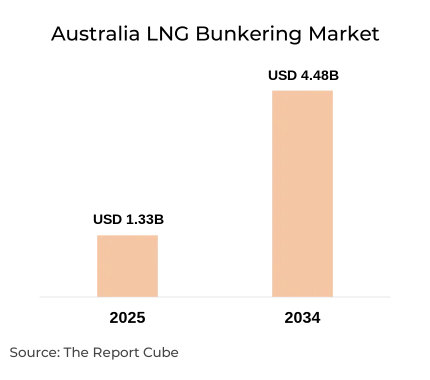
- Australia LNG Bunkering Market valued USD 1.33 billion during 2025
- Market projected reaching USD 4.48 billion by 2034
- Market expected expanding at compound annual growth rate 14.45%
By Bunkering Method
- Ship-to-ship bunkering segment dominated market with approximately 39% share
Competition
- More than 10 companies are actively engaged in producing Australia LNG Bunkering Market
- Top 5 companies acquired around 49% of the market share.
- Siem Offshore Inc, Gas Energy Australia, Woodside Petroleum Ltd, Oceania Marine Energy, Norwest Energy NL, and others
By Vessel Type
- Container ships accounted for nearly 33% market share
Australia LNG Bunkering Market Insights & Analysis
The Australia LNG Bunkering Market is anticipated to register a 14.45% CAGR during 2026-2034. The market size was valued at USD 1.33 billion in 2025 and is projected to reach USD 4.48 billion by 2034. The market is witnessing rapid expansion as the maritime industry increasingly adopts cleaner fuel alternatives to reduce greenhouse gas emissions. Liquefied natural gas (LNG) has emerged as a preferred marine fuel due to its ability to significantly reduce sulfur oxides, nitrogen oxides, and carbon emissions compared with conventional marine fuels. As global shipping regulations become stricter, the demand for LNG bunkering infrastructure is increasing across major ports.
Australia’s strategic location in international shipping routes and its strong LNG production capabilities provide significant opportunities for LNG bunkering development. The country is one of the world’s largest LNG exporters, which allows it to leverage existing LNG supply chains to support marine fuel distribution. Government initiatives supporting decarbonization of maritime transport are also contributing to market growth. Investments in port infrastructure, LNG storage facilities, and bunkering vessels are improving the availability of LNG fuel for commercial shipping fleets. As the maritime industry continues transitioning toward cleaner fuel technologies, LNG bunkering services are expected to expand significantly across Australian ports.
Australia LNG Bunkering Market Dynamics
Key Market Driver: Rising Demand for Cleaner Marine Fuels
The growing demand for environmentally friendly marine fuels is one of the primary drivers supporting the Australia LNG Bunkering Market. International maritime regulations aimed at reducing emissions from shipping operations are encouraging ship operators to transition from traditional heavy fuel oil to alternative fuels such as LNG. LNG-powered vessels produce significantly lower emissions of sulfur oxides, nitrogen oxides, and particulate matter compared with conventional marine fuels. As environmental regulations tighten under international maritime agreements, shipping companies are increasingly investing in LNG-fueled vessels and retrofitting existing ships with LNG-compatible engines.
Major Industry Challenge: High Infrastructure Development Costs
Despite strong market growth potential, the development of LNG bunkering infrastructure involves significant capital investment. LNG storage facilities, specialized bunkering vessels, cryogenic handling systems, and safety infrastructure require substantial financial resources.
Ports and energy companies must invest in specialized facilities capable of safely handling and distributing LNG fuel to ships. These facilities must meet strict safety standards due to the cryogenic nature of LNG and the complexity of fuel transfer operations. In addition, coordination between shipping companies, port authorities, and energy providers is required to ensure consistent LNG fuel availability. Developing comprehensive LNG bunkering networks across multiple ports can be a complex and costly process.
Emerging Trend Shaping Outlook: Expansion Of Integrated LNG Supply Chains
The integration of LNG supply chains and maritime fuel distribution networks is emerging as a key trend shaping the Australia LNG Bunkering Market. Energy companies are increasingly developing integrated LNG infrastructure that supports both export operations and marine fuel supply. LNG producers are exploring opportunities to allocate a portion of their production capacity to marine bunkering services. This integration allows energy companies to leverage existing LNG terminals, storage facilities, and transportation infrastructure to support maritime fuel demand.
Need Specific Data, Let’s Customize the Report for You
Request Regional DataAustralia LNG Bunkering Market Segment-wise Analysis
By Bunkering Method
- Ship-to-Ship
- Port-to-Ship
- Truck-to-Ship
- Portable Tanks
Bunkering method segmentation indicates that ship-to-ship bunkering represents the largest segment of the Australia LNG Bunkering Market, accounting for approximately 39% of total demand. Ship-to-ship transfer operations allow LNG fuel to be directly transferred between bunkering vessels and LNG-powered ships at sea or within port areas. This method offers operational flexibility and supports large fuel transfer volumes for commercial shipping fleets. Ship-to-ship bunkering is commonly used for container ships and large cargo vessels that require substantial LNG fuel supply.
By Vessel Type
- Container Ships
- Tankers
- Bulk Cargo Vessels
- Ferries and OSVs
- Other Vessel Types
Vessel type segmentation highlights container ships as the largest segment within the Australia LNG Bunkering Market, accounting for approximately 33% of total demand. Container shipping companies are increasingly investing in LNG-powered vessels to comply with international emission regulations and improve environmental sustainability. Tankers and bulk cargo vessels also represent significant market segments due to their heavy fuel consumption and long-distance maritime operations. LNG-powered engines provide efficient fuel performance and reduced emissions for these large vessels.
Regional Projection of Australia LNG Bunkering Market
- Western Australia
- Queensland
- New South Wales
- Other Regions
Western Australia represents the largest share of the Australia LNG Bunkering Market, accounting for approximately 37% of total market demand. The region hosts major LNG export terminals and energy infrastructure, making it a key hub for LNG production and maritime fuel supply. Queensland also contributes significantly to the market due to its LNG export facilities and strong maritime trade activity. New South Wales supports growing demand for LNG bunkering services through expanding port infrastructure and increasing shipping operations. Other regions across Australia are gradually developing LNG bunkering capabilities as port authorities invest in infrastructure to support cleaner marine fuel technologies.
Australia LNG Bunkering Market: Recent Development
- 2025: Woodside Petroleum Ltd expanded LNG supply infrastructure supporting marine fuel distribution across Australian ports.
- 2025: Siem Offshore Inc introduced LNG bunkering vessel operations supporting cleaner maritime fuel adoption.
- 2025: EVOL LNG launched integrated LNG fuel supply services supporting maritime and industrial energy demand.
- 2025: Gas Energy Australia expanded LNG fueling infrastructure supporting shipping industry decarbonization initiatives.
Australia LNG Bunkering Market Future Outlook (2034)
The Australia LNG Bunkering Market is expected to experience strong expansion through 2034 as the maritime industry accelerates its transition toward low-emission fuel technologies. With a projected CAGR of 14.45%, the market is anticipated to reach approximately USD 4.48 billion by 2034. Future market growth will largely depend on the expansion of LNG-powered vessel fleets and investments in LNG bunkering infrastructure across major ports. Governments and port authorities are expected to continue supporting infrastructure development to enable cleaner maritime operations. Technological advancements in LNG storage, fuel transfer systems, and safety monitoring technologies will also improve operational efficiency and safety within LNG bunkering operations.
Why Choose This Report?
- Provides a comprehensive overview of the overall market analysis, encompassing key trends, consumer behavior analysis, and risk assessment to support strategic decision-making.
- Provides accurate, up-to-date insights into market size, segmentation, and emerging opportunities, helping to minimize risk & capitalizing on growth.
- Gives deep understanding of target audience preferences, investment habits, and communication channels for enhanced product development & marketing effectiveness.
- Delivers competitive analysis & benchmarking, uncovering the strengths & weaknesses of market competitors to guide strategies.
- Consolidate comprehensive market intelligence, reducing reasoning & streamlining research efforts.
- Facilitates customized market segmentation & risk mitigation strategies, fine-tuned to the business objectives.
- Aids in identifying both market challenges & untapped opportunities within the industry to drive long-term business growth.
- Provides valuable information based on actual customer data & search trends.
Table of Contents
- Introduction
- Objective of the study
- Product Definition
- Market Segmentation
- Study Variables
- Research Methodology
- Secondary Data Points
- Companies Interviewed
- Primarydata Points
- Break Down of Primary Interviews
- Secondary Data Points
- Executive Summary
- Market Dynamics
- Drivers
- Challenges
- Opportunity Assessment
- Recent Trends and Developments
- Policy and Regulatory Landscape
- Australia LNG Bunkering Market Overview (2021-2034)
- Market Size, By Value (in USD Billions)
- Market Share, By Bunkering Method
- Ship-to-Ship
- Port-to-Ship
- Truck-to-Ship
- Portable Tanks
- Market Share, By Vessel Type
- Container Ships
- Tankers
- Bulk Cargo Vessels
- Ferries and OSVs
- Other Vessel Types
- Market Share, By End User
- Oil and Gas
- Shipping Lines
- Port Operators
- Defense and Coastguard
- Market Share, By Distribution Channel
- Direct Sales
- Bunkering Stations
- Market Share, By Region
- Western Australia
- Queensland
- New South Wales
- Other Regions
- Market Share, By Competitors
- Competition Characteristics
- Revenue Shares
- Australia Ship-to-Ship LNG Bunkering Market Overview, 2021-2034F
- By Value (USD Million/Billion)
- By Vessel Type- Market Size & Forecast 2021-2034, USD Million/Billion
- By End User- Market Size & Forecast 2021-2034, USD Million/Billion
- By Distribution Channel- Market Size & Forecast 2021-2034, USD Million/Billion
- Australia Port-to-Ship LNG Bunkering Market Overview, 2021-2034F
- By Value (USD Million/Billion)
- By Vessel Type- Market Size & Forecast 2021-2034, USD Million/Billion
- By End User- Market Size & Forecast 2021-2034, USD Million/Billion
- By Distribution Channel- Market Size & Forecast 2021-2034, USD Million/Billion
- Australia Truck-to-Ship LNG Bunkering Market Overview, 2021-2034F
- By Value (USD Million/Billion)
- By Vessel Type- Market Size & Forecast 2021-2034, USD Million/Billion
- By End User- Market Size & Forecast 2021-2034, USD Million/Billion
- By Distribution Channel- Market Size & Forecast 2021-2034, USD Million/Billion
- Australia Portable Tanks LNG Bunkering Market Overview, 2021-2034F
- By Value (USD Million/Billion)
- By Vessel Type- Market Size & Forecast 2021-2034, USD Million/Billion
- By End User- Market Size & Forecast 2021-2034, USD Million/Billion
- By Distribution Channel- Market Size & Forecast 2021-2034, USD Million/Billion
- Competitive Outlook (Company Profile - Partial List)
- Siem Offshore Inc
- Company Overview
- Business Segments
- Strategic Alliances/Partnerships
- Recent Developments
- Gas Energy Australia
- Company Overview
- Business Segments
- Strategic Alliances/Partnerships
- Recent Developments
- Woodside Petroleum Ltd
- Company Overview
- Business Segments
- Strategic Alliances/Partnerships
- Recent Developments
- Oceania Marine Energy
- Company Overview
- Business Segments
- Strategic Alliances/Partnerships
- Recent Developments
- Norwest Energy NL
- Company Overview
- Business Segments
- Strategic Alliances/Partnerships
- Recent Developments
- EVOL LNG
- Company Overview
- Business Segments
- Strategic Alliances/Partnerships
- Recent Developments
- Kanfer Shipping
- Company Overview
- Business Segments
- Strategic Alliances/Partnerships
- Recent Developments
- Others
- Siem Offshore Inc
- Contact Us & Disclaimer
Top Key Players & Market Share Outlook
- Siem Offshore Inc
- Gas Energy Australia
- Woodside Petroleum Ltd
- Oceania Marine Energy
- Norwest Energy NL
- EVOL LNG
- Kanfer Shipping
- Others
Frequently Asked Questions






