



Build Your Custom Market Intelligence Report
Customize Your ReportJapan Loungewear Market Key Takeaways
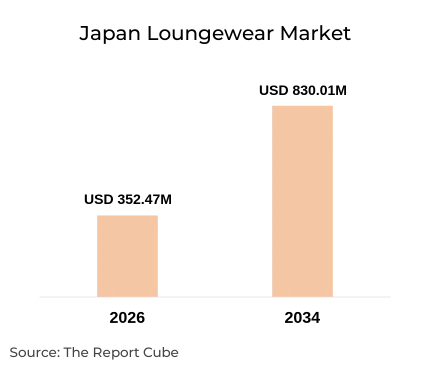
- Market size reached USD 352.47 million during the 2026 assessment year.
- Industry projected to attain USD 830.01 million by 2034.
- Market forecast indicates a CAGR of 11.30% during 2026-2034.
- Nike, Adidas, Lululemon Athletica, and H&M remain leading market participants.
- Female consumers dominate the end-user segment across the Japan market.
- Cotton accounts for the highest material type revenue contribution.
- Kanto remains the leading regional loungewear market in Japan.
- Sustainable fabrics and AI-driven retail personalization accelerate market expansion.
Japan Loungewear Market Insights & Analysis
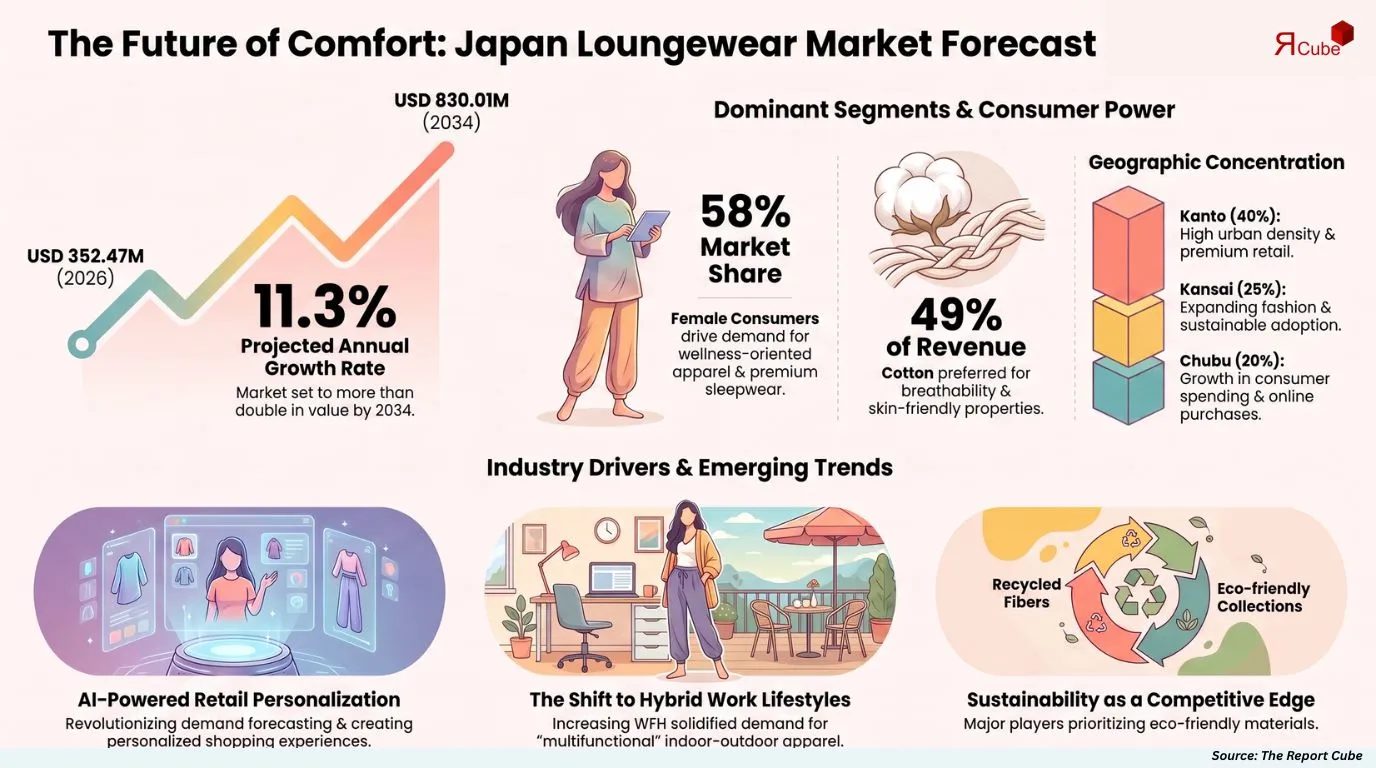
The Japan Loungewear Market is anticipated to register a 11.30% CAGR during 2026-2034. The market size was valued at USD 352.47 million in 2026 and is projected to reach USD 830.01 million by 2034. The market is witnessing robust growth due to evolving consumer lifestyles, increasing work-from-home adoption, and rising demand for comfortable yet stylish apparel. Japanese consumers are increasingly prioritizing premium fabrics, minimalist fashion, and multifunctional clothing suitable for home, travel, and casual outdoor activities. Growing wellness awareness and athleisure trends continue strengthening market expansion.
Government initiatives promoting sustainable textile manufacturing and domestic apparel innovation, combined with investments in recycled fabrics and smart retail technologies, are supporting industry development. Artificial intelligence-driven demand forecasting, inventory optimization, and personalized shopping experiences are enhancing operational efficiency. These advancements are expected to reinforce long-term market growth throughout the forecast period.
Japan Loungewear Market Dynamics
The Japan loungewear market continues evolving due to changing fashion preferences, increasing wellness consciousness, and rising disposable incomes. Apparel manufacturers are expanding collections featuring breathable fabrics, premium comfort, and contemporary aesthetics to satisfy diverse consumer expectations. These evolving dynamics continue creating substantial opportunities across Japan's apparel industry.
Growing investments in digital retail platforms, sustainable fabric innovation, and smart manufacturing technologies are strengthening market development. Technological advancements in artificial intelligence, predictive analytics, automated inventory management, and customer behavior analysis are significantly improving retail efficiency and product planning. These developments are expected to reinforce market competitiveness and support future industry expansion.
|
Factor |
Type |
Specific Impact on Market |
Magnitude |
|---|---|---|---|
|
Rising home-centric lifestyles |
Driver |
Increases loungewear demand |
High |
|
Growing premium apparel preference |
Driver |
Expands branded product sales |
High |
|
AI-powered retail personalization |
Trend |
Enhances customer engagement |
High |
|
Intense brand competition |
Challenge |
Limits pricing flexibility |
Medium |
|
Sustainable textile innovation |
Opportunity |
Boosts eco-friendly product adoption |
High |
Key Market Driver: Growing Demand for Comfortable Apparel
Increasing consumer preference for comfortable everyday clothing remains the primary driver of the Japan Loungewear Market. Hybrid working lifestyles, wellness-focused living, and premium fashion preferences have accelerated demand for stylish loungewear suitable for both indoor and casual outdoor use. Manufacturers continue introducing innovative fabric blends, ergonomic designs, and sustainable collections to strengthen market adoption.
Major Industry Challenge: Intensifying Brand Market Competition
Strong competition among domestic and international apparel brands remains a significant challenge for market participants. Frequent product launches, evolving fashion trends, and changing consumer preferences require continuous innovation and brand differentiation. Companies are investing in premium product development, digital marketing, and omnichannel retail strategies to strengthen competitive positioning.
Emerging Trend Shaping Outlook: AI-Enabled Fashion Retail Solutions
AI-enabled fashion retail solutions are emerging as a transformative trend shaping the future outlook of the market. Artificial intelligence supports personalized product recommendations, inventory forecasting, customer behavior analysis, dynamic pricing, and demand prediction. Integration with digital commerce platforms significantly improves customer engagement while optimizing supply chain efficiency.
The market continues benefiting from increasing online shopping adoption, sustainable fashion preferences, and premium lifestyle trends. Industry participants are emphasizing eco-friendly materials, digital retail transformation, and consumer-centric product innovation to strengthen competitive positioning. These developments continue supporting long-term market growth. Strategic collaborations among apparel manufacturers, fashion retailers, textile producers, and e-commerce platforms are accelerating innovation across the value chain. Companies focusing on AI-powered retail technologies, sustainable fabrics, and premium comfort are expected to maintain strong competitive advantages throughout the forecast period.
Need Specific Data, Let’s Customize the Report for You
Request CustomizationJapan Loungewear Market Segment-wise Analysis
The Japan loungewear market demonstrates diversified segmentation based on end-user and material type categories. Rising consumer preference for premium comfort, sustainable apparel, and multifunctional fashion continues influencing segment performance. Increasing adoption of eco-friendly fabrics and digital retail experiences is creating substantial opportunities across multiple consumer categories.
By End User
- Female
- Male
- Kids
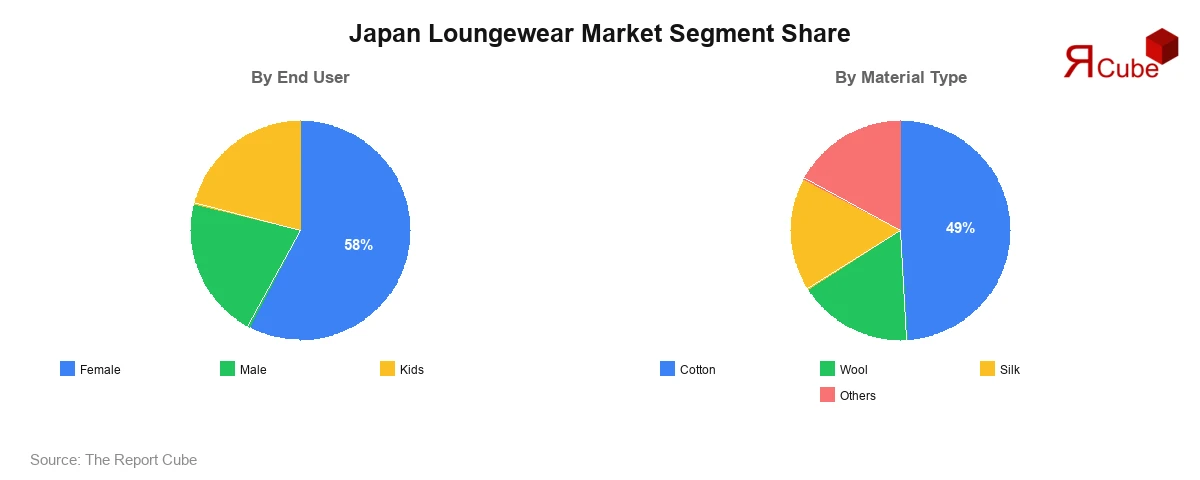
Female consumers dominate the end-user segment with an estimated market share of approximately 58%. Their leadership is supported by growing fashion awareness, increasing demand for premium sleepwear, work-from-home clothing, and wellness-oriented apparel. Expanding collections featuring stylish, sustainable, and multifunctional loungewear continue reinforcing segment dominance across Japan's fashion industry. Male consumers continue witnessing steady growth through increasing casual wear adoption, while Kids contribute through expanding family spending on comfortable, high-quality apparel and seasonal collections.
By Material Type
- Cotton
- Wool
- Silk
- Others
Cotton accounts for approximately 49% market share, making it the dominant material type segment within the Japan Loungewear Market. Growth is driven by superior breathability, softness, moisture absorption, and year-round comfort. Consumers increasingly prefer natural cotton fabrics due to their durability, skin-friendly properties, and compatibility with sustainable fashion preferences.
Wool remains important for winter collections, while Silk supports premium luxury apparel. Other materials, including recycled fibers and blended textiles, continue gaining popularity through sustainable fashion innovations.
Country Insights
The regional landscape of the Japan Loungewear Market reflects differences in consumer purchasing power, fashion preferences, retail infrastructure, and urban population density. Demand remains concentrated in highly urbanized regions with strong apparel retail networks and premium lifestyle spending. Continued investments in sustainable fashion and digital commerce are expected to support nationwide market growth.
|
Region |
Estimated Market Share |
Key Growth Factors |
Consumer Trends |
|---|---|---|---|
|
Kanto |
40% |
High urban population and premium retail presence |
Growing premium apparel demand |
|
Kansai |
25% |
Expanding fashion retail infrastructure |
Rising sustainable clothing adoption |
|
Chubu |
20% |
Manufacturing and consumer spending growth |
Increasing online fashion purchases |
|
Other Regions |
15% |
Regional retail expansion |
Growing preference for comfortable apparel |
- Kanto
- Kansai
- Chubu
- Other Regions
Kanto leads the market with an estimated 40% share due to its dense urban population, strong retail infrastructure, and high consumer spending on premium fashion products. Tokyo and surrounding metropolitan areas drive significant demand for stylish, multifunctional, and sustainable loungewear supported by advanced omnichannel retail networks.
Growing investments in digital retail platforms, AI-powered customer engagement technologies, and environmentally responsible apparel production continue reinforcing Kanto's leadership position. Expanding premium lifestyle trends are expected to sustain regional market dominance throughout the forecast period.
Japan Loungewear Market: Recent Development (2025)
- Lululemon Athletica expanded premium comfort apparel collections targeting Japan's growing wellness-focused consumer segment successfully nationwide.
- Nike introduced sustainable cotton loungewear lines enhancing environmentally responsible fashion offerings across Japanese retail channels significantly.
- Adidas strengthened digital commerce capabilities improving personalized shopping experiences through artificial intelligence-powered consumer engagement technologies effectively.
- H&M expanded recycled textile collections supporting sustainable fashion adoption and environmentally conscious apparel purchasing across Japan.
Japan Loungewear Market Future Outlook (2034)
The Japan Loungewear Market is expected to reach USD 830.01 million by 2034 while expanding at a CAGR of 11.30% throughout the forecast period. Rising hybrid work culture, premium apparel demand, sustainable fashion preferences, and digital retail transformation are expected to create substantial opportunities for apparel manufacturers and retailers across Japan.
Technological advancements in AI-driven retail analytics, personalized shopping experiences, sustainable textile innovation, automated manufacturing, and digital merchandising are expected to significantly improve operational efficiency and consumer engagement. Continued investments in eco-friendly fabrics, omnichannel commerce, and premium lifestyle products will support long-term market expansion through 2034.
Japan Loungewear Market Report Coverage
|
Report Attribute |
Details |
|---|---|
|
Market Name |
Japan Loungewear Market |
|
Market Size (2026) |
USD 352.47 million |
|
Market Size (2034) |
USD 830.01 million |
|
Forecast Period |
2026-2034 |
|
CAGR |
11.30% |
|
Customization |
Available Upon Request |
|
Segments Covered |
By End User, By Material Type, By Distribution Channel |
|
Regions Covered |
Kanto, Kansai, Chubu, Other Regions |
|
Key Companies |
Nike, Adidas, Lululemon Athletica, H&M, Gap Inc., Puma, Under Armour, Zara, Others |
|
Report Format |
PDF, Excel, PPT |
Why Choose This Report?
- Comprehensive assessment of market size, forecasts, and apparel industry opportunities.
- Detailed evaluation of end-user and material type segment performance.
- In-depth regional analysis highlighting Japanese consumer fashion trends.
- Competitive intelligence covering leading domestic and international apparel brands.
- Insights into AI-powered retail technologies and sustainable textile innovations.
- Reliable forecasting methodology supporting investment and strategic business planning.
Table of Contents
- Introduction
- Objective of the study
- Product Definition
- Market Segmentation
- Study Variables
- Research Methodology
- Secondary Data Points
- Companies Interviewed
- Primary Data Points
- Break Down of Primary Interviews
- Secondary Data Points
- Executive Summary
- Market Dynamics
- Drivers
- Challenges
- Opportunity Assessment
- Recent Trends and Developments
- Policy and Regulatory Landscape
- Japan Loungewear Market Overview and Forecast Analysis (2021-2034)
- Market Size, By Value, By growth rate (CAGR/USD Millions)
- Demand - Supply Trends
- Market Share, By End User
- Female
- Male
- Kids
- Market Share, By Material Type
- Cotton
- Wool
- Silk
- Others
- Market Share, By Distribution Channel
- Store-Based
- Non-Store-Based
- Market Share, By Region
- Kanto
- Kansai
- Chubu
- Other Regions
- Market Share, By Competitors
- Competition Characteristics
- Revenue Shares
- Japan Female Loungewear Market Overview, 2021-2034F
- By Value (USD Million)
- By Material Type- Market Size & Forecast 2021-2034, USD Million
- By Distribution Channel- Market Size & Forecast 2021-2034, USD Million
- Japan Male Loungewear Market Overview, 2021-2034F
- By Value (USD Million)
- By Material Type- Market Size & Forecast 2021-2034, USD Million
- By Distribution Channel- Market Size & Forecast 2021-2034, USD Million
- Japan Kids Loungewear Market Overview, 2021-2034F
- By Value (USD Million)
- By Material Type- Market Size & Forecast 2021-2034, USD Million
- By Distribution Channel- Market Size & Forecast 2021-2034, USD Million
- Competitive Outlook (Company Profile - Partial List)
- Nike
- Company Overview
- Business Segments
- Strategic Alliances/Partnerships
- Recent Developments
- Adidas
- Company Overview
- Business Segments
- Strategic Alliances/Partnerships
- Recent Developments
- Lululemon Athletica
- Company Overview
- Business Segments
- Strategic Alliances/Partnerships
- Recent Developments
- H&M
- Company Overview
- Business Segments
- Strategic Alliances/Partnerships
- Recent Developments
- Gap Inc.
- Company Overview
- Business Segments
- Strategic Alliances/Partnerships
- Recent Developments
- Puma
- Company Overview
- Business Segments
- Strategic Alliances/Partnerships
- Recent Developments
- Under Armour
- Company Overview
- Business Segments
- Strategic Alliances/Partnerships
- Recent Developments
- Zara
- Company Overview
- Business Segments
- Strategic Alliances/Partnerships
- Recent Developments
- Others
- Nike
- Contact Us & Disclaimer
Top Key Players & Market Share Outlook
- Nike
- Adidas
- Lululemon Athletica
- H&M
- Gap Inc.
- Puma
- Under Armour
- Zara
- Others
Frequently Asked Questions






