



Build Your Custom Market Intelligence Report
Customize Your ReportMaldives Luxury Apparel Market Insights & Analysis
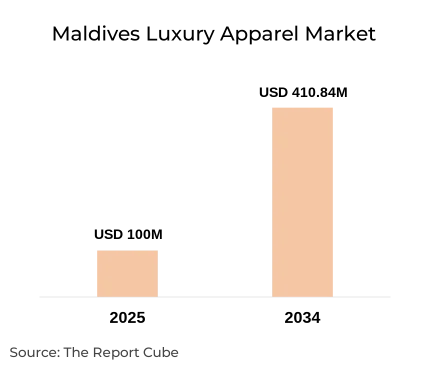
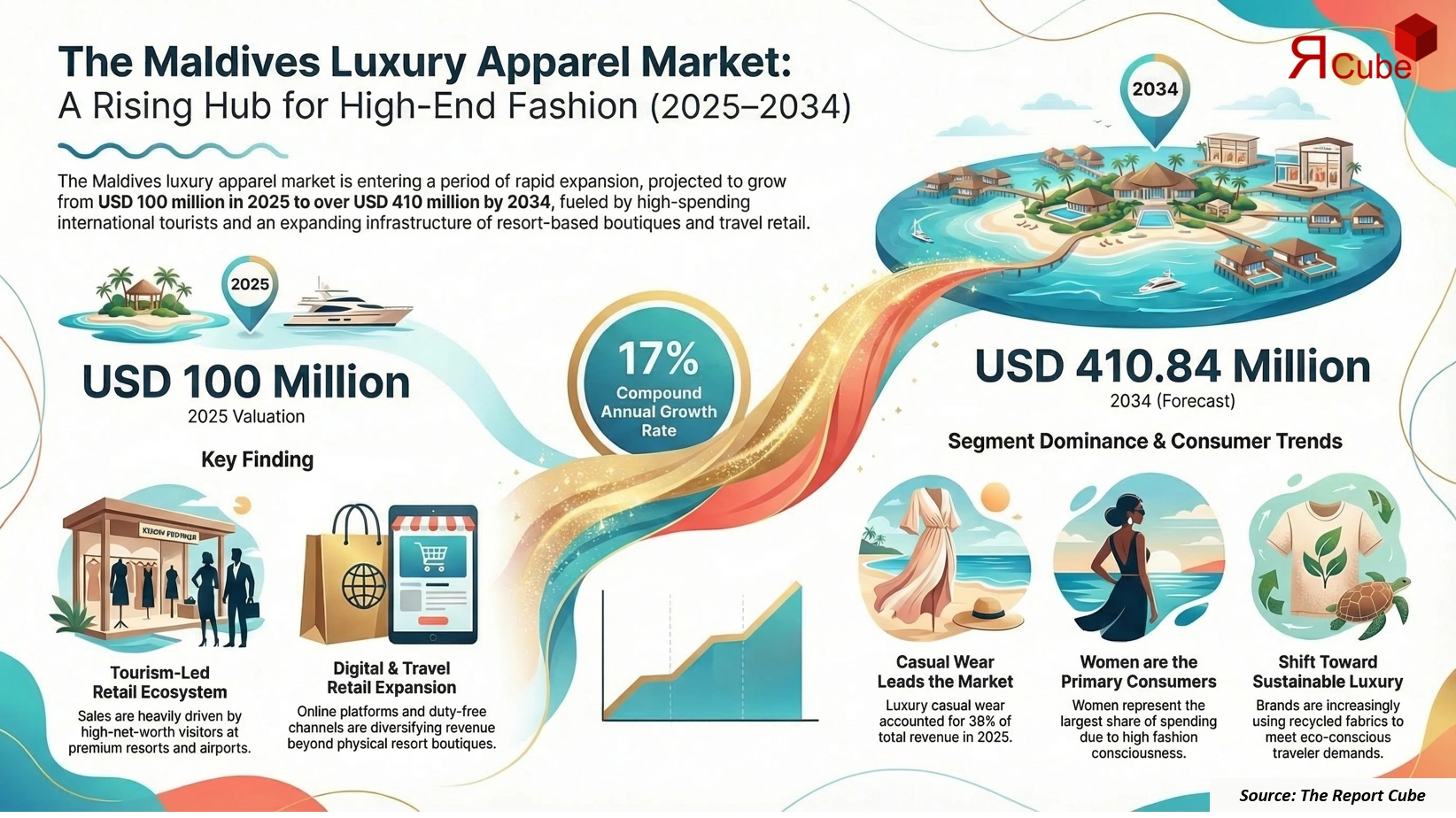
The Maldives Luxury Apparel Market is expected to register strong growth at a CAGR of 17% during the forecast period 2026–2034. The market was valued at USD 100 million in 2025 and is projected to reach USD 410.84 million by 2034. The Maldives luxury apparel market is experiencing steady growth, supported by rising inflows of high-net-worth travelers, increasing disposable income among affluent consumers, and the nation’s expanding reputation as an exclusive global tourism destination.
Demand for premium fashion products remains strongly connected to the country’s luxury hospitality ecosystem, where international visitors actively spend on designer resort wear, branded apparel, and high-end lifestyle products. The growing presence of luxury resorts, airport duty-free outlets, and premium retail boutiques has improved accessibility for global fashion brands and strengthened the competitive retail landscape. In addition, increasing exposure to international fashion trends through digital media, influencer marketing, and luxury e-commerce platforms is reshaping consumer preferences among both tourists and local buyers. As brand awareness, premium retail infrastructure, and experiential shopping continue to evolve, the Maldives luxury apparel market is expected to maintain positive long-term growth momentum throughout the forecast period
Maldives Luxury Apparel Market Recent Developments
- 2025: Expansion of luxury fashion boutiques within premium resort islands and airport retail zones.
- 2024: Increased focus on sustainable and ethically sourced luxury apparel collections.
Policy & Regulatory Landscape
- Tourism-Led Retail Policies: Support luxury retail growth through duty-free and travel retail channels.
- Import & Trade Regulations: Facilitate the entry of global luxury brands into the Maldivian market.
Maldives Luxury Apparel Market Dynamics
Key Driver: Growth in Luxury Tourism and High-Spending Visitors
The primary driver of the Maldives Luxury Apparel Market is the steady growth in luxury tourism and the consistent inflow of high-spending international visitors. Affluent travelers visiting the Maldives demonstrate strong demand for branded apparel, designer resort wear, and exclusive fashion collections tailored to premium leisure experiences.
The integration of luxury retail spaces within high-end resorts, private islands, and international airports significantly enhances product visibility and encourages impulse purchasing behavior. This tourism-led consumption pattern remains central to market performance, as visitor spending directly influences luxury apparel sales. As a result, the tourism ecosystem continues to be the most influential factor sustaining long-term demand growth.
Book your FREE 30-minute expert consultation today
Contact UsIndustry Trends: Rising Demand for Resort Wear and Sustainable Luxury Fashion
A major trend shaping the Maldives Luxury Apparel Market is the growing preference for luxury resort wear, premium casual clothing, and athleisure outfits designed for tropical island settings. Tourists visiting luxury resorts often choose comfortable yet stylish apparel suitable for leisure, beach activities, and high-end hospitality experiences. At the same time, sustainability is becoming an important factor in buying decisions.
Consumers are showing more interest in clothing made from eco-friendly materials and produced through responsible manufacturing practices. In response, luxury fashion brands are introducing sustainable collections that maintain high quality, comfort, and exclusivity. These changes reflect a shift in customer expectations, where style, comfort, and environmental awareness are all considered together in purchasing decisions within the luxury apparel segment.
Major Challenge: Limited Domestic Consumer Base
The Maldives Luxury Apparel Market faces a key challenge due to its small local population, which limits steady year-round sales. Most demand comes from international tourists who visit luxury resorts and premium destinations. This makes the market dependent on seasonal travel patterns, where sales rise during peak holiday periods and slow when tourist arrivals decrease.
Changes in global economic conditions, travel costs, or international events can also affect visitor spending on luxury fashion products. This dependence creates uneven revenue flow and makes planning difficult for retailers and brands. To manage this situation, companies align stock levels with tourism seasons and focus on high-traffic retail points such as resorts, airports, and duty-free stores. Strong reliance on tourism means the market must continue improving retail strategies and customer experience to maintain stable growth and long-term performance.
Opportunity: Expansion of Online and Travel Retail Channels
The expansion of luxury e-commerce platforms and travel retail channels presents a strong growth opportunity for the Maldives Luxury Apparel Market. Online brand stores allow luxury fashion labels to reach both local consumers and repeat international visitors even after they leave the country. This helps brands maintain customer engagement beyond physical store locations.
At the same time, duty-free shops and airport retail outlets continue to deliver high-value sales, especially from tourists purchasing premium apparel during arrival or departure. These channels improve product accessibility and make shopping more convenient for high-end customers. They also help luxury brands reduce reliance on a single sales format by diversifying revenue streams. With rising digital adoption and strong tourism activity, both e-commerce and travel retail are becoming important drivers for long-term market expansion and improved brand presence in the Maldives.
Maldives Luxury Apparel Market Impact Analysis
| Factor | Type | Specific Impact on Market | Magnitude | Business Implication |
|---|---|---|---|---|
| Record Tourist Arrivals (2.04M+) | Demand Driver | Expanding affluent customer base for resort boutiques | High | Increase curated resortwear collections and pop-ups |
| Resort-Centric Retail Dominance | Market Structure | 168 resorts with in-house luxury boutiques control sales | High | Secure prime leases in ultra-luxury resort clusters |
| High Visitor Spending ($4,250/trip) | Consumer | 15-28% of tourist expenditure allocated to shopping | High | Target high-value segments with premium pricing power |
| Duty-Free Expansion at Airports | Market | MVR 688.7M sales at Velana; Gan development underway | Medium-High | Expand airport retail footprint beyond Velana hub |
| Sustainability & Eco-Conscious Demand | Consumer | Guests seek reef-safe materials and artisanal products | High | Integrate eco-luxury narratives and sustainable fabrics |
| Integrated Marina & Village Concepts | Structural Driver | Fari Marina and CROSSROADS aggregate designer edits | Medium | Leverage experiential merchandising at marinas |
| Luxury Segment Growth (51% Revenue) | Market Behavior | Premium properties drive 11.37% CAGR through 2031 | High | Align product mix with ultra-luxury resort positioning |
| Global Brand Competition | Competitive | Cheval Blanc, Soneva, JOALI dominate curation landscape | Medium-High | Differentiate through exclusive capsules and local talent |
| Middle East Conflict Impact | Market Constraint | Tourism revenue decline of USD 500M affects retail spend | Medium | Diversify source markets and adjust inventory planning |
| Experiential Shopping Integration | Technological | Retail embedded in guest journey with personalization | Medium | Invest in immersive brand activations and art collaborations |
Maldives Luxury Apparel Market Segment-wise Analysis
By Product Type:
- Luxury Formal Wear
- Luxury Casual Wear
- Luxury Sportswear / Athleisure
- Luxury Outerwear
- Luxury Nightwear & Loungewear
- Others
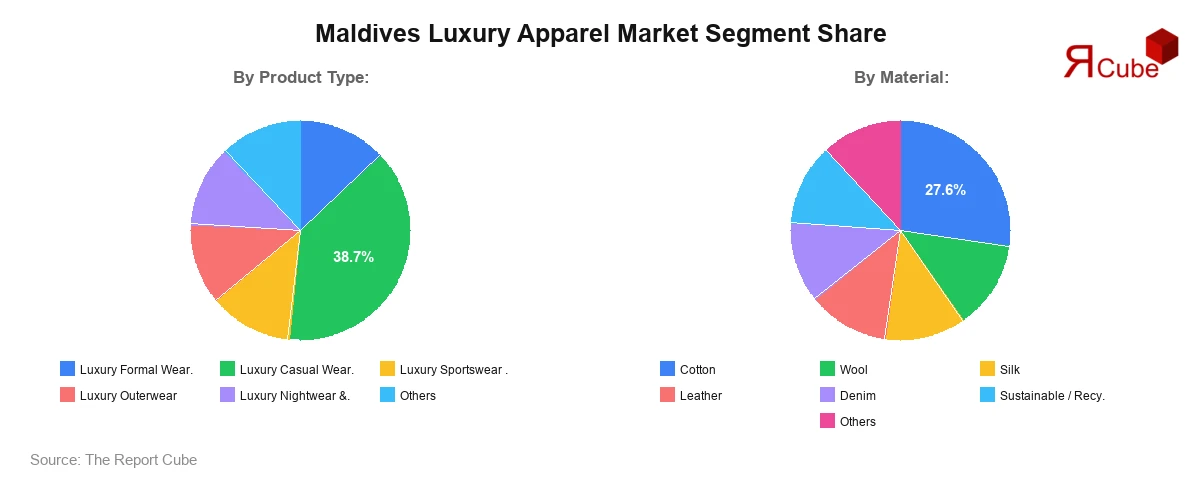
Luxury casual wear accounts for an estimated 38.7% of the Maldives luxury apparel market, making it the dominant fashion category among high-net-worth travelers seeking refined yet effortless resort dressing. Demand is strongest for breathable dresses, linen resort shirts, kaftans, coordinated separates, and premium swim cover-ups designed for seamless transitions from beachfront leisure to fine-dining experiences.
Market momentum is further supported by Instagram-led brand discovery, luxury e-commerce pre-ordering, and curated capsule collections available through upscale resort boutiques. Consumers increasingly prioritize versatile silhouettes that combine comfort, exclusivity, photogenic appeal, and travel practicality over traditional occasion-focused formalwear.
By Material:
- Cotton
- Wool
- Silk
- Leather
- Denim
- Sustainable / Recycled Fabrics
- Others
Cotton holds an estimated 27.6% share of the Maldives luxury apparel market, establishing itself as the preferred fabric for premium resortwear, relaxed tailoring, kaftans, and elevated travel essentials among affluent international visitors. Its lightweight texture, breathability, and moisture-absorbing properties make it particularly suitable for the Maldives’ tropical climate and luxury island lifestyle.
Demand continues to rise as luxury consumers increasingly favor natural, comfortable, and easy-to-maintain fabrics that support both daytime leisure and refined evening styling. Market growth is further strengthened by curated capsule collections in resort boutiques, digital luxury retail platforms, and pre-arrival hotel shopping services tailored to personalized vacation wardrobes.
End-User and Distribution Outlook of Maldives Luxury Apparel Market
By End User:
- Men
- Women
- Kids
- Unisex
Women account for an estimated 42.7% share of the Maldives luxury apparel market, making them the leading consumer segment across premium resortwear, designer swimwear, and destination-focused fashion purchases. Demand is primarily fueled by affluent female travelers seeking curated vacation wardrobes that blend comfort, exclusivity, and social media appeal during luxury island stays and visits to Malé and Hulhumalé boutiques.
Higher average spending on coordinated outfits, accessories, and occasion-specific styling further strengthens the segment’s market position. Growth is supported by fast-moving seasonal collections, personalized digital lookbooks, pre-arrival shopping services, and seamless omni-channel retail experiences connecting online discovery with luxury resort boutique fulfillment.
By Distribution Channel:
- Brand-Owned Stores / Boutiques
- Luxury Department Stores
- Multi-Brand Retailers
- Online (Brand Websites & Luxury E-Commerce)
- Travel Retail / Duty-Free
Brand-owned stores and resort boutiques account for an estimated 32.8% share of the Maldives luxury apparel market, positioning them as the leading distribution channel within the country’s premium retail ecosystem. Their dominance is driven by the Maldives’ one-island-one-resort model, which enables direct access to ultra-high-net-worth travelers through highly curated in-resort shopping experiences.
Luxury fashion brands and boutique operators increasingly integrate apparel, beachwear, and exclusive capsule collections into the broader guest journey, supported by digital lookbooks, private styling services, and seamless room-charge purchasing. Continued growth is reinforced by sustainability-focused collections, limited-edition collaborations, and data-led inventory planning enabled through integrated resort retail and property management systems.
Need insights for a specific region within this market?
Request Regional DataWhy Choose This Report?
- Provides detailed market sizing and long-term forecasts for the Maldives Luxury Apparel Market.
- Offers comprehensive segmentation by product type, material, end user, price tier, and distribution channel.
- Includes insights into tourism-driven demand and premium retail dynamics.
- Analyzes competitive strategies of leading global luxury brands.
- Supports investment and expansion decisions with data-backed insights.
- Reduces research effort through consolidated primary and secondary analysis.
- Identifies growth opportunities, risks, and evolving consumer preferences.
- Designed for brands, investors, retailers, and strategic decision-makers.
Table of Contents
- Introduction
- Objective of the Study
- Product and Category Definition
- Market Segmentation
- Study Variables
- Research Methodology
- Secondary Data Points
- Breakdown of Secondary Sources
- Primary Data Points
- Breakdown of Primary Interviews
- Secondary Data Points
- Executive Summary
- Market Dynamics
- Emerging Opportunities
- Adoption Trends
- Demand Drivers
- Disruption Analysis (Challenges)
- Industry Analysis & Strategic Insights
- Supply/Value Chain Analysis
- Pricing Analysis
- Go-To-Market (GTM) Strategy
- BCG Matrix
- Recent Trends and Developments
- Import and Export Analysis
- Regulatory and Policy Landscape
- Country-wise Policies
- Government Initiatives
- Maldives Luxury Apparel Market Overview (2020-2034)
- Market Size, By Value (USD Million)
- Market Share, By Product Type
- Luxury Formal Wear
- Luxury Casual Wear
- Luxury Sportswear / Athleisure
- Luxury Outerwear
- Luxury Nightwear & Loungewear
- Others
- Market Share, By Material
- Cotton
- Wool
- Silk
- Leather
- Denim
- Sustainable / Recycled Fabrics
- Others
- Market Share, By End User
- Men
- Women
- Kids
- Unisex
- Market Share, By Price Tier
- Premium Luxury
- High-End Luxury
- Accessible / Entry Luxury
- Market Share, By Distribution Channel
- Brand-Owned Stores / Boutiques
- Luxury Department Stores
- Multi-Brand Retailers
- Online (Brand Websites & Luxury E-Commerce)
- Travel Retail / Duty-Free
- Market Share, By Competitors
- Competition Characteristics
- Revenue Shares
- Competitive Analysis, 2026
- Market Share of Key Players
- Competitive Mapping for Each Segment and Companies Operating Regionally
- Company Profile (Partial List)
- LVMH Moët Hennessy Louis Vuitton SE
- Company Overview
- Business Segments
- Strategic Alliances / Partnerships
- Recent Developments
- Kering S.A.
- Company Overview
- Business Segments
- Strategic Alliances / Partnerships
- Recent Developments
- Chanel Limited
- Company Overview
- Business Segments
- Strategic Alliances / Partnerships
- Recent Developments
- Hermès International S.A.
- Company Overview
- Business Segments
- Strategic Alliances / Partnerships
- Recent Developments
- Prada S.p.A.
- Company Overview
- Business Segments
- Strategic Alliances / Partnerships
- Recent Developments
- Richemont (Compagnie Financière Richemont S.A.)
- Company Overview
- Business Segments
- Strategic Alliances / Partnerships
- Recent Developments
- Burberry Group plc
- Company Overview
- Business Segments
- Strategic Alliances / Partnerships
- Recent Developments
- PVH Corp.
- Company Overview
- Business Segments
- Strategic Alliances / Partnerships
- Recent Developments
- Ralph Lauren Corporation
- Company Overview
- Business Segments
- Strategic Alliances / Partnerships
- Recent Developments
- Capri Holdings Limited
- Company Overview
- Business Segments
- Strategic Alliances / Partnerships
- Recent Developments
- Others (Partial List)
- LVMH Moët Hennessy Louis Vuitton SE
- Contact Us & Disclaimer
Top Key Players & Market Share Outlook
- LVMH Moët Hennessy Louis Vuitton SE
- Kering S.A.
- Chanel Limited
- Hermès International S.A.
- Prada S.p.A.
- Richemont (Compagnie Financière Richemont S.A.)
- Burberry Group plc
- PVH Corp.
- Ralph Lauren Corporation
- Capri Holdings Limited
Frequently Asked Questions






