



Build Your Custom Market Intelligence Report
Customize Your ReportMiddle East Luxury Retail Market Key Takeaways
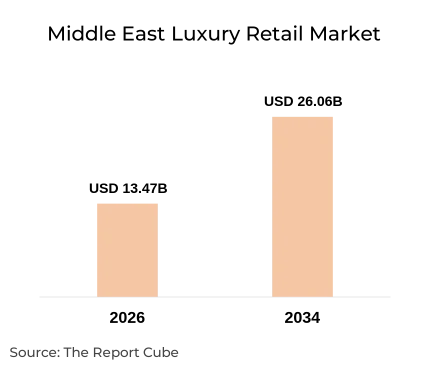
- Middle East luxury retail market valued at USD 13.47 billion in 2026, reflecting sustained regional consumption growth.
- Industry projected to reach USD 26.06 billion by 2034 at a robust 8.60% CAGR.
- Market expanding at a consistent 8.60% CAGR across the full 2026–2034 forecast period.
- Women's segment leads the end-user category driven by premium fashion and accessories demand.
- Offline retail dominates distribution channel procurement across the Middle East luxury landscape.
- Online retail remains the fastest-growing distribution channel as digital luxury adoption accelerates.
- Chalhoub Group, Al Tayer Insignia, and Majid Al Futtaim lead luxury retail operations regionally.
- Premiumization trends and expanding tourist spending are reshaping luxury category procurement dynamics.
Middle East Luxury Retail Market Overview
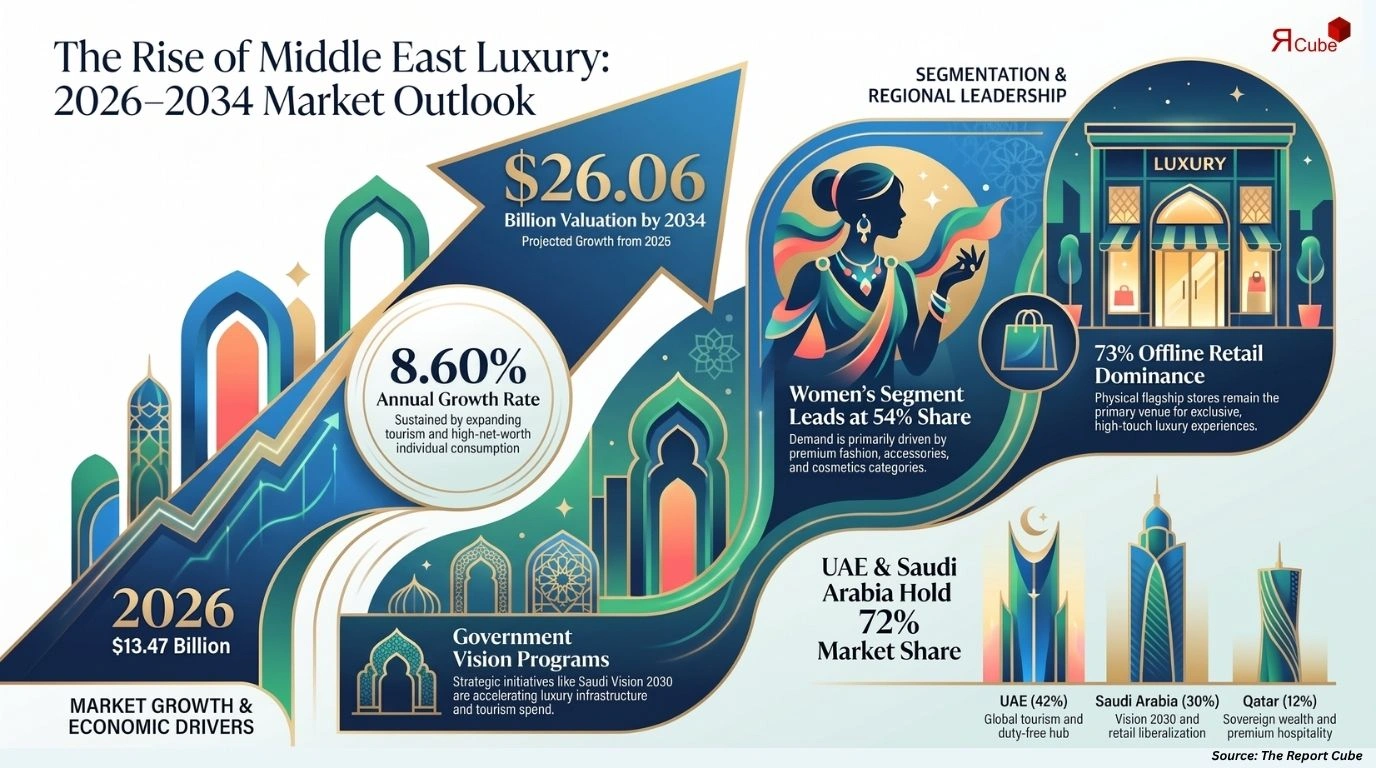
The Middle East Luxury Retail Market is anticipated to register an 8.60% CAGR during 2026–2034. The market size was valued at USD 13.47 billion in 2026 and is projected to reach USD 26.06 billion by 2034. The region's growing high-net-worth individual (HNWI) population, expanding tourism infrastructure, and increasing appetite for international luxury brands are collectively sustaining demand across fashion, jewelry, watches, cosmetics, and premium lifestyle categories. Government-led economic diversification programs including Saudi Vision 2030 and UAE Centennial 2071 are accelerating investment in luxury retail infrastructure, duty-free zones, and premium experiential shopping environments.
Expanding urban consumer bases across the UAE, Saudi Arabia, Qatar, and Kuwait are generating consistent demand for international flagship store openings and exclusive brand partnerships. Chalhoub Group, Al Tayer Insignia, and Alshaya Group have deepened brand portfolios through exclusive distribution agreements with European luxury houses. Rising female workforce participation, growing youth spending power, and increasing exposure to global fashion content through digital platforms are collectively broadening the region's luxury consumer demographic and sustaining long-term category growth well beyond traditional gifting and status-oriented purchase motivations.
Middle East Luxury Retail Market Size & Forecast
|
Metric |
Details |
|---|---|
|
Market Size (2026) |
USD 13.47 Billion |
|
Market Size (2034) |
USD 26.06 Billion |
|
CAGR (2026–2034) |
8.60% |
|
Base Year |
2026 |
|
Historical Years |
2021–2025 |
|
Forecast Years |
2026–2034 |
This Middle East Luxury Retail Market Size study values the industry at USD 13.47 billion in 2026 and projects expansion to USD 26.06 billion by 2034, advancing at an 8.60% CAGR - significantly outpacing the global luxury retail average, driven by surging HNWI consumer populations, inbound tourism spend, and accelerating demand for experiential and personalized premium retail formats.
Middle East Luxury Retail Market Dynamics
The Middle East Luxury Retail Market is evolving rapidly as government infrastructure investments mature, digital retail adoption deepens, and an expanding young affluent consumer base drives category diversification. Rising tourist arrivals, duty-free retail expansion, and growing appetite for personalized luxury experiences across flagship retail environments are reinforcing sustained demand for premium brand offerings across the UAE, Saudi Arabia, Qatar, and Kuwait through the 2034 forecast horizon.
|
Factor |
Type |
Specific Impact on Market |
Magnitude |
|---|---|---|---|
|
Growing HNWI population and tourist spending |
Driver |
Increases luxury goods demand across flagship and duty-free retail channels |
High |
|
Expanding female consumer segment |
Driver |
Accelerates women's fashion, accessories, and cosmetic luxury category growth |
High |
|
Global luxury brand supply chain disruptions |
Challenge |
Creates inventory gaps and delays for regional distribution partners |
Medium |
|
Government Vision programs and tourism investment |
Opportunity |
Attracts new luxury brand entrants and supports flagship retail infrastructure |
High |
|
Digital luxury commerce adoption |
Trend |
Reshapes distribution toward omnichannel and online luxury retail platforms |
Medium |
- Growth Drivers - Expanding HNWI Population and Tourism Spend: The Middle East Luxury Retail Market Growth trajectory is underpinned by a rapidly expanding high-net-worth individual base across the UAE, Saudi Arabia, and Qatar. International tourist arrivals across Dubai, Riyadh, and Doha have surpassed pre-pandemic records, generating substantial inbound luxury retail spend across flagship stores operated by Chalhoub Group, Al Tayer Insignia, and Alshaya Group throughout the region.
- Market Opportunities - Vision 2030 Tourism and Retail Infrastructure Investment: Saudi Arabia's Vision 2030 program is projected to attract over 150 million annual tourists by 2030, with luxury retail infrastructure investments across NEOM, Red Sea Project, and Diriyah creating new premium retail real estate demand. Majid Al Futtaim and Azadea Group are well-positioned to expand luxury brand presence across newly commissioned retail destinations as government tourism and entertainment expenditure accelerates category demand beyond traditional urban luxury retail corridors.
- Industry Challenges - Counterfeit Goods and Gray Market Penetration: The proliferation of counterfeit luxury goods through informal digital channels and cross-border gray market imports remains a persistent structural challenge across GCC luxury retail markets. Brand authentication enforcement varies across jurisdictions, creating consumer confidence risk and pricing pressure for authorized distributors. Regional customs authorities and luxury brands are intensifying anti-counterfeiting collaborations, though enforcement gaps in smaller markets continue generating revenue displacement for legitimate luxury retail operators.
Middle East Luxury Retail Market Trends
- Emerging Trends: Among the most significant Middle East Luxury Retail Market Trends is the accelerating shift toward experiential luxury retail, where flagship stores increasingly integrate hospitality, personalization services, and cultural programming to differentiate physical shopping environments from e-commerce alternatives. Luxury brands including Louis Vuitton, Cartier, and Hermès are investing in boutique renovations across Dubai Mall and The Avenues Kuwait to deliver elevated in-store client experiences aligned with regional consumer expectations for exclusivity, heritage storytelling, and bespoke product customization services.
- Technology Trends: Artificial intelligence-powered personalization engines, virtual try-on platforms, and digital clienteling tools are being adopted by leading Middle East luxury retail operators to enhance consumer engagement and improve conversion rates across both physical and digital touchpoints. Chalhoub Group's investment in proprietary luxury e-commerce platforms and Al Tayer Insignia's digital transformation initiatives are benchmarking the region's technology integration capabilities. Blockchain-based luxury product authentication solutions are expected to gain adoption across GCC markets as counterfeit prevention and resale traceability become standard brand requirements.
- Consumer / Buyer Trends: Middle Eastern luxury consumers - particularly under-35 millennials and Gen Z segments across the UAE and Saudi Arabia - are increasingly prioritizing brand values, sustainability credentials, and exclusivity narratives alongside traditional quality and heritage positioning. Professional buyers representing corporate gifting, hospitality procurement, and sovereign wealth-linked purchasing entities continue to represent a disproportionately high share of regional luxury transaction volumes. Over 70% of Gulf luxury consumers now research purchases digitally prior to completing in-store transactions, reinforcing omnichannel engagement as a commercial necessity.
Need Specific Data, Let’s Customize the Report for You
Request CustomizationMiddle East Luxury Retail Market Segment Analysis
Bahrain's Middle East Luxury Retail Market serves distinct end-user demographics and operates across multiple distribution formats, each shaped by unique consumer purchasing behavior, brand accessibility preferences, and evolving channel economics across the region's key markets.
By End User
|
End User |
Estimated Share (2026) |
Key Characteristics |
|---|---|---|
|
Women's |
54% |
Dominant luxury fashion, cosmetics, jewelry, and accessories demand |
|
Men's |
32% |
Growing watches, tailoring, footwear, and premium accessories consumption |
|
Unisex |
14% |
Emerging category; fragrance, lifestyle, and homewares growing rapidly |
The women's end-user segment commands the largest Middle East Luxury Retail Market Share, accounting for an estimated 54% of total market demand in 2026. Chalhoub Group and Alshaya Group are primary retail operators serving women's luxury categories through exclusive brand agreements with Chanel, Dior, and Sephora across UAE and Saudi flagship locations. The men's segment, representing approximately 32%, is growing steadily as premium menswear, luxury watchmaking, and tailored accessories gain adoption among younger male consumers. The unisex category, estimated at 14%, is the emerging growth segment driven by luxury fragrance, homeware, and lifestyle brand expansion across the region through Azadea Group and Majid Al Futtaim-operated retail environments.
By Distribution Channel
|
Distribution Channel |
Estimated Share (2026) |
Growth Outlook |
|---|---|---|
|
Offline Retail |
73% |
Steady; flagship stores, malls, and duty-free remain primary luxury purchase venues |
|
Online Retail |
27% |
Fastest-growing; digital luxury adoption accelerating across UAE and Saudi Arabia |
Offline retail dominates the distribution channel segment at an estimated 73% share in 2026, underpinned by the enduring importance of in-store luxury experience, physical product authentication, and exclusive concierge services. Al Tayer Insignia and Majid Al Futtaim maintain extensive luxury flagship and multi-brand retail presences across Dubai Mall, Mall of the Emirates, and The Avenues Kuwait. Online retail, representing approximately 27%, is the fastest-growing channel as Chalhoub Group's Ounass luxury e-commerce platform and international digital luxury destinations expand consumer access to premium brands across the full GCC region through curated, digitally personalized shopping experiences.
Middle East Luxury Retail Market Regional Analysis
|
Region |
Estimated Market Share |
Key Growth Factors |
Consumer Trends |
|---|---|---|---|
|
United Arab Emirates |
42% |
Global tourism hub, Dubai luxury retail infrastructure, duty-free expansion |
Highest omnichannel luxury adoption; international tourist spend dominant |
|
Saudi Arabia |
30% |
Vision 2030 entertainment & retail liberalization, growing female consumer segment |
Rapid domestic luxury consumer base expansion; rising fashion engagement |
|
Qatar |
12% |
FIFA World Cup legacy retail infrastructure, sovereign wealth-backed consumption |
Premium hospitality luxury procurement; gifting and jewelry demand strong |
|
Kuwait |
10% |
Established HNWI consumer base, high per-capita income, traditional luxury culture |
Brand loyalty to European heritage luxury houses; conservative premium fashion |
|
Bahrain |
6% |
Duty-free retail hub, GCC trade gateway, growing artisanal gifting economy |
Compact but discerning consumer base; cross-border Saudi luxury retail traffic |
- United Arab Emirates - 42% Share: The UAE leads the Middle East luxury retail landscape by a significant margin, anchored by Dubai's position as one of the world's top three luxury retail destinations. Dubai Mall, Mall of the Emirates, and Dubai International Airport's duty-free zones collectively generate the highest luxury retail throughput in the region. International tourist arrivals exceeding 20 million annually sustain demand for flagship stores operated by Al Tayer Insignia and Chalhoub Group across multiple luxury categories.
- Saudi Arabia - 30% Share: Saudi Arabia is the region's fastest-growing luxury market as Vision 2030 catalyzes retail liberalization, entertainment sector expansion, and rapidly rising female consumer participation. Riyadh's luxury retail infrastructure - anchored by Kingdom Centre Mall and expanding luxury residential communities - is attracting international brand flagship openings. Azadea Group and Alshaya Group are expanding brand portfolios targeting Saudi Arabia's rapidly maturing young affluent consumer segment.
- Qatar - 12% Share: Qatar's luxury retail market reflects a mature sovereign wealth-backed economy with concentrated HNWI demand. The Place Vendôme Mall, Villaggio, and luxury hotel boutiques serve as primary luxury retail venues. Post-FIFA World Cup hospitality infrastructure sustains premium visitor demand, while sovereign and corporate gifting traditions generate consistent high-ticket luxury procurement across jewelry, watches, and premium accessories categories.
- Kuwait - 10% Share: Kuwait maintains one of the region's highest luxury spending intensities per capita, supported by a deeply established HNWI culture and multi-generational loyalty to European heritage luxury brands. The Avenues Mall remains the premier luxury retail destination in the country, hosting flagship boutiques across fashion, jewelry, and lifestyle categories operated by Chalhoub Group and Majid Al Futtaim.
- Bahrain - 6% Share: Bahrain operates as a specialized duty-free luxury retail hub, attracting significant cross-border luxury purchasing traffic from neighboring Saudi Arabia. Bahrain City Centre and luxury hotel retail zones serve as key premium brand access points. Majid Al Futtaim and Chalhoub Group maintain active presences supporting a compact but commercially significant luxury consumer base across the Kingdom.
Middle East Luxury Retail Market Share & Competitive Landscape
The Middle East luxury retail competitive landscape is distribution-concentrated at the brand partnership level, with regional conglomerate operators holding exclusive agreements with leading international luxury houses. Key players compete across brand portfolio depth, flagship store experience quality, digital commerce capability, and GCC market reach.
|
Company |
Competitive Strength |
Primary Segment Served |
|---|---|---|
|
Chalhoub Group |
Largest regional luxury distributor; 70+ brands; omnichannel retail leadership |
Women's fashion, cosmetics, lifestyle; UAE and Saudi focus |
|
Al Tayer Insignia |
Premium multi-brand luxury portfolio; flagship store excellence |
Women's and men's fashion; UAE flagship retail |
|
Majid Al Futtaim |
Premium mall operator and luxury retail anchor tenant manager |
All segments; UAE, Saudi Arabia, Kuwait |
|
Alshaya Group |
Multi-brand franchise operator; large-format beauty and fashion |
Women's cosmetics, fashion; GCC-wide distribution |
|
Azadea Group |
Fashion and lifestyle retail focus; growing Saudi market presence |
Women's and men's fashion; Levant and GCC expansion |
|
Others |
Regional boutiques, mono-brand flagships, duty-free operators |
Category-specific luxury across GCC |
Key Companies in the Middle East Luxury Retail Market
Chalhoub Group
Chalhoub Group, headquartered in Dubai, UAE, is the Middle East's largest luxury goods distributor, representing over 70 premium and luxury brands across fashion, beauty, and lifestyle categories. Operating more than 750 stores across 14 countries, the group's proprietary Ounass luxury e-commerce platform has emerged as the region's leading digital luxury destination. In 2025, Chalhoub Group accelerated expansion into Saudi Arabia's rapidly liberalizing luxury retail environment, deepening exclusive brand partnerships to capture Vision 2030-driven consumer demand across fashion and premium beauty categories.
Al Tayer Insignia
Al Tayer Insignia, headquartered in Dubai, UAE, is a leading luxury retail operator holding exclusive regional distribution rights for prestigious international brands including Giorgio Armani, Bottega Veneta, and Harvey Nichols. Operating flagship stores across the UAE's premier retail destinations, the company has invested substantially in in-store clienteling technology and VIP customer service programming. In 2025, Al Tayer Insignia expanded its luxury menswear and premium accessories portfolio, responding to growing demand from younger Gulf male consumers seeking authenticated international luxury brand access.
Middle East Luxury Retail Market Recent Developments
|
Year |
Company |
Development |
|---|---|---|
|
2025 |
Chalhoub Group |
Accelerated Saudi Arabia retail expansion; launched new luxury fashion flagships across Riyadh's premium mall destinations |
|
2025 |
Al Tayer Insignia |
Expanded luxury menswear and accessories portfolio; invested in digital clienteling technology across UAE flagship stores |
|
2025 |
Majid Al Futtaim |
Opened new luxury retail wing at Mall of the Emirates; added international luxury brand flagships targeting HNWIs |
|
Jan 2025 |
Chalhoub Group |
Ounass platform achieved regional luxury e-commerce milestone, crossing USD 500 million in annual gross merchandise value |
Middle East Luxury Retail Market Future Outlook
The Middle East Luxury Retail Market Forecast projects market expansion to USD 26.06 billion by 2034, advancing at an 8.60% CAGR through the forecast period. Sustained growth in women's premium fashion, accelerating men's luxury category adoption, and rising unisex lifestyle brand demand will collectively reinforce ingredient procurement and distribution investment across GCC markets. Chalhoub Group, Al Tayer Insignia, and Majid Al Futtaim are expected to deepen brand portfolios and expand omnichannel retail capabilities to capture Vision 2030-driven luxury consumer growth across Saudi Arabia and Qatar through 2034.
Technological advancement in luxury retail - including AI-powered personalization, blockchain product authentication, and immersive in-store experiential formats - will increasingly differentiate leading regional retail operators from mid-tier competitors. Sustainable luxury sourcing practices, ethical brand certification requirements, and digital transparency standards will become baseline requirements as Gulf luxury consumers and sovereign tourism programs demand stronger brand accountability across supply chain and environmental performance dimensions through the 2034 forecast horizon.
Middle East Luxury Retail Market Report Coverage
This Middle East Luxury Retail Market Report covers comprehensive analysis of the region's premium retail sector across the full 2026–2034 forecast period, including segmentation, regional breakdown, competitive profiling, and strategic outlook.
|
Report Attribute |
Details |
|---|---|
|
Market Name |
Middle East Luxury Retail Market |
|
Market Size (2026) |
USD 13.47 Billion |
|
Market Size (2034) |
USD 26.06 Billion |
|
Forecast Period |
2026–2034 |
|
CAGR |
8.60% |
|
Base Year |
2026 |
|
Historical Years |
2021–2025 |
|
Forecast Years |
2026–2034 |
|
Segments Covered |
By Product Type, By End-User, By Distribution Channel |
|
Regions Covered |
United Arab Emirates, Saudi Arabia, Qatar, Kuwait, Bahrain |
|
Key Companies |
Chalhoub Group, Al Tayer Insignia, Majid Al Futtaim, Alshaya Group, Azadea Group, Others |
|
Report Format |
PDF, Excel, PPT |
|
Customization |
Available as per client requirements |
Why Choose This Middle East Luxury Retail Market Report?
- Comprehensive coverage of the Middle East's growing premium and luxury retail sector across five GCC markets.
- Accurate market sizing from USD 13.47 billion in 2026 through the full 2034 forecast horizon.
- Detailed segmentation by end-user category (Women's, Men's, Unisex) and distribution channel type.
- Country-level insights covering UAE, Saudi Arabia, Qatar, Kuwait, and Bahrain with share estimates.
- Competitive profiling of leading regional luxury retail conglomerates and distribution operators.
- Analysis of Vision 2030 and UAE Centennial 2071 impacts on luxury retail infrastructure investment.
- Forecast data supporting brand partnership, market entry, and investment planning decisions.
- Trend analysis covering digital commerce, experiential retail, and sustainable luxury adoption.
Table of Contents
- Introduction
- Objective of the Study
- Product Definition
- Market Segmentation
- Study Variables
- Research Methodology
- Secondary Data Points
- Companies Interviewed
- Primary Data Points
- Breakdown of Primary Interviews
- Secondary Data Points
- Executive Summary
- Market Dynamics
- Drivers
- Challenges
- Opportunity Assessment
- Recent Trends and Developments
- Policy and Regulatory Landscape
- Middle East Luxury Retail Market Overview and Forecast Analysis (2021-2034)
- Market Size, By Value, By Growth Rate (CAGR/USD Billions)
- Demand – Supply Trends
- Market Share, By Product Type
- Clothing and Apparel
- Leather Goods
- Watches and Fine Jewelry
- Footwear & Eyewear
- Other
- Market Share, By End-User
- Women's
- Men's
- Unisex
- Market Share, By Distribution Channel
- Offline Retail
- Online Retail
- Market Share, By Region
- United Arab Emirates
- Saudi Arabia
- Qatar
- Kuwait
- Bahrain
- Market Share, By Competitors
- Competition Characteristics
- Revenue Shares
- Clothing and Apparel Middle East Luxury Retail Market Overview, 2021-2034F
- By Value (USD Million)
- By End-User – Market Size & Forecast 2021-2034, USD Million
- Women's
- Men's
- Unisex
- Leather Goods Middle East Luxury Retail Market Overview, 2021-2034F
- By Value (USD Million)
- By End-User – Market Size & Forecast 2021-2034, USD Million
- Women's
- Men's
- Unisex
- Watches and Fine Jewelry Middle East Luxury Retail Market Overview, 2021-2034F
- By Value (USD Million)
- By End-User – Market Size & Forecast 2021-2034, USD Million
- Women's
- Men's
- Unisex
- Footwear & Eyewear Middle East Luxury Retail Market Overview, 2021-2034F
- By Value (USD Million)
- By End-User – Market Size & Forecast 2021-2034, USD Million
- Women's
- Men's
- Unisex
- Other Middle East Luxury Retail Market Overview, 2021-2034F
- By Value (USD Million)
- By End-User – Market Size & Forecast 2021-2034, USD Million
- Women's
- Men's
- Unisex
- Competitive Outlook (Company Profile - Partial List)
- Chalhoub Group
- Company Overview
- Business Segments
- Strategic Alliances/Partnerships
- Recent Developments
- Al Tayer Insignia
- Company Overview
- Business Segments
- Strategic Alliances/Partnerships
- Recent Developments
- Majid Al Futtaim
- Company Overview
- Business Segments
- Strategic Alliances/Partnerships
- Recent Developments
- Alshaya Group
- Company Overview
- Business Segments
- Strategic Alliances/Partnerships
- Recent Developments
- Azadea Group
- Company Overview
- Business Segments
- Strategic Alliances/Partnerships
- Recent Developments
- Others
- Chalhoub Group
- Contact Us & Disclaimer
Top Key Players & Market Share Outlook
- Chalhoub Group
- Al Tayer Insignia
- Majid Al Futtaim
- Alshaya Group
- Azadea Group
- Others
Frequently Asked Questions