



Build Your Custom Market Intelligence Report
Customize Your ReportGlobal Magnetic Resonance Imaging Market Key Takeaways
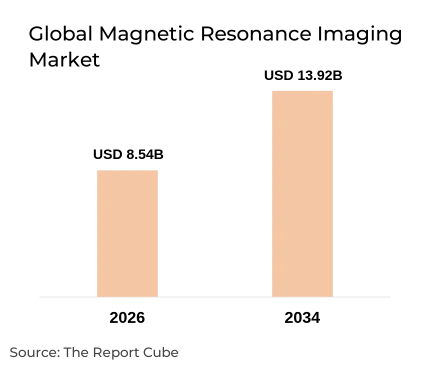
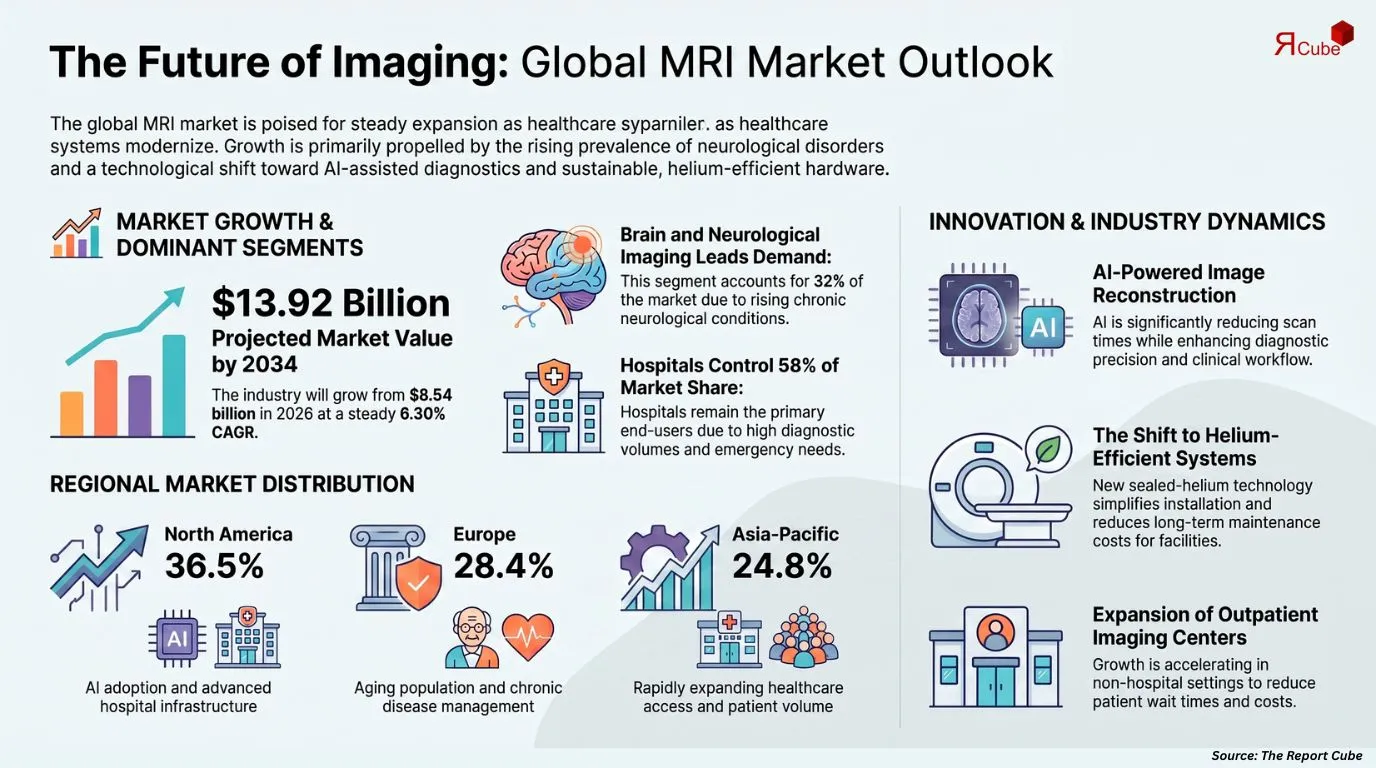
- Market size estimated at USD 8.54 billion during 2026 worldwide.
- Industry projected to reach USD 13.92 billion by 2034.
- Market anticipated to expand at a healthy 6.30% CAGR through 2034.
- Hospitals remain the leading end-user segment due to higher diagnostic volumes.
- Brain and neurological imaging dominates application demand across healthcare facilities.
- North America leads the global market with advanced imaging infrastructure and reimbursement.
- AI-enabled MRI platforms and helium-efficient systems improve workflow and diagnostic precision.
- Major companies include GE Healthcare, Siemens AG, Philips, Fujifilm, Esaote, Toshiba Corporation.
Global Magnetic Resonance Imaging Market Insights & Analysis
The Global Magnetic Resonance Imaging Market is anticipated to register a 6.30% CAGR during 2026–2034. The market size was valued at USD 8.54 billion in 2026 and is projected to reach USD 13.92 billion by 2034. Growing incidences of neurological disorders, cardiovascular diseases, musculoskeletal conditions, and cancer continue to strengthen MRI demand worldwide. Governments across North America, Europe, and Asia-Pacific are increasing investments in hospital modernization and advanced diagnostic imaging infrastructure, while healthcare providers are expanding outpatient imaging capacity to reduce diagnostic waiting times.
Technological innovation remains a primary growth catalyst. Manufacturers are introducing AI-assisted image reconstruction, faster scanning protocols, sealed-helium MRI systems, and portable imaging solutions that improve workflow efficiency and patient accessibility. Continuous product launches from leading manufacturers and regulatory approvals for next-generation MRI platforms are accelerating replacement demand across mature healthcare markets.
Global Magnetic Resonance Imaging Market Dynamics
The market continues to evolve through technological advancements, expanding disease prevalence, and healthcare infrastructure modernization. Continuous innovation in AI-assisted imaging, helium-efficient MRI systems, and workflow automation is improving clinical productivity while increasing diagnostic accuracy across hospitals and imaging centers worldwide.
|
Factor |
Type |
Specific Impact on Market |
Magnitude |
|---|---|---|---|
|
Rising neurological disorders |
Driver |
Higher demand for brain MRI examinations |
High |
|
AI-powered image reconstruction |
Opportunity |
Faster scans with improved image quality |
High |
|
Expansion of outpatient imaging centers |
Growth Driver |
Increased accessibility and patient throughput |
Medium-High |
|
Sealed-helium MRI technology |
Emerging Trend |
Reduced maintenance and installation complexity |
Medium |
|
Hospital infrastructure modernization |
Growth Catalyst |
Higher procurement of advanced MRI systems |
High |
Key Market Driver: Increasing Demand for Advanced Diagnostics
The growing burden of stroke, Alzheimer's disease, spinal disorders, orthopedic injuries, and oncology cases has significantly increased MRI utilization worldwide. MRI remains the preferred imaging modality for soft-tissue visualization without ionizing radiation, making it indispensable for neurological, cardiovascular, and musculoskeletal diagnosis. Aging populations across developed economies further support sustained scanner installations and replacement cycles.
Healthcare providers are also investing in high-field MRI systems capable of delivering superior image resolution while reducing examination time. Integration of AI-assisted workflow solutions enables radiologists to improve productivity, reduce repeat scans, and manage increasing patient volumes more efficiently.
Major Industry Challenge: Healthcare Infrastructure Disparities
Despite growing demand, unequal distribution of advanced imaging infrastructure across emerging economies continues limiting MRI accessibility. Rural healthcare facilities often lack specialized radiology departments and trained imaging professionals, resulting in delayed diagnoses and lower utilization rates.
Long procurement cycles, installation requirements involving magnetic shielding, and infrastructure readiness further slow deployment in developing healthcare systems. These factors primarily affect market penetration rather than long-term demand, encouraging vendors to develop compact and easier-to-install MRI platforms.
Emerging Trend Shaping Outlook: AI and Helium-Efficient MRI Innovation
Manufacturers are increasingly launching AI-enabled MRI systems featuring automated patient positioning, accelerated reconstruction algorithms, intelligent workflow management, and predictive maintenance capabilities. These innovations reduce scan duration while enhancing diagnostic consistency.
Another transformative trend involves sealed-helium and ultra-low-helium MRI systems that minimize helium dependence, simplify installation, and improve sustainability. These next-generation platforms are expected to expand MRI accessibility across hospitals, outpatient facilities, and mobile imaging environments during the forecast period.
Need Specific Data, Let’s Customize the Report for You
Request CustomizationGlobal Magnetic Resonance Imaging Market Segment-wise Analysis
The Global Magnetic Resonance Imaging Market is segmented by Application and End User. Growing demand for high-resolution diagnostic imaging, increasing chronic disease prevalence, and expanding hospital imaging infrastructure continue supporting revenue growth across both segments. AI-assisted MRI workflows and faster scanning technologies are further improving adoption across multiple clinical specialties.
By Application
- Obstructive Sleep Apnea
- Brain and Neurological
- Spine and Musculoskeletal
- Vascular
- Abdominal
- Cardiac
- Breast
- Others
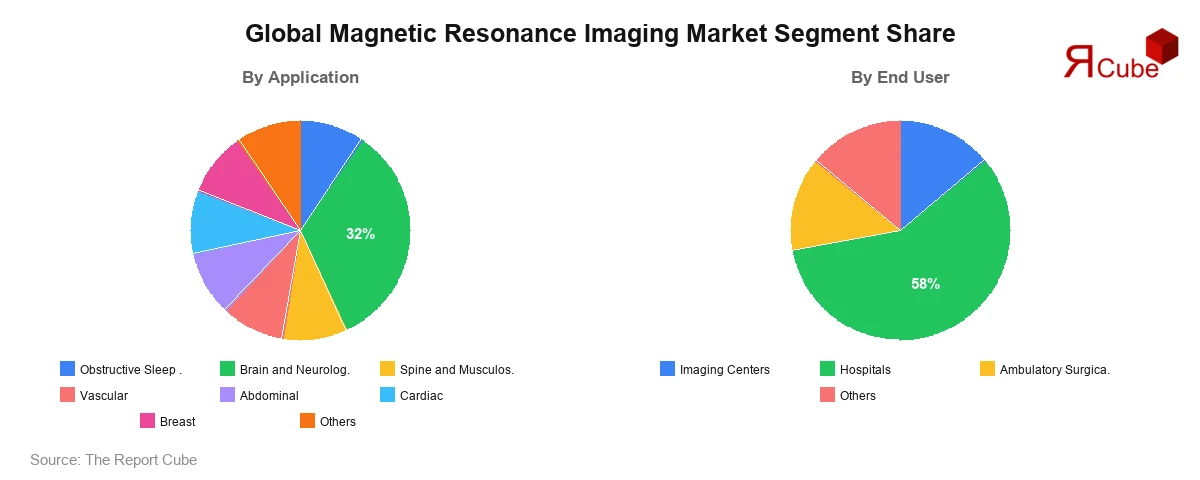
Brain and neurological imaging is expected to remain the dominant application, accounting for nearly 32% of the global market throughout the forecast period. Rising incidences of stroke, epilepsy, Alzheimer's disease, Parkinson's disease, and traumatic brain injuries continue driving MRI utilization. Advanced 3T systems, AI-powered reconstruction software, and functional MRI techniques further improve diagnostic confidence while reducing examination times for complex neurological assessments.
Spine and musculoskeletal imaging represents the second-largest application owing to increasing sports injuries, degenerative spinal disorders, arthritis, osteoporosis, and orthopedic surgeries. Cardiac, vascular, abdominal, breast, and sleep apnea imaging are also witnessing healthy growth due to expanding preventive healthcare programs and wider availability of high-field MRI scanners capable of delivering superior soft-tissue visualization across multiple clinical specialties.
By End User
- Imaging Centers
- Hospitals
- Ambulatory Surgical Centers
- Others
Hospitals continue dominating the end-user landscape with an estimated 58% market share owing to comprehensive diagnostic capabilities, emergency imaging services, specialized radiology departments, and continuous investments in advanced MRI platforms. Large healthcare systems increasingly replace aging scanners with AI-enabled, helium-efficient equipment to improve patient throughput, workflow efficiency, and diagnostic precision.
Imaging centers are experiencing rapid expansion as outpatient diagnostic services become increasingly preferred for convenience, reduced waiting times, and lower healthcare costs. Ambulatory surgical centers also contribute steadily through pre-operative and post-operative imaging requirements, while private diagnostic providers continue expanding MRI accessibility across urban and semi-urban healthcare markets.
Regional Projection of Global Magnetic Resonance Imaging Market
North America continues leading the global MRI industry due to advanced healthcare infrastructure, high MRI scanner density, favorable reimbursement systems, rapid adoption of AI-enabled imaging technologies, and continuous replacement of legacy equipment. Meanwhile, Asia-Pacific is projected to register the fastest growth as governments expand diagnostic infrastructure and healthcare access.
|
Region |
Estimated Market Share |
Key Growth Factors |
Consumer Trends |
|---|---|---|---|
|
North America |
36.5% |
Advanced hospitals, AI adoption, reimbursement support |
Demand for faster and precise diagnostics |
|
Europe |
28.4% |
Aging population, healthcare modernization |
High utilization of MRI for chronic diseases |
|
Asia-Pacific |
24.8% |
Expanding healthcare infrastructure, rising patient volume |
Increasing adoption of advanced MRI systems |
|
Latin America |
5.8% |
Growing diagnostic investments |
Improved access to imaging services |
|
Middle East & Africa |
4.5% |
Hospital expansion and public healthcare initiatives |
Rising awareness of early disease diagnosis |
- North America North America accounts for approximately 36.5% of global revenue, supported by strong investments in advanced imaging equipment, widespread deployment of AI-assisted MRI systems, and high demand for neurological, cardiovascular, and oncology diagnostics. The United States remains the largest contributor owing to continuous technological innovation and replacement demand across hospitals and imaging networks. Continuous product innovation from major manufacturers, increasing outpatient imaging capacity, and favorable reimbursement policies further strengthen regional leadership. Growing adoption of low-helium MRI systems, cloud-enabled workflow management, and intelligent image reconstruction technologies is expected to sustain North America's competitive position throughout the forecast period.
Global Magnetic Resonance Imaging Market: Recent Development (2025)
- GE Healthcare introduced advanced AI-enabled MRI workflow solutions improving image quality, scan speed, clinical productivity, and patient experience.
- Siemens Healthineers expanded intelligent MRI software capabilities supporting automated image reconstruction, streamlined workflows, and improved diagnostic consistency globally.
- Philips enhanced MRI portfolio integrating artificial intelligence, workflow automation, and sustainability-focused helium-efficient imaging technologies for healthcare providers.
- Fujifilm strengthened diagnostic imaging innovations through advanced MRI visualization technologies supporting faster clinical decision-making across multiple specialties.
Global Magnetic Resonance Imaging Market Future Outlook (2034)
The Global Magnetic Resonance Imaging Market is projected to grow at a 6.30% CAGR, reaching USD 13.92 billion by 2034. Rising demand for early disease diagnosis, increasing prevalence of neurological and cardiovascular disorders, and expanding adoption of AI-powered imaging technologies will continue supporting long-term market expansion. Hospitals and imaging centers are expected to prioritize next-generation MRI systems offering faster scanning, higher image quality, and improved workflow efficiency.
Artificial intelligence, cloud-enabled imaging platforms, automated image reconstruction, and helium-efficient MRI technologies are anticipated to redefine diagnostic imaging over the coming decade. Continuous investments in precision medicine, outpatient diagnostic infrastructure, and digital healthcare transformation will create significant growth opportunities for manufacturers including GE Healthcare, Siemens AG, Philips, Fujifilm, Toshiba Corporation, Esaote SPA, Aurora Imaging Technologies, and Sanrad Medical Systems Pvt. Ltd.
Global Magnetic Resonance Imaging Market Report Coverage
|
Report Attribute |
Details |
|---|---|
|
Market Name |
Global Magnetic Resonance Imaging Market |
|
Market Size (2026) |
USD 8.54 Billion |
|
Market Size (2034) |
USD 13.92 Billion |
|
Forecast Period |
2026–2034 |
|
CAGR |
6.30% |
|
Base Year |
2026 |
|
Segments Covered |
By Architecture, By Type, By Field Strength, By Application, By End User |
|
Regions Covered |
North America, Europe, Asia-Pacific, Latin America, Middle East & Africa |
|
Key Companies |
GE Healthcare, Siemens AG, Toshiba Corporation, Aurora Imaging Technologies, Koninklijke Philips N.V., Esaote SPA, Sanrad Medical Systems Pvt. Ltd., Fujifilm, Others |
|
Customization |
Available upon Request |
|
Report Format |
PDF, Excel, Presentation |
Why Choose This Report?
- Comprehensive industry assessment with quantitative market forecasts.
- Detailed application and end-user segmentation analysis.
- Extensive regional market outlook and growth evaluation.
- Competitive landscape covering major global manufacturers.
- Technology trends including AI-powered MRI innovations.
- Actionable insights supporting strategic investment decisions.
- Reliable market sizing using industry-supported research methodology.
- Future growth opportunities through 2034 clearly identified.
Table of Contents
- Introduction
- Objective of the study
- Product Definition
- Market Segmentation
- Study Variables
- Research Methodology
- Secondary Data Points
- Companies Interviewed
- Primary Data Points
- Break Down of Primary Interviews
- Secondary Data Points
- Executive Summary
- Market Dynamics
- Drivers
- Challenges
- Opportunity Assessment
- Recent Trends and Developments
- Policy and Regulatory Landscape
- Global Magnetic Resonance Imaging Market Overview and Forecast Analysis (2021-2034)
- Market Size, By Value, By growth rate (CAGR/USD Billions)
- Demand - Supply Trends
- Market Share, By Architecture
- Closed system
- Open system
- Market Share, By Type
- Conventional
- Bio-based
- Market Share, By Process
- Trans-Esterification
- Direct Esterification
- Market Share, By Field Strength
- Mid field strength
- Low field strength
- High field strength
- Market Share, By Application
- Obstructive sleep apnea
- Brain and neurological
- Spine and musculoskeletal
- Vascular
- Abdominal
- Cardiac
- Breast
- Others
- Market Share, By End User
- Imaging centers
- Hospitals
- Ambulatory surgical centers
- Others
- Market Share, By Region
- North America
- Europe
- Asia-Pacific
- Latin America
- Middle East & Africa
- Market Share, By Competitors
- Competition Characteristics
- Revenue Shares
- Global Closed system Magnetic Resonance Imaging Market Overview, 2021-2034F
- By Value (USD Million)
- By Type- Market Size & Forecast 2021-2034, USD Million
- By Process- Market Size & Forecast 2021-2034, USD Million
- By Field Strength- Market Size & Forecast 2021-2034, USD Million
- By Application- Market Size & Forecast 2021-2034, USD Million
- By End User- Market Size & Forecast 2021-2034, USD Million
- Global Open system Magnetic Resonance Imaging Market Overview, 2021-2034F
- By Value (USD Million)
- By Type- Market Size & Forecast 2021-2034, USD Million
- By Process- Market Size & Forecast 2021-2034, USD Million
- By Field Strength- Market Size & Forecast 2021-2034, USD Million
- By Application- Market Size & Forecast 2021-2034, USD Million
- By End User- Market Size & Forecast 2021-2034, USD Million
- Competitive Outlook (Company Profile - Partial List)
- GE Healthcare
- Company Overview
- Business Segments
- Strategic Alliances/Partnerships
- Recent Developments
- Siemens AG
- Company Overview
- Business Segments
- Strategic Alliances/Partnerships
- Recent Developments
- Toshiba Corporation
- Company Overview
- Business Segments
- Strategic Alliances/Partnerships
- Recent Developments
- Aurora Imaging Technologies, Inc.
- Company Overview
- Business Segments
- Strategic Alliances/Partnerships
- Recent Developments
- Koninklijke Philips N.V.
- Company Overview
- Business Segments
- Strategic Alliances/Partnerships
- Recent Developments
- Esaote SPA
- Company Overview
- Business Segments
- Strategic Alliances/Partnerships
- Recent Developments
- Sanrad Medical Systems Pvt ltd.
- Company Overview
- Business Segments
- Strategic Alliances/Partnerships
- Recent Developments
- Fujifilm
- Company Overview
- Business Segments
- Strategic Alliances/Partnerships
- Recent Developments
- Others
- GE Healthcare
- Contact Us & Disclaimer
Top Key Players & Market Share Outlook
- GE Healthcare
- Siemens AG
- Toshiba Corporation
- Aurora Imaging Technologies, Inc.
- Koninklijke Philips N.V.
- Esaote SPA
- Sanrad Medical Systems Pvt ltd.
- Fujifilm
- Others
Frequently Asked Questions






