



Build Your Custom Market Intelligence Report
Customize Your ReportRussia Micronutrient Fertilizer Market Insights & Analysis
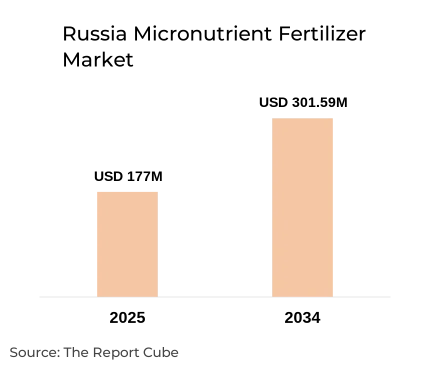
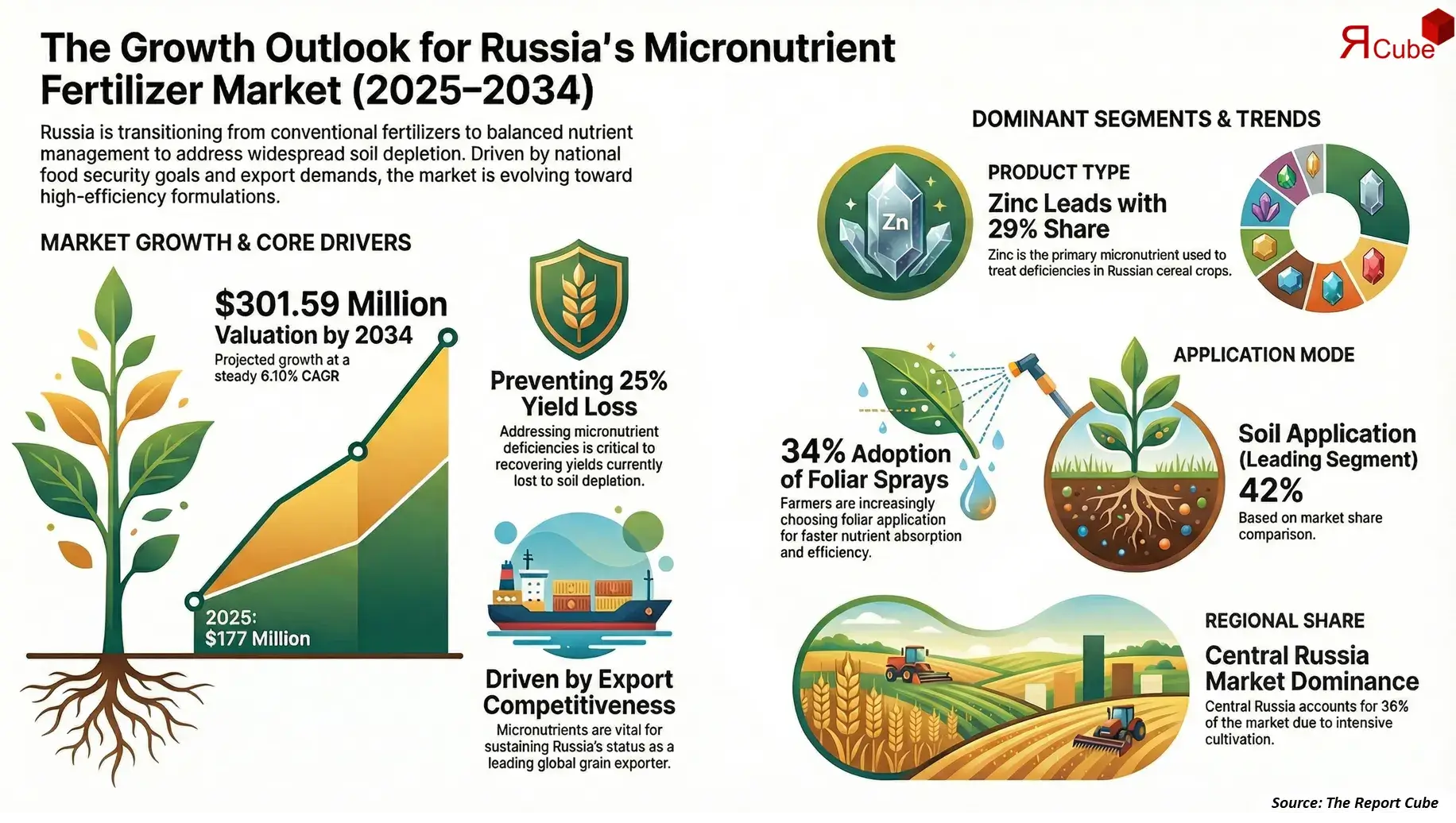
The Russia Micronutrient Fertilizer Market is anticipated to register a CAGR of 6.10% during the forecast period 2026-2034. The market size was valued at USD 177 million in 2025 and is projected to reach USD 301.59 million by 2034. This growth is strongly linked to Russia’s increasing focus on improving crop productivity, soil health restoration, and yield optimization across large-scale agricultural operations.
Russian agriculture is witnessing a gradual shift from conventional macronutrient-based fertilization toward balanced nutrient management practices. Micronutrient deficiencies, particularly zinc, boron, and iron, are increasingly being identified as yield-limiting factors in cereals, oilseeds, fruits, and vegetables. As a result, farmers and agribusinesses are adopting micronutrient fertilizers to enhance nutrient uptake efficiency and improve crop quality. This transition is supported by rising awareness, agronomic advisory programs, and expanding domestic fertilizer production capacity.
Furthermore, government-backed food security initiatives and export-driven grain production strategies are accelerating the adoption of advanced fertilizers. With Russia remaining one of the world’s leading grain producers and exporters, micronutrient fertilizers are becoming a critical input to sustain competitiveness. These interconnected drivers position the Russia Micronutrient Fertilizer Market for consistent expansion throughout the forecast period.
Russia Micronutrient Fertilizer Market Recent Developments
- 2025: PhosAgro expanded micronutrient-enriched fertilizer formulations targeting zinc and boron deficiencies in cereals.
- 2025: EuroChem introduced customized foliar micronutrient solutions for oilseed and vegetable crops.
Government Initiatives & Policies
- State Program for Agricultural Development: Supports sustainable fertilizer use and soil fertility improvement.
- Food Security Doctrine of the Russian Federation: Promotes higher crop yields and efficient input utilization.
Russia Micronutrient Fertilizer Market Dynamics
Key Driver: Rising Need for Yield Optimization and Soil Health Improvement
The primary driver of the Russia Micronutrient Fertilizer Market is the growing need to enhance crop yields while maintaining long-term soil health. Intensive farming practices across Russia’s key grain belts have led to widespread micronutrient depletion, directly affecting crop productivity. Studies indicate that micronutrient deficiencies can reduce yields by 10-25% if left unaddressed. Consequently, farmers are increasingly integrating zinc, boron, and manganese fertilizers into their nutrient management plans. This shift is further supported by agronomic research and field trials demonstrating measurable yield gains and improved crop resilience. As producers aim to maximize output per hectare amid fluctuating climate conditions, micronutrient fertilizers are emerging as a vital agronomic solution.
Book your FREE 30-minute expert consultation today
Contact UsIndustry Trends: Shift Toward Foliar and Precision Application Methods
A notable trend shaping the market is the growing preference for foliar spray and precision-based application methods. Foliar application allows faster nutrient absorption and targeted correction of deficiencies during critical crop growth stages. In Russia, foliar micronutrient usage has grown steadily, accounting for nearly 34% of total application modes in 2025. Fertigation is also gaining traction in high-value crops, supported by expanding irrigation infrastructure. Additionally, manufacturers are developing chelated and liquid micronutrient formulations to improve bioavailability and ease of application. This trend reflects the broader movement toward precision agriculture, where efficiency and cost-effectiveness are prioritized.
Major Challenge: Limited Awareness and Uneven Adoption Among Small Farms
Despite strong growth prospects, limited awareness among small and medium-sized farms remains a key challenge for the market. Many producers continue to rely heavily on nitrogen, phosphorus, and potassium fertilizers, underestimating the role of micronutrients. In remote regions, access to agronomic advisory services and advanced fertilizer products is uneven, slowing adoption rates. Additionally, price sensitivity among smaller farms can restrict the uptake of specialized micronutrient solutions. These factors create regional disparities in market penetration, potentially restraining overall growth if not addressed through education and extension programs.
Opportunity: Expansion of High-Value Crops and Export-Oriented Agriculture
The expansion of high-value crops and export-oriented agriculture presents a significant opportunity for the Russia Micronutrient Fertilizer Market. Oilseeds, fruits, vegetables, and greenhouse crops require precise nutrient management to meet quality and yield standards. As Russia increases agricultural exports, particularly to Asia and the Middle East, demand for premium-grade produce is rising. Micronutrient fertilizers play a crucial role in improving crop uniformity, nutritional content, and shelf life. This creates strong opportunities for manufacturers offering crop-specific and customized micronutrient solutions, supporting sustained market expansion.
Russia Micronutrient Fertilizer Market Segment-wise Analysis
By Product Type:
- Zinc
- Boron
- Iron
- Manganese
- Copper
- Molybdenum
- Other Micronutrients
Zinc dominates the product type segment, accounting for approximately 29% of the market share in 2025. Zinc deficiency is widespread in Russian soils, particularly affecting cereals and corn. Boron follows closely, driven by its critical role in oilseed and sugar beet production. Iron and manganese are increasingly used in horticultural crops to correct chlorosis and improve photosynthesis. The diversified product mix reflects the varying nutrient requirements across Russia’s extensive agricultural landscape.
By Application Mode:
- Soil Application
- Foliar Spray
- Fertigation
Soil application remains the leading mode, representing nearly 42% of total consumption, due to its compatibility with large-scale farming systems. However, foliar spray is the fastest-growing segment, supported by its efficiency in addressing acute deficiencies during critical growth stages. Fertigation, while currently smaller in share, is expanding steadily in irrigated and protected cultivation systems. The coexistence of these application modes highlights the market’s adaptability to diverse farming practices.
Regional Projection of Russia Micronutrient Fertilizer Industry
- Central Russia
- Southern Russia
- Volga Region
- Ural Region
- North Caucasus
Central Russia leads the market with an estimated 36% share, driven by extensive cereal and oilseed cultivation and higher adoption of advanced fertilizers. Southern Russia follows, benefiting from favorable climatic conditions and intensive crop production. The Volga Region is emerging as a high-growth area due to expanding grain exports and increasing awareness of soil nutrient management. Central Russia’s dominance is expected to continue throughout the forecast period, supported by strong infrastructure and agronomic support systems.
Need insights for a specific region within this market?
Request Regional DataWhy Choose This Report?
- Provides a comprehensive overview of the overall market analysis, encompassing key trends, consumer behavior analysis, and risk assessment to support strategic decision-making.
- Provides accurate, up-to-date insights into market size, segmentation, and emerging opportunities, helping to minimize risk & capitalizing on growth.
- Gives deep understanding of target audience preferences, investment habits, and communication channels for enhanced product development & marketing effectiveness.
- Delivers competitive analysis & benchmarking, uncovering the strengths & weaknesses of market competitors to guide strategies.
- Consolidate comprehensive market intelligence, reducing reasoning & streamlining research efforts.
- Facilitates customized market segmentation & risk mitigation strategies, fine-tuned to the business objectives.
- Aids in identifying both market challenges & untapped opportunities within the industry to drive long-term business growth.
- Provides valuable information based on actual customer data & search trends.
Table of Contents
- Introduction
- Objective of the Study
- Product and Category Definition
- Market Segmentation
- Study Variables
- Research Methodology
- Secondary Data Points
- Breakdown of Secondary Sources
- Primary Data Points
- Breakdown of Primary Interviews
- Secondary Data Points
- Executive Summary
- Market Dynamics
- Drivers
- Challenges
- Opportunity Assessment
- Recent Trends and Developments
- Regulatory and Policy Landscape
- Russia Micronutrient Fertilizer Market Overview (2021-2034)
- Market Size, By Value (USD Million)
- Market Share, By Product Type
- Zinc
- Boron
- Iron
- Manganese
- Copper
- Molybdenum
- Other Micronutrients
- Market Share, By Application Mode
- Soil Application
- Foliar Spray
- Fertigation
- Market Share, By Crop Type
- Field Crops
- Horticultural Crops
- Turf & Ornamental
- Market Share, By Formulation
- Chelated
- Non‑Chelated
- Market Share, By Region
- Central Russia
- Southern Russia
- Volga Region
- Ural Region
- North Caucasus
- Market Share, By Company
- Revenue Shares & Analysis
- Competition Characteristics
- Regional Analysis - Russia
- Central Russia Micronutrient Market
- Market Size, By Value (USD Million)
- Market Share, By Product Type
- Market Share, By Application Mode
- Market Share, By Crop Type
- Southern Russia Micronutrient Market
- Market Size, By Value (USD Million)
- Market Share, By Product Type
- Market Share, By Application Mode
- Market Share, By Crop Type
- Volga Region Micronutrient Market
- Market Size, By Value (USD Million)
- Market Share, By Product Type
- Market Share, By Application Mode
- Market Share, By Crop Type
- Ural Region Micronutrient Market
- Market Size, By Value (USD Million)
- Market Share, By Product Type
- Market Share, By Application Mode
- Market Share, By Crop Type
- North Caucasus Micronutrient Market
- Market Size, By Value (USD Million)
- Market Share, By Product Type
- Market Share, By Application Mode
- Market Share, By Crop Type
- Central Russia Micronutrient Market
- Competitive Outlook and Company Profiles
- PhosAgro Group
- Company Overview
- Micronutrient Portfolio
- Strategic Alliances/Partnerships
- Recent Developments
- EuroChem Group
- Company Overview
- Micronutrient Portfolio
- Strategic Alliances/Partnerships
- Recent Developments
- UralChem Holding
- Company Overview
- Micronutrient Portfolio
- Strategic Alliances/Partnerships
- Recent Developments
- Acron Group
- Company Overview
- Micronutrient Portfolio
- Strategic Alliances/Partnerships
- Recent Developments
- Biolchim S.p.A.
- Company Overview
- Micronutrient Portfolio
- Strategic Alliances/Partnerships
- Recent Developments
- ICL Group Ltd
- Company Overview
- Micronutrient Portfolio
- Strategic Alliances/Partnerships
- Recent Developments
- Valagro S.p.A.
- Company Overview
- Micronutrient Portfolio
- Strategic Alliances/Partnerships
- Recent Developments
- Yara International
- Company Overview
- Micronutrient Portfolio
- Strategic Alliances/Partnerships
- Recent Developments
- Avgust Group
- Company Overview
- Micronutrient Portfolio
- Strategic Alliances/Partnerships
- Recent Developments
- Mivena BV
- Company Overview
- Micronutrient Portfolio
- Strategic Alliances/Partnerships
- Recent Developments
- Others
- PhosAgro Group
- Contact Us and Disclaimer
Top Key Players & Market Share Outlook
- PhosAgro Group
- EuroChem Group
- UralChem Holding
- Acron Group
- Biolchim S.p.A.
- ICL Group Ltd
- Valagro S.p.A.
- Yara International
- Avgust Group
- Mivena BV
- Others
Frequently Asked Questions






