




Build Your Custom Market Intelligence Report
Customize Your ReportIndonesia Palm Oil Market Insights & Analysis
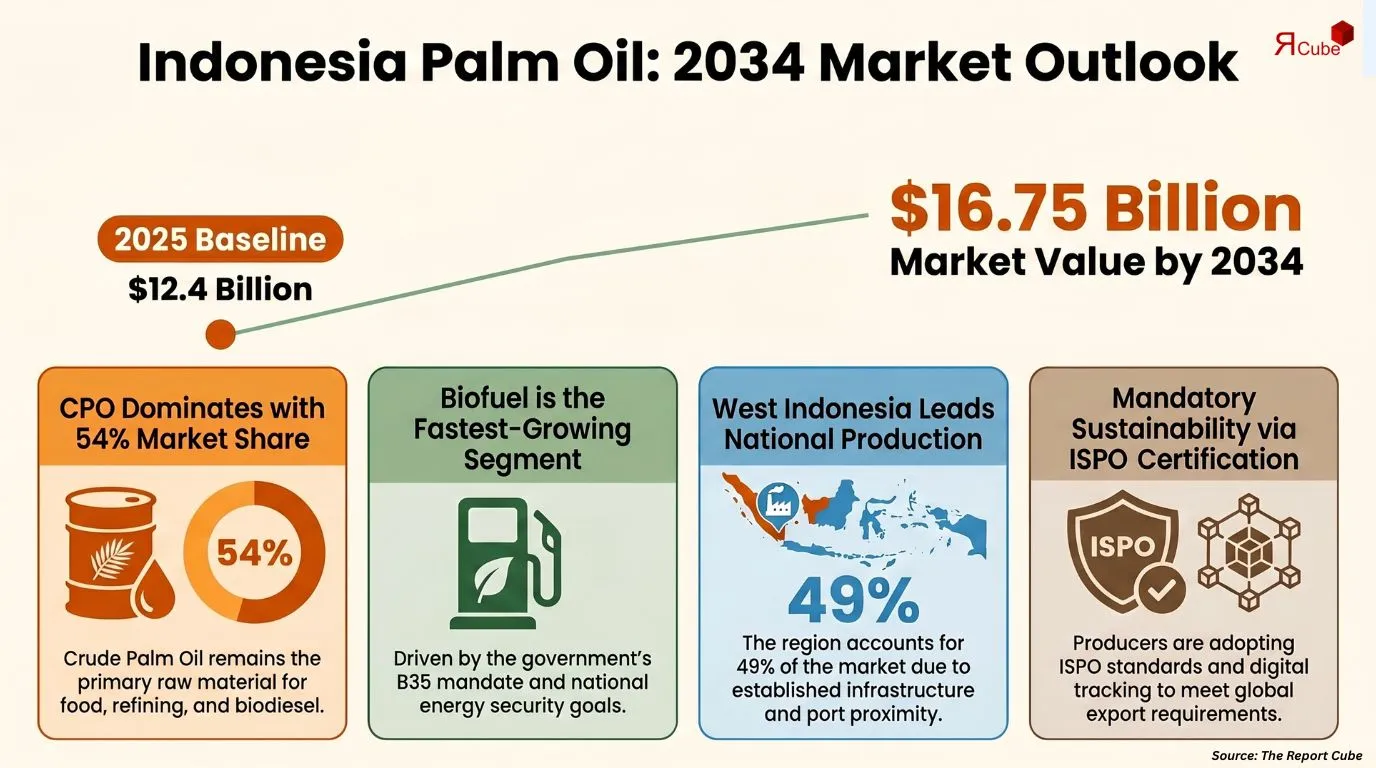
The Indonesia Palm Oil Market is anticipated to register a CAGR of 3.40% during 2026-2034. The market size was valued at USD 12.4 billion in 2025 and is projected to reach USD 16.75 billion by 2034. Indonesia remains the world’s largest producer and exporter of palm oil, making the industry a cornerstone of national economic growth, rural employment, and export revenues.
The market’s steady expansion is primarily supported by consistent global demand from food processing, personal care, and biofuel industries. Palm oil’s cost efficiency, high yield per hectare, and versatility across applications continue to reinforce its preference over alternative vegetable oils. Domestically, rising population levels and increasing consumption of packaged and processed foods are sustaining baseline demand, while exports to India, China, and the European Union remain critical revenue contributors.
Additionally, Indonesia’s palm oil sector is undergoing gradual structural improvements focused on sustainability, productivity enhancement, and traceability. Investments in replanting aging plantations, improving milling efficiency, and adopting sustainable certification standards are reshaping the industry’s long-term outlook. While regulatory pressures and environmental scrutiny persist, ongoing reforms and diversification into higher-value palm derivatives are positioning the market for stable and resilient growth through 2034.
Indonesia Palm Oil Market Recent Developments
- 2025: Wilmar International expanded its sustainable palm oil refining capacity to support traceable export supply chains.
- 2025: Golden Agri-Resources launched advanced replanting programs to improve yield and plantation productivity.
Government Initiatives & Policies
- Indonesian Sustainable Palm Oil (ISPO) Program: National certification framework promoting sustainable palm oil production.
- B35 Biodiesel Mandate: Government policy increasing palm oil usage in biofuel blending.
Indonesia Palm Oil Market Dynamics
Key Driver: Strong Global Demand from Food, Energy, and Consumer Goods Industries
Global demand remains the primary driver of Indonesia’s palm oil market growth. Palm oil is extensively used in food manufacturing due to its stability, neutral taste, and long shelf life, making it a preferred ingredient in baked goods, confectionery, and edible oils. Additionally, the expanding biofuel sector, supported by Indonesia’s biodiesel blending mandates, is significantly boosting domestic consumption. Rising demand from personal care and cosmetics manufacturers further strengthens market fundamentals. These diversified end-use industries collectively ensure stable offtake volumes, supporting consistent production levels and revenue growth across the value chain.
Book your FREE 30-minute expert consultation today
Contact UsIndustry Trends: Increasing Focus on Sustainable and Certified Palm Oil Production
Sustainability has emerged as a defining trend within the Indonesia palm oil industry. Producers are increasingly aligning operations with ISPO and international sustainability standards to address environmental concerns and maintain access to export markets. Traceability systems, satellite monitoring, and digital plantation management tools are being adopted to improve transparency and compliance. Moreover, large producers are investing in methane capture, waste-to-energy projects, and reduced deforestation practices. These initiatives not only enhance environmental performance but also improve long-term operational efficiency and brand credibility in global markets.
Major Challenge: Environmental Scrutiny and Regulatory Pressures
Environmental concerns continue to pose challenges for the Indonesia palm oil market. Issues related to deforestation, biodiversity loss, and carbon emissions have resulted in stricter regulations and trade barriers in key export markets. Compliance costs associated with sustainability certifications, land-use regulations, and monitoring requirements can strain small and mid-sized producers. Furthermore, fluctuating export policies and geopolitical trade dynamics create uncertainty for exporters. Addressing these challenges requires coordinated efforts across the industry to balance environmental responsibility with economic viability.
Opportunity: Expansion of Downstream Processing and Biofuel Applications
Downstream processing presents a significant growth opportunity for Indonesia’s palm oil industry. By expanding into refined palm oil derivatives, oleochemicals, and specialty fats, producers can capture higher margins and reduce reliance on raw commodity exports. Additionally, the government’s continued push for higher biodiesel blending ratios is expected to increase domestic palm oil absorption, stabilizing prices and reducing exposure to global market volatility. These opportunities support value addition, employment generation, and long-term industry resilience.
Indonesia Palm Oil Market Segment-wise Analysis
By Product Type:
- Crude Palm Oil (CPO)
- Palm Kernel Oil (PKO)
- Fractionated Palm Oil
- Red Palm Oil
- Oleic Palm Oil
Crude Palm Oil dominates the product type segment, accounting for approximately 54% of total market share in 2025. Its dominance is attributed to extensive use as a base raw material for refining into various palm derivatives. Strong export demand and consistent domestic consumption for food and biodiesel production continue to support CPO’s leading position, while refined and specialty products are gradually gaining traction.
By End Use:
- Food & Beverage Industry
- Personal Care & Cosmetics
- Biofuel Energy
- Pharmaceuticals
- Other Uses
The Food & Beverage Industry represents the leading end-use segment, contributing nearly 46% of total demand. Palm oil’s affordability and functional properties make it essential for processed food manufacturing. However, the biofuel energy segment is the fastest growing, driven by government blending mandates and energy security objectives, gradually reshaping overall consumption patterns.
Regional Projection of Indonesia Palm Oil Industry
- West Indonesia
- Central Indonesia
- North Indonesia
- East Indonesia
West Indonesia leads the regional market, holding approximately 49% of total production share in 2025. The region benefits from extensive plantation areas, well-established processing infrastructure, and proximity to major export ports. Continued investment in logistics, plantation modernization, and sustainability programs is expected to reinforce West Indonesia’s leadership throughout the forecast period.
Need insights for a specific region within this market?
Request Regional DataWhy Choose This Report?
- Provides a comprehensive overview of the overall market analysis, encompassing key trends, consumer behavior analysis, and risk assessment to support strategic decision-making.
- Provides accurate, up-to-date insights into market size, segmentation, and emerging opportunities, helping to minimize risk & capitalizing on growth.
- Gives deep understanding of target audience preferences, investment habits, and communication channels for enhanced product development & marketing effectiveness.
- Delivers competitive analysis & benchmarking, uncovering the strengths & weaknesses of market competitors to guide strategies.
- Consolidate comprehensive market intelligence, reducing reasoning & streamlining research efforts.
- Facilitates customized market segmentation & risk mitigation strategies, fine-tuned to the business objectives.
- Aids in identifying both market challenges & untapped opportunities within the industry to drive long-term business growth.
- Provides valuable information based on actual customer data & search trends.
Table of Contents
- Introduction
- Objective of the Study
- Product and Category Definition
- Market Segmentation
- Study Variables
- Research Methodology
- Secondary Data Points
- Breakdown of Secondary Sources
- Primary Data Points
- Breakdown of Primary Interviews
- Secondary Data Points
- Executive Summary
- Market Dynamics
- Drivers
- Challenges
- Opportunity Assessment
- Recent Trends and Developments
- Regulatory and Policy Landscape
- Indonesia Palm Oil Market Overview (2020-2034)
- Market Size, By Value (USD Billion)
- Market Share, By Product Type
- Crude Palm Oil (CPO)
- Palm Kernel Oil (PKO)
- Fractionated Palm Oil
- Red Palm Oil
- Oleic Palm Oil
- Market Share, By End Use
- Food & Beverage Industry
- Personal Care & Cosmetics
- Biofuel Energy
- Pharmaceuticals
- Other Uses
- Market Share, By Nature
- Organic
- Conventional
- Market Share, By Buyer Type
- Refiners Crushers
- Consumer Brands
- Biodiesel Blenders
- Industrial Users
- Other Buyers
- Market Share, By Sales Channel
- Contract Sales
- Spot Market
- Export Traders
- Domestic Distributors
- Market Share, By Region
- West
- Central
- North
- East
- Market Share, By Company
- Competition Characteristics
- Revenue Shares & Analysis
- West Indonesia Palm Oil Market (Sumatra)
- Market Size, By Value (USD Billion)
- Market Share, By Product Type
- Market Share, By End Use
- Market Share, By Nature
- Market Share, By Buyer Type
- Market Share, By Sales Channel
- North Indonesia Palm Oil Market (Kalimantan)
- Market Size, By Value (USD Billion)
- Market Share, By Product Type
- Market Share, By End Use
- Market Share, By Nature
- Market Share, By Buyer Type
- Market Share, By Sales Channel
- Central Indonesia Palm Oil Market (Java)
- Market Size, By Value (USD Billion)
- Market Share, By Product Type
- Market Share, By End Use
- Market Share, By Nature
- Market Share, By Buyer Type
- Market Share, By Sales Channel
- East Indonesia Palm Oil Market (Sulawesi)
- Market Size, By Value (USD Billion)
- Market Share, By Product Type
- Market Share, By End Use
- Market Share, By Nature
- Market Share, By Buyer Type
- Market Share, By Sales Channel
- Competitive Outlook and Company Profiles
- Wilmar International
- Company Overview
- Plantation Footprint
- Refining and Downstream
- Recent Developments
- Golden Agri-Resources
- Company Overview
- Plantation Footprint
- Refining and Downstream
- Recent Developments
- Musim Mas Group
- Company Overview
- Plantation Footprint
- Refining and Downstream
- Recent Developments
- Asian Agri
- Company Overview
- Plantation Footprint
- Refining and Downstream
- Recent Developments
- Astra Agro Lestari
- Company Overview
- Plantation Footprint
- Refining and Downstream
- Recent Developments
- First Resources
- Company Overview
- Plantation Footprint
- Refining and Downstream
- Recent Developments
- M.P. Evans Group
- Company Overview
- Plantation Footprint
- Refining and Downstream
- Recent Developments
- Provident Agro
- Company Overview
- Plantation Footprint
- Refining and Downstream
- Recent Developments
- PT SMART Tbk
- Company Overview
- Plantation Footprint
- Refining and Downstream
- Recent Developments
- PT Salim Ivomas
- Company Overview
- Plantation Footprint
- Refining and Downstream
- Recent Developments
- Others
- Wilmar International
- Contact Us and Disclaimer
Top Key Players & Market Share Outlook
- Wilmar International
- Golden Agri-Resources
- Musim Mas Group
- Asian Agri
- Astra Agro Lestari
- First Resources
- M.P. Evans Group
- Provident Agro
- PT SMART Tbk
- PT Salim Ivomas
- Others
Frequently Asked Questions






