



Build Your Custom Market Intelligence Report
Customize Your ReportKey Highlights
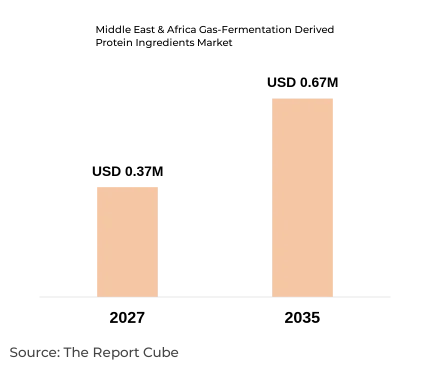
- The Middle East & Africa Gas-Fermentation Derived Protein Ingredients Market is assessed using the supplied 2027 value of USD 0.37 Million; the input forecast gives USD 0.67 Million for 2035.
- The supplied CAGR for the Middle East & Africa Gas-Fermentation Derived Protein Ingredients Market is 7.70% during 2027–2035.
- Gas fermentation uses selected microorganisms to convert gaseous carbon and energy feedstocks into microbial biomass or protein-rich ingredients.
- The supplied segmentation covers primary carbon gas and application, including food and multiple feed uses.
- Commercial demand depends on feedstock availability, fermentation yield, downstream processing, energy cost and consistent product specifications.
- Food and feed applications face different regulatory pathways, customer qualification requirements and price-performance tests.
- Input segment percentages marked with asterisks lack source, year and measurement basis and are not treated as verified shares.
Market Outlook
Gas-fermentation-derived protein ingredients are produced by cultivating microorganisms with gaseous feedstocks such as carbon dioxide, methane, carbon monoxide or synthesis gas. The resulting biomass or processed ingredient can be used in human food and animal nutrition, subject to product-specific safety, regulatory and customer requirements. The Middle East & Africa Gas-Fermentation Derived Protein Ingredients Market therefore spans fermentation technology, gas supply, bioprocess engineering and ingredient commercialization.
The market's commercial structure differs by carbon feedstock and end application. Methane-based systems can supply microbial protein for feed, while hydrogen- and carbon-dioxide-based systems are being developed for food ingredients and other nutrition uses. Process economics depend on gas composition, hydrogen and electricity costs, reactor design, yield, drying and downstream purification.
The supplied estimates place the Middle East & Africa Gas-Fermentation Derived Protein Ingredients Market at USD 0.37 Million in 2027 and USD 0.67 Million in 2035, with a stated CAGR of 7.70% over 2027–2035. These are supplied market inputs rather than independently verified market totals. Growth prospects depend on scale-up, regulatory clearance, offtake agreements and whether producers can reach competitive ingredient costs.
Competition includes specialist fermentation companies, industrial biotechnology developers and established feed and food ingredient suppliers. Companies are pursuing human-food ingredients, aquaculture feed, livestock feed and pet food, but commercial maturity varies substantially by product and production site.
Government Regulations
Gas-fermentation-derived protein ingredients are regulated according to intended use, production organism, manufacturing process and destination market. In the European Union, Regulation (EU) 2015/2283 applies to foods that meet the novel-food definition, including certain foods derived from microorganisms or new production processes; an ingredient can be marketed only after the applicable authorisation and Union List update. EFSA's scientific guidance requires detailed information on production, inputs, composition and safety. In the United States, food ingredients must have an applicable food-additive authorisation or meet a statutory exclusion such as GRAS under the intended conditions of use. FDA announced a proposed rule on 10 August 2026 to enhance oversight of GRAS uses. Animal-feed applications also require assessment under relevant feed and animal-food rules; human-food and feed permissions should not be assumed to be interchangeable.
Middle East & Africa Gas-Fermentation Derived Protein Ingredients Market Dynamics
Demand is influenced by pressure on conventional protein supply chains, the economics of gaseous feedstocks and renewable energy, industrial fermentation performance, product approvals and the ability to meet customer specifications. The relative attractiveness of each segment depends on feedstock, target market and commercial scale.
|
Factor |
Type |
Specific Impact on Market |
Magnitude |
|---|---|---|---|
|
Alternative protein sourcing |
Driver |
Creates interest in land-independent microbial protein and diversified supply |
Medium-High |
|
Aquaculture and feed ingredient demand |
Driver |
Supports evaluation of scalable protein meals with consistent composition |
Medium-High |
|
Novel-food authorisation |
Opportunity |
Can open additional food categories after product-specific safety review |
Medium-High |
|
Carbon utilisation and gas sourcing |
Opportunity |
Can link protein production to captured or industrial gas streams where quality is suitable |
Medium |
|
Energy and feedstock costs |
Challenge |
Hydrogen, electricity, methane and gas purification can dominate operating economics |
High |
|
Scale-up and customer qualification |
Challenge |
Large fermenters, downstream processing and approvals require capital and time |
High |
Growth Drivers: Demand for Diversified Protein and Industrial Fermentation
Gas fermentation offers a route to produce protein ingredients without relying on conventional agricultural land for the microbial biomass itself. Companies such as Calysta describe methane-fed fermentation for FeedKind, while Solar Foods describes a process using carbon dioxide, hydrogen and electricity for Solein. These platforms do not eliminate input requirements: gas quality, nutrients, water, energy, process control and downstream processing remain essential. The growth opportunity is strongest where producers can demonstrate consistent composition, safety, supply reliability and a competitive delivered cost.
Need Specific Data, Let’s Customize the Report for You
Request CustomizationMarket Opportunities: Food Ingredients and Qualified Feed Applications
Human food is a potential higher-value application where ingredients can meet regulatory, sensory, nutritional and formulation requirements. Solar Foods announced on 9 November 2026 that EFSA had issued a positive scientific opinion for Solein under proposed conditions of use; final European Commission authorisation remains necessary before EU marketing under the relevant conditions. Feed applications offer another route, particularly aquaculture and pet food, where producers can qualify ingredients against nutritional performance and supply contracts. Product approvals and commercial readiness remain specific to each ingredient and jurisdiction.
Industry Challenges: Feedstock Economics, Scale-up and Regulatory Qualification
The main challenge is converting technically successful fermentation into repeatable, cost-competitive industrial production. Hydrogen and electricity costs, methane sourcing, carbon-gas purity, reactor productivity, drying and separation can affect unit economics. Food ingredients also face novel-food or GRAS assessments, labelling and customer testing, while feed products must meet species-specific nutritional and safety requirements. A regulatory clearance in one country or for one use does not automatically authorise the same ingredient in another market or application.
Market Trends: Expansion Across Carbon Feedstocks and Food-Grade Applications
The market is broadening from feed-focused methane fermentation toward carbon-dioxide and hydrogen-based food ingredients, while feed producers are extending product portfolios into aquaculture, livestock and pet nutrition. Industrial scale-up is another defining trend: Solar Foods reports Factory 01 as its first large-scale facility and is engineering Factory 02 with a stated capacity ambition. The commercial impact of these projects will depend on actual commissioning, utilisation, approvals and customer offtake.
Middle East & Africa Gas-Fermentation Derived Protein Ingredients Market Segment Analysis
The Middle East & Africa Gas-Fermentation Derived Protein Ingredients Market is segmented by primary carbon gas and application. Each category reflects a different demand dimension, from the technology or input used to the route through which the ingredient or service reaches customers.
By Primary Carbon Gas
- Carbon Dioxide-Based Fermentation
- Methane-Based Fermentation
- CO and Syngas Fermentation
- Other Qualified Gas Fermentation
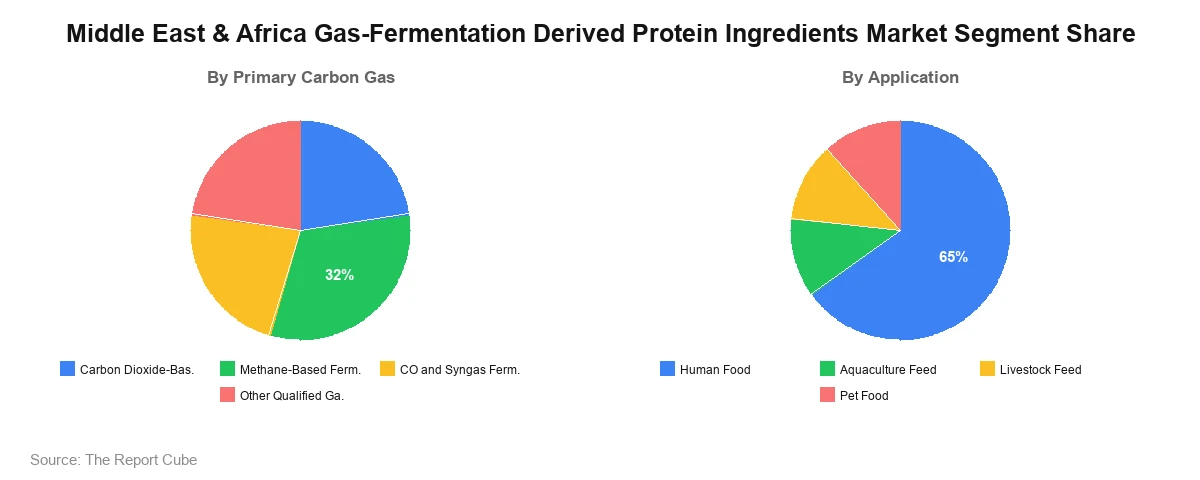
The supplied input lists Carbon Dioxide-Based Fermentation, Methane-Based Fermentation, CO and Syngas Fermentation and Other Qualified Gas Fermentation. Methane-Based Fermentation is assigned an input-only 32% figure, but no source, year or measurement basis accompanies it. The figure is not independently verifiable and is not treated as a confirmed share. Commercial selection depends on gas purity and consistency, microorganism performance, process yield, energy requirements and the cost and availability of feedstock.
By Application
- Human Food
- Aquaculture Feed
- Livestock Feed
- Pet Food
The application category covers Human Food, Aquaculture Feed, Livestock Feed and Pet Food. Human Food is assigned an input-only 65% figure without source, year or denominator, so it cannot be validated as a market share. Food applications require ingredient approval, sensory performance and formulation compatibility, while feed applications are assessed against nutritional value, digestibility, safety, price and reliable bulk supply.
Competitive Landscape
The Middle East & Africa Gas-Fermentation Derived Protein Ingredients Market includes the supplied key players listed below. The table describes broad participation and does not imply market ranking or market share. Company capabilities are based on official product or company information where available; the presence of a company in the supplied list is not, by itself, proof of a leading position in every geography.
|
Company |
Competitive Strength / Capability |
Primary Segment / Focus |
|---|---|---|
|
Solar Foods |
Solein protein platform using CO₂, hydrogen and electricity |
Human food ingredients |
|
Air Protein |
Supplied participant; specific commercial scale and product approvals require product-level verification |
Food, feed or fermentation ingredients (scope varies) |
|
Calysta |
FeedKind gas-fermentation protein portfolio |
Aquaculture, livestock and pet food |
|
Unibio |
Methane-based microbial protein technology (company-reported) |
Feed protein |
|
Deep Branch |
Supplied participant; specific commercial scale and product approvals require product-level verification |
Food, feed or fermentation ingredients (scope varies) |
|
NovoNutrients |
Supplied participant; specific commercial scale and product approvals require product-level verification |
Food, feed or fermentation ingredients (scope varies) |
|
Gas fermentation and microbial bioproduct development (company-reported) |
Animal nutrition and protein ingredients |
|
|
Arkeon |
Supplied participant; specific commercial scale and product approvals require product-level verification |
Food, feed or fermentation ingredients (scope varies) |
|
Circe Bioscience |
Supplied participant; specific commercial scale and product approvals require product-level verification |
Food, feed or fermentation ingredients (scope varies) |
|
Avecom |
Supplied participant; specific commercial scale and product approvals require product-level verification |
Food, feed or fermentation ingredients (scope varies) |
- Solar Foods: Solar Foods is a Finnish food-technology company developing Solein, a microbial protein ingredient produced using carbon dioxide, hydrogen and electricity. The company reports that Factory 01 began operation in 2024 and describes Factory 02 as a planned capacity expansion. In November 2026, Solar Foods announced a positive EFSA scientific opinion for Solein; the company stated that final EU authorisation was still pending.
- Calysta: Calysta develops FeedKind microbial protein through gas fermentation and markets products for aquaculture, livestock and pet food. The company describes its first FeedKind production plant in China, operated through its Calysseo joint venture with Adisseo, as producing thousands of tonnes annually. Product availability and application claims remain specific to its product portfolio and markets.
Recent Developments and Updates
- 9 November 2026: Solar Foods announced that EFSA had issued a positive scientific opinion for Solein under proposed conditions of use. The company said the EU authorisation process still required a subsequent European Commission implementing act and member-state process.
- 10 August 2026: The U.S. FDA proposed a rule to enhance oversight and transparency for uses of substances claimed to be Generally Recognized as Safe. The proposal is relevant to ingredient developers using the GRAS pathway; it is not a product-specific approval.
- 2026 company update: Solar Foods describes Factory 01 as its first large-scale Solein production facility and says it is engineering Factory 02, with a stated annual capacity ambition of 6,400 tonnes. This is a company plan and should not be read as commissioned capacity.
Middle East & Africa Gas-Fermentation Derived Protein Ingredients Market Future Outlook
The market's development will depend on whether producers can scale fermentation systems, secure reliable low-carbon gas and energy inputs, complete product-specific regulatory reviews and sign repeat-purchase contracts. Human food could broaden the value pool as novel ingredients clear safety and consumer acceptance hurdles. Aquaculture, livestock and pet food can provide alternative routes to market, but buyers will continue to compare microbial protein with established meals on price, digestibility, amino-acid profile and supply assurance. The market will remain uneven across feedstocks, applications and regions.
Middle East & Africa Gas-Fermentation Derived Protein Ingredients Market Report Coverage
This Middle East & Africa Gas-Fermentation Derived Protein Ingredients Market report summarizes the supplied market valuation and forecast, segmentation, geographic framework, regulatory context and competitive ecosystem for the stated study period.
|
Parameter |
Details |
|---|---|
|
Market Name |
Middle East & Africa Gas-Fermentation Derived Protein Ingredients Market |
|
2027 Market Value |
USD 0.37 Million |
|
2035 Market Value |
USD 0.67 Million |
|
CAGR |
7.70% |
|
Base Year |
2026 |
|
Historical Period |
2022-2026 |
|
Forecast Period |
2027-2034 |
|
Geographic Scope |
Middle East & Africa Gas-Fermentation Derived Protein Ingredients |
|
Key Companies |
Solar Foods, Air Protein, Calysta, Unibio, Deep Branch, NovoNutrients, String Bio, Arkeon, Circe Bioscience, Avecom |
Why Choose This Middle East & Africa Gas-Fermentation Derived Protein Ingredients Market Report?
- Sets out the supplied 2027 value, 2035 forecast and 7.70% CAGR for the Middle East & Africa Gas-Fermentation Derived Protein Ingredients Market.
- Retains both supplied segmentation categories and every listed subsegment for the Middle East & Africa Gas-Fermentation Derived Protein Ingredients Market.
- Explains the drivers, opportunities, challenges and trends shaping the Middle East & Africa Gas-Fermentation Derived Protein Ingredients Market.
- Provides geographic context for Middle East & Africa Gas-Fermentation Derived Protein Ingredients and identifies where comparable regional share data are unavailable.
- Reviews the supplied company list without inventing market rankings or revenue shares.
- Summarizes relevant regulatory and technical considerations for the Middle East & Africa Gas-Fermentation Derived Protein Ingredients Market.
- Separates supplied estimates, official-source evidence and data gaps to support more transparent decisions.
Table of Contents
- Introduction
- Objective of the Study
- Product Definition
- Market Segmentation
- Study Variables
- Research Methodology
- Secondary Data Points
- Companies Interviewed
- Primary Data Points
- Breakdown of Primary Interviews
- Secondary Data Points
- Executive Summary
- Market Dynamics
- Drivers
- Challenges
- Opportunity Assessment
- Recent Trends and Developments
- Policy and Regulatory Landscape
- Middle East & Africa Gas-Fermentation Derived Protein Ingredients Market Overview and Forecast Analysis (2022-2035)
- Market Size, By Value, By Growth Rate (CAGR/USD Millions)
- Demand – Supply Trends
- Market Share, By Primary Carbon Gas
- Carbon Dioxide-Based Fermentation
- Methane-Based Fermentation (Natural gas, renewable methane, biogas methane)
- CO and Syngas Fermentation
- Other Qualified Gas Fermentation
- Market Share, By Ingredient Format
- Whole-Cell Microbial Protein
- Extracted or Concentrated Protein
- Hydrolysed Protein and Peptides (Protein hydrolysates, peptides)
- Market Share, By Physical Form
- Dry Ingredients (Powders, granules)
- Wet Ingredients (Wet biomass paste, liquid suspension)
- Market Share, By Application
- Human Food (Meat and dairy alternatives, bakery and snacks, beverages and other foods)
- Aquaculture Feed (Fish feed, shrimp feed)
- Livestock Feed (Poultry, swine, ruminants)
- Pet Food (Dry pet food, wet pet food)
- Market Share, By Certified Grade
- Human-Food Grade
- Feed Grade
- Market Share, By Competitors
- Competition Characteristics
- Revenue Shares
- Carbon Dioxide-Based Fermentation Middle East & Africa Gas-Fermentation Derived Protein Ingredients Market Overview, 2022-2035F
- By Value (USD Million)
- By Ingredient Format – Market Size & Forecast 2022-2035, USD Million
- Whole-Cell Microbial Protein
- Extracted or Concentrated Protein
- Hydrolysed Protein and Peptides (Protein hydrolysates, peptides)
- Methane-Based Fermentation Middle East & Africa Gas-Fermentation Derived Protein Ingredients Market Overview, 2022-2035F
- By Value (USD Million)
- By Ingredient Format – Market Size & Forecast 2022-2035, USD Million
- Whole-Cell Microbial Protein
- Extracted or Concentrated Protein
- Hydrolysed Protein and Peptides (Protein hydrolysates, peptides)
- CO and Syngas Fermentation Middle East & Africa Gas-Fermentation Derived Protein Ingredients Market Overview, 2022-2035F
- By Value (USD Million)
- By Ingredient Format – Market Size & Forecast 2022-2035, USD Million
- Whole-Cell Microbial Protein
- Extracted or Concentrated Protein
- Hydrolysed Protein and Peptides (Protein hydrolysates, peptides)
- Other Qualified Gas Fermentation Middle East & Africa Gas-Fermentation Derived Protein Ingredients Market Overview, 2022-2035F
- By Value (USD Million)
- By Ingredient Format – Market Size & Forecast 2022-2035, USD Million
- Whole-Cell Microbial Protein
- Extracted or Concentrated Protein
- Hydrolysed Protein and Peptides (Protein hydrolysates, peptides)
- Competitive Outlook (Company Profile – Partial List)
- Solar Foods
- Company Overview
- Business Segments
- Strategic Alliances/Partnerships
- Recent Developments
- Air Protein
- Company Overview
- Business Segments
- Strategic Alliances/Partnerships
- Recent Developments
- Calysta
- Company Overview
- Business Segments
- Strategic Alliances/Partnerships
- Recent Developments
- Unibio
- Company Overview
- Business Segments
- Strategic Alliances/Partnerships
- Recent Developments
- Deep Branch
- Company Overview
- Business Segments
- Strategic Alliances/Partnerships
- Recent Developments
- NovoNutrients
- Company Overview
- Business Segments
- Strategic Alliances/Partnerships
- Recent Developments
- String Bio
- Company Overview
- Business Segments
- Strategic Alliances/Partnerships
- Recent Developments
- Arkeon
- Company Overview
- Business Segments
- Strategic Alliances/Partnerships
- Recent Developments
- Circe Bioscience
- Company Overview
- Business Segments
- Strategic Alliances/Partnerships
- Recent Developments
- Avecom
- Company Overview
- Business Segments
- Strategic Alliances/Partnerships
- Recent Developments
- Solar Foods
- Contact Us & Disclaimer
Top Key Players & Market Share Outlook
- Solar Foods
- Air Protein
- Calysta
- Unibio
- Deep Branch
- NovoNutrients
- String Bio
- Arkeon
- Circe Bioscience
- Avecom
Frequently Asked Questions