



Build Your Custom Market Intelligence Report
Customize Your ReportGlobal Molybdenum (Mo) Market Insights & Analysis
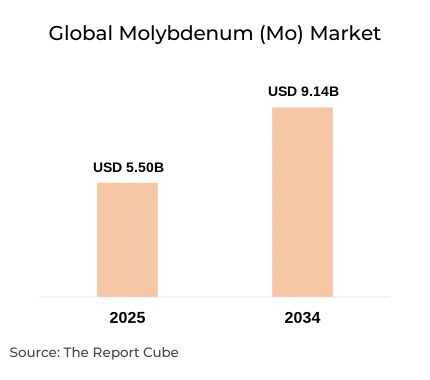
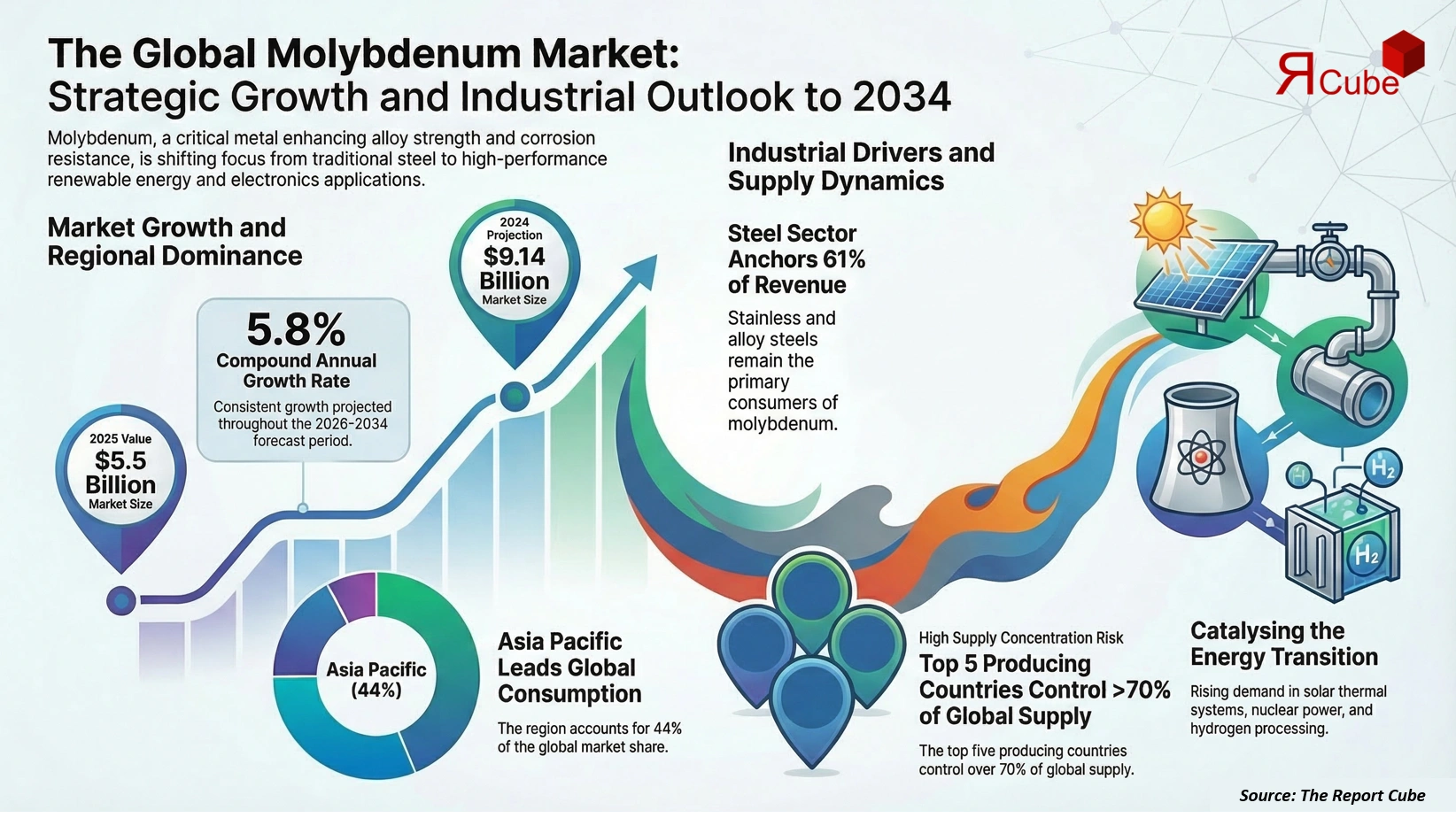
The Global Molybdenum (Mo) Market is anticipated to register a CAGR of 5.80% during 2026-2034. The market size was valued at USD 5.5 Billion in 2025 and is projected to reach USD 9.14 Billion by 2034. This growth reflects the strategic importance of molybdenum as a critical alloying metal used to enhance strength, corrosion resistance, and heat tolerance in industrial materials. Increasing demand from steel manufacturing, energy infrastructure, and high-performance engineering applications continues to position molybdenum as an essential industrial commodity.
Beyond its traditional role in steel strengthening, molybdenum is gaining broader relevance across petrochemical processing, electronics manufacturing, and high-temperature component production. Demand is closely tied to global industrial output, infrastructure investment, and energy sector expansion. In 2024, over 79% of molybdenum consumption was linked to steel-related applications, underlining its dependency on construction, automotive, and heavy machinery sectors. Meanwhile, rising investment in refining capacity and advanced materials is creating incremental demand for molybdenum chemicals, catalysts, and specialty alloys, reinforcing long-term market stability.
Global Molybdenum (Mo) Market Recent Developments
- 2025: China Molybdenum expanded downstream processing capacity to support alloy steel manufacturers.
- 2025: Freeport-McMoRan optimized molybdenum recovery at copper mining operations in South America.
Government Initiatives & Policies
- U.S. Critical Minerals Strategy: Supports domestic supply security for molybdenum and strategic metals.
- EU Raw Materials Initiative: Promotes sustainable sourcing and recycling of industrial metals.
Global Molybdenum (Mo) Market Dynamics
Key Driver: Expanding Demand for High-Performance Steel and Alloys
The primary driver of the molybdenum market is rising demand for high-performance steel and alloy products across construction, automotive, and energy sectors. Molybdenum improves steel strength, weldability, and resistance to corrosion and extreme temperatures, making it essential for pipelines, pressure vessels, and structural components. In 2025, global stainless and alloy steel production grew by nearly 6%, directly supporting molybdenum consumption. Infrastructure upgrades, renewable energy installations, and oil and gas investments continue to sustain steady demand for molybdenum-enhanced materials.
Major Challenge: Price Volatility and Supply Concentration
Price volatility remains a notable challenge for the molybdenum market due to its by-product nature, as most production is linked to copper mining. Fluctuations in copper output directly influence molybdenum supply availability. Additionally, production is geographically concentrated, with a limited number of countries accounting for a large share of global output. In 2024, the top five producing countries contributed over 70% of global supply. This concentration can expose end users to supply disruptions and pricing uncertainty, impacting procurement strategies.
Industry Trends: Rising Use in Catalysts and Specialty Chemicals
An emerging industry trend is the increasing use of molybdenum in catalysts and specialty chemical applications. Molybdenum-based catalysts are widely used in petroleum refining, desulfurization, and petrochemical processes. As global fuel quality standards tighten, refiners are investing in advanced catalyst systems to reduce sulfur emissions. In 2025, catalyst-related applications accounted for approximately 12% of total molybdenum demand. This trend is helping diversify market reliance beyond traditional steel applications.
Opportunity Ahead: Growth in Energy Transition and Advanced Manufacturing
The global energy transition presents new opportunities for molybdenum consumption in renewable energy systems, nuclear power components, and high-temperature industrial equipment. Molybdenum alloys are increasingly used in solar thermal systems, hydrogen processing equipment, and advanced electronics. As clean energy investments rise, demand for durable, high-performance materials is expected to grow. Advanced manufacturing techniques and increasing focus on material efficiency further support long-term opportunities for molybdenum producers.
Global Molybdenum (Mo) Market Segment-wise Analysis
By Product Type:
- Steel Products (Stainless Steel, Alloy Steel, Carbon Steel)
- Chemical or Petrochemical Products
- Foundry Products
- Mo Metal or Alloys
- Nickel-based Alloys
- Other Molybdenum Products
Steel products represent the dominant product type, accounting for approximately 61% of total market revenue in 2025. Stainless and alloy steels benefit most from molybdenum additions due to enhanced corrosion resistance and mechanical strength. Demand remains strong across construction, transportation, and energy infrastructure projects. While chemical and metal alloy segments are growing steadily, steel-related products continue to anchor overall market demand.
By Application:
- Alloying Agent in Steel
- Catalysts (Refining or Petrochemicals)
- Pigments or Lubricants
- Electronics or High-temperature Components
- Other Industrial Applications
The alloying agent in steel application dominates the market with nearly 66% share in 2025. Molybdenum’s role in enhancing steel durability and performance under harsh conditions makes it indispensable for industrial applications. Catalyst applications follow, supported by refining capacity expansion and stricter fuel standards. Electronics and high-temperature components, though smaller in volume, offer higher value-added growth potential.
Regional Projection of Global Molybdenum (Mo) Industry
- North America
- Europe
- Asia Pacific
- Middle East or Africa
- South America
Asia Pacific leads the molybdenum market, accounting for approximately 44% of global consumption in 2025. Strong steel production, infrastructure development, and manufacturing growth in China, Japan, and India support regional dominance. North America follows, driven by energy infrastructure investments and advanced manufacturing demand. Europe maintains steady consumption supported by automotive and industrial sectors, while South America plays a critical role on the supply side due to significant mining operations.
Why Choose This Report?
- Provides a comprehensive overview of the overall market analysis, encompassing key trends, consumer behavior analysis, and risk assessment to support strategic decision-making.
- Provides accurate, up-to-date insights into market size, segmentation, and emerging opportunities, helping to minimize risk & capitalizing on growth.
- Gives deep understanding of target audience preferences, investment habits, and communication channels for enhanced product development & marketing effectiveness.
- Delivers competitive analysis & benchmarking, uncovering the strengths & weaknesses of market competitors to guide strategies.
- Consolidate comprehensive market intelligence, reducing reasoning & streamlining research efforts.
- Facilitates customized market segmentation & risk mitigation strategies, fine-tuned to the business objectives.
- Aids in identifying both market challenges & untapped opportunities within the industry to drive long-term business growth.
- Provides valuable information based on actual customer data & search trends.
Table of Contents
- Introduction
- Objective of the Study
- Product or Category Definition
- Market Segmentation
- Study Variables
- Research Methodology
- Secondary Data Points
- Breakdown of Secondary Sources
- Primary Data Points
- Breakdown of Primary Interviews
- Secondary Data Points
- Executive Summary
- Market Dynamics
- Drivers
- Challenges
- Opportunity Assessment
- Recent Trends or Developments
- Regulatory or Policy Landscape
- Global Molybdenum (Mo) Market Overview (2020-2034)
- Market Size, By Value (USD Billion)
- Market Share, By Product Type
- Steel Products
- Stainless Steel
- Alloy Steel
- Carbon Steel
- Chemical or Petrochemical Products
- Foundry Products
- Mo Metal or Alloys
- Nickel-based Alloys
- Other Molybdenum Products
- Steel Products
- Market Share, By Application
- Alloying Agent in Steel
- Catalysts (Refining or Petrochemicals)
- Pigments or Lubricants
- Electronics or High-temperature Components
- Other Industrial Applications
- Market Share, By End-user Industry
- Oil or Gas
- Chemical or Petrochemical
- Automotive
- Industrial Machinery
- Building or Construction
- Aerospace or Defense
- Energy or Power Generation
- Other Industries
- Market Share, By Source
- Primary Production (Molybdenum Mines)
- By-product from Copper or Other Ores
- Recycling
- Market Share, By Region
- North America
- Europe
- Asia Pacific
- Middle East or Africa
- South America
- Market Share, By Company
- Revenue Shares
- Competitive Landscape
- North America Molybdenum (Mo) Market
- Market Size, By Value (USD Billion)
- Market Share, By Product Type
- Market Share, By Application
- Market Share, By End-user Industry
- Market Share, By Source
- Market Share, By Region/Country Group
- Market Share, By Country
- United States
- Canada
- Mexico
- Europe Molybdenum (Mo) Market
- Market Size, By Value (USD Billion)
- Market Share, By Product Type
- Market Share, By Application
- Market Share, By End-user Industry
- Market Share, By Source
- Market Share, By Region/Country Group
- Market Share, By Country
- Germany
- France
- United Kingdom
- Italy
- Spain
- Northern or Nordic Countries
- Rest of Europe
- Asia Pacific Molybdenum (Mo) Market
- Market Size, By Value (USD Billion)
- Market Share, By Product Type
- Market Share, By Application
- Market Share, By End-user Industry
- Market Share, By Source
- Market Share, By Region/Country Group
- Market Share, By Country
- China
- Japan
- India
- South Korea
- Australia
- Rest of Asia Pacific
- Middle East or Africa Molybdenum (Mo) Market
- Market Size, By Value (USD Billion)
- Market Share, By Product Type
- Market Share, By Application
- Market Share, By End-user Industry
- Market Share, By Source
- Market Share, By Region/Country Group
- Market Share, By Country
- Saudi Arabia
- United Arab Emirates
- South Africa
- Rest of Middle East or Africa
- South America Molybdenum (Mo) Market
- Market Size, By Value (USD Billion)
- Market Share, By Product Type
- Market Share, By Application
- Market Share, By End-user Industry
- Market Share, By Source
- Market Share, By Region/Country Group
- Market Share, By Country
- Brazil
- Argentina
- Chile
- Rest of South America
- Competitive Outlook or Company Profiles
- Freeport-McMoRan
- Company Overview
- Product Portfolio
- Strategic Alliances/Partnerships
- Recent Developments
- Codelco
- Company Overview
- Product Portfolio
- Strategic Alliances/Partnerships
- Recent Developments
- China Molybdenum
- Company Overview
- Product Portfolio
- Strategic Alliances/Partnerships
- Recent Developments
- Anglo American
- Company Overview
- Product Portfolio
- Strategic Alliances/Partnerships
- Recent Developments
- Grupo México
- Company Overview
- Product Portfolio
- Strategic Alliances/Partnerships
- Recent Developments
- Jinduicheng Molybdenum Group
- Company Overview
- Product Portfolio
- Strategic Alliances/Partnerships
- Recent Developments
- Teck Resources
- Company Overview
- Product Portfolio
- Strategic Alliances/Partnerships
- Recent Developments
- Antofagasta
- Company Overview
- Product Portfolio
- Strategic Alliances/Partnerships
- Recent Developments
- Rio Tinto
- Company Overview
- Product Portfolio
- Strategic Alliances/Partnerships
- Recent Developments
- KGHM
- Company Overview
- Product Portfolio
- Strategic Alliances/Partnerships
- Recent Developments
- Freeport-McMoRan
- Contact Us or Disclaimer
Top Key Players & Market Share Outlook
- Freeport-McMoRan
- Codelco
- China Molybdenum
- Anglo American
- Grupo México
- Jinduicheng Molybdenum Group
- Teck Resources
- Antofagasta
- Rio Tinto
- KGHM
- Contact Us or Disclaimer
Frequently Asked Questions






