



Build Your Custom Market Intelligence Report
Customize Your ReportAfrica Mosquito Repellent Market Key Highlights
By Product Type:
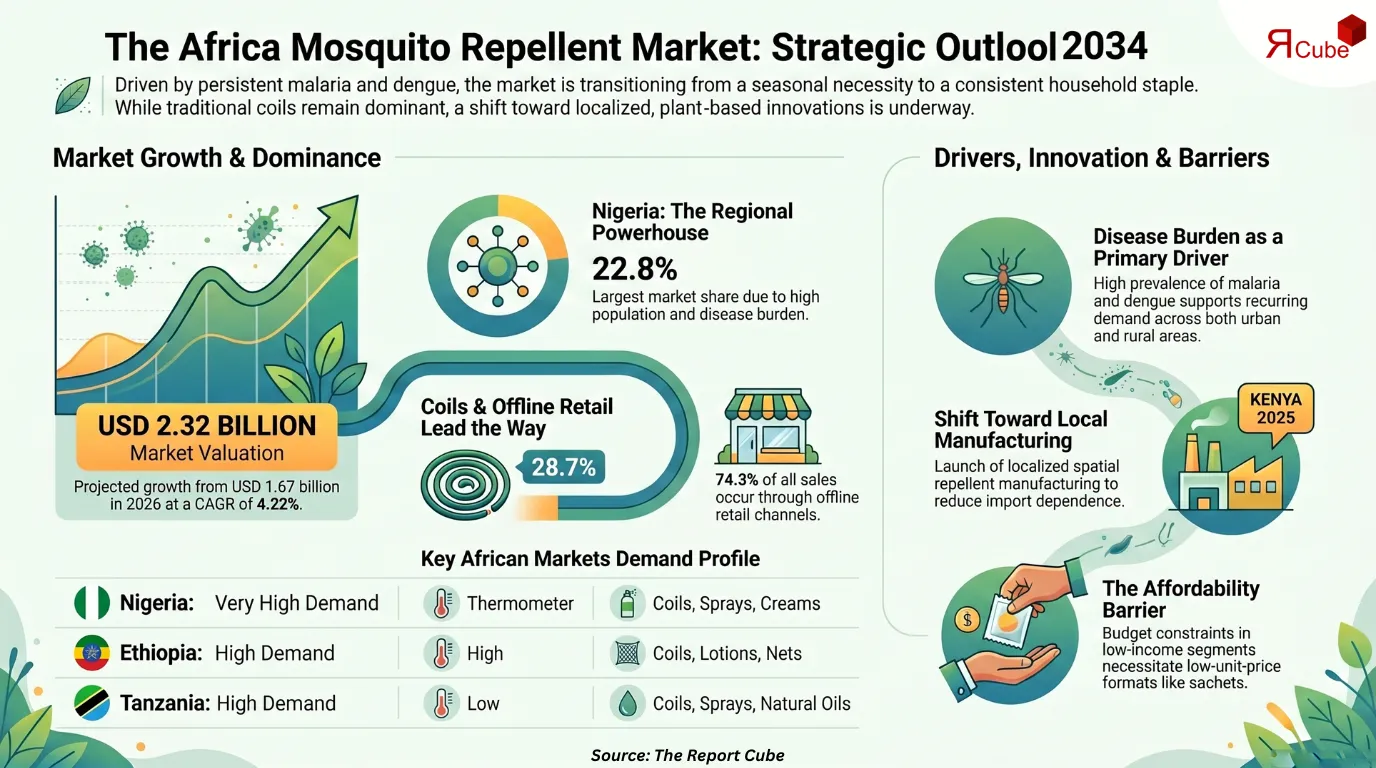
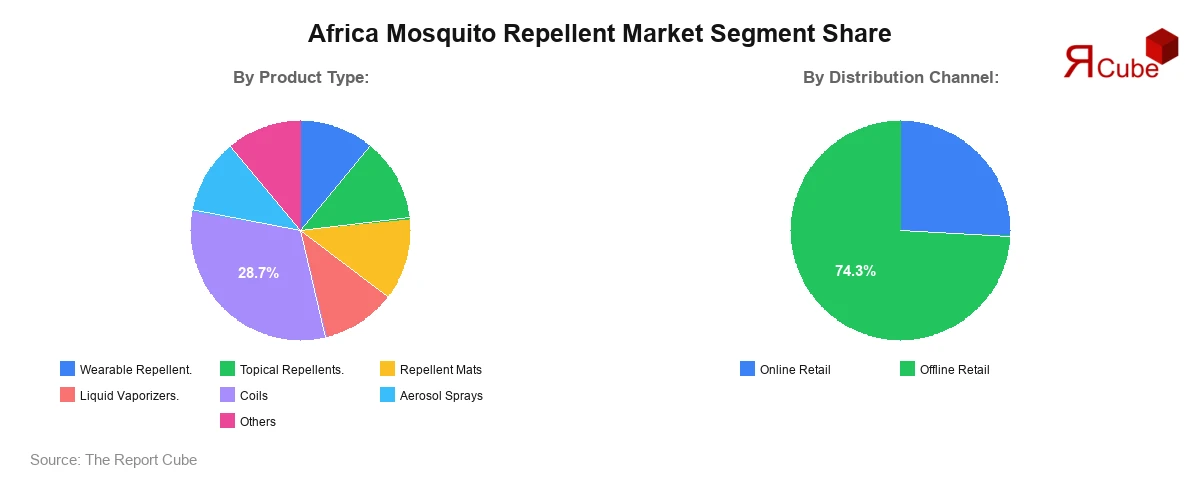
Coils segment leads the market with nearly 28.7% share.
By Distribution Channel:
Offline Retail segment dominates the market with around 74.3% of revenue.
Regional Outlook:
Nigeria dominates the Africa Mosquito Repellent market with approximately 22.8% share.
Africa Mosquito Repellent Market Insights & Analysis
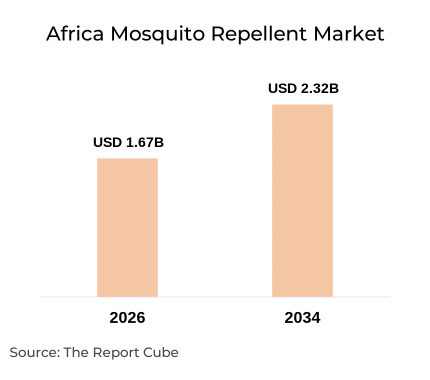
The Africa Mosquito Repellent Market is anticipated to register a CAGR of around 4.22% during the forecast period 2026-2034. The market size is valued at USD 1.67 billion in 2026 and is projected to reach USD 2.32 billion by 2034. The market continues to benefit from the persistent prevalence of mosquito-borne illnesses across the continent, particularly malaria, which remains a major public health concern in many African countries. Health ministries, international aid organizations, and regional disease-control agencies are strengthening prevention programs, resulting in greater adoption of mosquito repellent products in both urban and rural communities. Rising awareness regarding personal protection measures has also contributed to increased spending on coils, sprays, vaporizers, and topical repellents among households.
Investment activity across the Mosquito Repellent Market in Africa is increasingly focused on localized manufacturing, innovative formulations, and expanded product accessibility. Companies are introducing plant-based repellents, spatial protection technologies, and longer-lasting solutions designed for tropical environments. Partnerships between public health institutions and private manufacturers are supporting the development of region-specific products that address local disease-prevention requirements. In addition, improvements in retail distribution infrastructure and healthcare outreach programs are helping manufacturers penetrate underserved regions, creating sustainable growth opportunities throughout the forecast period.
Africa Mosquito Repellent Market Impact Analysis
| Factor | Type | Specific Impact on Market | Magnitude | Business Implication |
|---|---|---|---|---|
| High Burden of Vector Diseases | Market | Malaria and dengue prevalence drives continuous repellent usage | High | Supports recurring demand across households and rural areas |
| Rising Health Awareness and Education | Consumer | Public campaigns increase adoption of preventive repellent products | Medium | Enables growth for branded solutions in informed communities |
| Preference for Natural and Herbal Formulations | Consumer | Shift from harsh chemicals to plant based repellent ingredients | Medium | Creates opportunity for premium safe and gentle product lines |
| Expansion of Modern Retail and E Commerce | Market | Wider product availability through supermarkets and online channels | Medium | Improves reach for organized brands beyond major urban centres |
| Price Sensitivity in Low Income Segments | Consumer | Budget constraints limit uptake of higher priced repellent formats | High | Necessitates low unit price sachets and value focused offerings |
| Regulatory Focus on Product Safety | Regulatory | Stricter norms on toxicity and labeling for topical repellents | Medium | Favours compliant manufacturers with robust quality systems |
| Climate Change and Longer Mosquito Seasons | Environmental | Warmer conditions extend breeding cycles and infestation periods | High | Lengthens peak sales season and supports higher annual volumes |
Africa Mosquito Repellent Market Dynamics
Key Driver: Rising Burden of Mosquito-Borne Diseases Across Africa
A significant factor supporting growth in the Africa Mosquito Repellent Market is the continued effort to reduce malaria transmission across high-risk regions. Countries including Nigeria, Tanzania, Ethiopia, and Kenya collectively account for a substantial share of global malaria cases, creating ongoing demand for effective mosquito-control solutions. Repellents are increasingly viewed as a practical layer of protection that complements insecticide-treated bed nets and other preventive interventions. As a result, household expenditure on mosquito prevention products has shown steady growth across several African economies.
Government agencies and healthcare organizations continue to conduct educational initiatives highlighting the importance of personal protection against mosquito bites. These awareness campaigns have improved product acceptance among consumers and encouraged more frequent usage of repellents throughout the year rather than only during seasonal outbreaks. The growing recognition of preventive healthcare measures is expected to remain a fundamental driver of market expansion over the coming decade.
Industry Trends: Growing Adoption of Plant-Based and Spatial Repellent Technologies
Product innovation is becoming a defining characteristic of the Mosquito Repellent Market in Africa. Manufacturers are responding to evolving consumer preferences by developing formulations that provide extended protection while minimizing skin irritation and environmental impact. Plant-based ingredients such as citronella, eucalyptus, neem, and lemongrass are gaining traction among consumers seeking naturally derived alternatives. This trend is particularly notable among families with young children and individuals who use repellents regularly.
Another important development involves the growing adoption of spatial repellents and passive protection technologies. Unlike traditional products that require direct application, spatial repellents create a protective zone within homes and communal areas. Their ability to provide continuous protection over extended periods is attracting attention from both consumers and public-health stakeholders. As innovation continues, manufacturers are expected to diversify product offerings to meet varying household needs across different African markets.
Book your FREE 30-minute expert consultation today
Contact UsMajor Challenge: Affordability Constraints in Low-Income Communities
Although awareness of mosquito prevention is improving, affordability remains a challenge for the Africa Mosquito Repellent Market. Many consumers in low-income communities prioritize essential household expenditures, limiting the frequency of mosquito repellent purchases. Premium products featuring advanced technologies often remain beyond the reach of a large segment of the population, particularly in rural and remote areas.
Distribution limitations present an additional obstacle. Transportation infrastructure constraints and fragmented retail networks can restrict product availability in underserved regions. These challenges may result in inconsistent supply and higher retail prices, affecting overall market penetration. Manufacturers that successfully balance affordability with product effectiveness are expected to gain a competitive advantage in the coming years.
Opportunity: Expansion of Local Manufacturing and Public Health Partnerships
The establishment of local manufacturing facilities represents a major opportunity for the Mosquito Repellent Market in Africa. Domestic production can significantly reduce dependence on imported products while improving supply chain efficiency and product availability. Governments across the continent are increasingly encouraging investments in healthcare-related manufacturing to strengthen regional resilience and support economic development.
The 2025 launch of the KEMRI and SC Johnson spatial repellent manufacturing facility in Kenya illustrates the growing importance of localized production. Such initiatives enable manufacturers to tailor products to regional conditions while reducing logistics costs and lead times. As more countries prioritize domestic production capabilities, opportunities are expected to emerge for both multinational corporations and regional manufacturers operating within the mosquito repellent value chain.
Africa Mosquito Repellent Market Segment-wise Analysis
By Product Type:
- Wearable Repellents
- Topical Repellents
- Repellent Mats
- Liquid Vaporizers
- Coils
- Aerosol Sprays
- Others
Coils remain the leading product category within the Africa Mosquito Repellent Market, accounting for an estimated 28.7% of total revenue. Their popularity is largely linked to affordability, ease of use, and widespread availability across urban and rural retail channels. In many communities where electricity access remains inconsistent, coils continue to serve as a practical and accessible mosquito-control solution. Their low unit cost enables frequent usage, particularly among households seeking cost-effective protection against mosquito bites.
Manufacturers have introduced improved formulations designed to extend burn duration and enhance protection coverage while reducing smoke-related concerns. Continued demand from malaria-endemic regions supports stable sales volumes, making coils one of the most resilient product categories in the market. While advanced repellents are gaining traction, coils are expected to retain a significant share due to their strong consumer familiarity and affordability.
By Distribution Channel:
- Online Retail
- Offline Retail
Offline retail continues to account for the largest share of revenue in the Mosquito Repellent Market in Africa, representing approximately 74.3% of market sales. Consumers frequently purchase mosquito repellents from pharmacies, supermarkets, neighborhood stores, and local distribution outlets because these channels provide immediate access to products. Traditional retail networks remain particularly important in rural regions where internet penetration and e-commerce adoption are comparatively lower.
Established retail relationships also enable manufacturers to maintain strong visibility and product availability across diverse geographic markets. Although online sales are gradually increasing in major cities, offline channels continue to dominate due to widespread accessibility and consumer purchasing habits. Expansion of retail infrastructure throughout emerging African economies is expected to further reinforce the importance of brick-and-mortar distribution channels during the forecast period.
Regional Projection of Africa Mosquito Repellent Industry
- Algeria
- Ethiopia
- Tanzania
- Egypt
- South Africa
- Morocco
- Nigeria
Nigeria represents the largest country-level market within the Africa Mosquito Repellent Market, holding an estimated share of 22.8% in 2026. The country's large population base, favorable climatic conditions for mosquito breeding, and high incidence of malaria collectively contribute to substantial demand for mosquito prevention products. Continuous public-health campaigns have increased awareness regarding personal protection, encouraging broader adoption of repellents across residential settings.
The expansion of retail networks, improving healthcare access, and rising consumer spending on preventive health products are supporting further market development. Leading manufacturers continue to strengthen their presence through expanded distribution partnerships and product launches tailored to local affordability requirements. Given its demographic scale and ongoing disease-control efforts, Nigeria is expected to remain a critical revenue contributor to the Mosquito Repellent Market in Africa throughout the forecast horizon.
Need insights for a specific region within this market?
Request Regional DataAfrica Mosquito Repellent Market - Countries Analysis
The Africa mosquito repellent market is growing on the back of high mosquito-borne disease burden, rising awareness, and gradual shift toward safer, natural formulations.
| Country | Demand Level | Key Areas | System Dominance | Core Demand Logic | Growth Nature |
|---|---|---|---|---|---|
| Nigeria | Very High | Lagos, Abuja, Kano belt | Coils, sprays, creams | Severe malaria burden, dense cities | Mass-market, fastest expansion |
| Ethiopia | High | Addis Ababa, Oromia zones | Coils, lotions, treated nets | Endemic malaria, rural outreach | Program-led, steady growth |
| Tanzania | High | Dar es Salaam, lake regions | Coils, sprays, natural oils | Tourism plus high disease risk | Awareness-led, consistent rise |
| Egypt | Medium | Cairo, Nile delta corridor | Aerosol sprays, vaporizers | Urban comfort, dengue scares | Retail-driven, brand upgrading |
| South Africa | Medium | Gauteng, coastal tourist zones | Sprays, lotions, plug-ins | Seasonal risk, outdoor lifestyle | Premiumization, natural shift |
| Morocco | Low to Medium | Casablanca, Rabat, north coast | Sprays, household aerosols | Localized outbreaks, comfort use | Slow, tourism-linked growth |
| Algeria | Low to Medium | Algiers, coastal humid strip | Sprays, coils, basic creams | Localized coastal mosquito peaks | Gradual, awareness dependent |
Government Initiatives & Policies
- Kenya Malaria Strategy 2023-2027: Kenya continues implementing large-scale vector-control programs, including insecticide-treated nets, indoor residual spraying, and innovative mosquito-control technologies to reduce malaria transmission and strengthen community protection.
- African Union Big Push Against Malaria 2025: The African Union's 2025 malaria progress framework promotes domestic manufacturing of vector-control products, expanded access to innovative repellents, and stronger regional health resilience initiatives.
Africa Mosquito Repellent Industry Recent Developments
- 2025: SC Johnson & Kenya Medical Research Institute (KEMRI) launched a spatial repellent manufacturing plant in Kenya dedicated to producing Guardian™ spatial repellents for residential and semi-enclosed environments. The facility strengthens local manufacturing capabilities, improves regional product accessibility, reduces import dependence, and supports malaria prevention initiatives across East Africa through advanced mosquito-control technologies.
Why Choose This Report?
- Provides a comprehensive overview of the overall market analysis, encompassing key trends, consumer behavior analysis, and risk assessment to support strategic decision-making.
- Provides accurate, up-to-date insights into market size, segmentation, and emerging opportunities, helping to minimize risk & capitalizing on growth.
- Gives deep understanding of target audience preferences, investment habits, and communication channels for enhanced product development & marketing effectiveness.
- Delivers competitive analysis & benchmarking, uncovering the strengths & weaknesses of market competitors to guide strategies.
- Consolidate comprehensive market intelligence, reducing reasoning & streamlining research efforts.
- Facilitates customized market segmentation & risk mitigation strategies, fine-tuned to the business objectives.
- Aids in identifying both market challenges & untapped opportunities within the industry to drive long-term business growth.
- Provides valuable information based on actual customer data & search trends.
Table of Contents
- Introduction
- Objective of the Study
- Product and Category Definition
- Market Segmentation
- Study Variables
- Research Methodology
- Secondary Data Points
- Breakdown of Secondary Sources
- Primary Data Points
- Breakdown of Primary Interviews
- Secondary Data Points
- Executive Summary
- Market Dynamics
- Emerging Opportunities
- Adoption Trends
- Demand Drivers
- Disruption Analysis (Challenges)
- Industry Analysis and Strategic Insights
- Supply and Value Chain Analysis
- Pricing Analysis
- Go-To-Market Strategy
- BCG Matrix
- Recent Trends and Developments
- Import and Export Analysis
- Regulatory and Policy Landscape
- Region-wise Policies
- Government Initiatives
- Ethiopia Two-Wheeler Tire Market Overview and Forecast Analysis (2021-2034)
- Market Size, By Value, By Growth Rate (CAGR/USD Million)
- Market Share, By Vehicle Type
- Motorcycle
- Scooter and Moped
- Market Share, By Propulsion
- Electric
- ICE
- Market Share, By Demand Type
- Replacement
- OEM
- Market Share, By Sales Channel
- Online
- Multi-Brand Stores
- Direct Sales
- Exclusive Outlets
- Market Share, By Tire Type
- Bias
- Radial
- Market Share, By Tire Size
- Tire Size 1
- Tire Size 2
- Tire Size 3
- Tire Size 4
- Tire Size 5
- Market Share, By Price Category
- Premium
- Budget
- Economy
- Market Share, By Region
- North
- Central
- West
- South and Southwest
- Market Share, By Company
- Revenue Shares and Analysis
- Competitive Landscape
- North Region Ethiopia Two-Wheeler Tire Market Overview and Forecast Analysis (2021-2034)
- Market Size, By Value, By Growth Rate (CAGR/USD Million)
- Market Share, By Vehicle Type
- Market Share, By Propulsion
- Market Share, By Demand Type
- Market Share, By Sales Channel
- Market Share, By Tire Type
- Market Share, By Tire Size
- Market Share, By Price Category
- Central Region Ethiopia Two-Wheeler Tire Market Overview and Forecast Analysis (2021-2034)
- Market Size, By Value, By Growth Rate (CAGR/USD Million)
- Market Share, By Vehicle Type
- Market Share, By Propulsion
- Market Share, By Demand Type
- Market Share, By Sales Channel
- Market Share, By Tire Type
- Market Share, By Tire Size
- Market Share, By Price Category
- West Region Ethiopia Two-Wheeler Tire Market Overview and Forecast Analysis (2021-2034)
- Market Size, By Value, By Growth Rate (CAGR/USD Million)
- Market Share, By Vehicle Type
- Market Share, By Propulsion
- Market Share, By Demand Type
- Market Share, By Sales Channel
- Market Share, By Tire Type
- Market Share, By Tire Size
- Market Share, By Price Category
- South and Southwest Region Ethiopia Two-Wheeler Tire Market Overview and Forecast Analysis (2021-2034)
- Market Size, By Value, By Growth Rate (CAGR/USD Million)
- Market Share, By Vehicle Type
- Market Share, By Propulsion
- Market Share, By Demand Type
- Market Share, By Sales Channel
- Market Share, By Tire Type
- Market Share, By Tire Size
- Market Share, By Price Category
- Competitive Analysis, 2026
- Market Share of Key Players
- Competitive Mapping for Each Segment and Companies Operating Regionally
- North Region Ethiopia Two-Wheeler Tire Companies Share and Competitive Analysis, 2026
- Central Region Ethiopia Two-Wheeler Tire Companies Share and Competitive Analysis, 2026
- West Region Ethiopia Two-Wheeler Tire Companies Share and Competitive Analysis, 2026
- South and Southwest Region Ethiopia Two-Wheeler Tire Companies Share and Competitive Analysis, 2026
- Company Profile (Partial List)
- Apollo Tyres Ltd.
- Company Overview
- Product Portfolio
- Strategic Alliances and Partnerships
- Recent Developments
- Michelin
- Company Overview
- Product Portfolio
- Strategic Alliances and Partnerships
- Recent Developments
- Goodyear Tire and Rubber Company
- Company Overview
- Product Portfolio
- Strategic Alliances and Partnerships
- Recent Developments
- MRF
- Company Overview
- Product Portfolio
- Strategic Alliances and Partnerships
- Recent Developments
- Bridgestone Corporation
- Company Overview
- Product Portfolio
- Strategic Alliances and Partnerships
- Recent Developments
- Continental AG
- Company Overview
- Product Portfolio
- Strategic Alliances and Partnerships
- Recent Developments
- CEAT
- Company Overview
- Product Portfolio
- Strategic Alliances and Partnerships
- Recent Developments
- Pirelli Tyre S.p.A
- Company Overview
- Product Portfolio
- Strategic Alliances and Partnerships
- Recent Developments
- Maxxis International
- Company Overview
- Product Portfolio
- Strategic Alliances and Partnerships
- Recent Developments
- Sumitomo Rubber Industries Ltd.
- Company Overview
- Product Portfolio
- Strategic Alliances and Partnerships
- Recent Developments
- Others (Partial List)
- Apollo Tyres Ltd.
- Contact Us and Disclaimer
Top Key Players & Market Share Outlook
- Sara Lee Household & Body Care Kenya
- Godrej Consumer Products Limited
- Spectrum Brands Holdings, Inc.
- Thermacell Repellents, Inc.
- SC Johnson & Son, Inc.
- Kapi Limited
- Jyothy Labs Limited
- AIM Group
- Dabur India Ltd.
- Reckitt Benckiser Group plc
Frequently Asked Questions






