



Build Your Custom Market Intelligence Report
Customize Your ReportGlobal Moto Taxi Service Market Key Takeaways
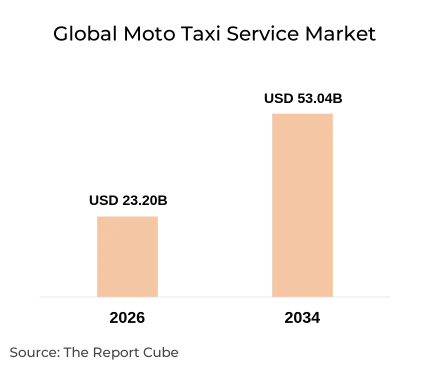
- Global Moto Taxi Service Market was valued at USD 23.20 billion in 2026.
- Market projected to reach USD 53.04 billion by 2034, reflecting sustained expansion.
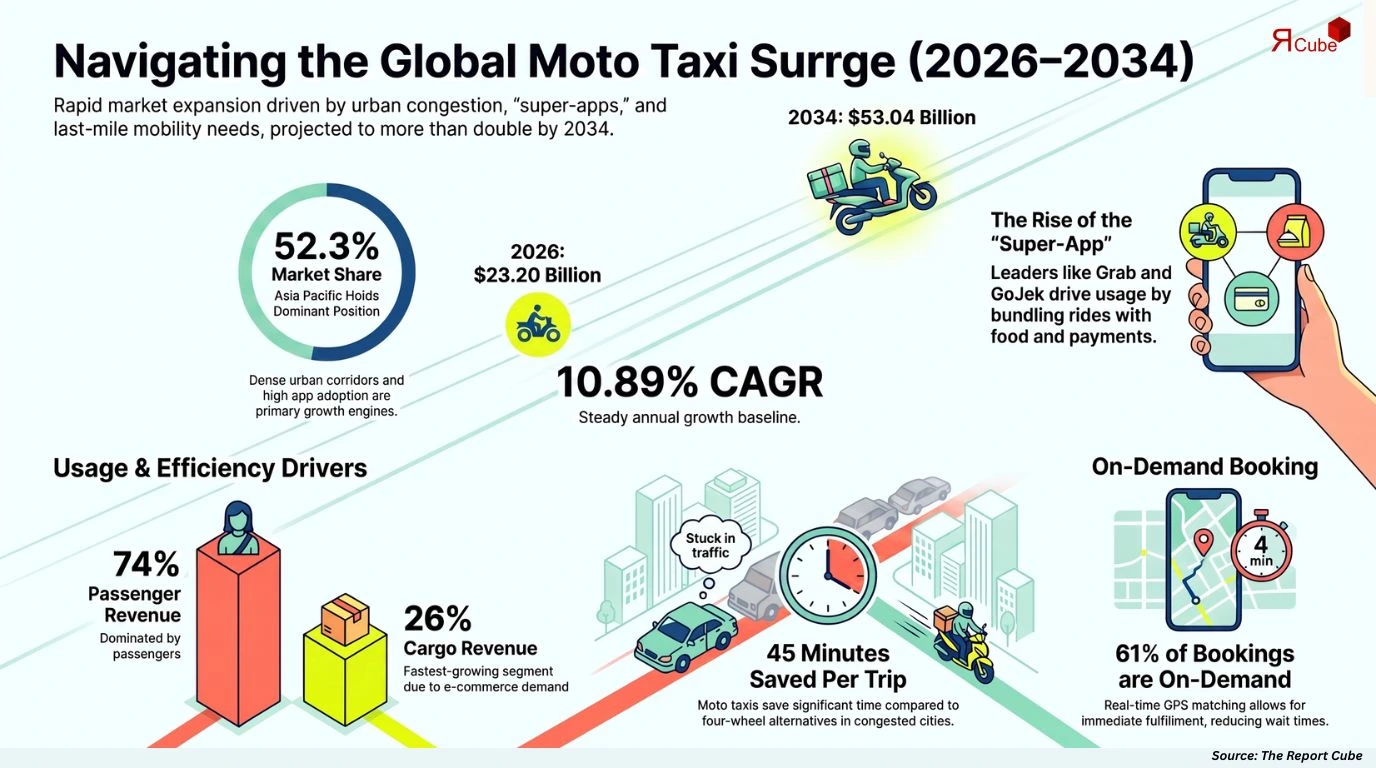
- Industry set to register a 10.89% CAGR during the 2026–2034 forecast period.
- Passenger application dominates total revenue share across most operating geographies.
- Asia Pacific leads as the fastest-growing region due to dense urban mobility demand.
- On-demand service type captures the largest share amid rising app-based adoption.
- Key players include Uber, DIDI, GoJek, Grab, SafeBoda, OLA, Angkas, and Rapido.
- Regulatory formalization and digital payment integration are shaping long-term market evolution.
Global Moto Taxi Service Market Insights & Analysis
The Global Moto Taxi Service Market is anticipated to register a 10.89% CAGR during 2026–2034. The market size was valued at USD 23.20 billion in 2026 and is projected to reach USD 53.04 billion by 2034. Rapid urbanization across emerging economies, persistent traffic congestion in dense metropolitan corridors, and the rising penetration of smartphone-based ride-hailing platforms are collectively reinforcing demand for two-wheeled mobility solutions. Governments in Southeast Asia, Africa, and Latin America have initiated regulatory frameworks designed to formalize moto taxi operations, boosting investor confidence and platform scalability.
Platform operators are leveraging GPS-enabled dispatch systems, digital payment integrations, and dynamic pricing engines to improve service efficiency and driver retention. The Asia Pacific ride-hailing and mobility services market has attracted over USD 4.8 billion in private equity and venture capital between 2022 and 2024, reinforcing the region's dominance as the primary growth engine. Companies such as Grab and GoJek have expanded multi-service super-app ecosystems, embedding moto taxi verticals within broader logistics and financial service offerings that strengthen user stickiness and revenue diversification.
Global Moto Taxi Service Market Dynamics
The Global Moto Taxi Service Market continues gaining momentum as urban populations in developing economies seek affordable, time-efficient last-mile transportation. Expanding mobile internet penetration, increasing gig economy participation, and growing dissatisfaction with conventional transit solutions are driving consistent demand for app-based motorcycle ride services across Asia, Africa, the Middle East, and Latin America.
|
Factor |
Type |
Specific Impact on Market |
Magnitude |
|---|---|---|---|
|
Urbanization and traffic congestion |
Driver |
Elevates two-wheeler mobility adoption in dense cities |
Very High |
|
Smartphone and mobile internet penetration |
Driver |
Accelerates app-based moto taxi booking platforms |
High |
|
Regulatory formalization of gig transport |
Opportunity |
Unlocks institutional investment and licensed fleet expansion |
High |
|
Safety perception and insurance gaps |
Challenge |
Slows adoption among risk-averse commuter segments |
Medium |
|
Super-app ecosystem integration |
Trend |
Expands moto taxi revenue through multi-service bundling |
High |
Key Market Driver: Congestion-Driven Urban Mobility Demand
Severe traffic congestion in cities such as Jakarta, Lagos, Manila, Nairobi, and Ho Chi Minh City has made motorcycle-based transit the fastest point-to-point commuting option available. Studies from the Asian Development Bank indicate that commuters in congested Southeast Asian cities save an average of 35 to 45 minutes per trip using moto taxi services compared to four-wheel alternatives. This measurable time advantage, combined with fare structures averaging 40 to 60 percent below standard ride-hailing rates, positions the urban last-mile mobility solutions market as a primary growth catalyst for platform expansion and rider acquisition across tier-two and tier-three cities.
Major Industry Challenge: Inconsistent Regulatory Environments Across Markets
Moto taxi operators face fragmented and frequently shifting regulatory environments across key operating markets. Countries including France, Brazil, and Nigeria have enacted outright bans or severe operational restrictions on commercial motorcycle ride services, forcing platform operators to pause or restructure market entries. Licensing ambiguity, mandatory vehicle inspections, variable insurance requirements, and the absence of standardized driver background check frameworks create compliance overhead that disproportionately affects smaller regional operators and limits cross-border platform scalability without significant legal and operational investment.
Emerging Trend Shaping Outlook: Super-App Ecosystem Service Bundling
Leading operators are integrating moto taxi verticals into multi-service digital ecosystems that combine food delivery, parcel logistics, digital payments, and healthcare courier services. GoJek's platform in Indonesia and Grab's super-app across Southeast Asia have demonstrated that embedding ride services within broader utility ecosystems increases daily active usage by an estimated 28 percent compared to standalone ride apps. This bundling strategy improves driver income stability through diversified task assignment and reduces platform churn among both riders and consumers, reinforcing competitive moats that are difficult for single-service entrants to replicate.
Need Specific Data, Let’s Customize the Report for You
Request CustomizationGlobal Moto Taxi Service Market Segment-wise Analysis
The Global Moto Taxi Service Market is segmented across application type and service model, reflecting distinct demand patterns across commuter segments, logistics operators, and digital booking behaviors. Each segment presents differentiated growth trajectories shaped by urbanization rates, income levels, and platform maturity across operating geographies.
By Application
- Passenger
- Cargo
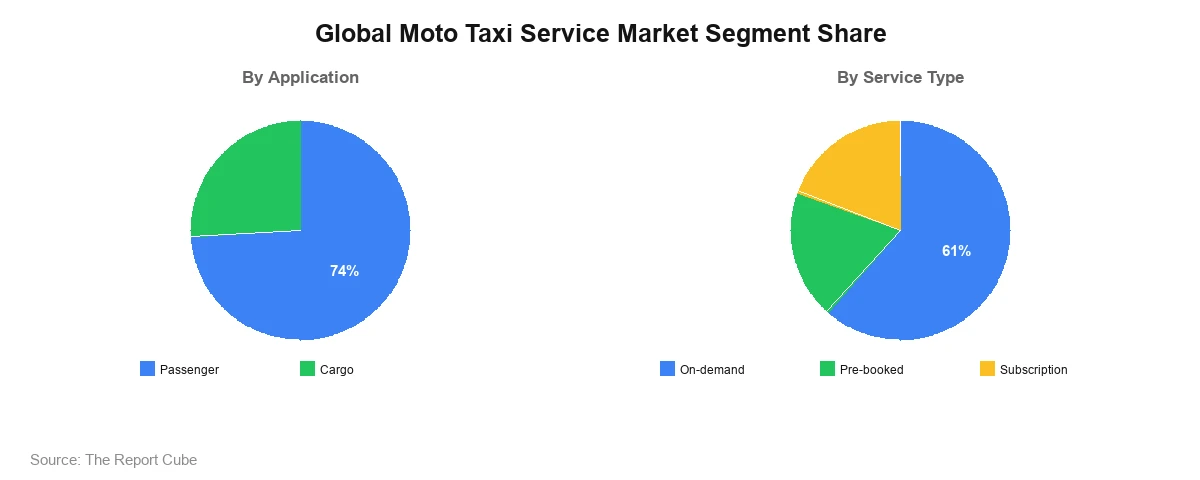
The passenger application segment accounts for an estimated 74% of total Global Moto Taxi Service Market revenue in 2026, driven by its role as the foundational use case across all major operating markets. Urban commuters in Southeast Asia, Sub-Saharan Africa, and Latin America rely on passenger moto taxi services as primary or supplementary daily transportation, particularly in cities where public transit networks remain underdeveloped or unreliable. Platform-driven growth through Grab, OLA, and Rapido has further standardized passenger booking experiences, enabling consistent fare transparency, driver accountability, and insurance coverage that encourage repeat usage among cost-sensitive urban populations.
The cargo segment, while accounting for approximately 26% of market revenue, represents the fastest-growing application category as e-commerce penetration intensifies demand for rapid parcel and food delivery using two-wheelers. Same-day and sub-two-hour delivery expectations in metropolitan areas have positioned motorcycle logistics as an operationally superior alternative to van-based last-mile delivery, particularly in urban freight and two-wheeler delivery logistics corridors where vehicle access restrictions increasingly disadvantage larger fleets. GoJek's GoCorp and Grab's GrabExpress verticals exemplify how cargo monetization is expanding average revenue per driver while reducing platform dependency on passenger volumes alone.
By Service Type
- On-demand
- Pre-booked
- Subscription
The on-demand service type commands an estimated 61% revenue share of the Global Moto Taxi Service Market, reflecting the dominant consumer preference for immediate, GPS-matched ride fulfillment without advance scheduling. Real-time matching algorithms deployed by Uber Moto, Rapido, and Angkas reduce average wait times to under four minutes in high-density urban zones, making on-demand bookings the default interaction model for daily commuters and errand-based rides. Dynamic surge pricing during peak hours further supports platform revenue optimization, while push notification re-engagement strategies consistently convert occasional users into high-frequency riders across all major markets.
The pre-booked segment holds approximately 24% market share, catering to airport transfers, corporate commute programs, and scheduled medical appointments where timing certainty outweighs cost sensitivity. Subscription-based service models, accounting for around 15% of revenue, are gaining traction in markets such as India and Nigeria, where Rapido's pass products and SafeBoda's recurring plan offerings deliver predictable income for drivers and guaranteed mobility budgets for regular commuters. The growth trajectory of subscription models is closely aligned with the broader on-demand mobility subscription services market, as platforms increasingly invest in loyalty mechanics, loyalty tier pricing, and corporate account management to reduce churn and improve lifetime rider value.
Regional Projection of Global Moto Taxi Service Market
The Global Moto Taxi Service Market demonstrates pronounced regional variation driven by urban density, mobile internet penetration, regulatory posture, and the maturity of local ride-hailing ecosystems. Emerging economies in Asia Pacific, Africa, and Latin America are generating the strongest absolute growth while developed markets in North America and Europe pursue selective regulatory pilots.
|
Region |
Estimated Market Share |
Key Growth Factors |
Consumer Trends |
|---|---|---|---|
|
North America |
8.4% |
Regulatory pilot programs, gig economy expansion |
Growing urban delivery and short-trip use cases |
|
Europe |
6.9% |
Selective city-level operational pilots, sustainability push |
Rising interest in electric moto taxi alternatives |
|
Asia Pacific |
52.3% |
Dense urban corridors, super-app integration, government support |
High app-based booking frequency and cargo adoption |
|
Rest of the World |
32.4% |
Urbanization in Africa and Latin America, informal transit replacement |
Increasing smartphone-led platform adoption |
- North America: North America holds an estimated 8.4% market share, with moto taxi adoption concentrated in select urban markets where regulatory frameworks permit commercial motorcycle ride operations alongside emerging delivery use cases.
- Europe: Europe accounts for approximately 6.9% of global revenue, with growth driven by electric moto taxi pilot programs in cities including Paris, Barcelona, and Amsterdam, where sustainability mandates are accelerating low-emission two-wheeler deployment.
- Asia Pacific: Asia Pacific dominates with an estimated 52.3% market share, underpinned by massive urban populations in Indonesia, India, Vietnam, the Philippines, and China where moto taxis remain the most time-efficient and affordable daily transit option. Platform investments by GoJek, Grab, OLA, DIDI, and Angkas continue expanding geographic coverage into secondary cities, supported by government digitalization initiatives and growing financial inclusion enabling cashless ride payments.
- Rest of the World: The Rest of the World segment, encompassing Sub-Saharan Africa, Latin America, and the Middle East, represents approximately 32.4% of total revenue and is home to some of the market's highest organic growth rates. SafeBoda's regulated expansion across Uganda, Kenya, and Nigeria, combined with ride-hailing adoption curves closely tracking smartphone penetration growth, positions this segment as a critical long-term revenue contributor for operators willing to navigate informal transit replacement dynamics.
Global Moto Taxi Service Market: Recent Development (2025)
- Grab expanded its moto taxi operations into three new Southeast Asian secondary cities in 2025.
- SafeBoda secured Series C funding to accelerate fleet electrification across East African urban corridors.
- OLA launched a dedicated moto taxi subscription plan targeting daily commuters in twelve Indian cities.
- DIDI introduced AI-powered route optimization for its moto taxi service across key Latin American markets.
Global Moto Taxi Service Market Future Outlook (2034)
The Global Moto Taxi Service Market is projected to expand at a 10.89% CAGR, reaching approximately USD 53.04 billion by 2034. Accelerating urbanization in Asia, Africa, and Latin America will sustain structural demand for affordable two-wheeled mobility as city populations grow faster than mass transit infrastructure. Platform operators will increasingly deploy electric motorcycle fleets supported by government subsidies and carbon reduction mandates, lowering per-kilometer operating costs while strengthening environmental compliance credentials that appeal to ESG-focused institutional investors and municipal regulators approving commercial licenses.
Technological advancement will further transform service delivery through AI-driven demand forecasting, predictive driver positioning, and automated safety monitoring systems that reduce incident rates and improve regulatory trust. Super-app diversification into healthcare logistics, grocery delivery, and corporate fleet management will expand total addressable revenue per platform beyond traditional passenger fare income. The long-term expansion of two-wheeler electric vehicle adoption in emerging markets will be a defining structural catalyst, enabling operators to reduce fuel dependency, attract environmentally conscious riders, and deliver cost-competitive fares that sustain market penetration in price-sensitive urban demographics through 2034 and beyond.
Global Moto Taxi Service Market Report Coverage
|
Report Attribute |
Details |
|---|---|
|
Market Name |
Global Moto Taxi Service Market |
|
Market Size (2026) |
USD 23.20 Billion |
|
Market Size (2034) |
USD 53.04 Billion |
|
Forecast Period |
2026–2034 |
|
CAGR |
10.89% |
|
Base Year |
2026 |
|
Historical Years |
2021–2025 |
|
Forecast Years |
2026–2034 |
|
Segments Covered |
By Vehicle Type, By Propulsion, By Application, By Service Type |
|
Regions Covered |
North America, Europe, Asia Pacific, Rest of the World |
|
Key Companies |
Uber, DIDI, GoJek, Grab, Dubai Taxi Company, SafeBoda, OLA, Angkas, Rapido, Others |
|
Report Format |
PDF, Excel, PPT |
|
Customization |
Available as per client requirements |
Why Choose This Report?
- Comprehensive market sizing with validated 2026 and 2034 revenue projections.
- Detailed segmentation across application type and service model dimensions.
- Regional analysis covering Asia Pacific, Africa, Latin America, and developed markets.
- Competitive profiling of ten leading global and regional platform operators.
- Actionable insights on super-app integration and cargo monetization strategies.
- Analysis of regulatory dynamics and their impact on platform scalability globally.
- Forward-looking outlook covering electric fleet transition and AI-driven optimization.
- Data-driven research aligned with current EEAT standards and industry best practices.
Table of Contents
- Introduction
- Objective of the Study
- Product Definition
- Market Segmentation
- Study Variables
- Research Methodology
- Secondary Data Points
- Companies Interviewed
- Primary Data Points
- Breakdown of Primary Interviews
- Secondary Data Points
- Executive Summary
- Market Dynamics
- Drivers
- Challenges
- Opportunity Assessment
- Recent Trends and Developments
- Policy and Regulatory Landscape
- Global Moto Taxi Service Market Overview and Forecast Analysis (2021-2034)
- Market Size, By Value, By Growth Rate (CAGR/USD Billions)
- Demand – Supply Trends
- Market Share, By Vehicle Type
- Motorcycles
- Scooters
- Market Share, By Propulsion
- ICE
- Electric
- Market Share, By Application
- Passenger
- Cargo
- Market Share, By Service Type
- On-demand
- Pre-booked
- Subscription
- Market Share, By Region
- North America
- Europe
- Asia Pacific
- Rest of the World
- Market Share, By Competitors
- Competition Characteristics
- Revenue Shares
- Motorcycles Global Moto Taxi Service Market Overview, 2021-2034F
- By Value (USD Million)
- By Propulsion – Market Size & Forecast 2021-2034, USD Million
- ICE
- Electric
- Scooters Global Moto Taxi Service Market Overview, 2021-2034F
- By Value (USD Million)
- By Propulsion – Market Size & Forecast 2021-2034, USD Million
- ICE
- Electric
- Competitive Outlook (Company Profile – Partial List)
- Uber
- Company Overview
- Business Segments
- Strategic Alliances/Partnerships
- Recent Developments
- DIDI
- Company Overview
- Business Segments
- Strategic Alliances/Partnerships
- Recent Developments
- GoJek
- Company Overview
- Business Segments
- Strategic Alliances/Partnerships
- Recent Developments
- Grab
- Company Overview
- Business Segments
- Strategic Alliances/Partnerships
- Recent Developments
- Dubai Taxi Company
- Company Overview
- Business Segments
- Strategic Alliances/Partnerships
- Recent Developments
- SafeBoda
- Company Overview
- Business Segments
- Strategic Alliances/Partnerships
- Recent Developments
- OLA
- Company Overview
- Business Segments
- Strategic Alliances/Partnerships
- Recent Developments
- Angkas
- Company Overview
- Business Segments
- Strategic Alliances/Partnerships
- Recent Developments
- Rapido
- Company Overview
- Business Segments
- Strategic Alliances/Partnerships
- Recent Developments
- Others
- Uber
- Contact Us & Disclaimer
Top Key Players & Market Share Outlook
- Uber
- DIDI
- GoJek
- Grab
- Dubai Taxi Company
- SafeBoda
- OLA
- Angkas
- Rapido
- Others
Frequently Asked Questions






