


Build Your Custom Market Intelligence Report
Customize Your ReportNorth America Beverage Filling & Capping Machine Market Overview
The North America Beverage Filling & Capping Machine Market comprises industrial equipment used to fill beverages into bottles, cans, cartons, and other containers and apply closures to maintain product integrity. These machines are essential across water, dairy, juice, wine, spirits, beer, energy drinks, and soft drink manufacturing. Beverage producers use filling and capping equipment to improve production efficiency, maintain consistent fill volumes, support hygienic processing, and meet packaging requirements across different product categories.
Demand is influenced by packaged beverage consumption, investments in beverage manufacturing facilities, automation initiatives, and the need for flexible production lines. Water represents an important end-use category, supported by demand for bottled drinking water and other packaged water products. Dairy, juice, beer, wine, spirits, and non-alcoholic beverages also require specialized filling and closure systems depending on product characteristics, container materials, processing conditions, and shelf-life requirements.
North America Beverage Filling & Capping Machine Market Key Highlights
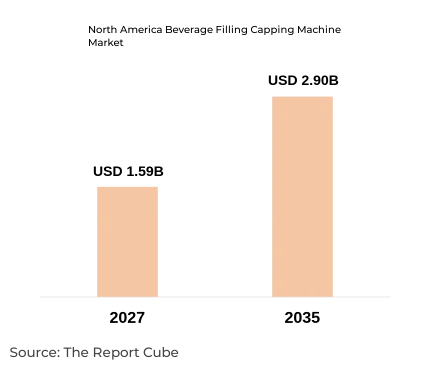
- The North America Beverage Filling & Capping Machine Market is estimated to reach USD 1.59 billion in 2027, based on the supplied market data.
- The market is projected to reach USD 2.90 billion by 2035, registering a CAGR of 7.80% during 2027–2035.
- Water accounted for approximately 24.3% of North American beverage filling and capping machine market revenue in 2022, making it the leading end-use segment in the published historical assessment.
- Automatic machines are estimated to account for approximately 78% of the market in 2026. This is an analyst estimate, not a verified published North American revenue split.
- Filling equipment accounted for approximately 85.3% of the market's equipment-segment revenue in 2022, according to the published historical assessment.
- Demand is supported by packaged water consumption, beverage manufacturing investments, production automation, and the modernization of filling and packaging lines.
- Technological developments include automated filling controls, integrated capping systems, hygienic equipment design, aseptic filling, and flexible container handling.
- Key companies include KHS Group, SIG, Tetra Laval, Coesia, IMA Group, Syntegon, GEA Group, ProMach, Duravant, and Barry-Wehmiller.
North America Beverage Filling & Capping Machine Market Outlook
The North America Beverage Filling & Capping Machine Market is expected to experience continued growth as beverage producers invest in manufacturing capacity, production efficiency, and modern packaging technologies. Water, dairy, juice, beer, spirits, and soft drink manufacturers require filling and closure equipment that can handle different liquid characteristics and packaging formats. The demand for packaged beverages and the need to maintain consistent production quality are expected to support equipment investments across the region.
Automation is an important area of equipment development. Automatic filling and capping systems can support higher production volumes, consistent container handling, reduced manual intervention, and improved production monitoring. Beverage manufacturers are also evaluating integrated production lines that combine filling, capping, inspection, labeling, and downstream packaging functions. These solutions can improve coordination between production stages and reduce operational interruptions associated with separate equipment installations.
Over the forecast period, competition is expected to focus on equipment performance, energy consumption, production flexibility, automation, after-sales support, and integration capabilities. Suppliers with broad beverage portfolios and established regional service networks may benefit from replacement demand and new production-line investments. Smaller and specialized equipment manufacturers may compete through application-specific filling systems, customized solutions, and flexible machinery for selected beverage categories.
Government Regulations and Industry Standards
The North America Beverage Filling & Capping Machine Market is influenced by food safety regulations, sanitary equipment requirements, workplace safety standards, and applicable packaging and food-contact requirements. In the United States, the Food and Drug Administration's Current Good Manufacturing Practice regulations under 21 CFR Part 117 require equipment and utensils used in food manufacturing, processing, packing, and holding to be appropriately designed, constructed, maintained, and cleanable.
Food-contact surfaces must be made of suitable materials and maintained to prevent contamination. These requirements are relevant to beverage filling and packaging equipment because machines may directly contact liquids or operate within food-processing environments. Equipment suppliers and beverage manufacturers must also consider applicable workplace safety requirements, electrical standards, and relevant industry engineering practices. Regulatory requirements vary according to the beverage product, manufacturing process, and jurisdiction.
North America Beverage Filling & Capping Machine Market Dynamics
The North America Beverage Filling & Capping Machine Market is influenced by beverage manufacturing expansion, automation investments, demand for packaged water and other beverages, and the modernization of processing facilities. Equipment suppliers are developing flexible and hygienic systems to meet different production requirements. However, high equipment investment, maintenance costs, integration complexity, and changing production requirements create challenges for beverage manufacturers and machinery suppliers.
| Factor | Type | Specific Impact on Market | Magnitude |
|---|---|---|---|
| Increasing Demand for Packaged Beverages | Growth Driver | Demand for bottled water, dairy drinks, juices, beer, and soft drinks supports investment in beverage filling and capping equipment. | High |
| Increasing Automation in Beverage Manufacturing | Growth Driver | Automatic filling and capping systems improve production consistency, reduce manual intervention, and support higher-volume manufacturing. | High |
| Modernization of Existing Beverage Production Facilities | Market Opportunity | Replacement of older machinery and integration of modern filling and closure systems create opportunities for equipment manufacturers. | High |
| Demand for Hygienic and Aseptic Filling Solutions | Market Opportunity | Manufacturers can expand sales of sanitary and aseptic filling systems for dairy, juice, and other sensitive beverage applications. | High |
| High Initial Equipment Investment and Installation Costs | Industry Challenge | Capital requirements for automated production lines can limit adoption among smaller beverage manufacturers and regional producers. | High |
| Maintenance, Integration, and Operational Complexity | Industry Challenge | Complex machinery requires skilled technicians, spare parts, maintenance planning, and integration with existing production infrastructure. | Medium |
Growth Drivers: Increasing Demand for Packaged Beverages Across North America
Increasing demand for packaged beverages is an important factor supporting the adoption of filling and capping machinery across North America. Beverage manufacturers require reliable equipment to package water, dairy products, juices, alcoholic beverages, and non-alcoholic drinks in different container formats. Bottled water represents a particularly important application, with the published 2022 market assessment identifying water as the leading end-use segment by revenue. Growing demand for convenient packaged beverages and the need for hygienic product handling encourage manufacturers to invest in filling and closure equipment. Producers also require machinery that can maintain consistent filling accuracy and closure quality across different production volumes.
Market Opportunities: Modernization of Existing Beverage Manufacturing Facilities
Modernization of existing beverage manufacturing facilities creates opportunities for filling and capping machine suppliers. Beverage producers may replace aging equipment with modern systems to improve filling accuracy, increase production flexibility, reduce downtime, and support new packaging formats. Modernization projects may also involve integrating filling and capping equipment with rinsing, inspection, labeling, and downstream packaging machinery. Equipment suppliers offering turnkey engineering, installation, commissioning, and lifecycle support can address the requirements of manufacturers upgrading existing production lines. Demand for replacement machinery is also supported by the need to maintain reliable production performance and comply with current hygiene and operational requirements.
Industry Challenges: High Initial Investment and Installation Costs
High initial investment requirements can restrict the adoption of advanced filling and capping machinery, particularly among smaller beverage producers. Automated production lines may require substantial expenditure on machinery, installation, facility modifications, electrical systems, utilities, and operator training. The total investment can increase when manufacturers require customized equipment or integrated production solutions. Smaller producers may prefer semi-automatic machinery or gradual production-line upgrades to manage capital expenditure. Equipment suppliers must therefore address different customer investment capacities through flexible machinery configurations, financing arrangements, and service-based support models.
Need Specific Data, Let’s Customize the Report for You
Request CustomizationMarket Trends: Increasing Integration of Automated and High-Speed Filling Lines
Beverage machinery manufacturers are increasingly offering integrated filling and capping systems designed to improve production coordination and operational efficiency. These systems may combine container handling, filling, closure application, inspection, and other packaging functions within a connected production line. High-speed equipment is particularly relevant to large-scale beverage producers manufacturing bottled water, soft drinks, beer, and other high-volume products. Manufacturers are also developing flexible systems that can accommodate different container sizes and packaging formats. KHS, for example, offers filling equipment for water, beer, soft drinks, dairy products, and other beverages, with product configurations covering bottles, cans, and kegs.
North America Beverage Filling & Capping Machine Market Segment Analysis
The North America Beverage Filling & Capping Machine Market is segmented by end-use, type, equipment, and country. End-use segmentation covers dairy, juice, wine, spirits, water, beer, energy and soft drinks, and other beverage categories. Type segmentation distinguishes automatic, semi-automatic, and manual machinery, while equipment segmentation includes filling and capping systems. The country-level assessment covers the United States, Canada, and Mexico. Historical market-share figures are identified separately from analyst estimates to avoid presenting different reference years as directly comparable.
By End-use
- Dairy
- Juice
- Wine
- Spirits
- Water
- Beer
- Energy & Soft Drinks
- Others
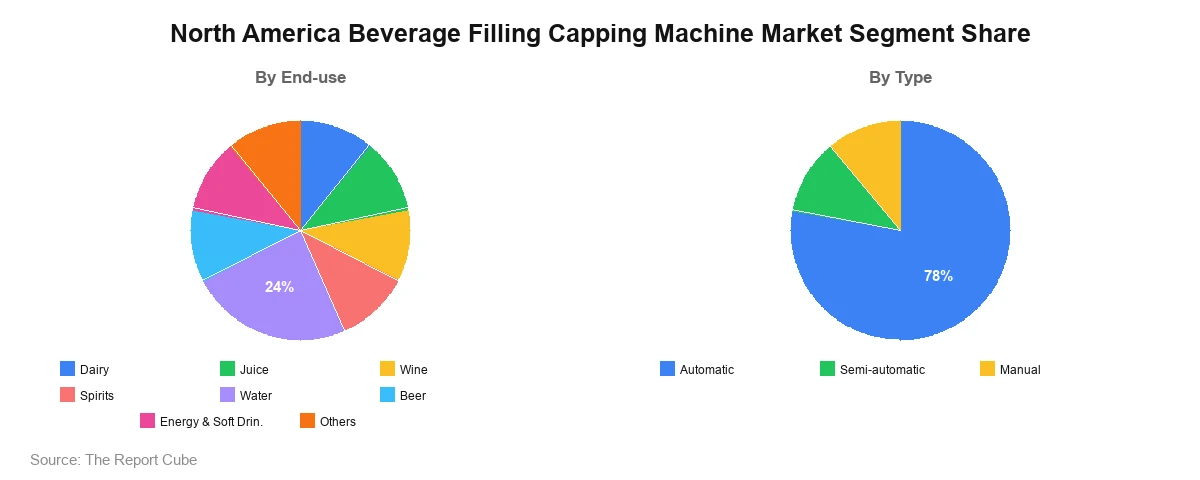
Water leads the category with an approximate 24% share in 2026, based on the supplied estimate. The published historical assessment reported that water accounted for 24.3% of North American beverage filling and capping machine market revenue in 2022. The 24% figure used for 2026 is therefore a rounded reference estimate based on the historical published share, rather than an independently measured 2026 revenue split. Demand for bottled water supports investment in filling and capping equipment because producers require high-volume, hygienic, and consistent packaging systems. Dairy, juice, beer, wine, spirits, and energy and soft drinks also contribute to equipment demand through their different filling and closure requirements.
By Type
- Automatic
- Semi-automatic
- Manual
Automatic leads the category with an approximate 78% share in 2026, based on the supplied analyst estimate. No exact North American automatic, semi-automatic, and manual equipment revenue split was verified in the reviewed public sources. Automatic systems are widely used in large beverage manufacturing facilities because they support continuous production, consistent filling operations, and reduced manual intervention. Semi-automatic equipment remains relevant for smaller production facilities and specialized operations, while manual machinery may serve limited-volume or basic packaging requirements. The estimated 78% share should be treated as an analyst assumption rather than a published market statistic.
North America Beverage Filling & Capping Machine Market Regional Analysis
The North America Beverage Filling & Capping Machine Market covers the United States, Canada, and Mexico. Regional demand is influenced by beverage manufacturing capacity, packaged beverage consumption, investment in production automation, and the modernization of existing processing facilities. The United States represents the largest country market in the published 2022 assessment, while Canada and Mexico contribute through their beverage production and packaging industries. Country-level market development also depends on machinery imports, local manufacturing capabilities, equipment servicing, and investment in new production lines.
| Region | Key Growth Factors | Industry Trends |
|---|---|---|
| U.S. | Large beverage manufacturing base, packaged water demand, established food and beverage processing infrastructure, and investment in automated production lines. | Adoption of high-speed filling systems, automated capping equipment, hygienic machinery, and integrated beverage packaging lines. |
| Canada | Beverage manufacturing, dairy and juice production, packaged water consumption, and modernization of food-processing facilities. | Investment in hygienic filling systems, flexible packaging machinery, and equipment designed to meet food safety requirements. |
| Mexico | Beverage production, packaged drink consumption, expansion of manufacturing operations, and demand for production efficiency. | Growing use of automated filling machinery, flexible production lines, and equipment servicing to support beverage manufacturers. |
North America Beverage Filling & Capping Machine Market Competitive Landscape
The North America Beverage Filling & Capping Machine Market includes global packaging machinery manufacturers, beverage processing technology suppliers, and specialized filling and closure equipment providers. Competition is influenced by machinery performance, production capacity, filling accuracy, hygienic design, automation capabilities, integration services, and after-sales support. Some companies provide complete beverage production and packaging lines, while others specialize in selected equipment categories or packaging formats. The companies listed below are assessed according to their publicly documented product portfolios and participation in beverage filling, capping, and related packaging systems.
| Company | Competitive Strength | Primary Segment Served |
|---|---|---|
| KHS Group | Established beverage filling and packaging machinery manufacturer with solutions for water, beer, soft drinks, dairy, juice, wine, and spirits. | Beverage Filling, Capping, and Complete Packaging Lines |
| SIG | Specialist in aseptic carton filling systems for liquid dairy, plant-based beverages, non-carbonated soft drinks, and liquid food products. | Aseptic Beverage Filling and Integrated Closure Application |
| Tetra Laval International S.A. | Broad food and beverage processing and packaging portfolio, including Tetra Pak filling machines with integrated closure capabilities for selected formats. | Aseptic and Chilled Beverage Filling Systems |
| Coesia S.p.A. | Packaging machinery group offering beverage filling, sealing, over-capping, and end-of-line packaging technologies. | Beverage Filling and Packaging Automation |
| I.M.A. Industria Macchine Automatiche S.p.A. | Filling and closing machinery portfolio covering bottles, jars, cups, and tubs, with hygienic and aseptic configurations for selected applications. | Liquid Filling, Closing, and Cup Filling Systems |
| Syntegon Technology GmbH | Packaging technology supplier with liquid and food packaging equipment capabilities; beverage-specific filling and capping portfolio should be assessed by product line. | Food and Liquid Packaging Machinery |
| GEA Group Aktiengesellschaft | Filling and packaging systems for liquid products, including water, carbonated soft drinks, milk, and other beverages. | Beverage Filling and Processing Systems |
| ProMach | Broad packaging machinery portfolio covering beverage processing, filling, seaming, labeling, case packing, and integrated production lines. | Beverage Filling and Packaging Systems |
| Duravant | Food and beverage packaging automation portfolio with weighing, filling, closing, flexible packaging, and end-of-line systems. | Filling, Closing, and Packaging Automation |
| Barry-Wehmiller Group Inc. | BW Packaging offers filling and closing machinery through brands including Pneumatic Scale, Mateer, Hema, Angelus, and other specialized equipment businesses. | Beverage Filling, Capping, Seaming, and Closing Equipment |
- KHS Group. KHS is a directly relevant supplier of beverage filling and packaging machinery, with product offerings covering water, beer, soft drinks, milk, juice, wine, and spirits. Its equipment portfolio includes PET and glass bottle fillers, can filling systems, keg filling systems, and integrated filling technologies. The company also offers systems for different production capacities and container types, including equipment with integrated stretch blow molding and filling configurations. KHS's broad beverage application coverage and established filling technology portfolio position it as an important participant in the North American beverage filling and capping equipment market.
- GEA Group Aktiengesellschaft. GEA provides filling and packaging technologies for liquid products, including water, carbonated soft drinks, white milk, and beverages containing preservatives. Its plastic bottle filling systems are designed to combine production performance, operational safety, and hygienic equipment configurations. The company's product information highlights automatic cleaning cycles, accessible filling and capping areas, and sanitary components designed to support beverage processing requirements. These capabilities position GEA as an important supplier to beverage manufacturers seeking filling equipment for different liquid products.
Recent Developments and Updates
- 2026: PMMI's 2026 State of the Industry report provided updated U.S. and Canadian packaging machinery shipment data. Its filling, capping, and closing category reported 2025 U.S. shipments of USD 1.332 billion and Canadian shipments of USD 123 million across multiple end-use industries. The data covers a broader machinery category and should not be interpreted as the beverage-only market size.
- 2025: KHS continued to present its beverage filling portfolio across water, beer, soft drinks, milk, juice, wine, and spirits, with product configurations covering glass bottles, PET bottles, cans, and kegs. The company's portfolio demonstrates the continued availability of specialized and integrated filling technologies for different beverage categories.
North America Beverage Filling & Capping Machine Market Future Outlook
The North America Beverage Filling & Capping Machine Market is expected to maintain growth through 2035 as beverage manufacturers continue investing in production capacity, automation, and modern packaging technologies. Demand from packaged water, dairy, juice, beer, spirits, and soft drink producers is expected to support the adoption of filling and closure equipment. Manufacturers will continue evaluating machinery based on production volume, filling accuracy, hygienic performance, container compatibility, and operational reliability.
Technological developments in automatic filling systems, aseptic processing, integrated capping, and production-line automation are expected to influence competitive positioning. Equipment suppliers with broad beverage application capabilities, strong service networks, and flexible machinery configurations may benefit from modernization and replacement demand. However, high capital requirements, equipment maintenance, integration complexity, and changing production requirements will remain important considerations for buyers. The market's long-term development will depend on beverage industry investment, machinery innovation, and the ability of equipment manufacturers to deliver reliable and cost-effective solutions.
North America Beverage Filling & Capping Machine Market Report Coverage
The North America Beverage Filling & Capping Machine Market report provides an assessment of the industry across end-use categories, machine types, equipment categories, and country markets. It examines demand from water, dairy, juice, wine, spirits, beer, energy drinks, and soft drinks, along with the adoption of automatic, semi-automatic, and manual machinery. The report also evaluates market dynamics, equipment technology trends, regulatory considerations, and the competitive positioning of major machinery manufacturers. Market size and forecast values are based on the supplied estimates, while historical segment shares are identified according to their original reference years.
| Parameter | Details |
|---|---|
| Market Name | North America Beverage Filling & Capping Machine Market |
| Market Size (Base Year) | 2026 |
| Market Size (2027) | USD 1.59 billion |
| Market Size (Forecast Year) | USD 2.90 billion by 2035 |
| CAGR | 7.80% (2027–2035) |
| Base Year | 2026 |
| Historical Period | 2022–2026 |
| Forecast Period | 2027–2035 |
| Geographic Scope | North America |
| Segmentation | By End-use, By Type, By Equipment, and By Country |
| Regions Covered | U.S., Canada, and Mexico |
| Key Companies | KHS Group, SIG, Tetra Laval International S.A., Coesia S.p.A., I.M.A. Industria Macchine Automatiche S.p.A., Syntegon Technology GmbH, GEA Group Aktiengesellschaft, ProMach, Duravant, and Barry-Wehmiller Group Inc. |
| Customization | Available based on specific research requirements |
Why Choose This North America Beverage Filling & Capping Machine Market Report?
- Provides a structured assessment of the North American beverage filling and capping machinery industry.
- Examines market demand across dairy, juice, wine, spirits, water, beer, energy drinks, and soft drinks.
- Evaluates automatic, semi-automatic, and manual machinery categories.
- Analyzes filling and capping equipment demand across beverage manufacturing applications.
- Reviews country-level market conditions across the United States, Canada, and Mexico.
- Evaluates growth drivers, market opportunities, industry challenges, and emerging machinery trends.
- Examines the competitive landscape, including global packaging machinery manufacturers and specialized equipment suppliers.
- Includes selected company developments, machinery portfolio evidence, and relevant food safety requirements.
Table of Contents
- Introduction
- Objective of the Study
- Product Definition
- Market Segmentation
- Study Variables
- Research Methodology
- Secondary Data Points
- Companies Interviewed
- Primary Data Points
- Breakdown of Primary Interviews
- Secondary Data Points
- Executive Summary
- Market Dynamics
- Drivers
- Challenges
- Opportunity Assessment
- Recent Trends and Developments
- Policy and Regulatory Landscape
- North America Beverage Filling Capping Machine Market Overview and Forecast Analysis (2022-2035)
- Market Size, By Value, By Growth Rate (CAGR/USD Billions)
- Demand – Supply Trends
- Market Share, By End-use
- Dairy
- Juice
- Wine
- Spirits
- Water
- Beer
- Energy & Soft Drinks
- Others
- Market Share, By Type
- Automatic
- Semi-automatic
- Manual
- Market Share, By Equipment
- Filling
- Capping
- Market Share, By Country
- U.S.
- Canada
- Mexico
- Market Share, By Competitors
- Competition Characteristics
- Revenue Shares
- Dairy North America Beverage Filling Capping Machine Market Overview, 2022-2035F
- By Value (USD Million)
- By Type – Market Size & Forecast 2022-2035, USD Million
- Automatic
- Semi-automatic
- Manual
- Juice North America Beverage Filling Capping Machine Market Overview, 2022-2035F
- By Value (USD Million)
- By Type – Market Size & Forecast 2022-2035, USD Million
- Automatic
- Semi-automatic
- Manual
- Wine North America Beverage Filling Capping Machine Market Overview, 2022-2035F
- By Value (USD Million)
- By Type – Market Size & Forecast 2022-2035, USD Million
- Automatic
- Semi-automatic
- Manual
- Spirits North America Beverage Filling Capping Machine Market Overview, 2022-2035F
- By Value (USD Million)
- By Type – Market Size & Forecast 2022-2035, USD Million
- Automatic
- Semi-automatic
- Manual
- Water North America Beverage Filling Capping Machine Market Overview, 2022-2035F
- By Value (USD Million)
- By Type – Market Size & Forecast 2022-2035, USD Million
- Automatic
- Semi-automatic
- Manual
- Beer North America Beverage Filling Capping Machine Market Overview, 2022-2035F
- By Value (USD Million)
- By Type – Market Size & Forecast 2022-2035, USD Million
- Automatic
- Semi-automatic
- Manual
- Energy & Soft Drinks North America Beverage Filling Capping Machine Market Overview, 2022-2035F
- By Value (USD Million)
- By Type – Market Size & Forecast 2022-2035, USD Million
- Automatic
- Semi-automatic
- Manual
- Others North America Beverage Filling Capping Machine Market Overview, 2022-2035F
- By Value (USD Million)
- By Type – Market Size & Forecast 2022-2035, USD Million
- Automatic
- Semi-automatic
- Manual
- Competitive Outlook (Company Profile – Partial List)
- KHS Group
- Company Overview
- Business Segments
- Strategic Alliances/Partnerships
- Recent Developments
- SIG
- Company Overview
- Business Segments
- Strategic Alliances/Partnerships
- Recent Developments
- Tetra Laval International S.A.
- Company Overview
- Business Segments
- Strategic Alliances/Partnerships
- Recent Developments
- Coesia S.p.A.
- Company Overview
- Business Segments
- Strategic Alliances/Partnerships
- Recent Developments
- I.M.A. Industria Macchine Automatiche S.p.A.
- Company Overview
- Business Segments
- Strategic Alliances/Partnerships
- Recent Developments
- Syntegon Technology GmbH
- Company Overview
- Business Segments
- Strategic Alliances/Partnerships
- Recent Developments
- GEA Group Aktiengesellschaft
- Company Overview
- Business Segments
- Strategic Alliances/Partnerships
- Recent Developments
- ProMach
- Company Overview
- Business Segments
- Strategic Alliances/Partnerships
- Recent Developments
- Duravant
- Company Overview
- Business Segments
- Strategic Alliances/Partnerships
- Recent Developments
- Barry-Wehmiller Group Inc.
- Company Overview
- Business Segments
- Strategic Alliances/Partnerships
- Recent Developments
- KHS Group
- Contact Us & Disclaimer
Top Key Players & Market Share Outlook
- KHS Group
- SIG
- Tetra Laval International S.A
- Coesia S.p.A
- I.M.A. Industria Macchine Automatiche S.p.A
- Syntegon Technology GmbH
- GEA Group Aktiengesellschaft
- ProMach
- Duravant
- Barry-Wehmiller Group Inc
Frequently Asked Questions