




Build Your Custom Market Intelligence Report
Customize Your ReportAustralia Organic Beverages Market Key Takeaways
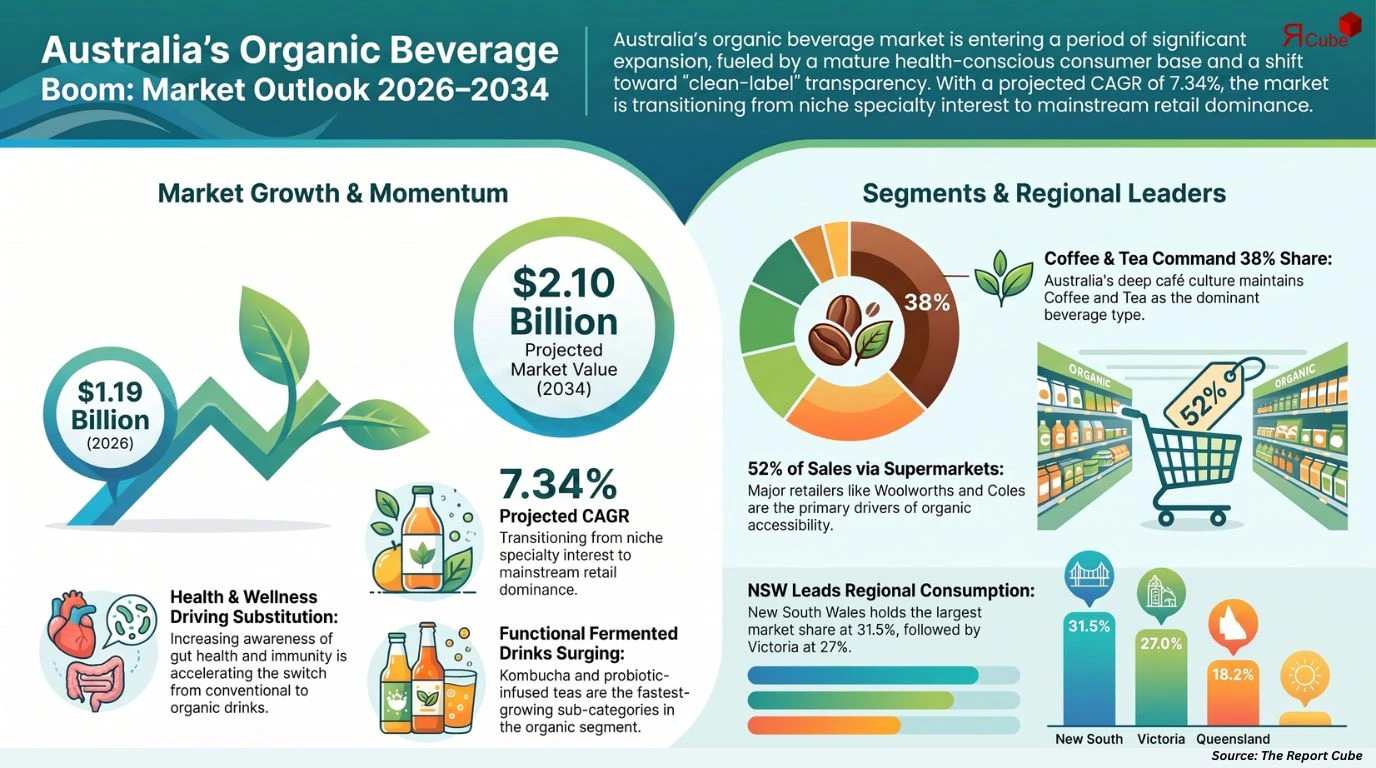
- Australia Organic Beverages Market was valued at USD 1.19 billion in 2026.
- The market is projected to reach USD 2.10 billion by 2034.
- Market is anticipated to expand at a 7.34% CAGR during 2026–2034.
- Organic Coffee and Tea dominate the market by beverage type segment.
- North America leads globally; Australia commands Asia-Pacific organic beverage growth.
- Asia-Pacific is the fastest-growing region for organic beverage consumption worldwide.
- Key players include Nestlé, Coca-Cola, Danone, Remedy Drinks, and Organic India.
- Rising clean-label demand and health-consciousness are accelerating organic beverage adoption.
Australia Organic Beverages Market Insights & Analysis
The Australia Organic Beverages Market is anticipated to register a 7.34% CAGR during 2026–2034. The market size was valued at USD 1.19 billion in 2026 and is projected to reach USD 2.10 billion by 2034. Australia's organic beverage sector is experiencing sustained momentum as consumers increasingly prioritize wellness, clean-label transparency, and sustainably sourced ingredients. Government-backed organic certification programs under Australian Certified Organic (ACO) and NASAA have strengthened supply chain credibility, while rising supermarket shelf allocations for organic products reflect growing mainstream retail penetration. Investment from multinational beverage companies in local organic sourcing and reformulation has further expanded product availability across metropolitan and regional distribution networks.
The market continues benefiting from Australia's mature health-conscious consumer base, widespread digital retail penetration, and increasing adoption of plant-based and fermented beverage alternatives. Domestic brands such as Remedy Drinks have secured significant investment rounds, with the company reportedly valued above AUD 350 million following international expansion. Expanding foodservice channels, including cafés and organic specialty stores, are further broadening consumption occasions for organic teas, kombucha, and non-dairy beverage alternatives across Australia's urban markets.
Australia Organic Beverages Market Dynamics
Australia's organic beverage landscape continues evolving under the influence of health-driven consumer behavior, expanding retail infrastructure, and strengthening certification ecosystems. Increasing premiumization across the beverage sector, combined with growing consumer awareness of agricultural sustainability and functional nutrition, is creating sustained demand for certified organic products across diverse consumption occasions and demographic segments throughout the country.
|
Factor |
Type |
Specific Impact on Market |
Magnitude |
|---|---|---|---|
|
Health and wellness trends |
Driver |
Accelerates organic beverage substitution over conventional drinks |
Very High |
|
E-commerce expansion |
Opportunity |
Increases direct-to-consumer organic beverage accessibility |
High |
|
Organic certification frameworks |
Driver |
Strengthens product trust and retail shelf eligibility |
High |
|
Functional ingredient demand |
Trend |
Boosts sales of kombucha, adaptogenic teas, and fortified drinks |
High |
|
Sustainable packaging mandates |
Challenge |
Drives reformulation and packaging investment among producers |
Medium |
Key Market Driver: Health-Conscious Consumer Spending Surge
Australian consumers are increasingly directing discretionary spending toward functional and certified organic beverages as awareness of gut health, immunity, and clean nutrition expands. According to the Australian Bureau of Statistics, spending on health-oriented food and beverages has grown consistently year-on-year, with organic products commanding a measurable premium over conventional alternatives. Retailers including Woolworths and Coles have responded by dedicating expanded shelf space to organic beverage categories, while specialty health retailers such as Harris Farm Markets are accelerating the organic beverage retail channel expansion across premium urban locations.
Major Industry Challenge: Organic Certification Cost and Supply Constraints
Small and mid-sized Australian beverage producers face significant operational pressure from the cost and administrative complexity of maintaining organic certification across multiple ingredient streams. Certification bodies require rigorous documentation, third-party auditing, and supplier traceability, increasing overhead for independent producers. Supply chain disruptions affecting certified organic sugarcane, tea leaves, and botanicals have further compressed margins, particularly for kombucha and herbal tea producers dependent on seasonal or imported organic inputs. These structural constraints limit production scalability and can restrict the organic ingredient supply chain in Australia for smaller-volume specialty beverage manufacturers.
Emerging Trend Shaping Outlook: Functional Fermented Beverages Gaining Momentum
Fermented organic beverages, including kombucha, water kefir, and probiotic-infused teas, are emerging as the fastest-growing sub-category within Australia's organic beverage segment. Consumer interest in gut microbiome health has driven double-digit annual growth for kombucha specifically, with market intelligence indicating domestic kombucha sales surpassing AUD 120 million annually. Brands are expanding product lines with adaptogenic herbs, nootropic botanicals, and low-sugar formulations targeting fitness-oriented demographics. This trend is simultaneously influencing organic soft drink reformulation strategies as mainstream manufacturers introduce fermented and prebiotic variants to capture health-oriented consumer segments.
Need Specific Data, Let’s Customize the Report for You
Request CustomizationAustralia Organic Beverages Market Segment-wise Analysis
Australia's organic beverage market spans a broad range of product types and retail distribution channels, each driven by distinct consumer behavior patterns, purchase frequency dynamics, and health motivation triggers. Segment performance reflects evolving lifestyle preferences, expanding retail infrastructure, and deepening consumer familiarity with organic certification standards across mainstream and specialty retail environments.
By Type
- Organic Coffee and Tea
- Organic Non-Dairy Beverages
- Organic Alcoholic Beverages
- Organic Soft Drinks
- Others
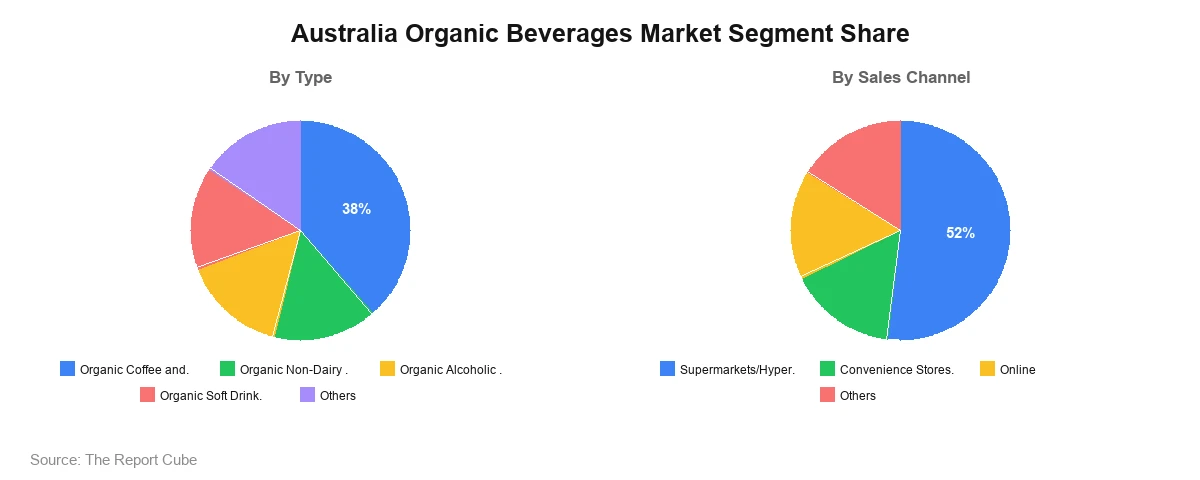
Organic Coffee and Tea holds the dominant position within the Australia Organic Beverages Market, accounting for approximately 38% of total revenue in 2026. Australia's deeply embedded café culture, combined with growing consumer preference for single-origin, certified organic, and fair-trade certified coffee and loose-leaf tea products, has reinforced the category's market leadership. Premium organic coffee capsules, cold brew concentrates, and specialty herbal teas have expanded shelf presence across supermarkets and specialty health retailers. Foodservice channels, particularly independent cafés and third-wave coffee establishments, remain important volume drivers for premium organic coffee sourcing in Australia.
Organic Non-Dairy Beverages represent the fastest-growing type segment, driven by rising lactose intolerance awareness, plant-based dietary adoption, and the expanding availability of certified organic oat, almond, soy, and coconut milk alternatives. Organic Alcoholic Beverages are gaining traction among premium wine consumers, particularly in South Australia and Victoria, where certified organic viticulture is expanding. Organic Soft Drinks and kombucha-based functional beverages continue attracting younger consumers seeking low-sugar, probiotic-enriched alternatives to conventional carbonated drinks, with brands investing in natural flavor innovation to improve mainstream consumer appeal.
By Sales Channel
- Supermarkets/Hypermarkets
- Convenience Stores
- Online
- Others
Supermarkets and Hypermarkets account for an estimated 52% of Australia Organic Beverages Market revenue, reflecting the channel's critical role in driving mainstream organic beverage accessibility. Major national retailers including Woolworths, Coles, and ALDI Australia have expanded dedicated organic beverage sections, supported by private-label organic product introductions and prominent promotional positioning. The channel benefits from high foot traffic, consumer trust in retail certification verification, and competitive pricing dynamics that make organic beverages increasingly accessible to middle-income Australian households purchasing through weekly grocery routines.
Online retail is the fastest-growing sales channel, supported by expanding direct-to-consumer brand strategies, subscription-based organic beverage delivery models, and marketplace growth through platforms including Amazon Australia and specialty health e-commerce sites. Convenience stores are gradually increasing organic beverage stocking, particularly in urban locations targeting on-the-go health-conscious consumers. The "Others" channel - encompassing specialty health food retailers, organic farmers' markets, and foodservice outlets - maintains a loyal and growing consumer base, particularly in markets aligned with Australia's specialty organic retail growth.
Regional Projection of Australia Organic Beverages Market
Australia's organic beverage market exhibits significant geographic variation based on population density, health-conscious consumer concentration, retail infrastructure maturity, and proximity to domestic organic production zones. Eastern seaboard states dominate revenue generation, while emerging interest in health and wellness lifestyles is expanding market penetration across less-saturated regional and Western Australian markets.
|
Region |
Estimated Market Share |
Key Growth Factors |
Consumer Trends |
|---|---|---|---|
|
New South Wales |
31.5% |
Dense urban population, premium retail density, foodservice expansion |
High adoption of functional and fermented organic beverages |
|
Victoria |
27.0% |
Café culture, organic wine proximity, specialty retail network |
Growing demand for organic non-dairy and cold brew options |
|
Queensland |
18.2% |
Health-conscious coastal lifestyle, expanding supermarket presence |
Rising organic soft drink and kombucha consumption |
|
Western Australia |
13.3% |
Increasing organic farming output, growing health retail sector |
Steady growth in organic tea and non-dairy beverage adoption |
|
South Australia & Others |
10.0% |
Organic viticulture cluster, boutique producer ecosystem |
Premium organic alcoholic beverage and herbal tea demand |
- New South Wales: NSW leads the Australia Organic Beverages Market with approximately 31.5% share, supported by Sydney's premium retail ecosystem, high-income consumer demographics, and dense organic specialty retail presence.
- Victoria: Victoria holds the second-largest share driven by Melbourne's established third-wave café culture, strong organic wine proximity in Yarra Valley and Mornington Peninsula, and a highly developed specialty food retail network.
- Queensland: Queensland represents a growing market anchored by health-conscious coastal lifestyle demographics, expanding organic beverage stocking in supermarket chains, and increasing kombucha and organic soft drink penetration in Brisbane's urban market.
- Western Australia: Western Australia is demonstrating steady organic beverage adoption growth, underpinned by rising domestic organic agricultural output and expanding health-oriented retail formats in Perth's metropolitan corridors.
- South Australia and Others: South Australia benefits from a strong certified organic viticulture cluster around McLaren Vale and Barossa Valley, supporting premium organic wine and botanical beverage consumption, while Tasmania and the ACT exhibit niche but high-per-capita organic beverage spending.
Australia Organic Beverages Market: Recent Development (2025)
- Remedy Drinks expanded its certified organic kombucha range into three new international markets.
- Nestlé Australia launched a certified organic cold brew coffee line targeting premium supermarket consumers.
- Danone partnered with Australian organic dairy cooperatives to expand certified organic non-dairy beverages.
- Coca-Cola Australia introduced an organic botanical soft drink variant under its premium beverage division.
Australia Organic Beverages Market Future Outlook (2034)
The Australia Organic Beverages Market is projected to reach USD 2.10 billion by 2034, expanding at a 7.34% CAGR throughout the forecast period. Growth will be sustained by deepening consumer commitment to health and wellness, accelerating clean-label product innovation, and continued expansion of organic certification infrastructure across domestic agricultural supply chains. Increasing investment in fermented beverage manufacturing, functional ingredient sourcing, and sustainable packaging will further strengthen the commercial foundation supporting long-term organic beverage sector expansion across Australian retail and foodservice channels.
Technological advancements in cold-press extraction, bio-fermentation, and precision nutrition formulation are expected to drive the next generation of premium organic beverage products. AI-powered demand forecasting and digital supply chain traceability tools will improve inventory management efficiency and ingredient authentication for organic producers. The integration of non-dairy functional beverage innovation strategies with organic certification is anticipated to generate significant new revenue streams, particularly in categories targeting sports nutrition, cognitive wellness, and metabolic health demographics over the forecast horizon to 2034.
Australia Organic Beverages Market Report Coverage
|
Report Attribute |
Details |
|---|---|
|
Market Name |
Australia Organic Beverages Market |
|
Market Size (2026) |
USD 1.19 Billion |
|
Market Size (2034) |
USD 2.10 Billion |
|
Forecast Period |
2026–2034 |
|
CAGR |
7.34% |
|
Base Year |
2026 |
|
Historical Years |
2021–2025 |
|
Forecast Years |
2026–2034 |
|
Segments Covered |
By Type, By Sales Channel |
|
Regions Covered |
New South Wales, Victoria, Queensland, Western Australia, South Australia and Others |
|
Key Companies |
Nestlé S.A., Coca-Cola Company, PepsiCo Inc., Danone S.A., Hain Celestial Group Inc., Organic India Pvt. Ltd., Keurig Dr Pepper Inc., Fentimans Ltd., Remedy Drinks Pty Ltd, Others |
|
Report Format |
PDF, Excel, PPT |
|
Customization |
Available as per client requirements |
Why Choose This Report?
- Comprehensive analysis of Australia's evolving organic beverage consumption landscape.
- Accurate market sizing with reliable forecast data through 2034.
- Detailed segmentation revealing dominant and fastest-growing revenue opportunities.
- Regional insights covering all major Australian states and territories.
- Competitive profiling of leading domestic and multinational organic beverage companies.
- Analysis of functional beverage innovation and clean-label product development trends.
- Strategic insights supporting investment, product planning, and market entry decisions.
- Data-driven research following EEAT principles and current industry best practices.
Table of Contents
- Introduction
- Objective of the Study
- Product Definition
- Market Segmentation
- Study Variables
- Research Methodology
- Secondary Data Points
- Companies Interviewed
- Primary Data Points
- Breakdown of Primary Interviews
- Secondary Data Points
- Executive Summary
- Market Dynamics
- Drivers
- Challenges
- Opportunity Assessment
- Recent Trends and Developments
- Policy and Regulatory Landscape
- Australia Organic Beverages Market Overview and Forecast Analysis (2021-2034)
- Market Size, By Value, By Growth Rate (CAGR/USD Billions)
- Demand – Supply Trends
- Market Share, By Type
- Organic Coffee and Tea
- Organic Non-Dairy Beverages
- Organic Alcoholic Beverages
- Organic Soft Drinks
- Others
- Market Share, By Sales Channel
- Supermarkets/Hypermarkets
- Convenience Stores
- Online
- Others
- Market Share, By Region
- New South Wales
- Victoria
- Queensland
- Western Australia
- South Australia & Others
- Market Share, By Competitors
- Competition Characteristics
- Revenue Shares
- Organic Coffee and Tea Australia Organic Beverages Market Overview, 2021-2034F
- By Value (USD Million)
- By Sales Channel – Market Size & Forecast 2021-2034, USD Million
- Supermarkets/Hypermarkets
- Convenience Stores
- Online
- Others
- Organic Non-Dairy Beverages Australia Organic Beverages Market Overview, 2021-2034F
- By Value (USD Million)
- By Sales Channel – Market Size & Forecast 2021-2034, USD Million
- Supermarkets/Hypermarkets
- Convenience Stores
- Online
- Others
- Organic Alcoholic Beverages Australia Organic Beverages Market Overview, 2021-2034F
- By Value (USD Million)
- By Sales Channel – Market Size & Forecast 2021-2034, USD Million
- Supermarkets/Hypermarkets
- Convenience Stores
- Online
- Others
- Organic Soft Drinks Australia Organic Beverages Market Overview, 2021-2034F
- By Value (USD Million)
- By Sales Channel – Market Size & Forecast 2021-2034, USD Million
- Supermarkets/Hypermarkets
- Convenience Stores
- Online
- Others
- Others Australia Organic Beverages Market Overview, 2021-2034F
- By Value (USD Million)
- By Sales Channel – Market Size & Forecast 2021-2034, USD Million
- Supermarkets/Hypermarkets
- Convenience Stores
- Online
- Others
- Competitive Outlook (Company Profile – Partial List)
- Nestlé S.A.
- Company Overview
- Business Segments
- Strategic Alliances/Partnerships
- Recent Developments
- Coca-Cola Company
- Company Overview
- Business Segments
- Strategic Alliances/Partnerships
- Recent Developments
- PepsiCo Inc.
- Company Overview
- Business Segments
- Strategic Alliances/Partnerships
- Recent Developments
- Danone S.A.
- Company Overview
- Business Segments
- Strategic Alliances/Partnerships
- Recent Developments
- Hain Celestial Group Inc.
- Company Overview
- Business Segments
- Strategic Alliances/Partnerships
- Recent Developments
- Organic India Pvt. Ltd.
- Company Overview
- Business Segments
- Strategic Alliances/Partnerships
- Recent Developments
- Keurig Dr Pepper Inc.
- Company Overview
- Business Segments
- Strategic Alliances/Partnerships
- Recent Developments
- Fentimans Ltd.
- Company Overview
- Business Segments
- Strategic Alliances/Partnerships
- Recent Developments
- Remedy Drinks Pty Ltd
- Company Overview
- Business Segments
- Strategic Alliances/Partnerships
- Recent Developments
- Others
- Nestlé S.A.
- Contact Us & Disclaimer
Top Key Players & Market Share Outlook
- Nestlé S.A.
- Coca-Cola Company
- PepsiCo Inc.
- Danone S.A.
- Hain Celestial Group Inc.
- Organic India Pvt. Ltd.
- Keurig Dr Pepper Inc.
- Fentimans Ltd.
- Remedy Drinks Pty Ltd
- Others
Frequently Asked Questions






