




Build Your Custom Market Intelligence Report
Customize Your ReportAustralia Organic Farming Market Insights & Analysis
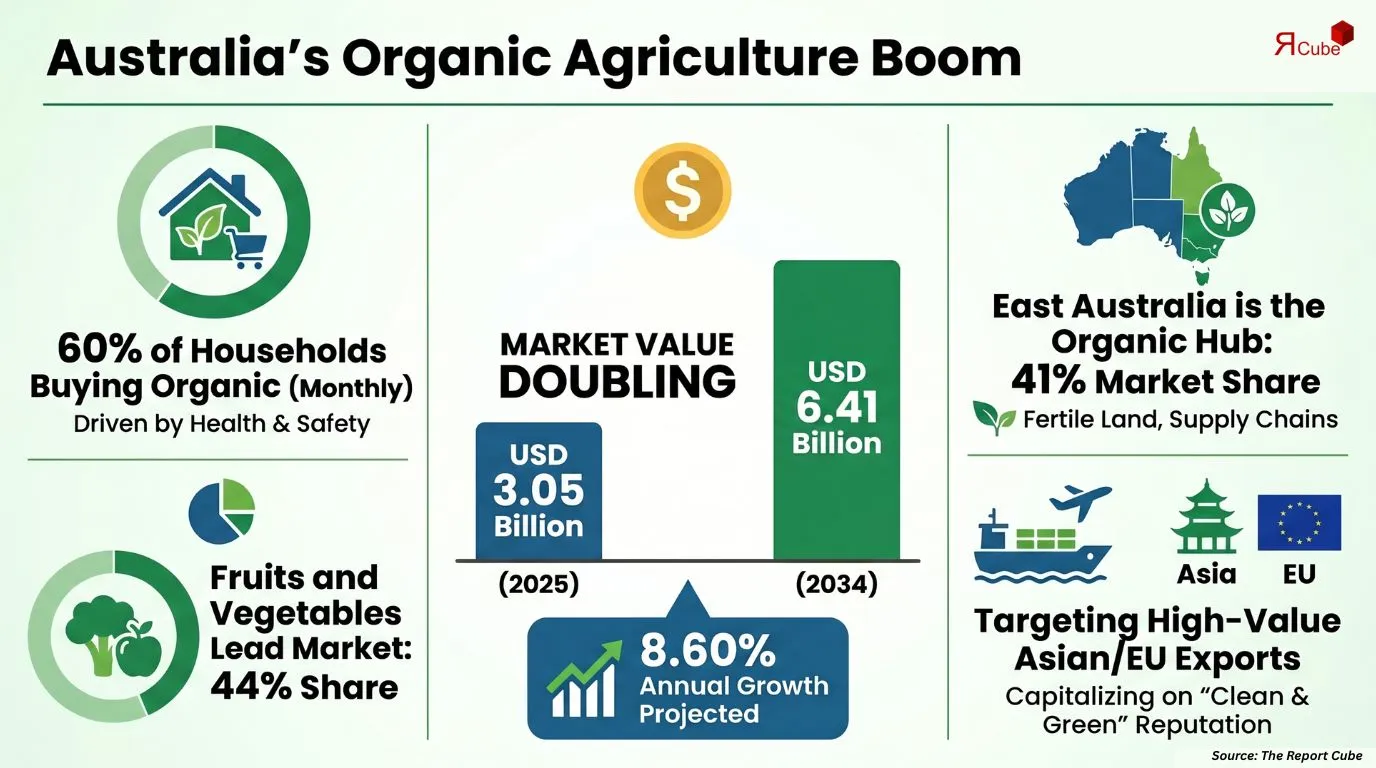
The Australia Organic Farming Market is anticipated to register a CAGR of 8.60% during 2026-2034. The market size was valued at USD 3.05 billion in 2025 and is projected to reach USD 6.41 billion by 2034. This steady expansion reflects Australia’s growing commitment to sustainable agriculture, rising consumer awareness regarding chemical-free food, and strong export demand for certified organic produce.
Australia has one of the largest areas of certified organic farmland globally, supported by favorable climatic conditions and large-scale farming practices. Increasing health consciousness among consumers has significantly boosted demand for organic fruits, vegetables, grains, and packaged organic food products. Additionally, supermarkets and specialty retailers are expanding organic product lines, making organic food more accessible across urban and regional areas.
Moreover, export-oriented organic farming is gaining momentum, particularly toward Asian and European markets where demand for premium organic products continues to rise. Government-backed certification frameworks, improved supply chain transparency, and digital traceability solutions are further strengthening farmer confidence. As sustainability becomes central to agricultural policy and consumer purchasing behavior, organic farming is transitioning from a niche segment to a mainstream component of Australia’s agri-food economy.
Australia Organic Farming Market Recent Developments
- 2025: Ozganics Australia expanded its certified organic processing capacity to support rising domestic and export demand.
- 2025: CERES Fair Food launched new regenerative organic supply partnerships with regional Australian farmers.
Government Initiatives & Policies
- National Organic Agriculture Strategy: Supports organic certification, export promotion, and sustainable farming practices.
- Australian Climate-Smart Agriculture Program: Encourages low-input, sustainable, and organic farming systems.
Australia Organic Farming Market Dynamics
Key Driver: Rising Consumer Demand for Chemical-Free and Sustainable Food Products
Increasing consumer awareness about food safety, environmental sustainability, and long-term health impacts of synthetic chemicals is a primary driver of organic farming adoption in Australia. Surveys indicate that over 60% of Australian households actively purchase organic products at least once a month. Organic produce is perceived as healthier, more environmentally friendly, and ethically produced, encouraging farmers to shift away from conventional practices. Retailers are also responding by allocating greater shelf space to organic categories, reinforcing demand across the value chain.
Book your FREE 30-minute expert consultation today
Contact UsIndustry Trends: Expansion of Regenerative and Integrated Organic Farming Practices
Integrated organic and regenerative farming models are emerging as key industry trends. Farmers are increasingly combining organic certification with soil carbon management, biodiversity conservation, and water efficiency practices. This approach enhances long-term soil fertility while improving farm resilience to climate variability. Additionally, digital tools for farm monitoring and organic compliance tracking are gaining adoption, improving productivity and reducing certification complexity. These trends are strengthening the commercial viability of organic farming operations.
Major Challenge: Higher Production Costs and Yield Variability
Despite strong demand, organic farming faces challenges related to higher labor costs, limited availability of organic inputs, and yield variability compared to conventional farming. Organic certification processes can be time-consuming and costly, particularly for small-scale farmers. Additionally, pest and disease management without synthetic chemicals requires greater expertise and manual intervention. These factors can impact short-term profitability, slowing adoption among risk-averse growers.
Opportunity: Growing Export Demand for Australian Organic Produce
Rising global demand for premium organic food presents a major growth opportunity for Australian producers. Markets such as China, Japan, South Korea, and the European Union value Australia’s clean agricultural image and strict certification standards. Organic grains, beef, dairy, and processed foods are witnessing strong export growth. Enhanced trade agreements, coupled with digital traceability and branding initiatives, are expected to unlock new revenue streams for organic farmers over the forecast period.
Australia Organic Farming Market Segment-wise Analysis
By Farming Type:
- Pure Organic
- Integrated Organic
- Organic Livestock
- Organic Dairy
Pure organic farming dominates the market, accounting for approximately 38% of total revenue in 2025. Its leadership is driven by strong consumer preference for fully certified organic crops and produce. Integrated organic farming is also gaining traction as farmers adopt hybrid models to improve soil health while maintaining productivity. Organic livestock farming is expanding steadily, supported by growing demand for organic meat and eggs.
By Crop Type:
- Fruits & Vegetables
- Cereals & Grains
- Oilseeds & Pulses
- Herbs & Spices
Fruits and vegetables represent the leading crop segment, contributing nearly 44% of the market share. Strong domestic consumption, short production cycles, and premium pricing support segment growth. Organic cereals and grains are also witnessing increased adoption due to export demand and use in organic packaged foods, reinforcing overall market diversification.
Regional Projection of Australia Organic Farming Industry
- East Australia
- West Australia
- North Australia
- South & Central Australia
East Australia leads the organic farming market with an estimated 41% share in 2025. The region benefits from fertile land, higher population density, and well-established organic supply chains. Strong retail presence, farmer cooperatives, and export infrastructure further support market dominance. East Australia is expected to maintain leadership as investments in organic certification and sustainable farming continue to rise.
Need insights for a specific region within this market?
Request Regional DataWhy Choose This Report?
- Provides a comprehensive overview of the overall market analysis, encompassing key trends, consumer behavior analysis, and risk assessment to support strategic decision-making.
- Provides accurate, up-to-date insights into market size, segmentation, and emerging opportunities, helping to minimize risk & capitalizing on growth.
- Gives deep understanding of target audience preferences, investment habits, and communication channels for enhanced product development & marketing effectiveness.
- Delivers competitive analysis & benchmarking, uncovering the strengths & weaknesses of market competitors to guide strategies.
- Consolidate comprehensive market intelligence, reducing reasoning & streamlining research efforts.
- Facilitates customized market segmentation & risk mitigation strategies, fine-tuned to the business objectives.
- Aids in identifying both market challenges & untapped opportunities within the industry to drive long-term business growth.
- Provides valuable information based on actual customer data & search trends.
Table of Contents
- Introduction
- Objective of the Study
- Product and Category Definition
- Market Segmentation
- Study Variables
- Research Methodology
- Secondary Data Points
- Breakdown of Secondary Sources
- Primary Data Points
- Breakdown of Primary Interviews
- Secondary Data Points
- Executive Summary
- Market Dynamics
- Drivers
- Challenges
- Opportunity Assessment
- Recent Trends and Developments
- Regulatory and Policy Landscape
- Australia Organic Farming Market Overview (2021-2034)
- Market Size, By Value (AUD Billion)
- Market Share, By Farming Type
- Pure Organic
- Integrated Organic
- Organic Livestock
- Organic Dairy
- Other Farming
- Market Share, By Crop Type
- Fruits Vegetables
- Cereals Grains
- Oilseeds Pulses
- Herbs Spices
- Other Crops
- Market Share, By Method
- Crop Rotation
- Polyculture
- Weed Management
- Soil Management
- Mulching
- Cutting
- Composting
- Others
- Market Share, By Input Type
- Organic Fertilizers
- Bio Pesticides
- Organic Seeds
- Soil Amendments
- Market Share, By Distribution Channel
- Supermarkets
- Hypermarkets
- Specialty Organic Stores
- Online Retail
- Farmgate Sales
- Other Channels
- Market Share, By End User
- Household Consumers
- Food Service
- Food Brands
- Export Buyers
- Market Share, By Region
- East Australia
- West Australia
- North Australia
- South Australia
- Central Australia
- Market Share, By Company
- Competition Characteristics
- Revenue Shares & Analysis
- East Australia Organic Farming Market
- Market Size, By Value (AUD Billion)
- Market Share, By Farming Type
- Market Share, By Crop Type
- Market Share, By Input Type
- Market Share, By Distribution Channel
- Market Share, By End User
- West Australia Organic Farming Market
- Market Size, By Value (AUD Billion)
- Market Share, By Farming Type
- Market Share, By Crop Type
- Market Share, By Input Type
- Market Share, By Distribution Channel
- Market Share, By End User
- North Australia Organic Farming Market
- Market Size, By Value (AUD Billion)
- Market Share, By Farming Type
- Market Share, By Crop Type
- Market Share, By Input Type
- Market Share, By Distribution Channel
- Market Share, By End User
- South Australia Organic Farming Market
- Market Size, By Value (AUD Billion)
- Market Share, By Farming Type
- Market Share, By Crop Type
- Market Share, By Input Type
- Market Share, By Distribution Channel
- Market Share, By End User
- Central Australia Organic Farming Market
- Market Size, By Value (AUD Billion)
- Market Share, By Farming Type
- Market Share, By Crop Type
- Market Share, By Input Type
- Market Share, By Distribution Channel
- Market Share, By End User
- Competitive Outlook and Company Profiles
- Eco Farms
- Company Overview
- Product Portfolio
- Strategic Alliances/Partnerships
- Recent Developments
- CERES Fair Food
- Company Overview
- Product Portfolio
- Strategic Alliances/Partnerships
- Recent Developments
- Taste Organic
- Company Overview
- Product Portfolio
- Strategic Alliances/Partnerships
- Recent Developments
- Dirty Clean Food
- Company Overview
- Product Portfolio
- Strategic Alliances/Partnerships
- Recent Developments
- Ozganics Australia
- Company Overview
- Product Portfolio
- Strategic Alliances/Partnerships
- Recent Developments
- Trumps Pty Ltd
- Company Overview
- Product Portfolio
- Strategic Alliances/Partnerships
- Recent Developments
- Aloe Vera Australia
- Company Overview
- Product Portfolio
- Strategic Alliances/Partnerships
- Recent Developments
- Wild One Beverages
- Company Overview
- Product Portfolio
- Strategic Alliances/Partnerships
- Recent Developments
- Organic Angels
- Company Overview
- Product Portfolio
- Strategic Alliances/Partnerships
- Recent Developments
- Australian Organic
- Company Overview
- Product Portfolio
- Strategic Alliances/Partnerships
- Recent Developments
- Others
- Eco Farms
- Contact Us and Disclaimer
Top Key Players & Market Share Outlook
- Eco Farms
- CERES Fair Food
- Taste Organic
- Dirty Clean Food
- Ozganics Australia
- Trumps Pty Ltd
- Aloe Vera Australia
- Wild One Beverages
- Organic Angels
- Australian Organic
- Others
Frequently Asked Questions






