


Build Your Custom Market Intelligence Report
Customize Your ReportVietnam Organic Personal Care Market Key Highlights
By Product Category:
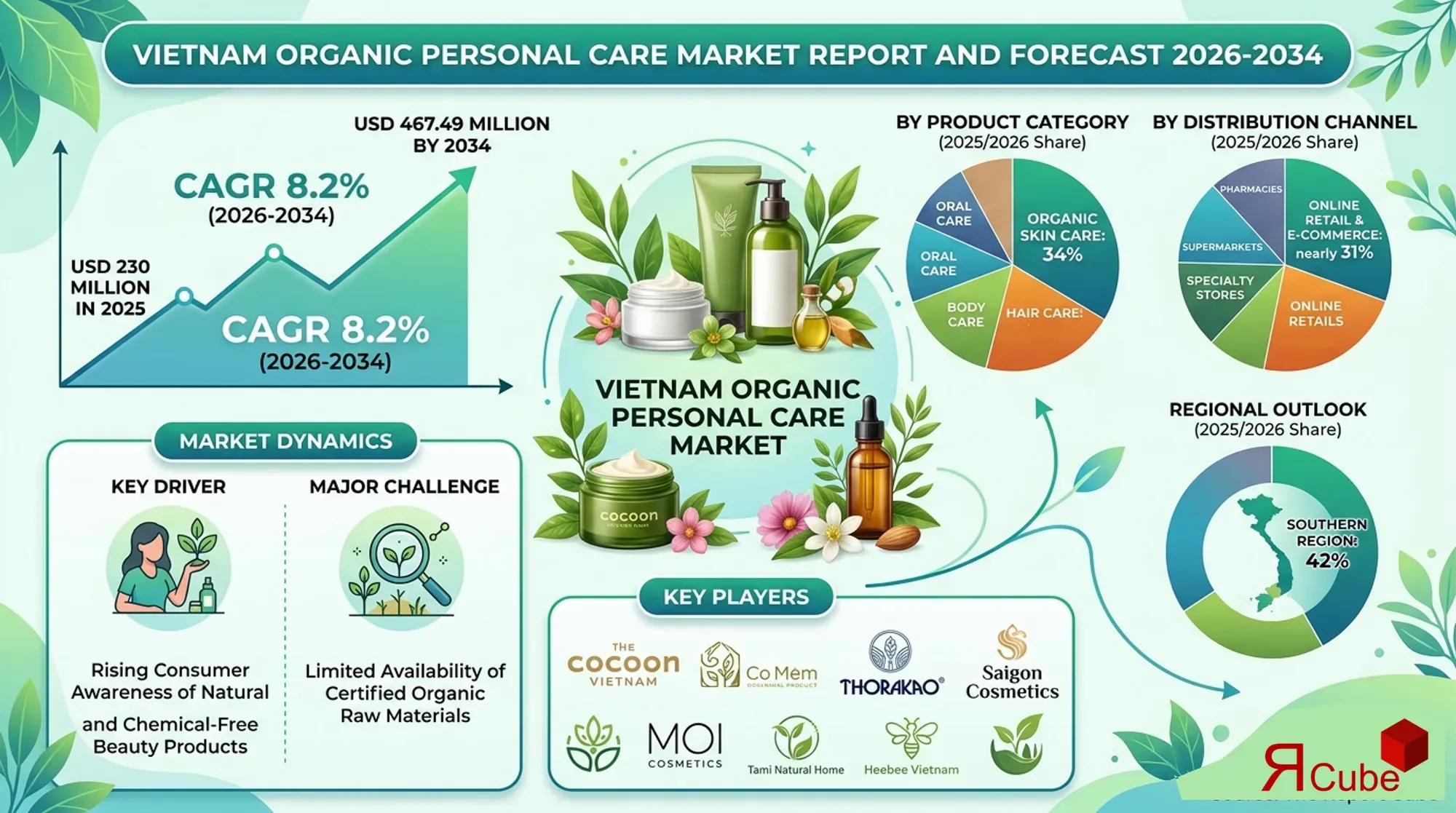
Organic Skin Care segment leads the market, with around 34% share.
By Distribution Channel:
Online Retail & E-commerce segment dominates the market, accounting for nearly 31% of total revenue.
Regional Outlook:
Southern region dominates the Vietnam organic personal care market, with around 42% share.
Government Initiatives & Policies
- Vietnam National Green Growth Strategy (2021-2030, updated implementation 2026): The Vietnamese government promotes eco-friendly production and sustainable consumer goods industries, including natural cosmetics and organic personal care manufacturing.
- ASEAN Cosmetic Directive Implementation by Vietnam Drug Administration (Updated 2025-2026): Vietnam strengthened regulations requiring ingredient transparency, product safety testing, and labeling compliance for cosmetic products, improving consumer trust in certified organic personal care products.
Vietnam Organic Personal Care Market Insights & Analysis
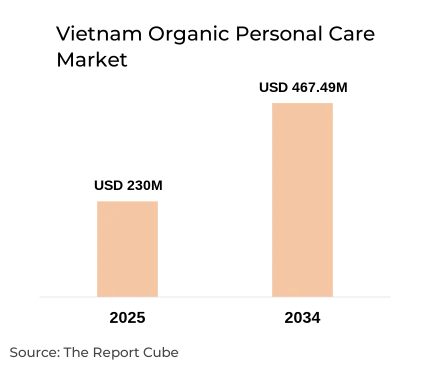
The Vietnam Organic Personal Care Market is anticipated to register a CAGR of 8.2% during 2026-2034. The market size was valued at USD 230 million in 2025 and is projected to reach USD 467.49 million by 2034. The market is experiencing steady expansion as Vietnamese consumers increasingly shift toward healthier lifestyles and sustainable beauty solutions. Rising awareness about harmful chemicals commonly found in conventional personal care products is encouraging consumers to adopt organic and plant-based alternatives.
Vietnam’s beauty and personal care sector has experienced notable transformation over the past five years. Urban consumers are becoming more informed about product ingredients, environmental impact, and ethical sourcing practices. According to industry surveys conducted in 2025, nearly 63% of Vietnamese urban consumers actively read ingredient labels before purchasing skincare or haircare products. This growing awareness is strengthening demand for certified organic products formulated without synthetic preservatives, parabens, or artificial fragrances.
Local brands are gaining traction alongside international cosmetic companies. Domestic companies such as Cocoon Vietnam and Milaganics have built strong reputations by promoting cruelty-free and vegan-certified products derived from Vietnamese botanical ingredients such as coffee, turmeric, coconut oil, and rice extracts. At the same time, international players including The Body Shop and Innisfree Vietnam are expanding retail presence and strengthening e-commerce operations to capture rising demand from young consumers.
Investment in research and development has also increased across Vietnam’s cosmetic manufacturing ecosystem. Several companies are establishing advanced formulation laboratories focused on herbal extraction technologies and dermatologically tested organic formulations. These developments are helping domestic brands compete more effectively with multinational beauty companies. As consumer awareness continues to grow and regulatory standards improve, the Vietnam organic personal care market is expected to witness sustained growth throughout the forecast period.
Vietnam Organic Personal Care Market Dynamics
Key Driver: Rising Consumer Awareness of Natural and Chemical-Free Beauty Products
One of the most influential growth drivers for the Vietnam organic personal care market is the increasing awareness regarding the health impact of synthetic cosmetic ingredients. Consumers across major cities such as Ho Chi Minh City, Hanoi, and Da Nang are becoming more conscious about skin health and long-term exposure to chemicals found in conventional products. Surveys conducted in 2025 indicated that over 58% of Vietnamese consumers prefer products labeled natural, organic, or herbal.
The influence of social media and beauty influencers has also accelerated consumer education about skincare ingredients. Vietnamese consumers frequently research product safety through online platforms, blogs, and dermatology content creators. As a result, organic brands emphasizing ingredient transparency and plant-based formulations are gaining stronger consumer trust.
In addition, the country’s young population plays a critical role in driving demand. Nearly 60% of Vietnam’s population is under the age of 35, and this demographic group actively seeks environmentally responsible and cruelty-free beauty solutions. Brands promoting sustainability, vegan ingredients, and eco-friendly packaging are therefore witnessing stronger engagement and repeat purchases.
Book your FREE 30-minute expert consultation today
Contact UsIndustry Trends: Growth of Local Botanical Ingredients and Sustainable Beauty Formulations
A key trend shaping the Vietnam organic personal care market is the increasing use of locally sourced botanical ingredients. Vietnamese cosmetic manufacturers are leveraging the country’s rich biodiversity to create unique formulations using natural extracts such as green tea, lotus flower, rice bran oil, and coconut derivatives. These ingredients not only enhance product differentiation but also support the development of authentic Vietnamese organic beauty brands.
Several domestic manufacturers are investing in sustainable agricultural supply chains to secure consistent organic ingredient sourcing. Partnerships between cosmetic companies and local farming cooperatives are becoming more common, enabling traceable ingredient supply and promoting rural economic development.
Another important trend is the growing popularity of vegan-certified and cruelty-free cosmetics. Vietnamese consumers increasingly favor brands that avoid animal testing and synthetic additives. As a result, several local companies are obtaining international certifications such as ECOCERT and COSMOS to strengthen product credibility and global market access.
In addition, refillable packaging and environmentally friendly containers are becoming more common in organic product lines. Companies are introducing recyclable glass bottles, biodegradable materials, and refill pouches to reduce plastic waste. These sustainability initiatives are resonating strongly with younger consumers who prioritize environmentally responsible purchasing behavior.
Major Challenge: Limited Availability of Certified Organic Raw Materials
One of the primary challenges facing the Vietnam organic personal care market is the limited domestic supply of certified organic raw materials. Although Vietnam possesses abundant agricultural resources, obtaining internationally recognized organic certifications for cosmetic ingredients remains complex and costly. Many cosmetic manufacturers still rely on imported organic ingredients to maintain consistent quality standards.
The certification process for organic ingredients involves strict farming practices, detailed documentation, and compliance with international regulatory standards. These requirements increase production costs for cosmetic companies, which ultimately affects product pricing. Organic personal care products can be priced 20-40% higher than conventional alternatives, limiting accessibility for price-sensitive consumers.
Another challenge involves consumer skepticism about authenticity claims. Some consumers remain uncertain whether products labeled natural or herbal truly meet certified organic standards. Strengthening certification transparency and regulatory enforcement will be essential to address these concerns and maintain long-term consumer trust.
Opportunity: Expansion of E-commerce and Digital Beauty Retail
The rapid growth of online retail platforms presents significant opportunities for the Vietnam organic personal care market. Digital commerce platforms such as Shopee, Lazada, and TikTok Shop are transforming how consumers discover and purchase beauty products. In 2025, online beauty product sales in Vietnam accounted for approximately 31% of total cosmetic retail transactions.
E-commerce channels enable organic brands to reach consumers beyond major urban centers without requiring extensive physical retail networks. Smaller domestic brands can directly communicate product benefits, ingredient sourcing information, and sustainability initiatives through social media marketing and live-stream selling.
Beauty subscription models are also gaining popularity among Vietnamese consumers. These services deliver curated organic skincare packages to customers on a monthly basis, encouraging product experimentation and increasing customer loyalty. As digital commerce infrastructure continues to expand, online retail channels are expected to play a central role in the future growth of Vietnam’s organic personal care market.
Vietnam Organic Personal Care Market Segment-wise Analysis
By Product Category:
- Organic Skin Care
- Organic Hair Care
- Organic Body Care
- Organic Oral Care
- Organic Color Cosmetics
- Organic Fragrances
- Others
The organic skin care segment holds the largest share in the Vietnam organic personal care market, accounting for approximately 34% of total market revenue in 2025. Growing concerns about skin sensitivity, pollution exposure, and long-term chemical damage are driving consumers to adopt organic facial and body skincare products. Organic face care products such as cleansers, moisturizers, and serums represent the fastest-growing subcategory within this segment.
Vietnamese consumers increasingly prefer skincare products formulated with plant-based ingredients such as turmeric, aloe vera, rice extract, and green tea. These ingredients are widely recognized for their soothing, anti-inflammatory, and antioxidant properties. Local brands like Cocoon Vietnam and Milaganics have successfully positioned themselves in this category by emphasizing natural Vietnamese ingredients and cruelty-free formulations.
The rise of dermatology awareness campaigns and skincare education on social media has also contributed to higher demand for specialized organic skincare products targeting acne, hyperpigmentation, and sensitive skin conditions. With continuous product innovation and expanding consumer awareness, the organic skincare category is expected to maintain its leadership throughout the forecast period.
By Distribution Channel:
- Supermarkets & Hypermarkets
- Convenience Stores
- Specialty & Beauty Stores
- Pharmacies & Drugstores
- Online Retail & E-commerce
- Direct Sales
- Others
Online retail and e-commerce represent the fastest-growing distribution channel in the Vietnam organic personal care market, contributing nearly 31% of total product sales in 2025. Vietnamese consumers increasingly prefer online shopping due to convenience, wider product selection, and access to international brands that may not be available in local retail stores.
Major e-commerce platforms such as Shopee, Lazada, and Tiki have significantly expanded their beauty and personal care product categories, providing dedicated sections for natural and organic products. These platforms frequently host promotional campaigns, flash sales, and influencer-led product demonstrations that stimulate consumer purchases.
Digital marketing strategies such as live-stream selling, influencer partnerships, and interactive product demonstrations are also enhancing brand engagement. Organic personal care brands leverage these channels to educate consumers about ingredient sourcing, product benefits, and sustainability practices. As Vietnam’s digital economy continues to expand, online retail channels will remain a key growth engine for organic cosmetic brands.
Regional Projection of Vietnam Organic Personal Care Industry
- Northern
- Central
- Southern
- Others
The Southern region dominates the Vietnam organic personal care market, accounting for approximately 42% of national revenue in 2025. Ho Chi Minh City serves as the primary economic and commercial hub for cosmetic retail and beauty innovation. The region hosts a large number of cosmetic manufacturers, beauty retailers, and digital commerce platforms, which contributes to higher market activity.
Consumer purchasing power in southern Vietnam is significantly higher than in other regions, enabling greater adoption of premium organic personal care products. The presence of international beauty retailers and large shopping malls also supports stronger brand visibility and product availability.
Furthermore, the southern region has witnessed rapid growth in beauty clinics, dermatology centers, and aesthetic service providers that frequently recommend organic skincare solutions to patients. These factors collectively strengthen the region’s position as the leading market for organic personal care products in Vietnam.
Vietnam Organic Personal Care Market Recent Developments
- 2025: Innisfree Vietnam announced expansion plans in Hanoi by opening a new retail store in Vincom shopping malls and university districts, targeting young consumers aged 15-30 and aiming to capture approximately 5% of the Vietnamese natural beauty market within one year.
- 2025: Thorakao strengthened its position as a major domestic beauty brand as Vietnam intensified its campaign against counterfeit cosmetics, helping established local manufacturers gain stronger consumer trust and improved formal market sales.
- 2025: Saigon Cosmetics Corporation (SCC) introduced an expanded OEM manufacturing program offering turnkey fragrance and cosmetic production solutions, leveraging its CGMP ASEAN-certified facilities to support global cosmetic brand partnerships.
Need insights for a specific region within this market?
Request Regional DataWhy Choose This Report?
- Provides a comprehensive overview of the overall market analysis, encompassing key trends, consumer behavior analysis, and risk assessment to support strategic decision-making.
- Provides accurate, up-to-date insights into market size, segmentation, and emerging opportunities, helping to minimize risk & capitalizing on growth.
- Gives deep understanding of target audience preferences, investment habits, and communication channels for enhanced product development & marketing effectiveness.
- Delivers competitive analysis & benchmarking, uncovering the strengths & weaknesses of market competitors to guide strategies.
- Consolidate comprehensive market intelligence, reducing reasoning & streamlining research efforts.
- Facilitates customized market segmentation & risk mitigation strategies, fine-tuned to the business objectives.
- Aids in identifying both market challenges & untapped opportunities within the industry to drive long-term business growth.
- Provides valuable information based on actual customer data & search trends.
Table of Contents
- Introduction
- Objective of the Study
- Product and Category Definition
- Market Segmentation
- Study Variables
- Research Methodology
- Secondary Data Points
- Breakdown of Secondary Sources
- Primary Data Points
- Breakdown of Primary Interviews
- Secondary Data Points
- Executive Summary
- Market Dynamics
- Drivers
- Challenges
- Opportunity Assessment
- Recent Trends and Developments
- Regulatory and Policy Landscape
- Vietnam Organic Personal Care Market Overview (2021-2034)
- Market Size, By Value (USD Million)
- Market Share, By Product Category
- Organic Skin Care
- Organic Face Care
- Organic Body Care
- Organic Sun Care
- Organic Lip Care
- Organic Hair Care
- Organic Shampoo
- Organic Conditioner
- Organic Hair Treatment
- Organic Styling Products
- Organic Body Care
- Organic Body Wash
- Organic Body Lotion
- Organic Hand & Foot Care
- Organic Deodorants
- Organic Oral Care
- Organic Toothpaste
- Organic Mouthwash
- Organic Color Cosmetics
- Organic Face Makeup
- Organic Eye Makeup
- Organic Lip Makeup
- Organic Nail Products
- Organic Fragrances
- Organic Perfume
- Organic Body Mist
- Others
- Organic Skin Care
- Market Share, By Consumer Group
- Women
- Men
- Unisex
- Babies & Children
- Market Share, By Certification
- Certified Organic
- Natural & Herbal
- Clean-Label
- Others
- Market Share, By Price Range
- Mass
- Premium
- Luxury
- Market Share, By Distribution Channel
- Supermarkets & Hypermarkets
- Convenience Stores
- Specialty & Beauty Stores
- Pharmacies & Drugstores
- Online Retail & E-commerce
- Direct Sales
- Others
- Market Share, By Region
- Northern
- Central
- Southern
- Others
- Market Share, By Company
- Revenue Shares & Analysis
- Competitive Landscape
- Northern Vietnam Organic Personal Care Market
- Market Size, By Value (USD Million)
- Market Share, By Product Category
- Organic Skin Care
- Organic Hair Care
- Organic Body Care
- Organic Oral Care
- Organic Color Cosmetics
- Organic Fragrances
- Other Organic Personal Care
- Market Share, By Consumer Group
- Market Share, By Certification
- Market Share, By Price Range
- Market Share, By Distribution Channel
- Central Vietnam Organic Personal Care Market
- Market Size, By Value (USD Million)
- Market Share, By Product Category
- Organic Skin Care
- Organic Hair Care
- Organic Body Care
- Organic Oral Care
- Organic Color Cosmetics
- Organic Fragrances
- Other Organic Personal Care
- Market Share, By Consumer Group
- Market Share, By Certification
- Market Share, By Price Range
- Market Share, By Distribution Channel
- Southern Vietnam Organic Personal Care Market
- Market Size, By Value (USD Million)
- Market Share, By Product Category
- Organic Skin Care
- Organic Hair Care
- Organic Body Care
- Organic Oral Care
- Organic Color Cosmetics
- Organic Fragrances
- Other Organic Personal Care
- Market Share, By Consumer Group
- Market Share, By Certification
- Market Share, By Price Range
- Market Share, By Distribution Channel
- Competitive Outlook and Company Profiles
- Cocoon Vietnam
- Company Overview
- Product Portfolio
- Strategic Alliances/Partnerships
- Recent Developments
- Co Mem
- Company Overview
- Product Portfolio
- Strategic Alliances/Partnerships
- Recent Developments
- Thorakao
- Company Overview
- Product Portfolio
- Strategic Alliances/Partnerships
- Recent Developments
- Saigon Cosmetics
- Company Overview
- Product Portfolio
- Strategic Alliances/Partnerships
- Recent Developments
- MOI Cosmetics
- Company Overview
- Product Portfolio
- Strategic Alliances/Partnerships
- Recent Developments
- Tami Natural Home
- Company Overview
- Product Portfolio
- Strategic Alliances/Partnerships
- Recent Developments
- Heebee Vietnam
- Company Overview
- Product Portfolio
- Strategic Alliances/Partnerships
- Recent Developments
- Milaganics
- Company Overview
- Product Portfolio
- Strategic Alliances/Partnerships
- Recent Developments
- The Body Shop Vietnam
- Company Overview
- Product Portfolio
- Strategic Alliances/Partnerships
- Recent Developments
- Innisfree Vietnam
- Company Overview
- Product Portfolio
- Strategic Alliances/Partnerships
- Recent Developments
- OCM Vietnam
- Company Overview
- Product Portfolio
- Strategic Alliances/Partnerships
- Recent Developments
- Phan Nu Hoang Cung
- Company Overview
- Product Portfolio
- Strategic Alliances/Partnerships
- Recent Developments
- NauNau
- Company Overview
- Product Portfolio
- Strategic Alliances/Partnerships
- Recent Developments
- Skinna
- Company Overview
- Product Portfolio
- Strategic Alliances/Partnerships
- Recent Developments
- Green Garden
- Company Overview
- Product Portfolio
- Strategic Alliances/Partnerships
- Recent Developments
- Viet Huong Cosmetics
- Company Overview
- Product Portfolio
- Strategic Alliances/Partnerships
- Recent Developments
- L'Oreal Vietnam
- Company Overview
- Product Portfolio
- Strategic Alliances/Partnerships
- Recent Developments
- Peroma Vietnam
- Company Overview
- Product Portfolio
- Strategic Alliances/Partnerships
- Recent Developments
- Others
- Cocoon Vietnam
- Contact Us and Disclaimer
Top Key Players & Market Share Outlook
- Cocoon Vietnam
- Co Mem
- Thorakao
- Saigon Cosmetics
- MOI Cosmetics
- Tami Natural Home
- Heebee Vietnam
- Milaganics
- The Body Shop Vietnam
- Innisfree Vietnam
- OCM Vietnam
- Phan Nu Hoang Cung
- NauNau
- Skinna
- Green Garden
- Viet Huong Cosmetics
- L'Oreal Vietnam
- Peroma Vietnam
Frequently Asked Questions