



Build Your Custom Market Intelligence Report
Customize Your ReportGlobal Fashion E-Commerce Market Insights & Analysis
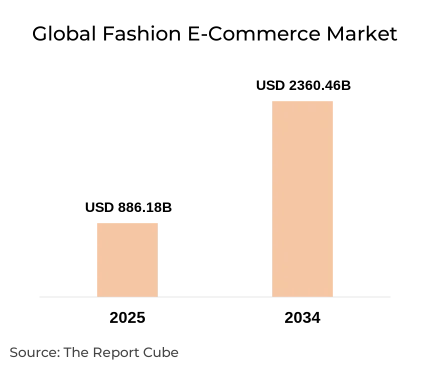
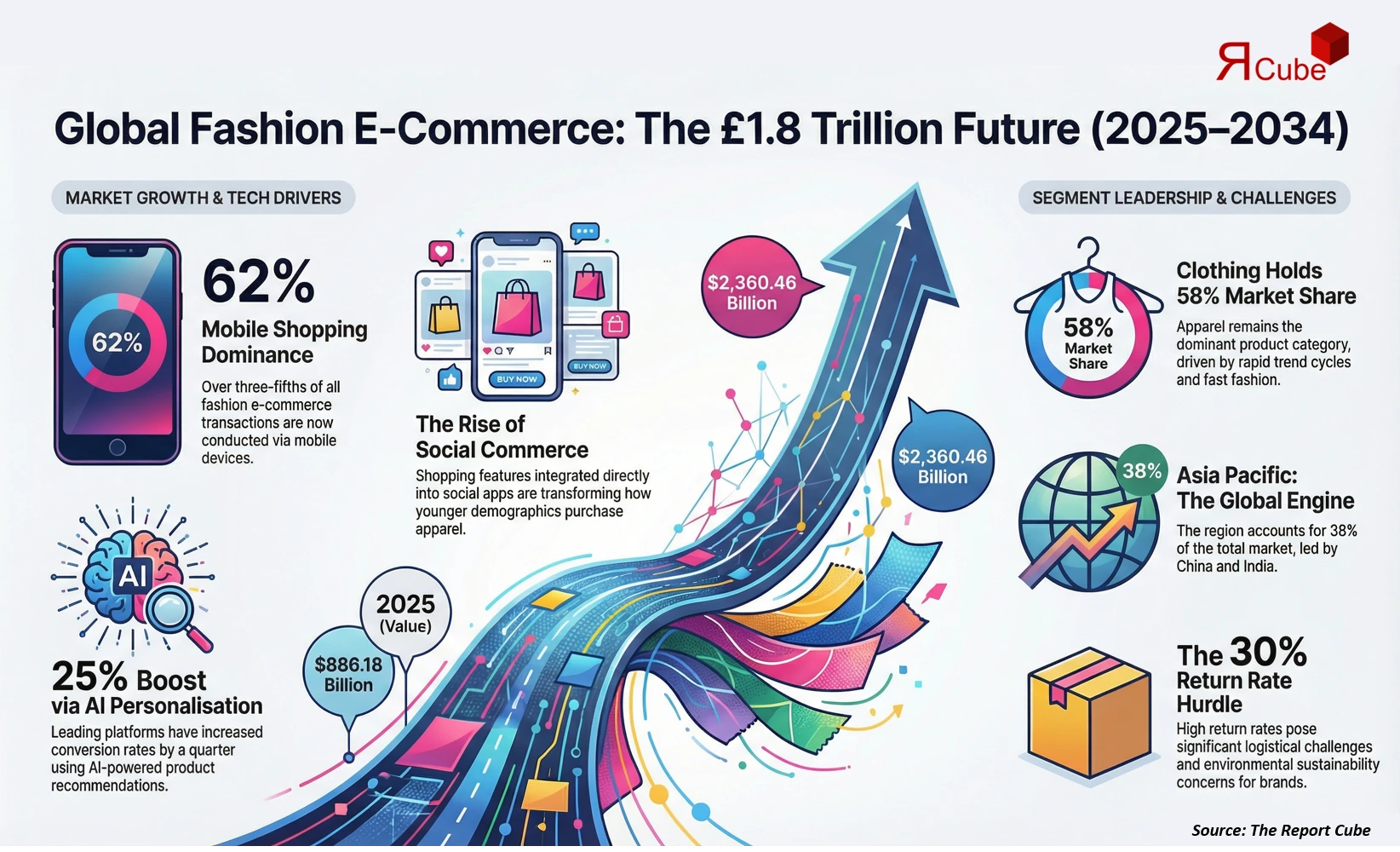
The Global Fashion E-Commerce Market is anticipated to register a CAGR of 11.50% during 2026-2034. The market size was valued at USD 886.18 billion in 2025 and is projected to reach USD 2,360.46 billion by 2034. The market has evolved into a core pillar of the global retail ecosystem, driven by rapid digital adoption, rising smartphone penetration, and changing consumer shopping behavior favoring convenience, variety, and competitive pricing.
Fashion e-commerce platforms enable brands to reach global audiences with minimal physical infrastructure while offering personalized shopping experiences through AI-driven recommendations. The growth of fast fashion, influencer-led purchasing decisions, and social commerce has further accelerated online fashion sales. Consumers increasingly prefer browsing, comparing, and purchasing apparel and accessories online due to flexible return policies and seamless payment options.
Additionally, emerging markets are witnessing exponential growth in online fashion consumption due to expanding middle-class populations and improving logistics networks. Sustainability-focused collections, resale platforms, and direct-to-consumer models are redefining the competitive landscape, positioning the fashion e-commerce market for sustained long-term growth.
Global Fashion E-Commerce Market Recent Developments
- 2025: Shein expanded AI-driven trend forecasting to reduce inventory waste and speed product launches.
- 2025: Amazon Fashion introduced virtual try-on features across multiple apparel categories.
Government Initiatives & Policies
- EU Digital Single Market Strategy: Supports cross-border e-commerce and digital retail growth.
- U.S. E-Commerce Consumer Protection Framework: Ensures transparency and fair digital trade practices.
Global Fashion E-Commerce Market Dynamics
Key Driver: Rapid Shift Toward Online and Mobile Shopping
The increasing preference for online shopping is the primary driver of the global fashion e-commerce market. Over 65% of fashion consumers globally now prefer online channels due to wider product assortments, dynamic pricing, and convenience. Mobile commerce plays a critical role, enabling impulse purchases and real-time engagement through apps and social media platforms.
Additionally, improved logistics, same-day delivery options, and hassle-free returns have reduced barriers to online apparel shopping. These factors collectively drive consistent growth across both developed and emerging markets.
Book your FREE 30-minute expert consultation today
Contact UsIndustry Trends: Social Commerce and Personalization
Social commerce has emerged as a transformative trend, with platforms integrating shopping features directly into social media applications. Influencer marketing and live-stream shopping events significantly impact purchasing decisions, especially among younger demographics. Personalized recommendations powered by AI have increased conversion rates by up to 25% for leading platforms.
Major Challenge: High Return Rates and Sustainability Concerns
High product return rates, particularly in apparel, pose operational and environmental challenges. Return rates often exceed 30% in fashion e-commerce, increasing logistics costs and carbon emissions. Additionally, growing scrutiny around fast fashion sustainability practices is pressuring brands to adopt ethical sourcing and transparent supply chains.
Opportunity: Expansion of D2C and Sustainable Fashion Models
Direct-to-consumer (D2C) models offer brands higher margins, better customer insights, and stronger brand loyalty. Meanwhile, sustainable fashion, resale platforms, and eco-friendly materials are gaining traction, creating new revenue streams and differentiation opportunities through 2034.
Global Fashion E-Commerce Market Segment-wise Analysis
By Product:
- Clothing
- Footwear
- Accessories
- Bags & Luggage
- Jewelry & Watches
- Other Fashion Products
Clothing dominates the global fashion e-commerce market, accounting for approximately 58% market share in 2025. High purchase frequency, wide product variety, and rapid trend cycles drive this segment’s leadership. Online platforms enable fast fashion brands to introduce new designs weekly, aligning closely with evolving consumer preferences.
Footwear and accessories collectively represent a significant share, supported by premiumization and brand-driven purchases. Jewelry and watches are gaining momentum due to improved digital trust and certification transparency. Bags and luggage are also witnessing steady growth, particularly in premium and travel-related categories.
By Gender:
- Men
- Women
- Unisex
The women’s segment leads with nearly 52% market share, driven by higher fashion consumption, seasonal demand, and product variety. Men’s fashion is the fastest-growing segment, fueled by rising grooming awareness and premium apparel adoption. Unisex fashion continues to gain popularity among Gen Z consumers.
By Age Group:
- Generation Z
- Millennials
- Generation X
- Baby Boomers
Millennials account for the largest share due to strong purchasing power and digital-native behavior. Generation Z is the fastest-growing group, heavily influenced by social media, sustainability values, and trend-driven shopping.
By Device:
- Desktop/Laptop
- Mobile
- Tablet
Mobile devices dominate with over 62% market share, supported by app-based shopping, digital wallets, and social commerce integration. Desktop remains relevant for premium and high-value purchases.
By Purchase Mode:
- Direct to Consumer (D2C)
- Marketplaces
- Social Commerce
Marketplaces lead due to extensive brand aggregation, while D2C is growing rapidly as brands seek control over pricing, data, and customer experience. Social commerce is emerging as a high-growth channel.
Need insights for a specific region within this market?
Request Regional DataRegional Projection of Global Fashion E-Commerce Industry
- North America
- Europe
- Asia Pacific
- Middle East & Africa
- South America
Asia Pacific leads the global fashion e-commerce market with approximately 38% share, driven by China, India, and Southeast Asia. High mobile adoption, large youth populations, and aggressive digital marketing fuel growth. North America and Europe remain strong markets, while the Middle East, Africa, and South America offer high-growth potential due to increasing internet penetration.
Why Choose This Report?
- Provides a comprehensive overview of the overall market analysis, encompassing key trends, consumer behavior analysis, and risk assessment.
- Provides accurate, up-to-date insights into market size, segmentation, and emerging opportunities.
- Gives deep understanding of target audience preferences and digital buying behavior.
- Delivers competitive analysis & benchmarking to guide strategic positioning.
- Consolidates market intelligence, reducing research time and costs.
- Supports customized market segmentation and risk mitigation strategies.
- Identifies key challenges and untapped opportunities for long-term growth.
- Provides insights based on actual consumer trends and data patterns.
Table of Contents
- Introduction
- Objective of the Study
- Fashion E-Commerce Definition
- Market Segmentation
- Study Variables
- Research Methodology
- Secondary Data Points
- Breakdown of Secondary Sources
- Primary Data Points
- Breakdown of Primary Interviews
- Secondary Data Points
- Executive Summary
- Market Dynamics
- Drivers
- Challenges
- Opportunity Assessment
- Recent Trends and Developments
- Regulatory and Policy Landscape
- Global Fashion E-Commerce Market Overview (2020-2034)
- Market Size, By Value (USD Billion)
- Market Share, By Product
- Clothing
- Footwear
- Accessories
- Bags & Luggage
- Jewelry & Watches
- Other Fashion Products
- Market Share, By Gender
- Men
- Women
- Unisex
- Market Share, By Age Group
- Generation Z
- Millennials
- Generation X
- Baby Boomers
- Market Share, By Device
- Desktop/Laptop
- Mobile
- Tablet
- Market Share, By Purchase Mode
- Direct to Consumer (D2C)
- Marketplaces
- Social Commerce
- Market Share, By Price Tier
- Mass
- Mid-Range
- Premium
- Luxury
- Market Share, By Company
- Competition Characteristics
- Revenue Shares & Analysis
- Market Share, By Region
- North America Fashion E-Commerce Market
- Market Size, By Value
- Market Share, By Product
- Market Share, By Purchase Mode
- Europe Fashion E-Commerce Market
- Market Size, By Value
- Market Share, By Product
- Market Share, By Purchase Mode
- Asia Pacific Fashion E-Commerce Market
- Market Size, By Value
- Market Share, By Product
- Market Share, By Purchase Mode
- Middle East and Africa Fashion E-Commerce Market
- Market Size, By Value
- Market Share, By Product
- Market Share, By Purchase Mode
- South America Fashion E-Commerce Market
- Market Size, By Value
- Market Share, By Product
- Market Share, By Purchase Mode
- North America Fashion E-Commerce Market
- Competitive Outlook and Company Profiles
- Zalando
- Company Overview
- Fashion E-Commerce Portfolio
- Strategic Alliances/Partnerships
- Recent Developments
- ASOS
- Company Overview
- Fashion E-Commerce Portfolio
- Strategic Alliances/Partnerships
- Recent Developments
- Amazon Fashion
- Company Overview
- Fashion E-Commerce Portfolio
- Strategic Alliances/Partnerships
- Recent Developments
- Shein
- Company Overview
- Fashion E-Commerce Portfolio
- Strategic Alliances/Partnerships
- Recent Developments
- Farfetch
- Company Overview
- Fashion E-Commerce Portfolio
- Strategic Alliances/Partnerships
- Recent Developments
- Others
- Company Overview
- Business Segments
- Strategic Alliances/Partnerships
- Recent Developments
- Zalando
- Contact Us / Disclaimer
Top Key Players & Market Share Outlook
- Zalando
- ASOS
- Amazon Fashion
- Shein
- Farfetch
- Others
Frequently Asked Questions