



Build Your Custom Market Intelligence Report
Customize Your ReportIndonesia Perfume Market Key Takeaways
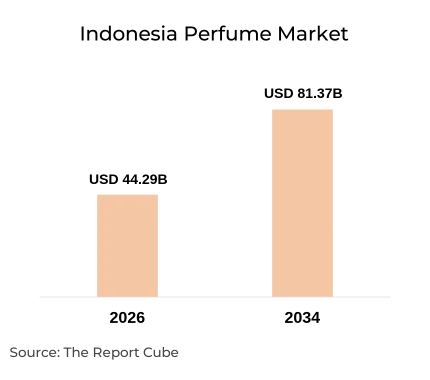
- Indonesia Perfume Market was valued at USD 44.29 billion in 2026, signaling robust expansion.
- Market is projected to reach USD 81.37 billion by 2034, reflecting strong demand.
- Industry is set to expand at a 7.90% CAGR through the 2026–2034 forecast period.
- Offline retail continues to dominate distribution, anchored by premium beauty destinations.
- Online retail is the fastest-growing distribution channel driven by social commerce.
- Women represent the leading end-user segment owing to broad fragrance consumption.
- Unisex perfume is the fastest-growing end-user category, gaining rapid consumer traction.
- Key players include LVMH, Chanel, Estée Lauder, Coty, Shiseido, Gucci, and Burberry.
Indonesia Perfume Market Insights & Analysis
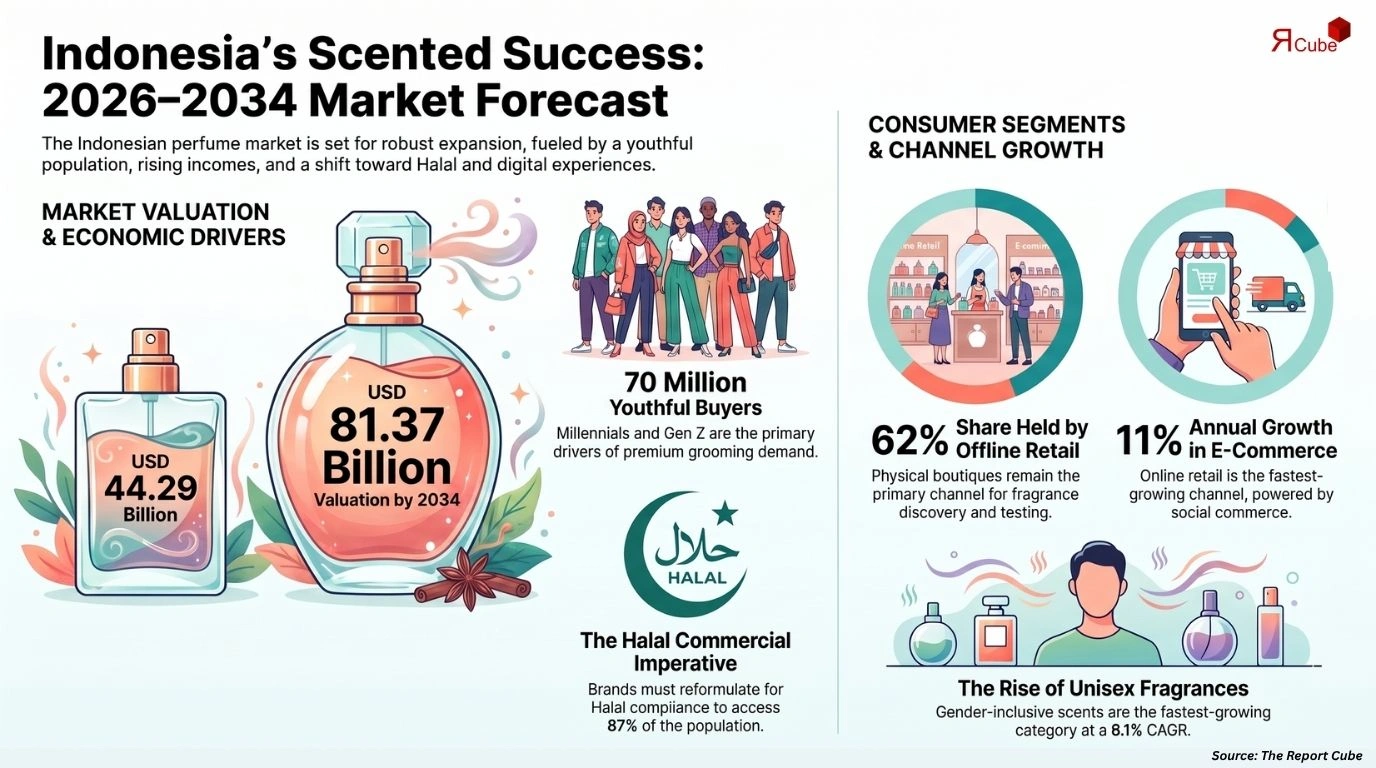
The Indonesia Perfume Market is anticipated to register a 7.90% CAGR during 2026–2034. The market size was valued at USD 44.29 billion in 2026 and is projected to reach USD 81.37 billion by 2034. The market is benefiting from a combination of rising disposable income, a youthful consumer base exceeding 70 million millennials and Gen Z buyers, and accelerating personal grooming awareness across urban and semi-urban populations. Indonesia's real GDP expanded by approximately 5% in 2025, providing a stable macroeconomic backdrop that is reinforcing consumer spending on premium lifestyle products including fragrances. Government initiatives supporting the halal economy - an industry valued at over IDR 4,000 trillion nationally - are directly shaping fragrance formulation and certification strategies, compelling brands to invest in compliant product lines to access the country's predominantly Muslim consumer base.
The Indonesia premium fragrance and personal care sector is witnessing heightened investment from global conglomerates seeking first-mover advantage in Southeast Asia's largest economy. Indonesia's local fragrance e-commerce segment alone was estimated at USD 1 billion in 2025 and is projected to nearly double to USD 1.89 billion by 2029, underscoring the scale of digital demand. Retail value sales of fragrances in Indonesia reached IDR 10,884 billion in 2025, representing 9% current-value growth. International brands such as LVMH, Shiseido, and Coty are deepening distribution through both luxury department stores and digital-first platforms such as Tokopedia and Shopee. Continued investments in influencer-led marketing, AI-powered scent recommendation tools, and exclusive online product drops are reshaping how consumers discover, evaluate, and purchase fragrances in the country.
Indonesia Perfume Market Dynamics
The Indonesia Perfume Market is expanding across all consumer tiers as rising income levels, urbanization, and social media influence combine to drive fragrance adoption beyond traditional luxury demographics. Mass-market and premium segments are growing concurrently, with brands competing on formulation quality, halal compliance, sustainability credentials, and digital accessibility. Regulatory modernization around halal certification and ingredient transparency continues reshaping the competitive landscape, creating both compliance pressures and differentiation opportunities for established and emerging players alike.
|
Factor |
Type |
Specific Impact on Market |
Magnitude |
|---|---|---|---|
|
Rising middle-class spending |
Driver |
Accelerates premium and mass fragrance adoption across urban populations |
Very High |
|
Halal certification mandates |
Driver |
Compels reformulation and boosts demand for compliant fragrance lines |
High |
|
Social commerce and influencer marketing |
Opportunity |
Expands online discovery and purchase conversion among younger consumers |
High |
|
Supply chain fragrance ingredient disruption |
Challenge |
Increases input costs and limits availability of specialty aroma compounds |
Moderate |
|
Premiumization and niche fragrance trend |
Trend |
Shifts consumer preferences toward curated, long-lasting, artisanal formulations |
High |
Key Market Driver: Rising Disposable Income and Urbanization
Indonesia's expanding middle class, projected to encompass over 50% of the population by 2030, is a principal engine driving fragrance consumption growth. Urban consumers in Jakarta, Surabaya, and Bandung are allocating increasing shares of discretionary spending toward personal grooming and lifestyle products, including branded and premium fragrances. According to industry data, fragrance retail in Indonesia recorded 9% value growth in 2025 amid stable macroeconomic conditions. The Southeast Asia personal care and beauty sector is benefiting from this income growth trajectory, with perfume purchases increasingly viewed as expressions of identity and social status rather than purely functional purchases, further reinforcing per-capita consumption volumes.
Major Industry Challenge: Halal Ingredient Compliance and Supply Chain Disruption
Approximately 87% of Indonesia's population identifies as Muslim, making halal certification not merely a regulatory box but a commercial imperative for fragrance brands operating in the market. Compliant formulation requires the elimination or substitution of alcohol-based carriers and ethically prohibited aroma compounds, necessitating significant R&D investment and reformulation timelines. Simultaneously, geopolitical disruptions affecting global fragrance ingredient trade routes in 2025 impacted the supply of specialty naturals and aroma chemicals, increasing input costs and reducing formulation flexibility. Brands unable to meet halal standards risk exclusion from major modern trade and e-commerce channels, particularly as retailers such as Tokopedia increasingly prioritize certified products in fragrance category listings.
Emerging Trend Shaping Outlook: Premiumization, Niche Scents, and Digital-First Discovery
Indonesian consumers are demonstrating a marked shift toward premiumization, with demand for long-lasting eau de parfum concentrations, artisanal oud-based compositions, and locally inspired ingredients such as pandan and ylang-ylang increasing steadily. Global niche brands including Byredo are refreshing regional strategies specifically to capture this appetite, while domestic players like Mykonos are building commercially successful positions around novel gourmand formulations. Digital platforms are central to this trend's acceleration - online fragrance retail and social commerce growth via TikTok, Instagram, and Shopee is enabling niche brands to reach national audiences with minimal physical retail investment, compressing time-to-market and democratizing access to premium fragrance experiences across Indonesia's diverse geographies.
Need Specific Data, Let’s Customize the Report for You
Request CustomizationIndonesia Perfume Market Segment-wise Analysis
The Indonesia Perfume Market is segmented across distribution channels and end-user demographics, reflecting the country's diversified retail infrastructure and evolving consumer preferences. Both dimensions reveal distinct growth patterns that present targeted expansion opportunities for international and domestic fragrance brands.
By Distribution Channel
- Online Retail
- Offline Retail
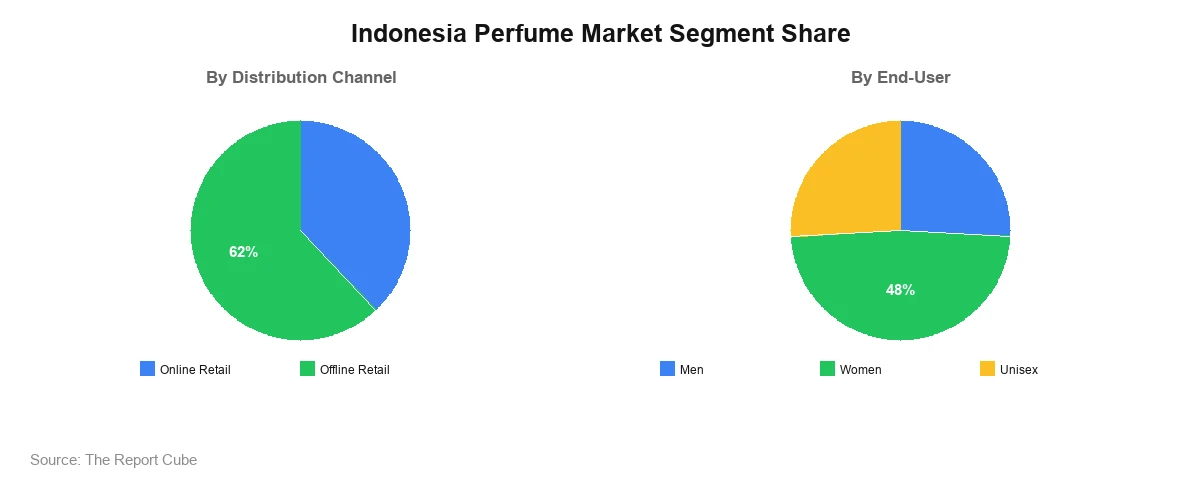
Offline retail dominates the Indonesia Perfume Market with an estimated 62% market share, reflecting the continued importance of physical touchpoints in fragrance purchase behavior. Department stores, specialty beauty retailers, luxury boutiques, and pharmacy chains serve as primary purchase environments where consumers can experience scent before committing to a purchase. Established brands including LVMH, Chanel, and Estée Lauder maintain strong shelf presences in premium outlets across Jakarta and Bali, leveraging counter-based consultation and sampling strategies to drive conversion. Duty-free retail at international airports also contributes meaningfully to offline channel revenues as Indonesian travel volumes recover.
Online retail represents the fastest-growing distribution channel, expanding at an estimated CAGR of approximately 11% through the forecast period, outpacing the overall market rate. E-commerce platforms Tokopedia and Shopee have become central fragrance discovery and transaction environments, with exclusive online product drops and influencer-seeded campaigns generating significant first-week sell-through volumes. Digital beauty platforms and social commerce expansion is enabling both international luxury brands and local fragrance startups to reach consumers in tier-two and tier-three cities previously underserved by physical fragrance retail. Mobile-first consumers, AI-powered scent recommendation tools, and increasing e-wallet adoption are collectively accelerating online channel penetration among younger Indonesian fragrance buyers.
By End-User
- Men
- Women
- Unisex
Women constitute the leading end-user segment with an estimated 48% market share, driven by broader fragrance consumption habits, higher purchase frequency, and diverse product format adoption spanning eau de toilette, eau de parfum, body mist, and solid fragrance formats. International brands including Chanel, Estée Lauder, and Gucci direct significant marketing investment toward female consumers in Indonesia, supported by celebrity endorsements, K-beauty crossover influences, and premium gifting occasions such as Eid, which represent peak purchase windows for the women's fragrance category. Continued investment from global players in locally relevant campaigns reinforces segment leadership.
The unisex fragrance category is the fastest-growing end-user segment, expanding at an estimated CAGR of 6.1% during the forecast period. Rising demand for gender-inclusive self-expression, combined with the global surge in oud, woody, and amber-forward compositions that transcend traditional gender segmentation, is driving unisex adoption among Indonesian millennials and Gen Z consumers. The Asia Pacific unisex and niche fragrance trend is particularly pronounced in Indonesia's urban centers, where consumers are increasingly resistant to prescriptive gender marketing in favor of scent-led personal identity. Men's fragrances account for an estimated 26% of the market, with grooming-conscious male consumers in their 20s and 30s driving incremental volume through deodorant-adjacent fragrance formats and long-lasting eau de parfum launches from Procter & Gamble and Avon Products.
Indonesia Perfume Market: Recent Development (2025)
- Coty Inc. launched its first refillable Chloé Rose Naturelle Intense perfume line addressing eco-conscious consumer demand.
- LVMH acquired a minority stake in niche fragrance house BDK Parfums, reinforcing its premium portfolio expansion strategy.
- Shiseido accelerated investment in Southeast Asia fragrance distribution, strengthening its Indonesia-focused premium brand partnerships.
- Estée Lauder expanded its Tom Ford Beauty fragrance range across Indonesian luxury retail and digital commerce platforms.
Indonesia Perfume Market Future Outlook (2034)
The Indonesia Perfume Market is projected to reach USD 81.37 billion by 2034, expanding at a 7.90% CAGR from a 2026 base of USD 44.29 billion. Long-term growth will be anchored by sustained income expansion across Indonesia's 286-million-person population, continued premiumization of fragrance consumption, and the deepening integration of digital retail channels into the fragrance purchase journey. Halal-certified fragrance innovation, natural ingredient sourcing, and ethically positioned brand narratives will become fundamental competitive requirements as regulatory frameworks tighten and consumer values evolve. Sustainable fragrance ingredient sourcing and reformulation will increasingly influence brand strategy, particularly as global supply chain pressures and environmental compliance expectations reshape procurement decisions for international fragrance manufacturers operating in Indonesia.
Technological transformation will redefine how Indonesian consumers discover and personalize fragrance experiences through the forecast period. AI-powered scent recommendation engines, augmented reality fragrance try-on tools, and data-driven direct-to-consumer subscription models will reduce purchase friction and deepen brand loyalty among digital-native consumer segments. Local fragrance brands inspired by indigenous botanicals - including oud, pandan, and ylang-ylang - will continue gaining commercial credibility alongside global luxury houses, fostering a more competitive and regionally distinctive market landscape. The broader Asia Pacific beauty and personal care growth trajectory will further accelerate multinational investment into Indonesian retail infrastructure, digital marketing capabilities, and halal product certification, collectively ensuring sustained market expansion through 2034 and beyond.
Indonesia Perfume Market Report Coverage
|
Report Attribute |
Details |
|---|---|
|
Market Name |
Indonesia Perfume Market |
|
Market Size (2026) |
USD 44.29 Billion |
|
Market Size (2034) |
USD 81.37 Billion |
|
Forecast Period |
2026–2034 |
|
CAGR |
7.90% |
|
Base Year |
2026 |
|
Historical Years |
2021–2025 |
|
Forecast Years |
2026–2034 |
|
Segments Covered |
By Distribution Channel, By End-User, By Category, By Product Type |
|
Regions Covered |
Java, Sumatra, Bali and Nusa Tenggara, Kalimantan, Sulawesi and Eastern Indonesia |
|
Key Companies |
LVMH (Louis Vuitton Moët Hennessy), Chanel, Estée Lauder Companies Inc., Coty Inc., Shiseido Company Limited, Gucci (Kering Group), Procter & Gamble, Burberry Group plc, Avon Products Inc., Others |
|
Report Format |
PDF, Excel, PPT |
|
Customization |
Available as per client requirements |
Why Choose This Report?
- Comprehensive analysis of Indonesia's fast-evolving perfume and fragrance landscape.
- Accurate market sizing and 7.90% CAGR forecast validated through 2034.
- Detailed segmentation by distribution channel and end-user demographics.
- Regional insights covering Java, Sumatra, Bali, Kalimantan, and Eastern Indonesia.
- Halal certification impact and compliance strategy analysis included.
- Competitive profiling of global leaders including LVMH, Chanel, and Coty.
- Digital retail and social commerce trend analysis for online channel strategy.
- Data-driven research aligned with EEAT standards and industry best practices.
Table of Contents
- Introduction
- Objective of the Study
- Product Definition
- Market Segmentation
- Study Variables
- Research Methodology
- Secondary Data Points
- Companies Interviewed
- Primary Data Points
- Breakdown of Primary Interviews
- Secondary Data Points
- Executive Summary
- Market Dynamics
- Drivers
- Challenges
- Opportunity Assessment
- Recent Trends and Developments
- Policy and Regulatory Landscape
- Indonesia Perfume Market Overview and Forecast Analysis (2021-2034)
- Market Size, By Value, By Growth Rate (CAGR/USD Billions)
- Demand – Supply Trends
- Market Share, By Product Type
- Eau de Parfum (EDP)
- Eau de Toilette (EDT)
- Eau de Cologne (EDC)
- Perfume Oils
- Others
- Market Share, By Category
- Luxury Perfumes
- Mass-Market Perfumes
- Market Share, By Distribution Channel
- Online Retail
- Offline Retai
- Market Share, By End-User
- Men
- Women
- Unisex
- Market Share, By Competitors
- Competition Characteristics
- Revenue Shares
- Eau de Parfum (EDP) Indonesia Perfume Market Overview, 2021-2034F
- By Value (USD Million)
- By Category – Market Size & Forecast 2021-2034, USD Million
- Luxury Perfumes
- Mass-Market Perfumes
- Eau de Toilette (EDT) Indonesia Perfume Market Overview, 2021-2034F
- By Value (USD Million)
- By Category – Market Size & Forecast 2021-2034, USD Million
- Luxury Perfumes
- Mass-Market Perfumes
- Eau de Cologne (EDC) Indonesia Perfume Market Overview, 2021-2034F
- By Value (USD Million)
- By Category – Market Size & Forecast 2021-2034, USD Million
- Luxury Perfumes
- Mass-Market Perfumes
- Perfume Oils Indonesia Perfume Market Overview, 2021-2034F
- By Value (USD Million)
- By Category – Market Size & Forecast 2021-2034, USD Million
- Luxury Perfumes
- Mass-Market Perfumes
- Others Indonesia Perfume Market Overview, 2021-2034F
- By Value (USD Million)
- By Category – Market Size & Forecast 2021-2034, USD Million
- Luxury Perfumes
- Mass-Market Perfumes
- Competitive Outlook (Company Profile - Partial List)
- LVMH (Louis Vuitton Moët Hennessy)
- Company Overview
- Business Segments
- Strategic Alliances/Partnerships
- Recent Developments
- Chanel
- Company Overview
- Business Segments
- Strategic Alliances/Partnerships
- Recent Developments
- Estée Lauder Companies Inc.
- Company Overview
- Business Segments
- Strategic Alliances/Partnerships
- Recent Developments
- Coty Inc.
- Company Overview
- Business Segments
- Strategic Alliances/Partnerships
- Recent Developments
- Shiseido Company Limited
- Company Overview
- Business Segments
- Strategic Alliances/Partnerships
- Recent Developments
- Gucci (Kering Group)
- Company Overview
- Business Segments
- Strategic Alliances/Partnerships
- Recent Developments
- Procter & Gamble
- Company Overview
- Business Segments
- Strategic Alliances/Partnerships
- Recent Developments
- Burberry Group plc
- Company Overview
- Business Segments
- Strategic Alliances/Partnerships
- Recent Developments
- Avon Products Inc.
- Company Overview
- Business Segments
- Strategic Alliances/Partnerships
- Recent Developments
- Others
- LVMH (Louis Vuitton Moët Hennessy)
- Contact Us & Disclaimer
Top Key Players & Market Share Outlook
- LVMH (Louis Vuitton Moët Hennessy)
- Chanel
- Estée Lauder Companies Inc.
- Coty Inc.
- Shiseido Company, Limited
- Gucci (Kering Group)
- Procter & Gamble
- Burberry Group plc
- Avon Products, Inc.
- Others
Frequently Asked Questions






