




Build Your Custom Market Intelligence Report
Customize Your ReportKey Takeaways (2026-2034)
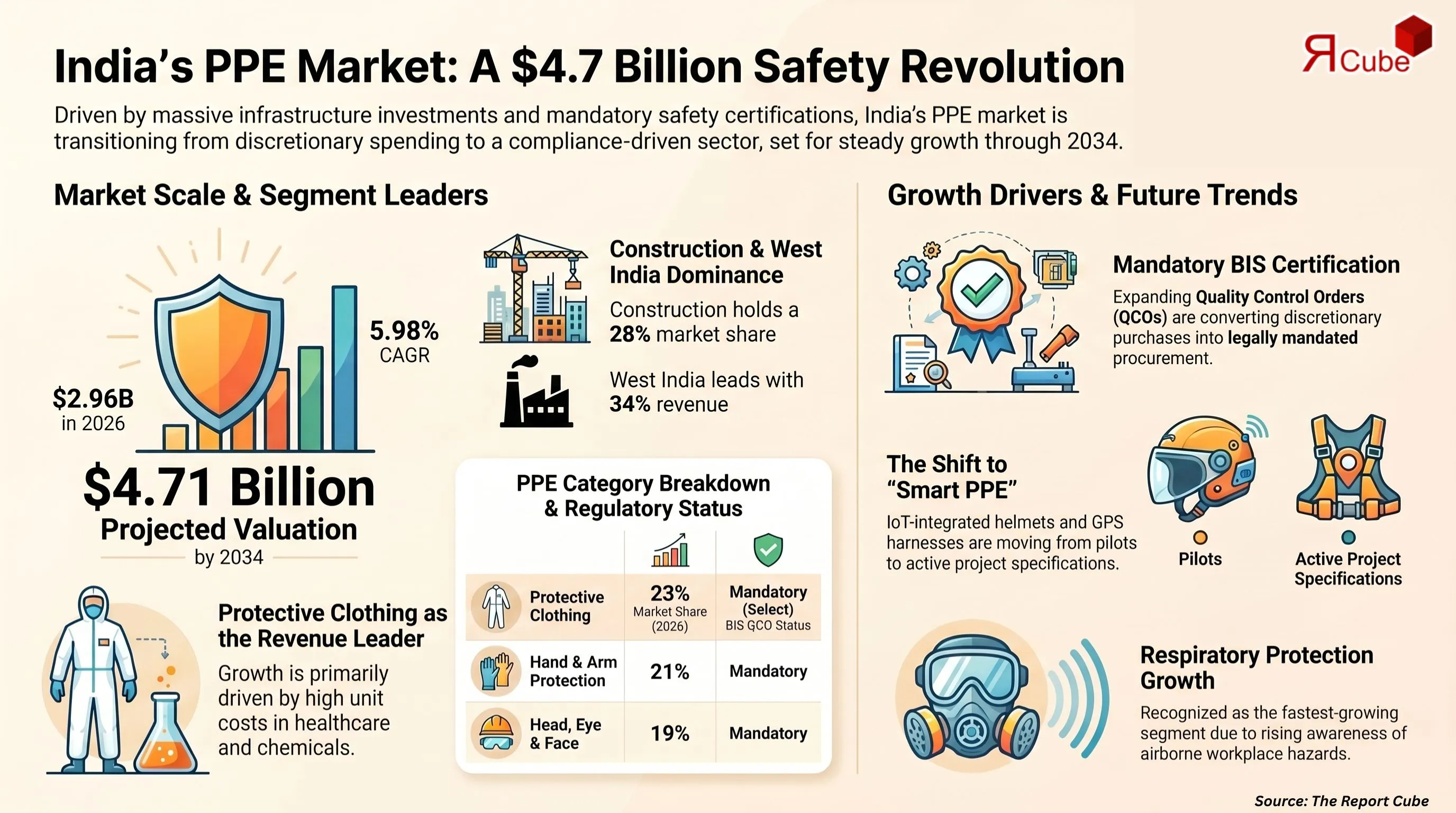
- The market is projected to grow from USD 2.96 billion in 2026 to USD 4.71 billion by 2034, reflecting steady expansion.
- A CAGR of 5.98% indicates consistent demand driven by industrial safety compliance and workforce protection needs.
- Protective Clothing remains the dominant equipment type, maintaining its leadership throughout the forecast period.
- Respiratory Protection stands out as the fastest-growing segment, fueled by rising awareness of airborne hazards and stricter workplace safety norms.
- The construction sector continues to be the largest end-use industry, supported by ongoing infrastructure development and urbanization.
- Regulatory frameworks like the Factories Act 1948 and BIS-mandated PPE standards play a crucial role in market growth, ensuring compliance and adoption.
- The market outlook is shaped by a combination of regulatory enforcement, industrial expansion, and increasing focus on worker safety.
India PPE Market Insights & Analysis
India's workforce of over 500 million people operates across sectors - construction, oil and gas, chemicals, healthcare - where occupational hazard exposure is high, yet PPE compliance enforcement has historically remained inconsistent. India recorded over 48,000 reported workplace fatalities in the formal sector between 2017 and 2022 (Ministry of Labour and Employment, India, 2023), a figure that almost certainly undercounts the informal economy, placing PPE adoption at the centre of an urgent policy and commercial conversation. This section maps the structural forces carrying the India PPE market from USD 2.96 billion in 2026 to USD 4.71 billion by 2034 at a 5.98% CAGR - from regulatory tightening to infrastructure-led demand from government capital expenditure programmes.
What is the size of the India PPE market?
The India PPE market is valued at USD 2.96 billion in 2026 and is projected to reach USD 4.71 billion by 2034, growing at a CAGR of 5.98% over the forecast period. India's INR 11.11 trillion infrastructure budget in FY2024–25 (Ministry of Finance, India, 2024) directly generates demand for head, hand, foot, and fall protection PPE across active construction sites. The Bureau of Indian Standards (BIS) mandatory certification regime is simultaneously expanding PPE product categories under IS standards - increasing compliance procurement from large contractors who cannot legally source uncertified equipment.
Post-COVID institutional memory in healthcare PPE procurement has reshaped state health departments and hospital chains, which now maintain elevated stock levels of respiratory and body protection as a matter of policy rather than emergency response. Rising formalisation of India's manufacturing sector under PLI (Production-Linked Incentive) schemes is further driving employer PPE obligations for factory-floor workers, creating a structural uplift that compounds year-on-year across the forecast period.
Import substitution adds a competitive dimension: domestic manufacturers - including Lakeland Industries' India operations and DuPont India - are gaining share against imported PPE through "Make in India" procurement preferences. The key structural distinction shaping this market is between compliance-driven procurement (mandatory BIS-certified PPE for regulated industries) and voluntary/discretionary procurement (SME construction, informal manufacturing) - a divide that determines which product categories and price tiers grow fastest through 2034.
India PPE Market Dynamics
Key Market Driver: Mandatory BIS Certification and Expanding Regulatory Compliance Requirements
PPE procurement in India has long been discretionary - employers buy what they choose, not what regulators require, because enforcement of the Factories Act 1948 PPE provisions has been fragmented across state labour departments. The Bureau of Indian Standards had issued mandatory certification orders covering 14 PPE product categories by 2024, yet a 2023 DGFASLI survey found that fewer than 30% of small and medium factories in high-risk sectors maintained full PPE compliance (DGFASLI, 2023). Tightening BIS Quality Control Orders and DGFASLI audit frequency are converting discretionary PPE spend into mandatory procurement - the primary structural driver of the 5.98% CAGR through 2034.
What is driving the India PPE market?
Mandatory BIS Quality Control Orders expanding across all major PPE categories, combined with increasing DGFASLI audit frequency, are the primary structural driver - converting historically discretionary PPE purchases into legally mandated procurement across formal-sector employers.
BIS QCOs for helmets (IS 2925), safety shoes (IS 15298), gloves (IS 4770), and respiratory masks (IS 15683) have already converted these categories into mandatory, traceable procurement. DGFASLI enforcement campaigns and state-level factory inspection quota increases are pressuring SME compliance timelines that were previously ignored. Factories Act 1948 Sections 13 and 14 - which place legal obligation on employers to provide PPE - are increasingly tested in state labour courts following high-profile industrial accidents, raising litigation risk for non-compliant firms.
Large EPC contractors including L&T and TATA Projects are mandating ISO-aligned PPE supplier qualification for subcontractors, cascading compliance requirements down supply chains and pulling previously informal procurement into the certified market. The table below maps which specific BIS Quality Control Orders govern each major PPE category - giving procurement managers a compliance timeline absent from most competitor sources.
|
PPE Category |
BIS Standard |
QCO Status (2024) |
Key Regulated Sectors |
|---|---|---|---|
|
Industrial Safety Helmets |
IS 2925 |
Mandatory |
Construction, Mining, Oil & Gas |
|
Rubber/PVC Hand Gloves |
IS 4770 |
Mandatory |
Chemical, Healthcare, Manufacturing |
|
Safety Footwear |
IS 15298 |
Mandatory |
Construction, Manufacturing |
|
Respiratory Protective Devices |
IS 15683 |
Mandatory (select types) |
Chemical, Mining, Healthcare |
|
High-Visibility Clothing |
IS 15809 |
Under review |
Construction, Road work |
|
Eye and Face Protection |
IS 5983 |
Mandatory |
Chemical, Welding, Manufacturing |
Major Industry Challenge: Informal Economy Penetration and Price-Driven Non-Compliance
India's construction and manufacturing sectors run on a two-tier labour market: formally employed workers in large firms receive PPE; informally contracted daily-wage workers on the same sites frequently do not. The informal economy accounts for approximately 90% of India's total workforce of 500 million people (ILO, 2023), meaning the vast majority of workers exposed to occupational hazards operate outside the BIS compliance enforcement perimeter entirely. This compliance gap - not product quality or awareness - is the primary structural ceiling on how fast PPE market volumes can grow, and understanding it is essential for any manufacturer targeting the mass-market price tier.
Sub-INR 500 price sensitivity in the informal sector creates a market within a market: BIS-compliant helmets retail at INR 800–2,000, while uncertified equivalents sell for INR 150–400. DGFASLI and BIS joint enforcement operations have seized non-certified helmets and gloves at major construction supply yards, yet the scale of the counterfeit market remains significant (DGFASLI, 2023). The Contract Labour Act 1970 places legal liability for subcontractor worker PPE on principal employers - yet enforcement of this liability remains inconsistent across state jurisdictions.
Distribution fragmentation compounds the problem: tier-2 and tier-3 city PPE distribution relies on general hardware traders carrying limited BIS-certified product ranges, making access to compliant equipment structurally difficult even where demand exists. Micro and small enterprises treat certified PPE as avoidable overhead rather than a legal obligation, and no regulatory mechanism currently changes that calculus.
Emerging Trend: Smart PPE and IoT-Integrated Safety Equipment Entering India's Large Project Sites
Standard PPE protects workers from known hazards - it does not detect when a worker is fatigued, has entered a restricted zone, or has been exposed to a gas leak in real time. India's large infrastructure projects - RVNL rail corridors, NHIDCL highway stretches, ONGC offshore platforms - each deploy thousands of workers daily in environments where real-time hazard monitoring failures have caused multi-fatality incidents in the 2020–2024 period. IoT-integrated helmets with proximity sensors, smart respiratory masks with particulate monitors, and GPS-enabled fall detection harnesses are transitioning from pilot programmes on Indian mega-sites to active procurement specifications for Tier-1 EPC contractors.
What are the emerging trends in the India PPE market?
IoT-integrated safety equipment - including smart helmets with GPS and gas sensors, wearable gas detectors, and GPS fall harnesses - is moving from pilot programmes to active procurement specifications at major Indian infrastructure project sites, marking the most significant product category shift of the 2024–2034 period.
Honeywell, 3M, and domestic manufacturer Karam are deploying sensor-embedded helmets at NHAI and NTPC project sites - tracking location, impact events, and environmental gas exposure simultaneously. Dräger and MSA Safety IoT-connected gas monitors are specified in ONGC and IOCL refinery PPE contracts, while DGFASLI's "Safe India" digital portal for workplace accident reporting creates data infrastructure that supports smart PPE incident correlation. Smart helmets currently retail at INR 8,000–25,000, confining adoption to premium project tiers - but the price trajectory points toward an INR 3,000–5,000 range by 2028–2029 as domestic electronics integration matures.
|
Smart PPE Type |
Technology Feature |
Price Range (INR) |
Current Adoption Tier |
Key Indian Project Type |
|---|---|---|---|---|
|
IoT Safety Helmet |
GPS + impact + gas sensor |
8,000–25,000 |
Large EPC / Tier-1 |
Highways, Rail, Power |
|
Smart Respiratory Mask |
Particulate + O₂ monitor |
5,000–18,000 |
Oil & Gas, Chemical |
Refinery, Petrochemical |
|
GPS Fall Harness |
Fall detection + location alert |
6,000–20,000 |
High-rise, Wind Energy |
Construction, Infra |
|
Thermal Imaging Vest |
Heat stress monitoring |
12,000–35,000 |
Foundry, Steel |
Manufacturing |
Emerging Opportunity - Healthcare and Pharmaceutical Sector PPE Demand Post-COVID Institutionalisation
India's healthcare sector entered COVID-19 with almost no institutionalised PPE procurement infrastructure - hospitals sourced gloves, gowns, and respirators on the spot market, at 5–10× normal prices, with inconsistent quality. India consumed an estimated 8.4 billion units of disposable PPE (gloves, masks, gowns, face shields) in 2020–2021 alone (Ministry of Health and Family Welfare, India, 2021), catalysing domestic manufacturing capacity that now competes internationally. The institutional memory of that supply shock is now driving formalised, recurring PPE procurement frameworks across AIIMS network hospitals, state health departments, and India's rapidly expanding pharmaceutical GMP manufacturing base.
National Health Mission (NHM) PPE procurement standardisation now operates through bulk tender frameworks for gloves, masks, and protective clothing across district hospitals - converting episodic purchasing into predictable recurring demand. Pharmaceutical sector GMP facilities operating under WHO-GMP and US FDA audit standards mandate anti-static coveralls, cleanroom gloves, and respiratory protection meeting IS/ISO standards as a condition of certification maintenance. The AYUSH hospital network expansion - 12,500+ facilities under current government plans - creates incremental PPE demand for practitioner protection across a footprint that did not exist a decade ago.
Alpha Pro Tech Ltd. and Ansell Ltd. are positioned to capture pharmaceutical cleanroom hand protection growth in India's medical device SEZs in Andhra Pradesh and Telangana. Healthcare PPE demand divides into three tiers with divergent commercial implications: AIIMS and tertiary care facilities (premium specification), district hospital NHM procurement (price-sensitive bulk), and pharma GMP facilities (regulatory-grade, repeat contracts).
Need Specific Data, Let’s Customize the Report for You
Request CustomizationIndia PPE Market Segment-wise Analysis
By Equipment Type
Treating all PPE equipment types as equivalent procurement categories misrepresents the market - each type serves a different hazard profile, is governed by different BIS standards, and grows at a different rate depending on which end-use sector is expanding. Protective Clothing commands the largest revenue share due to high unit cost, multi-layer material requirements for chemical/biological protection, and mandatory use across healthcare, chemical, and food processing sectors - yet Respiratory Protection is growing fastest as air quality and occupational dust exposure regulations tighten. The table below layers equipment type share data against BIS mandatory QCO status - revealing which categories have compliance-mandated demand floors and which remain discretionary.
Which equipment type holds the largest share in the India PPE market?
Protective Clothing holds the largest estimated revenue share at approximately 23% in 2026, driven by high unit cost and mandatory use across healthcare, chemical, and food processing sectors. Respiratory Protection is the fastest-growing category, accelerated by post-COVID regulatory tightening and oil and gas sector demand.
|
Equipment Type |
Estimated Market Share (2026) |
BIS QCO Mandatory? |
Primary End-Use Sector |
Growth Outlook |
|---|---|---|---|---|
|
Protective Clothing |
23% |
Yes (select categories) |
Healthcare, Chemical, Food |
Moderate–High |
|
Hand & Arm Protection |
21% |
Yes |
Chemical, Manufacturing, Healthcare |
Moderate |
|
Head, Eye & Face Protection |
19% |
Yes |
Construction, Mining, Welding |
Moderate |
|
Protective Footwear |
16% |
Yes |
Construction, Manufacturing |
Moderate |
|
Respiratory Protection |
12% |
Yes (select types) |
Oil & Gas, Chemical, Healthcare |
High |
|
Fall Protection |
5% |
Under review |
Construction, Wind Energy |
High |
|
Hearing Protection |
3% |
No |
Foundry, Textile, Steel |
Stable |
|
Others |
1% |
Varies |
Miscellaneous |
Low |
By End Use
PPE demand is not distributed evenly across India's industrial economy - end-use sector determines not only volume but also product specification, price tier, and procurement channel. Construction accounts for over 8% of India's GDP and employs an estimated 71 million workers (MOSPI, 2023), making it the single largest driver of PPE volume demand - yet it is also the sector with the widest gap between required and actual PPE usage. The following profiles each sector's contribution to the India PPE market and the specific equipment categories consumed.
Which end-use sector drives the India PPE market?
Construction is the largest end-use sector with an estimated 28% market share in 2026, driven by 71 million construction workers and sustained government infrastructure investment under the National Infrastructure Pipeline. Healthcare is the fastest-growing end-use sector, propelled by post-COVID procurement formalisation across AIIMS network hospitals and NHM district facilities.
Oil and gas carries the highest PPE spend per worker: ONGC, IOCL, BPCL, and Reliance Industries mandate comprehensive PPE packages, with offshore platform requirements driving demand for powered air-purifying respirators (PAPRs) and chemical suits at premium price points. Chemical clusters in Gujarat and Maharashtra - Dahej, Hazira, Vadodara - represent the highest revenue-per-worker PPE zone in India, even at a smaller total workforce than construction.
|
End-Use Sector |
Estimated Market Share (2026) |
PPE Spend Intensity |
Key PPE Categories |
Growth Outlook |
|---|---|---|---|---|
|
Construction |
28% |
Moderate |
Helmets, Harnesses, Footwear, Hi-Vis |
High |
|
Manufacturing |
22% |
Moderate |
Gloves, Eye Protection, Hearing, Footwear |
Moderate |
|
Oil & Gas |
18% |
High |
Chemical Suits, Respirators, Gloves, Footwear |
Moderate–High |
|
Healthcare |
14% |
Moderate–High |
Gloves, Masks, Gowns, Face Shields |
High |
|
Chemical |
10% |
High |
Chemical Suits, Gloves, Respirators, Eyewear |
Moderate |
|
Others |
8% |
Low–Moderate |
Varies by sub-sector |
Moderate |
Regional Projection of the India PPE Market
India's PPE market is not a single national market - it is a collection of regional demand clusters shaped by industrial composition, infrastructure investment concentration, and state-level labour law enforcement intensity. Maharashtra, Gujarat, and Tamil Nadu together account for an estimated 45–50% of India's organised industrial workforce (MOSPI, 2023), concentrating PPE demand in a western and southern corridor while northern and eastern regions remain significantly under-penetrated relative to their workforce size. This section maps each major region's contribution to the 2026–2034 expansion and identifies where infrastructure investment is creating new demand centres.
Which region leads the India PPE market?
West India - comprising Maharashtra and Gujarat - leads with an estimated 34% revenue share in 2026, driven by the concentration of chemical, petrochemical, oil and gas, and pharmaceutical manufacturing industries requiring premium-specification PPE.
- West India (Maharashtra + Gujarat) - Market leader by revenue. Maharashtra hosts Reliance, BPCL, and major pharmaceutical manufacturers driving premium PPE demand. Gujarat's chemical and petrochemical clusters - Dahej, Hazira, Vadodara - constitute the highest PPE spend-per-worker zone in India. Mumbai's construction boom (Metro lines, coastal road, Navi Mumbai airport) sustains helmet and harness volume demand through the forecast period.
- South India (Tamil Nadu + Karnataka + Andhra Pradesh + Telangana) - Second-largest region, growing at an above-average rate. Auto manufacturing hubs (Chennai, Hosur), electronics PLI units (Karnataka), and pharmaceutical GMP facilities (Hyderabad) anchor manufacturing PPE demand. Visakhapatnam port expansion and steel capacity growth drive incremental industrial PPE requirements.
- North India (Delhi NCR + Uttar Pradesh + Rajasthan + Haryana) - Third-largest and fastest-growing region. Delhi-Mumbai Industrial Corridor (DMIC) construction, UP Expressway network, and Rajasthan's mining activity generate sustained demand for helmets, harnesses, and footwear. PPE distribution infrastructure in UP and Bihar remains underdeveloped relative to the scale of project activity.
- East India (West Bengal + Odisha + Jharkhand + Bihar) - Significant coal, steel, and mineral mining activity through SAIL, Tata Steel, and Coal India creates concentrated mining-grade PPE demand. Construction PPE volumes rise with AMRUT 2.0 and Smart Cities Mission projects in Bhubaneswar, Ranchi, and Kolkata.
|
Region |
Estimated Market Share (2026) |
Key Industry Driver |
Dominant PPE Category |
Growth Outlook |
|---|---|---|---|---|
|
West (MH + GJ) |
34% |
Chemical, Oil & Gas, Pharma |
Chemical Suits, Respirators, Gloves |
Moderate–High |
|
South (TN + KA + AP + TS) |
27% |
Auto, Electronics, Pharma |
Hand Protection, Footwear, Clothing |
High |
|
North (NCR + UP + RJ + HR) |
24% |
Construction, DMIC, Mining |
Helmets, Harnesses, Footwear |
High |
|
East (WB + OD + JH + BR) |
15% |
Coal, Steel, Mining |
Helmets, Respiratory, Footwear |
Moderate |
India PPE Market - Recent Developments (2024–2025)
- 2025 - DuPont de Nemours Inc. expanded its Tyvek protective clothing distribution partnership with a Mumbai-based industrial safety distributor, targeting the Gujarat petrochemical cluster and Maharashtra pharma GMP sectors.
- Q4 2024 - Ansell Ltd. launched a new range of chemical-resistant gloves (AlphaTec series) formally registered under BIS IS 4770 standards for the Indian market, targeting oil refinery and chemical plant procurement.
- 2024 - Bureau of Indian Standards (BIS) issued a revised Quality Control Order mandating BIS certification for all imported safety footwear sold in India under IS 15298, effective January 2025.
- 2024 - FallTech announced an India distribution agreement with a Chennai-based safety equipment specialist, focusing on fall protection harnesses for wind energy and high-rise construction sites in South India.
- 2024 - Alpha Pro Tech Ltd. reported entry into India's hospital procurement tender framework through an empanelment with a state NHM authority for disposable protective gowns and face shields.
Each development above activates a specific BIS standard or procurement channel - together signalling accelerating formalisation of the India PPE market across both industrial and healthcare end-use segments.
India PPE Market Future Outlook (2034)
A 5.98% CAGR is steady growth - not the explosive trajectory of a newly discovered market category, but the durable expansion of a compliance-anchored sector where regulatory timelines, not consumer sentiment, set the pace. The risk to that 5.98% trajectory is not demand weakness - India's infrastructure pipeline and manufacturing PLI schemes guarantee underlying volume growth - but rather the continued dominance of non-certified PPE in the informal sector, which depresses average selling price and market value even as unit volumes grow. Four structural forces will determine whether India's PPE market reaches USD 4.71 billion, exceeds it, or falls short by 2034.
What is the future of the India PPE market?
The India PPE market is projected to reach USD 4.71 billion by 2034 at a 5.98% CAGR, driven by BIS QCO expansion, the National Infrastructure Pipeline, and smart PPE cost reduction. An accelerator scenario - full BIS QCO coverage plus mass smart PPE adoption - could push the market above USD 5.5 billion; sustained informal sector non-compliance could hold it below USD 4.5 billion.
- Policy driver: Expansion of BIS Quality Control Orders to cover all eight equipment type categories by 2027–2028 will convert remaining discretionary PPE categories into mandatory, traceable procurement across formal-sector employers - the single largest regulatory lever available to the market.
- Infrastructure driver: The National Infrastructure Pipeline (NIP) - 9,000+ projects worth INR 111 trillion targeted for completion by 2030 (Ministry of Finance, India, 2021) - generates sustained multi-year demand for helmets, harnesses, footwear, and high-visibility clothing. This pipeline is already contracted and is the most predictable demand driver in the forecast.
- Technology driver: Smart PPE reaching the INR 3,000–5,000 price threshold by 2028–2029 opens Tier-1 EPC contractor mass adoption. At that price point, smart helmets and respiratory monitors become economically viable across mid-tier project sites, not just flagship mega-projects.
- Risk factor: The 90% informal workforce share (ILO, 2023) limits certified PPE market expansion to the formal sector growth rate unless enforcement mechanisms fundamentally change. Currency depreciation compressing import costs for non-certified equipment represents an additional downside risk to average selling price.
Why Choose This Report?
- Full 2026–2034 forecast with 2026 base year validation across eight equipment type segments
- End-use sector analysis across six industries including oil & gas, construction, chemical, healthcare, and manufacturing
- Region-by-region market share projection covering West, South, North, East, and Central India
- BIS Quality Control Order compliance tracker across all major PPE categories
- Competitive landscape covering 9 named key players plus domestic Indian manufacturers
- Smart PPE and IoT-integrated safety equipment adoption analysis for 2026–2034
- Actionable data formatted for procurement strategy, investment decisions, and regulatory compliance planning
Table of Contents
- Introduction
- Objective of the study
- Product Definition
- Market Segmentation
- Study Variables
- Research Methodology
- Secondary Data Points
- Companies Interviewed
- Primary Data Points
- Breakdown of Primary Interviews
- Secondary Data Points
- Executive Summary
- Market Dynamics
- Drivers
- Challenges
- Opportunity Assessment
- Recent Trends and Developments
- Policy and Regulatory Landscape
- India Personal Protective Equipment (PPE) Market Overview and Forecast Analysis (2021-2034)
- Market Size, By Value, By growth rate (CAGR/USD Billions)
- Demand - Supply Trends
- Market Share, By Equipment Type
- Head, Eye and Face Protection
- Respiratory Protection
- Hand and Arm Protection
- Protective Clothing
- Fall Protection
- Protective Footwear
- Hearing Protection
- Others
- Market Share, By End Use
- Oil and Gas
- Construction
- Chemical
- Healthcare
- Manufacturing
- Others
- Market Share, By Region
- West
- South
- North
- East
- Market Share, By Competitors
- Competition Characteristics
- Revenue Shares
- India Head, Eye and Face Protection Personal Protective Equipment (PPE) Market Overview, 2021-2034F
- By Value (USD Million)
- By End Use- Market Size & Forecast 2021-2034, USD Million
- India Respiratory Protection Personal Protective Equipment (PPE) Market Overview, 2021-2034F
- By Value (USD Million)
- By End Use- Market Size & Forecast 2021-2034, USD Million
- India Hand and Arm Protection Personal Protective Equipment (PPE) Market Overview, 2021-2034F
- By Value (USD Million)
- By End Use- Market Size & Forecast 2021-2034, USD Million
- India Protective Clothing Personal Protective Equipment (PPE) Market Overview, 2021-2034F
- By Value (USD Million)
- By End Use- Market Size & Forecast 2021-2034, USD Million
- India Fall Protection Personal Protective Equipment (PPE) Market Overview, 2021-2034F
- By Value (USD Million)
- By End Use- Market Size & Forecast 2021-2034, USD Million
- India Protective Footwear Personal Protective Equipment (PPE) Market Overview, 2021-2034F
- By Value (USD Million)
- By End Use- Market Size & Forecast 2021-2034, USD Million
- India Hearing Protection Personal Protective Equipment (PPE) Market Overview, 2021-2034F
- By Value (USD Million)
- By End Use- Market Size & Forecast 2021-2034, USD Million
- India Others Personal Protective Equipment (PPE) Market Overview, 2021-2034F
- By Value (USD Million)
- By End Use- Market Size & Forecast 2021-2034, USD Million
- Competitive Outlook (Company Profile - Partial List)
- Radian Group Inc
- Company Overview
- Business Segments
- Strategic Alliances/Partnerships
- Recent Developments
- Cofra
- Company Overview
- Business Segments
- Strategic Alliances/Partnerships
- Recent Developments
- Delta Plus Group S.A.
- Company Overview
- Business Segments
- Strategic Alliances/Partnerships
- Recent Developments
- Alpha Pro Tech Ltd
- Company Overview
- Business Segments
- Strategic Alliances/Partnerships
- Recent Developments
- Lakeland Industries Inc
- Company Overview
- Business Segments
- Strategic Alliances/Partnerships
- Recent Developments
- Avon Protection PLC
- Company Overview
- Business Segments
- Strategic Alliances/Partnerships
- Recent Developments
- FallTech
- Company Overview
- Business Segments
- Strategic Alliances/Partnerships
- Recent Developments
- Ansell Ltd
- Company Overview
- Business Segments
- Strategic Alliances/Partnerships
- Recent Developments
- DuPont de Nemours Inc
- Company Overview
- Business Segments
- Strategic Alliances/Partnerships
- Recent Developments
- Others
- Radian Group Inc
- Contact Us & Disclaimer
Top Key Players & Market Share Outlook
- Radian Group Inc
- Cofra
- Delta Plus Group S.A.
- Alpha Pro Tech Ltd
- Lakeland Industries Inc
- Avon Protection PLC
- FallTech
- Ansell Ltd
- DuPont de Nemours Inc
- Others
Frequently Asked Questions






