



Build Your Custom Market Intelligence Report
Customize Your ReportSouth India Plant-Based Dairy Products Market Key Highlights
By Product Type:
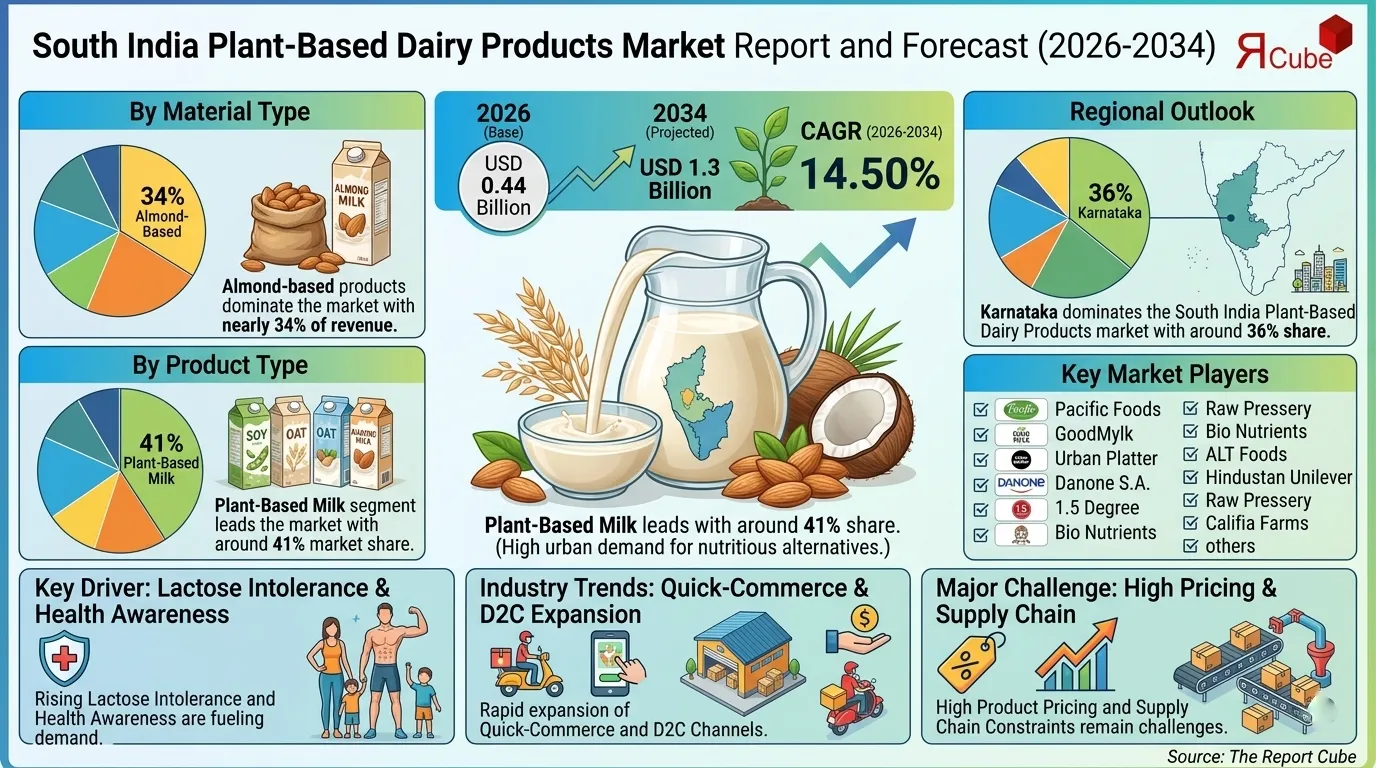
Plant-Based Milk segment leads the market with around 41% market share.
By Material Type:
Almond-based products dominate the market with nearly 34% of revenue.
Regional Outlook:
Karnataka dominates the South India Plant-Based Dairy Products market with around 36% share.
South India Plant-Based Dairy Products Market Insights & Analysis
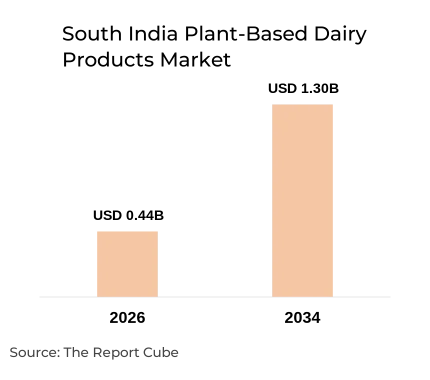
The South India Plant-Based Dairy Products Market is anticipated to register a CAGR of around 14.50% during the forecast period 2026-2034. The market size is valued at USD 0.44 billion in 2026 and is projected to reach USD 1.3 billion by 2034. The strong expansion reflects a shift in consumer preferences toward lactose-free and sustainable food choices. Urban centers such as Bengaluru, Chennai, and Hyderabad are leading adoption, driven by increasing disposable income and exposure to global dietary trends. The South India Plant-Based Dairy Products market size is witnessing steady traction as consumers actively seek healthier alternatives to traditional dairy.
Investment activity has accelerated across startups and established FMCG brands. Companies are scaling production capacity while improving supply chains for almond, oat, and coconut sourcing within India. Retail expansion through quick-commerce platforms has improved accessibility, especially among millennials and working professionals. Additionally, collaborations between foodservice providers and plant-based brands are expanding product visibility. With rising awareness around vegan diets and sustainability, the South India Plant-Based Dairy Products market growth continues to strengthen, supported by innovation in flavors, textures, and fortified nutrition profiles.
South India Plant-Based Dairy Products Market Dynamics
Key Driver: Rising Lactose Intolerance and Health Awareness
The increasing prevalence of lactose intolerance across India is a major growth driver for the South India Plant-Based Dairy Products market. Studies indicate that nearly 60% of Indian adults experience some degree of lactose sensitivity, prompting a shift toward plant-based alternatives. Consumers are also becoming more conscious of cholesterol levels, calorie intake, and clean-label ingredients. This has accelerated demand for almond milk, soy milk, and oat-based beverages across South India.
At the same time, fitness trends and preventive healthcare habits are influencing purchase decisions. Consumers are prioritizing nutrient-rich products with added vitamins, calcium, and protein. Brands are responding by launching fortified plant-based dairy products that cater to specific health goals. This shift in consumption patterns continues to drive South India Plant-Based Dairy Products market revenue growth.
Book your FREE 30-minute expert consultation today
Contact UsIndustry Trends: Rapid Expansion of Quick-Commerce and D2C Channels
The rise of digital retail platforms is reshaping how consumers access plant-based dairy products. Quick-commerce services and direct-to-consumer models have reduced delivery times and improved product availability in metropolitan areas. Brands such as GoodMylk and Urban Platter are leveraging online platforms to reach a broader audience in South India.
Subscription-based models are also gaining traction, enabling recurring purchases of plant-based milk and yogurt products. This trend supports consistent consumption patterns and strengthens brand loyalty. As online grocery adoption continues to rise, the South India Plant-Based Dairy Products market trends are increasingly influenced by digital transformation and personalized shopping experiences.
Major Challenge: High Product Pricing and Supply Chain Constraints
One of the key barriers in the South India Plant-Based Dairy Products market is the relatively high cost of plant-based alternatives compared to traditional dairy. Raw materials such as almonds and oats often depend on imports or specialized sourcing, increasing production costs. This results in higher retail prices, limiting adoption among price-sensitive consumers.
In addition, supply chain inefficiencies, including storage and transportation challenges, affect product availability in smaller cities and rural areas. Maintaining freshness and shelf stability for plant-based dairy products requires advanced logistics infrastructure. These factors collectively restrain the broader expansion of the South India Plant-Based Dairy Products market share.
Opportunity: Growing Vegan Population and Foodservice Integration
The increasing adoption of vegan and flexitarian diets presents a major opportunity for market expansion. Younger consumers in South India are embracing plant-based lifestyles due to ethical, environmental, and health considerations. This shift is opening new avenues for product innovation and diversification.
Foodservice and HoReCa sectors are also incorporating plant-based dairy into menus, including vegan desserts, coffee creamers, and dairy-free beverages. Cafés and restaurants are offering plant-based milk options, enhancing consumer exposure. This integration is expected to significantly boost South India Plant-Based Dairy Products market value in the coming years.
South India Plant-Based Dairy Products Market Segment-wise Analysis
By Product Type:
- Plant-Based Milk
- Plant-Based Yogurt
- Plant-Based Cheese
- Plant-Based Ice Cream and Frozen Desserts
- Plant-Based Creamers
- Other Plant-Based Dairy Products
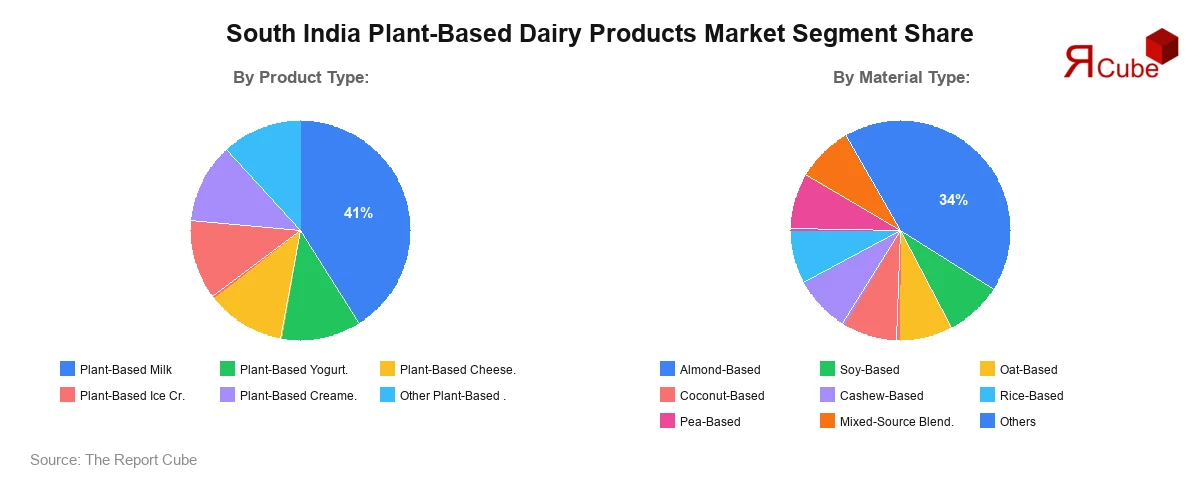
Plant-based milk dominates the South India Plant-Based Dairy Products market with approximately 41% share, driven by its widespread use in daily consumption such as tea, coffee, and cereals. Almond milk and oat milk are particularly popular due to their mild taste and perceived health benefits.
In urban households, plant-based milk has transitioned from a niche product to a regular pantry item. The segment’s growth is further supported by increasing availability in supermarkets and online platforms. Additionally, innovation in flavors and fortified variants is enhancing consumer acceptance, strengthening its position in the South India Plant-Based Dairy Products market expansion.
By Material Type:
- Almond-Based
- Soy-Based
- Oat-Based
- Coconut-Based
- Cashew-Based
- Rice-Based
- Pea-Based
- Mixed-Source Blends
- Others
Almond-based products lead the material type segment with around 34% market share due to their nutritional profile and strong consumer perception as a premium, healthy option. Almond milk and yogurt are widely consumed in South India, especially among health-conscious consumers.
The segment benefits from its association with weight management and heart health. Furthermore, brands are introducing locally sourced almond variants to reduce costs and improve supply chains. This segment continues to dominate the South India Plant-Based Dairy Products market revenue owing to its strong brand positioning and consumer trust.
Regional Projection of South India Plant-Based Dairy Products Industry
- Andhra Pradesh
- Telangana
- Karnataka
- Tamil Nadu
- Kerala
- Others
Karnataka holds the leading position in the South India Plant-Based Dairy Products market with an estimated 36% share. The dominance is driven by Bengaluru’s status as a technology and startup hub, where consumer awareness and purchasing power are significantly higher.
The city’s large population of young professionals and expatriates contributes to higher adoption of plant-based diets. Retail penetration, including supermarkets and quick-commerce platforms, is also more advanced in Karnataka compared to other states. Additionally, the presence of local startups and innovation hubs supports product development and market expansion. This positions Karnataka as a key growth engine for the South India Plant-Based Dairy Products market share.
Need insights for a specific region within this market?
Request Regional DataGovernment Initiatives & Policies
- India National Mission on Food Processing 2025: Supports plant-based food startups through funding and infrastructure development.
- FSSAI Plant-Based Food Guidelines 2026: Regulates labeling and safety standards for plant-based dairy alternatives.
South India Plant-Based Dairy Products Industry Recent Developments
- 2025: Danone S.A. expanded its vegan portfolio with probiotic almond yogurt under its Light & Fit brand, strengthening its plant-based positioning and supporting expansion strategies in India.
- 2025: GoodMylk and Urban Platter accelerated growth through quick-commerce platforms, improving accessibility in Bengaluru and Chennai with faster delivery and wider product reach.
Why Choose This Report?
- Provides a comprehensive overview of the overall market analysis, encompassing key trends, consumer behavior analysis, and risk assessment to support strategic decision-making.
- Provides accurate, up-to-date insights into market size, segmentation, and emerging opportunities, helping to minimize risk & capitalizing on growth.
- Gives deep understanding of target audience preferences, investment habits, and communication channels for enhanced product development & marketing effectiveness.
- Delivers competitive analysis & benchmarking, uncovering the strengths & weaknesses of market competitors to guide strategies.
- Consolidate comprehensive market intelligence, reducing reasoning & streamlining research efforts.
- Facilitates customized market segmentation & risk mitigation strategies, fine-tuned to the business objectives.
- Aids in identifying both market challenges & untapped opportunities within the industry to drive long-term business growth.
- Provides valuable information based on actual customer data & search trends.
Table of Contents
- Introduction
- Objective of the Study
- Product and Category Definition
- Market Segmentation
- Study Variables and Assumptions
- Research Methodology
- Secondary Data Points
- Breakdown of Secondary Sources
- Primary Data Points
- Breakdown of Primary Interviews
- Secondary Data Points
- Executive Summary
- Market Dynamics
- Drivers
- Challenges
- Opportunity Assessment
- Recent Trends and Developments
- Regulatory and Policy Landscape
- South India Plant-Based Dairy Products Market Overview (2021-2034)
- Market Size, By Value (USD Billion)
- Market Share, By Product Type
- Plant-Based Milk
- Almond Milk
- Soy Milk
- Oat Milk
- Coconut Milk
- Cashew Milk
- Rice Milk
- Mixed Nut Milk
- Other Plant-Based Milk
- Plant-Based Yogurt
- Almond Yogurt
- Coconut Yogurt
- Soy Yogurt
- Oat Yogurt
- Other Plant-Based Yogurt
- Plant-Based Cheese
- Slices and Blocks
- Spreads
- Shredded and Grated
- Other Plant-Based Cheese
- Plant-Based Ice Cream and Frozen Desserts
- Plant-Based Creamers
- Coffee Creamers
- Culinary Creams
- Others
- Plant-Based Milk
- Market Share, By Material Type
- Almond-Based
- Soy-Based
- Oat-Based
- Coconut-Based
- Cashew-Based
- Rice-Based
- Pea-Based
- Mixed-Source Blends
- Others
- Market Share, By Sales Channel
- Supermarkets and Hypermarkets
- Convenience Stores
- Specialty Stores
- Online Retail and E-Commerce Marketplaces
- Direct-to-Consumer and Subscription Models
- Others
- Market Share, By Nature
- Organic
- Conventional
- Market Share, By End Use
- Household Consumption
- Foodservice and HoReCa
- Food and Beverage Manufacturers
- Others
- Market Share, By State
- Andhra Pradesh
- Telangana
- Karnataka
- Tamil Nadu
- Kerala
- Others
- Market Share, By Company
- Revenue Shares and Analysis
- Competitive Landscape
- South India Plant-Based Dairy Products Market By State
- Market Size, By Value (USD Billion/Million)
- Market Share, By State
- Andhra Pradesh
- Telangana
- Karnataka
- Tamil Nadu
- Kerala
- Others
- Competitive Outlook and Company Profiles
- Pacific Foods
- Company Overview
- Product Portfolio
- Strategic Alliances/Partnerships
- Recent Developments
- GoodMylk
- Company Overview
- Product Portfolio
- Strategic Alliances/Partnerships
- Recent Developments
- Urban Platter
- Company Overview
- Product Portfolio
- Strategic Alliances/Partnerships
- Recent Developments
- Danone S.A.
- Company Overview
- Product Portfolio
- Strategic Alliances/Partnerships
- Recent Developments
- 1.5 Degree
- Company Overview
- Product Portfolio
- Strategic Alliances/Partnerships
- Recent Developments
- Bio Nutrients (India) Pvt. Ltd.
- Company Overview
- Product Portfolio
- Strategic Alliances/Partnerships
- Recent Developments
- ALT Foods
- Company Overview
- Product Portfolio
- Strategic Alliances/Partnerships
- Recent Developments
- Hindustan Unilever Limited
- Company Overview
- Product Portfolio
- Strategic Alliances/Partnerships
- Recent Developments
- Raw Pressery
- Company Overview
- Product Portfolio
- Strategic Alliances/Partnerships
- Recent Developments
- Califia Farms
- Company Overview
- Product Portfolio
- Strategic Alliances/Partnerships
- Recent Developments
- Nestle S.A.
- Company Overview
- Product Portfolio
- Strategic Alliances/Partnerships
- Recent Developments
- ProSoya Foods
- Company Overview
- Product Portfolio
- Strategic Alliances/Partnerships
- Recent Developments
- Sofit
- Company Overview
- Product Portfolio
- Strategic Alliances/Partnerships
- Recent Developments
- The Hershey Company
- Company Overview
- Product Portfolio
- Strategic Alliances/Partnerships
- Recent Developments
- Epigamia
- Company Overview
- Product Portfolio
- Strategic Alliances/Partnerships
- Recent Developments
- Others
- Pacific Foods
- Contact Us and Disclaimer
Top Key Players & Market Share Outlook
- Pacific Foods
- GoodMylk
- Urban Platter
- Danone S.A.
- 1.5 Degree
- Bio Nutrients (India) Pvt. Ltd.
- ALT Foods
- Hindustan Unilever Limited
- Raw Pressery
- Califia Farms
- Nestle S.A.
- ProSoya Foods
- Sofit
- The Hershey Company
- Epigamia
- Others
Frequently Asked Questions






