



Build Your Custom Market Intelligence Report
Customize Your ReportIndia Plant-Based Protein Food Market Key Takeaways
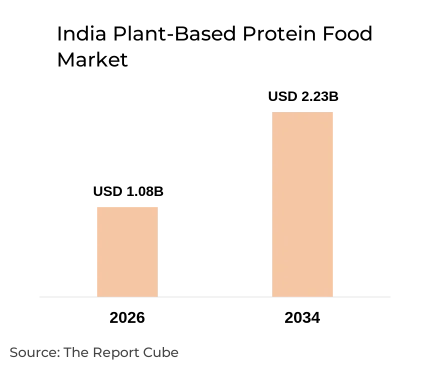
- India Plant-Based Protein Food Market valued at USD 1.08 billion in 2026.
- Market projected to reach USD 2.23 billion by 2034, exhibiting 9.50% CAGR.
- Isolates segment gaining traction as high-purity protein demand accelerates nationally.
- Modern Trade and Retail channels lead distribution across organized urban food retail.
- West India dominates regional revenue with strong food processing infrastructure presence.
- South India emerges as fastest-growing region driven by urban health consciousness.
- GoodDot, Imagine Meats, Wakao Foods, and Blue Tribe Foods lead competitive landscape.
- Flexitarian dietary shifts and FSSAI protein-labeling standards fuel long-term market expansion.
India Plant-Based Protein Food Market Insights & Analysis
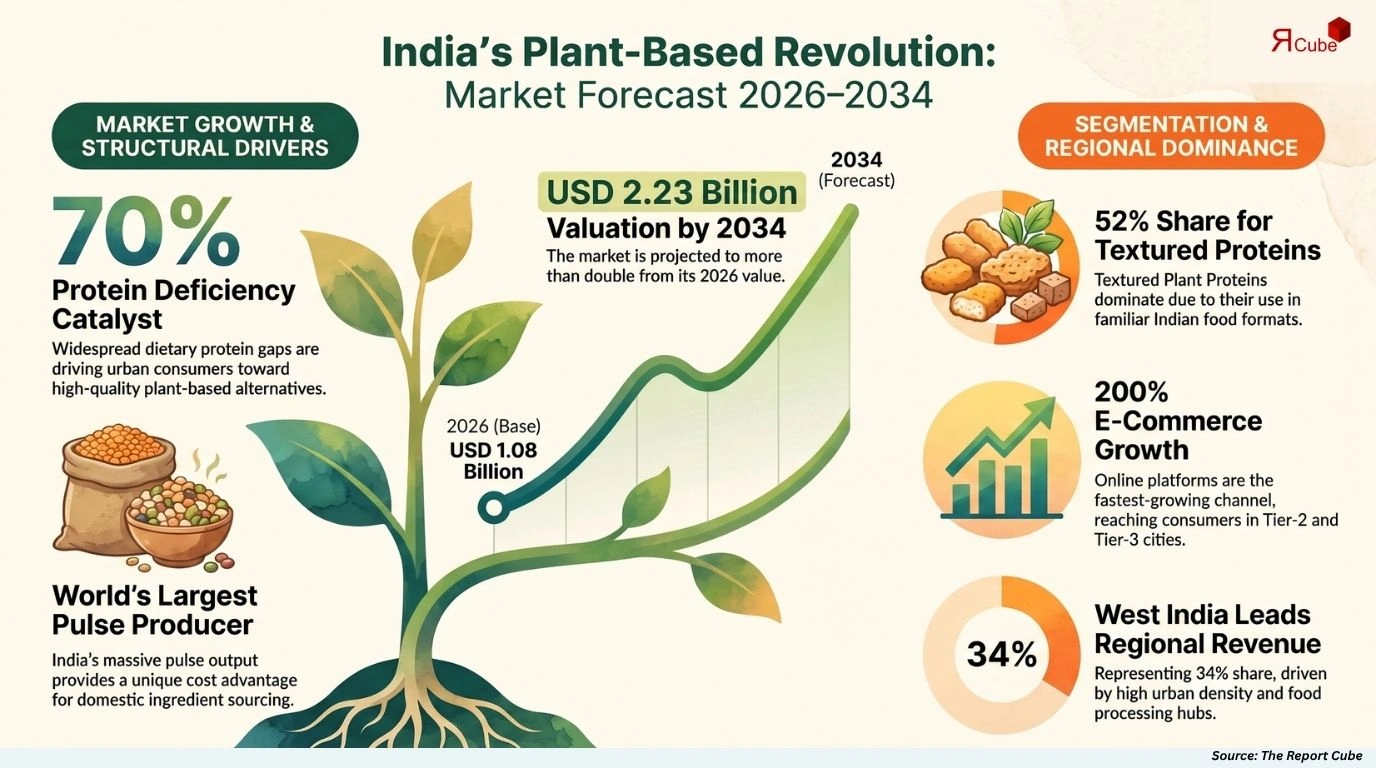
The India Plant-Based Protein Food Market is anticipated to register a 9.50% CAGR during 2026–2034. The market size was valued at USD 1.08 billion in 2026 and is projected to reach USD 2.23 billion by 2034. India's status as the world's largest pulse producer - with output exceeding 25.2 million tonnes in 2024–25 according to APEDA - provides a structural upstream advantage that underpins domestic ingredient availability and competitive cost positioning for plant-based food manufacturers. Government initiatives under the PLI scheme for food processing, combined with FSSAI's 2023 compositional standards for protein-enriched atta and soy flour, are reinforcing formulation quality across the plant-based protein food market in India.
Consumer engagement is advancing well beyond early adopters. Flexitarians now represent India's most commercially significant growth segment, joining an established base of vegetarians who account for roughly 38–39% of the national population. Investment activity reflects this momentum: GoodDot Enterprises has raised USD 5.3 million across three funding rounds and extended into tier-2 and tier-3 cities with ready-to-eat formats through 2026. Simultaneously, online grocery platforms have reported 200% year-on-year growth in plant protein product sales, with meat alternatives and concentrates driving the majority of volume gains. These investment flows and India's alternative protein startup ecosystem are materially expanding the market's commercial depth.
India Plant-Based Protein Food Market Dynamics
The India Plant-Based Protein Food Market is advancing on multiple structural fronts - shifting dietary norms, maturing distribution infrastructure, and rising institutional engagement from both domestic food conglomerates and mission-driven startups. Tata Consumer Products, ITC, and Nestlé India have all entered the plant-based space through dedicated product lines, validating a category that was largely startup-led until 2022. Regulatory clarity from FSSAI and government support for plant-based agriculture continue reinforcing market foundations.
|
Factor |
Type |
Specific Impact on Market |
Magnitude |
|---|---|---|---|
|
Rising flexitarian and vegan population |
Driver |
Expands addressable consumer base beyond traditional vegetarians |
Very High |
|
FSSAI protein labeling and compositional standards |
Driver |
Improves consumer trust and product quality benchmarking |
High |
|
E-commerce and quick-commerce platform growth |
Opportunity |
Extends plant-based product reach into Tier-2 and Tier-3 cities |
High |
|
Low consumer awareness in rural markets |
Challenge |
Restricts adoption to urban, educated, higher-income demographics |
High |
|
Texturization and extrusion technology innovation |
Trend |
Improves sensory parity with conventional meat products |
Very High |
Key Market Driver: India's Expanding Flexitarian Consumer Base
India's protein deficiency challenge - with multiple national nutrition surveys estimating that over 70% of Indian households consume inadequate dietary protein - has become a measurable commercial catalyst. Health-conscious millennials and urban professionals are actively seeking high-quality plant-based alternatives that integrate with traditional Indian cuisine formats including biryani, kebabs, and keema. This population shift, combined with greater nutritional awareness among gym-going consumers and the mainstreaming of soy protein isolates and concentrate ingredients, is driving consistent volume growth across both branded packaged goods and foodservice applications.
Major Industry Challenge: Rural Penetration and Price Sensitivity
Despite robust urban momentum, plant-based protein foods in India remain largely concentrated in the top 20 metropolitan areas. Per-unit price premiums compared to conventional protein sources - including eggs, lentils, and commodity soy products - continue limiting trial among price-sensitive middle-income and rural households. While GoodDot and Vezlay Foods have pursued shelf-stable, affordable formats specifically designed for mass-market accessibility, the category has yet to achieve meaningful penetration in semi-urban and rural geographies where more than 60% of India's population resides and purchasing power remains constrained.
Emerging Trend Shaping Outlook: Texturization Technology and Indian-Format Innovation
Advanced extrusion and wet texturization technologies are enabling manufacturers to replicate the fibrous texture, bite, and mouthfeel of chicken, mutton, and fish - formats Indian consumers prioritize over generic burger patties common in Western markets. GoodDot's Soya Chaap partnership with Haldiram in September 2025 illustrated how plant-based protein can be embedded into familiar regional food formats at scale. Brands including Wakao Foods have leveraged jackfruit's natural fibrous structure as a localized jackfruit-based meat alternative ingredient, while Shaka Harry and Imagine Meats continue developing kebab and curry-ready formats that align with Indian cooking behavior rather than adopting Western formats wholesale.
Need Specific Data, Let’s Customize the Report for You
Request CustomizationIndia Plant-Based Protein Food Market Segment-wise Analysis
India's plant-based protein food sector spans a diverse range of ingredient forms and distribution channels, each serving distinct consumer segments and purchasing behaviors. As per-capita protein awareness rises and product availability expands through modern retail and digital platforms, both ingredient sophistication and distribution reach are expected to deepen materially through 2034.
By Core Ingredient Form
- Concentrates
- Isolates
- Textured Plant Proteins
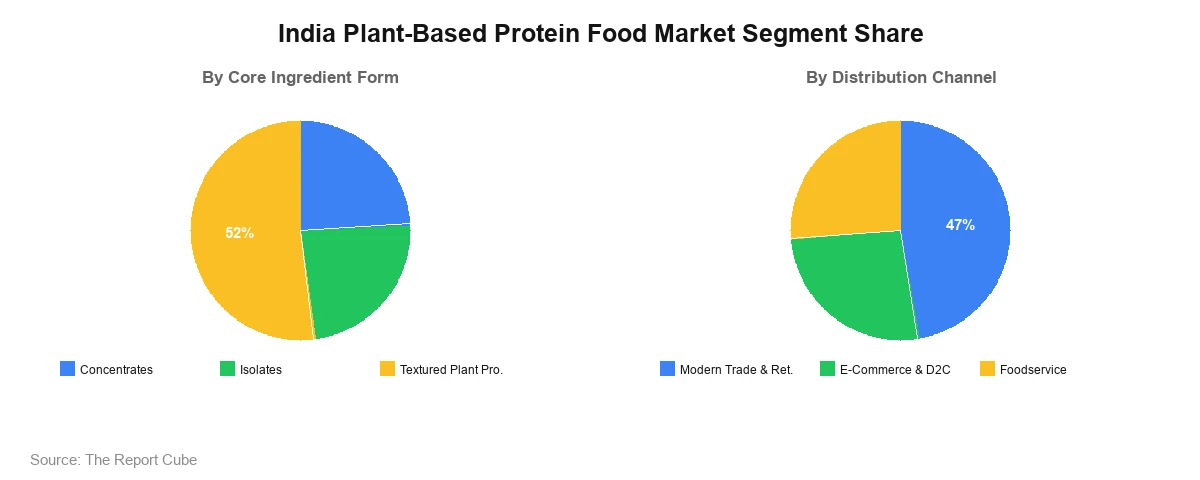
Textured Plant Proteins (TPP) account for an estimated 52% of the India Plant-Based Protein Food Market by core ingredient form, driven by their widespread application in affordable meat analogues, shelf-stable ready-to-cook products, and mass-market soya chaap and keema formats. GoodDot and Vezlay Foods have built entire product portfolios around TPP, leveraging its approximately 12 grams of protein per 100 grams, high palatability in spiced Indian preparations, and cost-effective manufacturing scalability. FSSAI's compositional standards for soy-based formats have further institutionalized quality benchmarks that benefit established TPP producers. The segment's dominance reflects the Indian market's prioritization of familiarity, affordability, and culinary compatibility over premium nutritional positioning - factors that continue making TPP the commercial backbone of textured vegetable protein product development nationwide.
Isolates are the fastest-growing sub-segment, registering compound expansion aligned with rising demand from fitness nutrition, sports supplement, and premium food fortification applications. Isolates deliver protein concentrations above 90% on a dry basis, making them the preferred input for protein bars, ready-to-drink shakes, and high-protein atta formulations gaining adoption among urban health consumers. Concentrates, holding the remaining approximately 20% share, serve dual roles in functional food manufacturing and foodservice ingredient supply chains. Brands including Urban Platter and Goodmylk have incorporated pea and rice protein concentrates into dairy-alternative product lines, targeting flexitarian consumers seeking clean-label beverage options. Continued investment in multi-source protein blending - combining pea, rice, and chickpea proteins to improve amino acid completeness - is expected to elevate both concentrate and isolate demand significantly through 2034.
By Distribution Channel
- Modern Trade & Retail
- E-Commerce & D2C
- Foodservice
Modern Trade and Retail maintains an estimated 47% share of the India Plant-Based Protein Food Market by distribution channel, anchored by the organized food retail networks of Reliance Fresh, Big Bazaar, DMart, and Spencer's - all of which have expanded dedicated plant-based sections in their urban store formats since 2023. Branded players including GoodDot and Vezlay Foods benefit from established shelf presence in these chains, supported by promotional partnerships and refrigerated and shelf-stable product placements that serve impulse buyers and regular shoppers alike. The modern trade channel also provides critical brand-building visibility for newer entrants seeking to legitimize their positioning alongside conventional protein products.
E-Commerce and D2C channels are expanding at the sharpest pace within the distribution landscape, with online grocery platforms reporting a 200% year-on-year increase in plant protein SKU sales. BigBasket, Amazon Fresh, Flipkart Grocery, and brand-owned D2C platforms have collectively enabled plant-based brands to reach health-conscious consumers in cities where physical retail shelf allocation remains limited. Blue Tribe Foods, Goodmylk, and Plantaway have invested heavily in D2C subscription models that reduce customer acquisition costs and improve repeat purchase rates. The India plant-based D2C food brand ecosystem is particularly well-suited to communicating ingredient transparency and sustainability credentials - attributes that resonate with the millennial and Gen-Z buyer segments driving category growth. Foodservice, led by QSR partnerships and five-star hotel collaborations, accounts for the remaining revenue share and is expected to grow as plant-based menu items become standard offerings across India's organized dining sector.
Regional Projection of India Plant-Based Protein Food Market
The India Plant-Based Protein Food Market demonstrates distinct regional variation shaped by urbanization levels, dietary traditions, food processing infrastructure density, and income-driven health awareness. Western and Southern India currently generate the majority of market revenue, while Northern India benefits from its vegetarian food culture and Eastern India represents the most nascent but increasingly opportunity-rich frontier.
|
Region |
Estimated Market Share |
Key Growth Factors |
Consumer Trends |
|---|---|---|---|
|
West India |
34% |
Food processing hubs, high urban density, startup concentration |
Premium and D2C plant-based product adoption |
|
South India |
28% |
Rising health consciousness, organized retail expansion, QSR penetration |
Dairy alternatives and protein-fortified foods |
|
North India |
24% |
Large vegetarian base, cultural familiarity with soy products |
Soya chaap, ready-to-cook meat alternatives |
|
East India |
14% |
Gradual urban income growth, improving e-commerce logistics |
Entry-level shelf-stable plant protein formats |
- West India: West India leads the market with approximately 34% revenue share, driven by Maharashtra and Gujarat's concentrated food technology ecosystem, venture capital activity, and the highest density of organized modern trade retail formats in the country.
- South India: South India is the fastest-growing regional market, supported by Bengaluru and Chennai's expanding health-conscious urban populations, growing QSR partnerships with plant-based brands, and strong organized retail infrastructure enabling wider product availability.
- North India: North India benefits from a culturally entrenched vegetarian consumer base and strong familiarity with soy-derived products such as soya chaap - positioning the region favorably for textured plant protein adoption in both retail and foodservice channels.
- East India: East India currently holds the smallest market share but is witnessing gradual acceleration as e-commerce logistics infrastructure improves and Kolkata and Bhubaneswar-based urban consumers gain access to a wider plant-based product assortment through digital grocery platforms.
India Plant-Based Protein Food Market: Recent Development (2025)
- GoodDot partnered with Haldiram's to supply Soya Chaap for Delhi NCR outlets, marking mainstream QSR entry.
- Imagine Meats launched frozen Indian-format plant-based curries and kebabs targeting working urban professionals nationally.
- Wakao Foods expanded its jackfruit-based product portfolio into South Indian cuisine formats through organized retail partnerships.
- Blue Tribe Foods strengthened its D2C subscription model adding new high-protein plant-based nugget SKUs for online consumers.
India Plant-Based Protein Food Market Future Outlook (2034)
The India Plant-Based Protein Food Market is projected to expand at a 9.50% CAGR, reaching approximately USD 2.23 billion by 2034. This trajectory will be reinforced by India's uniquely favorable structural conditions - a predominantly vegetarian-leaning food culture, the world's largest domestic pulse supply base, and a government actively promoting sustainable protein through PLI-linked food processing incentives. Sustained growth in organized retail, rapid e-commerce penetration into Tier-2 and Tier-3 cities, and QSR sector adoption of plant-based menu items are expected to collectively unlock new consumer cohorts well beyond the early-adopter urban millennial base currently driving revenues. Long-term demand for end-of-life ingredient recovery and protein upcycling will further align with India's sustainability commitments under its national food security framework.
Technology investment will be the decisive market shaper through 2034. Precision fermentation, AI-assisted food formulation, and advanced wet-extrusion systems will enable manufacturers to close the remaining sensory gap with conventional meat at commercially viable cost structures. Brands capable of achieving price parity with commodity soy and lentil-based products - while delivering superior protein density and Indian culinary compatibility - are expected to capture disproportionate market share. Regulatory evolution under FSSAI, including anticipated updated standards for plant-based meat analogue labeling and novel protein ingredients, will further institutionalize consumer trust and invite larger FMCG conglomerates into the category, deepening competitive intensity and accelerating innovation cycles across the entire value chain.
India Plant-Based Protein Food Market Report Coverage
|
Report Attribute |
Details |
|---|---|
|
Market Name |
India Plant-Based Protein Food Market |
|
Market Size (2026) |
USD 1.08 Billion |
|
Market Size (2034) |
USD 2.23 Billion |
|
Forecast Period |
2026–2034 |
|
CAGR |
9.50% |
|
Base Year |
2026 |
|
Historical Years |
2021–2025 |
|
Forecast Years |
2026–2034 |
|
Segments Covered |
By Core Ingredient Form, By Distribution Channel, By Product Type, By Protein Source |
|
Regions Covered |
North India, South India, East India, West India |
|
Key Companies |
GoodDot, Imagine Meats, Wakao Foods, Blue Tribe Foods, Vezlay Foods, Shaka Harry, Goodmylk, Plantaway, Urban Platter, Others |
|
Report Format |
PDF, Excel, PPT |
|
Customization |
Available as per client requirements |
Why Choose This Report?
- Comprehensive analysis of India's unique plant-based protein ingredient landscape.
- Accurate market sizing with reliable 9.50% CAGR forecast through 2034.
- Detailed segmentation covering ingredient form and distribution channel dynamics.
- India-specific regional insights across all four major sub-national markets.
- Competitive profiling of leading domestic and emerging D2C plant-based brands.
- Analysis of FSSAI regulatory developments shaping product quality standards.
- Strategic insights supporting investment, partnership, and market entry decisions.
- Data-driven research aligned with India's sustainable food economy priorities.
Table of Contents
- Introduction
- Objective of the Study
- Product Definition
- Market Segmentation
- Study Variables
- Research Methodology
- Secondary Data Points
- Companies Interviewed
- Primary Data Points
- Breakdown of Primary Interviews
- Secondary Data Points
- Executive Summary
- Market Dynamics
- Drivers
- Challenges
- Opportunity Assessment
- Recent Trends and Developments
- Policy and Regulatory Landscape
- India Plant-Based Protein Food Market Overview and Forecast Analysis (2021-2034)
- Market Size, By Value, By Growth Rate (CAGR/USD Billions)
- Demand – Supply Trends
- Market Share, By Protein Source
- Soy Protein
- Pea Protein
- Wheat (Gluten) Protein
- Emerging Proteins
- Market Share, By Product Type
- Dairy Alternatives
- Meat Alternatives
- Sports & Dietary Supplements
- Bakery & Snacks
- Market Share, By Core Ingredient Form
- Concentrates
- Isolates
- Textured Plant Proteins
- Market Share, By Distribution Channel
- Modern Trade & Retail
- E-Commerce & D2C
- Foodservice
- Market Share, By Region
- North India
- South India
- East India
- West India
- Market Share, By Competitors
- Competition Characteristics
- Revenue Shares
- Soy Protein India Plant-Based Protein Food Market Overview, 2021-2034F
- By Value (USD Million)
- By Product Type – Market Size & Forecast 2021-2034, USD Million
- Dairy Alternatives
- Meat Alternatives
- Sports & Dietary Supplements
- Bakery & Snacks
- Pea Protein India Plant-Based Protein Food Market Overview, 2021-2034F
- By Value (USD Million)
- By Product Type – Market Size & Forecast 2021-2034, USD Million
- Dairy Alternatives
- Meat Alternatives
- Sports & Dietary Supplements
- Bakery & Snacks
- Wheat (Gluten) Protein India Plant-Based Protein Food Market Overview, 2021-2034F
- By Value (USD Million)
- By Product Type – Market Size & Forecast 2021-2034, USD Million
- Dairy Alternatives
- Meat Alternatives
- Sports & Dietary Supplements
- Bakery & Snacks
- Emerging Proteins India Plant-Based Protein Food Market Overview, 2021-2034F
- By Value (USD Million)
- By Product Type – Market Size & Forecast 2021-2034, USD Million
- Dairy Alternatives
- Meat Alternatives
- Sports & Dietary Supplements
- Bakery & Snacks
- Competitive Outlook (Company Profile – Partial List)
- GoodDot
- Company Overview
- Business Segments
- Strategic Alliances/Partnerships
- Recent Developments
- Imagine Meats
- Company Overview
- Business Segments
- Strategic Alliances/Partnerships
- Recent Developments
- Wakao Foods
- Company Overview
- Business Segments
- Strategic Alliances/Partnerships
- Recent Developments
- Blue Tribe Foods
- Company Overview
- Business Segments
- Strategic Alliances/Partnerships
- Recent Developments
- Vezlay Foods
- Company Overview
- Business Segments
- Strategic Alliances/Partnerships
- Recent Developments
- Shaka Harry
- Company Overview
- Business Segments
- Strategic Alliances/Partnerships
- Recent Developments
- Goodmylk
- Company Overview
- Business Segments
- Strategic Alliances/Partnerships
- Recent Developments
- Plantaway & Urban Platter
- Company Overview
- Business Segments
- Strategic Alliances/Partnerships
- Recent Developments
- Others
- GoodDot
- Contact Us & Disclaimer
Top Key Players & Market Share Outlook
- GoodDot
- Imagine Meats
- Wakao Foods
- Blue Tribe Foods
- Vezlay Foods
- Shaka Harry
- Goodmylk
- Plantaway & Urban Platter
- Others
Frequently Asked Questions






