




Build Your Custom Market Intelligence Report
Customize Your ReportGlobal Plant Protein Ingredients Market Key Takeaways
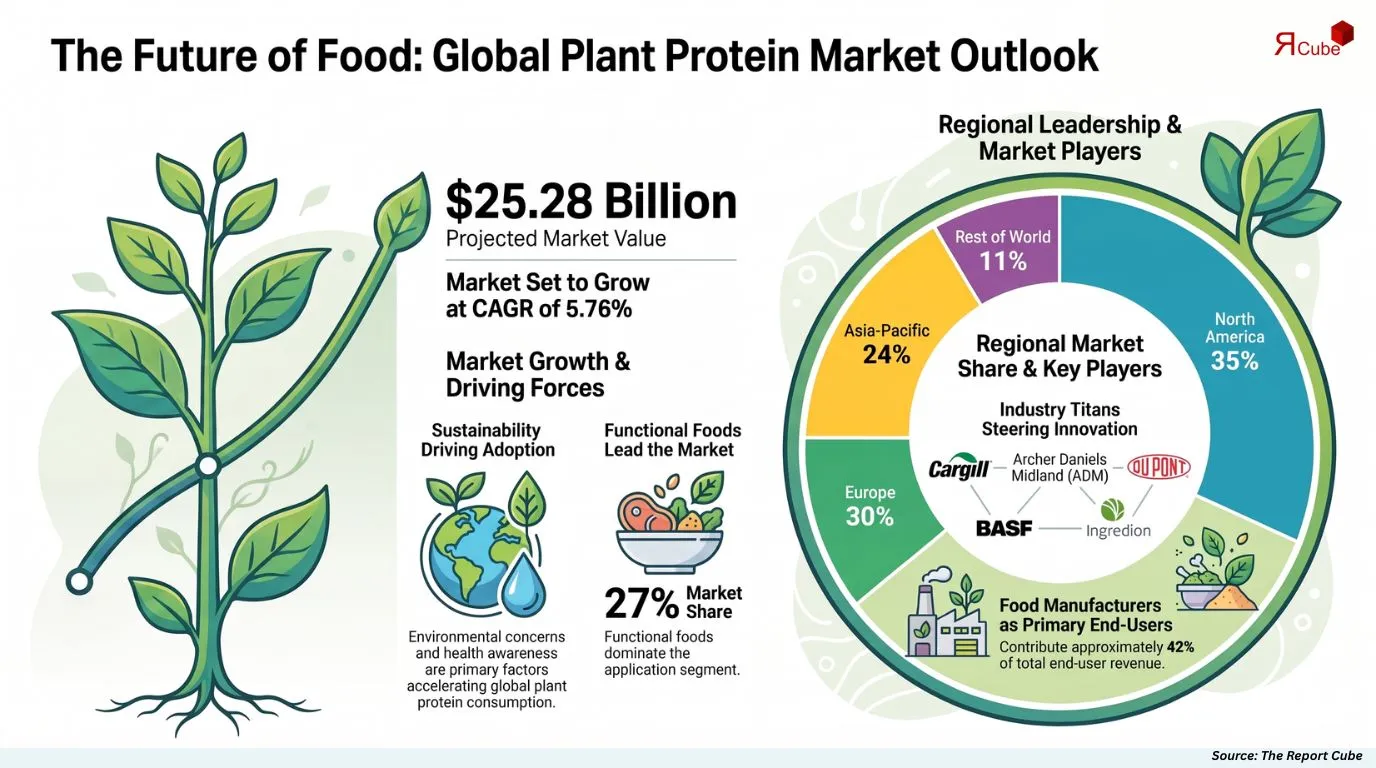
- Market size reached USD 16.15 billion during 2026 assessment year.
- Industry projected to attain USD 25.28 billion by 2034.
- Market forecast indicates a CAGR of 5.76% through 2034.
- Cargill, ADM, Roquette, Ingredion, and BASF remain leading participants.
- Functional Foods dominate the application segment across global markets.
- Food Manufacturers account for the highest end-user revenue contribution.
- North America remains the leading regional market for plant proteins.
- Sustainable nutrition demand continues accelerating plant protein adoption globally.
Global Plant Protein Ingredients Market Insights & Analysis
The Global Plant Protein Ingredients Market is anticipated to register a 5.76% CAGR during 2026-2034. The market size was valued at USD 16.15 billion in 2026 and is projected to reach USD 25.28 billion by 2034. The market is witnessing sustained growth due to rising consumer preference for plant-based nutrition, increasing demand for sustainable food ingredients, and growing awareness regarding health and wellness. Food manufacturers are increasingly incorporating plant protein ingredients into various product categories to meet evolving dietary preferences. Expanding adoption of clean-label and functional nutrition products is further contributing to market development.
Investments in protein extraction technologies, sustainable ingredient sourcing, and advanced food processing solutions continue strengthening the market landscape. Companies are focusing on improving protein functionality, taste, texture, and nutritional profiles to enhance consumer acceptance. Additionally, increasing emphasis on environmentally responsible food systems is expected to support long-term market growth throughout the forecast period.
Global Plant Protein Ingredients Market Dynamics
The global plant protein ingredients market is experiencing substantial transformation driven by changing dietary habits, sustainability priorities, and growing interest in alternative nutrition sources. Ingredient suppliers and food manufacturers are investing in advanced technologies to improve protein quality, digestibility, and sensory characteristics. These evolving market dynamics are creating significant opportunities across food, beverage, nutrition, and feed applications.
Growing consumer demand for protein-enriched products, functional nutrition, and sustainable food choices is strengthening market development. Technological advancements in extraction processes, ingredient refinement, and application-specific formulations are enhancing product performance. These developments are expected to reinforce market competitiveness and support future industry expansion.
|
Factor |
Type |
Specific Impact on Market |
Magnitude |
|---|---|---|---|
|
Growing demand for plant-based foods |
Driver |
Increases ingredient consumption globally |
High |
|
Rising health and wellness awareness |
Driver |
Expands protein-rich product demand |
High |
|
Innovation in plant protein formulations |
Trend |
Enhances functionality and application diversity |
High |
|
Agricultural supply variability |
Challenge |
Influences sourcing and production consistency |
Medium |
|
Expansion into specialized nutrition sectors |
Opportunity |
Creates new revenue opportunities |
High |
Key Market Driver: Rising Demand for Sustainable Protein Sources
The increasing demand for sustainable protein sources remains a major factor driving the global plant protein ingredients market. Consumers are actively seeking alternatives to conventional protein sources due to environmental concerns, health considerations, and changing lifestyle preferences. Plant proteins are increasingly utilized across food products, beverages, nutritional supplements, and alternative meat applications due to their nutritional benefits and sustainability profile. Food manufacturers continue expanding plant-based portfolios to address evolving consumer expectations. Furthermore, growing interest in balanced nutrition is expected to strengthen market growth throughout the forecast period.
Major Industry Challenge: Ensuring Consistent Ingredient Quality Standards
Maintaining consistent quality and functionality across plant protein ingredients remains a significant challenge within the market. Variations in crop quality, sourcing conditions, and processing methods may influence ingredient performance and final product characteristics. Manufacturers must ensure reliable texture, flavor, nutritional value, and formulation compatibility across diverse applications. Continuous investments in quality control systems, processing technologies, and supply chain management are helping industry participants address these challenges effectively.
Emerging Trend Shaping Outlook: Advanced Functional Protein Development
Advanced functional protein development is emerging as a major trend shaping the future outlook of the market. Manufacturers are increasingly developing customized plant protein solutions with enhanced solubility, improved taste profiles, and superior nutritional performance. These innovations are enabling broader utilization across sports nutrition, dairy alternatives, clinical nutrition, and ready-to-drink beverages. Advancements in ingredient technology are expected to improve product acceptance and create substantial opportunities for market expansion through 2034.
The market continues benefiting from growing health awareness, sustainable consumption trends, and expanding product innovation. Industry participants are focusing on ingredient functionality, nutritional enhancement, and application diversification to strengthen market competitiveness. These developments are supporting long-term market growth prospects. Strategic collaborations among ingredient suppliers, food processors, nutraceutical companies, and beverage manufacturers are accelerating commercialization and innovation. Organizations emphasizing sustainability, product quality, and research excellence are expected to maintain strong competitive positions throughout the forecast period.
Need Specific Data, Let’s Customize the Report for You
Request CustomizationGlobal Plant Protein Ingredients Market Segment-wise Analysis
The global plant protein ingredients market demonstrates a diversified segmentation structure based on application areas and end-user industries. Growing demand for sustainable nutrition, functional foods, and protein-enriched products continues influencing segment performance. Expanding investments in food innovation and alternative protein development are creating substantial opportunities across multiple market segments.
By Application
- Sports Nutrition
- Functional Foods
- Bakery
- Dairy Alternatives
- Meat Alternatives
- Infant Nutrition
- Animal Nutrition
- Clinical Nutrition
- Ready-to-drink Beverages
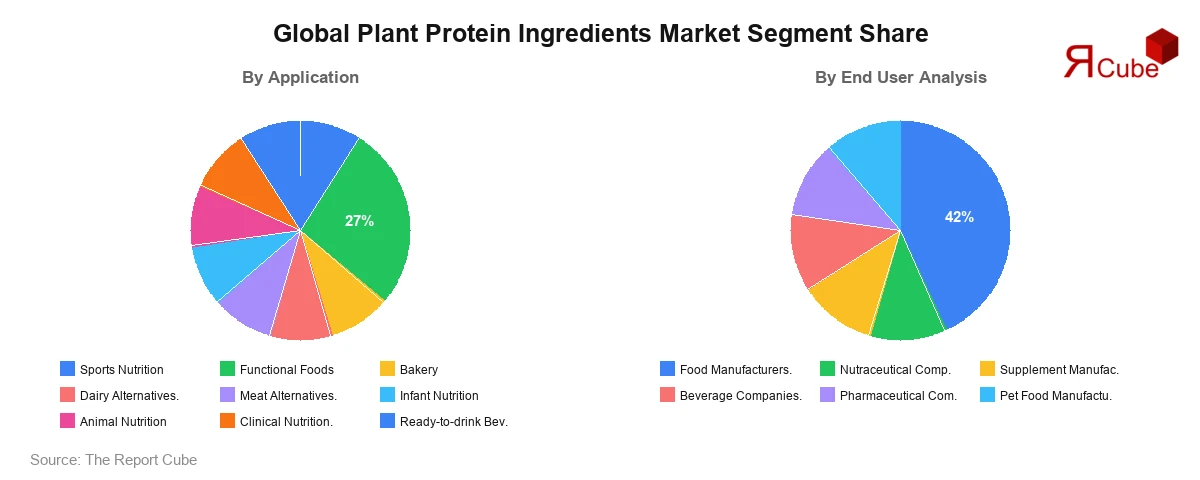
Functional Foods dominate the application segment with an estimated market share of approximately 27%. Growth is supported by increasing demand for protein-fortified products, wellness-focused foods, and nutrition-enhancing formulations. Consumers are increasingly prioritizing health-conscious dietary choices, encouraging manufacturers to incorporate plant proteins into everyday food products. Strong demand for functional nutrition continues reinforcing segment leadership.
Meat Alternatives and Dairy Alternatives represent rapidly growing segments due to increasing adoption of plant-based diets globally. Sports Nutrition, Clinical Nutrition, Infant Nutrition, Bakery, Animal Nutrition, and Ready-to-drink Beverages also contribute significantly to market expansion through diversified ingredient utilization.
By End User Analysis
- Food Manufacturers
- Nutraceutical Companies
- Supplement Manufacturers
- Beverage Companies
- Pharmaceutical Companies
- Pet Food Manufacturers
Food Manufacturers account for approximately 42% market share, making them the dominant end-user segment within the global plant protein ingredients market. Rising incorporation of plant proteins into packaged foods, snacks, dairy alternatives, and meat substitute products continues driving segment growth. Manufacturers are increasingly utilizing plant proteins to improve nutritional value and support product innovation strategies.
Nutraceutical Companies and Supplement Manufacturers are also witnessing strong growth due to increasing demand for protein supplements and wellness products. Beverage Companies, Pharmaceutical Companies, and Pet Food Manufacturers continue expanding plant protein utilization across their respective product portfolios.
Regional Projection of Global Plant Protein Ingredients Market
The regional landscape of the global plant protein ingredients market reflects differences in dietary preferences, manufacturing capabilities, and consumer awareness regarding plant-based nutrition. Demand remains concentrated in regions with strong alternative protein adoption and advanced food processing industries. Continued investments in sustainable food innovation are expected to support market growth across major regions.
|
Region |
Estimated Market Share |
Key Growth Factors |
Consumer Trends |
|---|---|---|---|
|
North America |
35% |
Strong plant-based food industry |
High alternative protein adoption |
|
Europe |
30% |
Sustainability-focused food consumption |
Growing clean-label preferences |
|
Asia-Pacific |
24% |
Expanding middle-class population |
Rising functional food demand |
|
Rest of World |
11% |
Increasing health awareness |
Growing plant-based product acceptance |
- North America
- Europe
- Asia-Pacific
- Rest of World
North America leads the market with an estimated 35% share due to strong consumer demand for plant-based foods, advanced food manufacturing capabilities, and extensive investments in alternative protein innovation. The region serves as a major hub for product development and commercialization activities.
The region also benefits from growing awareness regarding sustainability, nutrition, and health-conscious lifestyles. Increasing demand for plant-based alternatives and protein-enriched products is expected to reinforce North America’s leadership position throughout the forecast period.
Global Plant Protein Ingredients Market: Recent Development (2025)
- Cargill expanded specialty protein solutions supporting innovative plant-based food product development globally.
- Archer Daniels Midland enhanced protein processing technologies improving ingredient functionality and consistency.
- Roquette expanded production capabilities addressing growing global demand for plant protein ingredients.
- Ingredion introduced advanced protein formulations targeting nutrition, beverage, and alternative food applications.
Global Plant Protein Ingredients Market Future Outlook (2034)
The Global Plant Protein Ingredients Market is expected to reach USD 25.28 billion by 2034 while expanding at a CAGR of 5.76% throughout the forecast period. Rising demand for sustainable nutrition, increasing adoption of plant-based foods, and growing focus on health-conscious consumption are expected to create substantial opportunities for ingredient manufacturers and food companies.
Technological advancements in AI-driven ingredient optimization, advanced extraction technologies, protein formulation science, and sustainable processing systems are expected to improve product quality and manufacturing efficiency. Expanding investments in functional nutrition, alternative proteins, and specialized food applications will support long-term market growth and product diversification through 2034.
Global Plant Protein Ingredients Market Report Coverage
|
Report Attribute |
Details |
|---|---|
|
Market Name |
Global Plant Protein Ingredients Market |
|
Market Size (2026) |
USD 16.15 billion |
|
Market Size (2034) |
USD 25.28 billion |
|
Forecast Period |
2026-2034 |
|
CAGR |
5.76% |
|
Customization |
Available Upon Request |
|
Segments Covered |
Application, End User Analysis |
|
Regions Covered |
North America, Europe, Asia-Pacific, Rest of World |
|
Key Companies |
Cargill, Archer Daniels Midland, DuPont, BASF, Ingredion, Tate & Lyle, Roquette Freres, Sun Nutrafoods, Emsland Group, Others |
|
Report Format |
PDF, Excel, PPT |
Why Choose This Report?
- Comprehensive assessment of market size, forecasts, and growth opportunities.
- Detailed evaluation of application and end-user segment performance trends.
- In-depth regional analysis highlighting plant-based nutrition developments.
- Competitive intelligence covering major companies and strategic developments.
- Insights into sustainable protein innovation and alternative food trends.
- Reliable forecasting framework supporting investment and business planning decisions.
Table of Contents
- Introduction
- Objective of the study
- Product Definition
- Market Segmentation
- Study Variables
- Research Methodology
- Secondary Data Points
- Companies Interviewed
- Primary Data Points
- Breakdown of Primary Interviews
- Secondary Data Points
- Executive Summary
- Market overview
- Key findings
- Strategic recommendations
- Growth outlook
- Industry Overview
- Evolution of plant-based proteins
- Value chain analysis
- Manufacturing process overview
- Supply chain ecosystem
- Industry challenges and opportunities
- Market Size & Forecast
- For each product separately:
- Soy Protein Isolate
- Pea Protein 85%
- Rice Protein
- Analysis By:
- Volume (Tons)
- Revenue (USD Million)
- Historical (2020–2025)
- Forecast (2026–2034)
- Product Analysis
- Soy Protein Isolate
- Manufacturing process
- Protein content
- Functional properties
- Nutritional profile
- Major applications
- Pricing trends
- Supply-demand analysis
- Pea Protein 85%
- Yellow pea production
- Processing technology
- Protein concentration
- Functional characteristics
- Market adoption
- Key manufacturers
- Rice Protein
- Brown rice vs white rice
- Extraction technologies
- Nutritional advantages
- Application suitability
- Market dynamics
- Raw Material Analysis
- Soybean production
- Pea production
- Rice production
- Import & export
- Availability
- Price trends
- Climate impact
- Procurement landscape
- Manufacturing Analysis
- Production process
- Technology comparison
- Processing equipment
- Capacity analysis
- Yield analysis
- Production cost breakdown
- Soy Protein Isolate
- Pricing Analysis
- Historical pricing
- Current pricing
- Forecast pricing
- Price By:
- North America
- Europe
- China
- India
- Southeast Asia
- Factors influencing prices
- Demand Analysis
- Demand By application
- Sports Nutrition
- Functional Foods
- Bakery
- Dairy Alternatives
- Meat Alternatives
- Infant Nutrition
- Animal Nutrition
- Clinical Nutrition
- Ready-to-drink beverages
- End User Analysis
- Food manufacturers
- Nutraceutical companies
- Supplement manufacturers
- Beverage companies
- Pharmaceutical companies
- Pet food manufacturers
- Competitive Outlook (Company Profile - Partial List)
- Cargill
- Company Overview
- Business Segments
- Strategic Alliances/Partnerships
- Recent Developments
- Archer Daniels Midland
- Company Overview
- Business Segments
- Strategic Alliances/Partnerships
- Recent Developments
- DuPont
- Company Overview
- Business Segments
- Strategic Alliances/Partnerships
- Recent Developments
- BASF
- Company Overview
- Business Segments
- Strategic Alliances/Partnerships
- Recent Developments
- Ingredion
- Company Overview
- Business Segments
- Strategic Alliances/Partnerships
- Recent Developments
- Tate & Lyle
- Company Overview
- Business Segments
- Strategic Alliances/Partnerships
- Recent Developments
- Roquette Freres
- Company Overview
- Business Segments
- Strategic Alliances/Partnerships
- Recent Developments
- Sun Nutrafoods
- Company Overview
- Business Segments
- Strategic Alliances/Partnerships
- Recent Developments
- Emsland Group
- Company Overview
- Business Segments
- Strategic Alliances/Partnerships
- Recent Developments
- Others
- Cargill
- Contact Us & Disclaimer
Top Key Players & Market Share Outlook
- Cargill
- Archer Daniels Midland
- DuPont
- BASF
- Ingredion
- Tate & Lyle
- Roquette Freres
- Sun Nutrafoods
- Emsland Group
- Others
Frequently Asked Questions






